

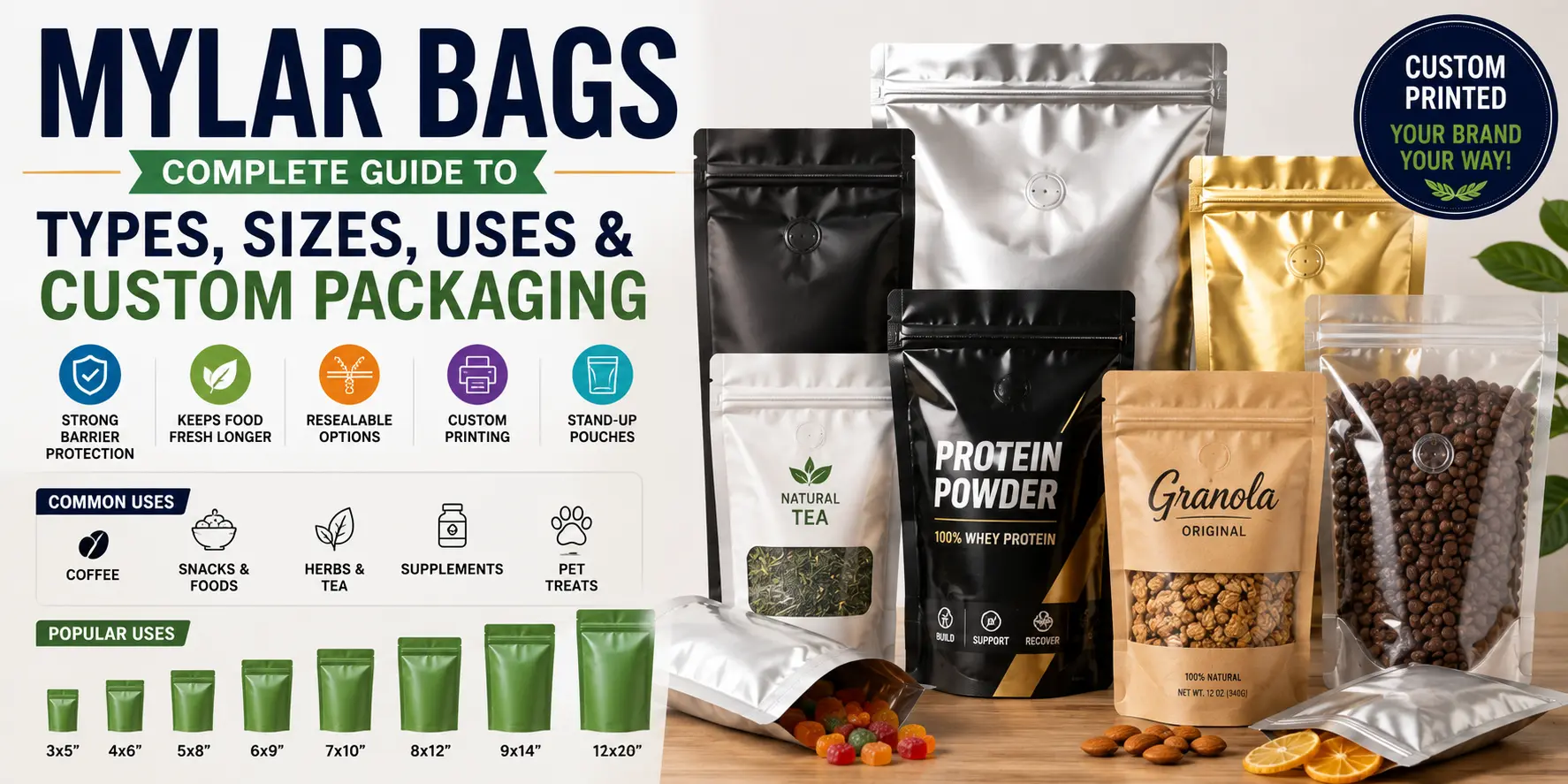
Mylar bags are flexible packaging bags made with strong barrier films. They help protect products from oxygen, moisture, light, odors, and outside air.
Today, brands across the United States use Mylar bags for food, coffee, snacks, supplements, pet treats, herbs, and many other products.
Mylar bags are also popular for long-term food storage. With the right bag, seal, and storage method, they can help protect dry foods for many years.
But not every Mylar bag is the same.
You can choose from flat Mylar bags, stand-up pouches, gusseted bags, zipper bags, child-resistant bags, clear bags, foil bags, and custom printed Mylar bags.
The right choice depends on what you are packaging, how much you need to pack, how long you need to protect it, and how you want your brand to look.
This complete guide explains Mylar bag types, sizes, thicknesses, materials, uses, features, and custom packaging options.
What Are Mylar Bags?
A Mylar bag is a flexible pouch made with layers of packaging film.
The word Mylar originally refers to a type of polyester film called BoPET. In modern packaging, people often use the term Mylar bag for high-barrier laminated pouches.
A typical high-barrier pouch can use layers such as:
- PET on the outside
- Metallized PET or aluminum foil in the middle
- PE or another heat-sealing film on the inside
Each layer has a job.
The outer layer gives the bag strength and a surface for printing. The barrier layer helps block oxygen, moisture, and light. The inner layer allows the bag to seal.
The exact material structure can change based on the product and the protection it needs.
Why Are Mylar Bags Popular?
Mylar bags offer several useful benefits for both consumers and businesses.
Strong Barrier Protection
A good Mylar pouch can provide strong protection against oxygen, moisture, light, and odors.
This can help protect product quality during storage and shipping.
Lightweight Packaging
Mylar bags weigh much less than many rigid containers.
This can help brands reduce packaging weight and make products easier to ship.
Flexible Sizes
You can make Mylar bags in many sizes.
Small bags work well for samples and single servings. Larger bags can hold bulk products.
Custom Printing
Brands can print logos, colors, product information, ingredients, instructions, and other artwork directly on the bag.
This turns the package into part of the brand experience.
Easy to Store
Empty Mylar bags take up little space.
Filled stand-up bags can also sit neatly on retail shelves.
Many Closure Options
Depending on the product, you can add:
- Zippers
- Tear notches
- Heat seals
- Hang holes
- Degassing valves
- Child-resistant closures
- Spouts
These features help brands create packaging that fits their product and customers.
What Are Mylar Bags Used For?
Mylar bags have many uses in the United States.
They work well for both consumer products and long-term storage.
Here are some of the most common uses.
Food Packaging
Mylar bags are popular for:
- Snacks
- Candy
- Gummies
- Dried fruit
- Rice
- Beans
- Pasta
- Granola
- Cereal
- Pet treats
- Powdered foods
- Freeze-dried foods
Food packaging needs the right food-contact materials and construction. Always choose a bag made for the specific product you plan to pack.
Coffee Packaging
Coffee needs packaging that protects its aroma and freshness.
Many coffee bags use a high-barrier structure with a one-way degassing valve.
Fresh coffee can release carbon dioxide after roasting. A degassing valve lets that gas escape while helping stop outside air from entering.
Coffee bags can also include:
- Zippers
- Tear notches
- Flat bottoms
- Side gussets
- Custom printing
- Matte finishes
- Gloss finishes
Supplement Packaging
Mylar bags can work well for products such as:
- Protein powders
- Powdered supplements
- Vitamins
- Gummies
- Nutrition powders
- Herbal products
The bag size and barrier structure should match the product.
Pet Food and Pet Treats
Pet treats and dry pet food often need packaging that keeps moisture and odors under control.
Stand-up Mylar pouches can provide a convenient format for retail products.
Brands can also add a zipper so customers can open and close the bag after each use.
Herbs and Specialty Products
Mylar bags are also used for herbs, spices, dried products, and other items that need protection from light, moisture, oxygen, or odors.
The exact packaging requirements depend on the product and local laws.
Long-Term Food Storage
Mylar bags are also common in home food storage.
Dry foods such as white rice, dried beans, wheat, and some freeze-dried foods can be packed in high-barrier bags for long-term storage.
For many dry foods, people use oxygen absorbers inside properly sealed bags. However, oxygen absorbers are not suitable for every food, so follow food-specific storage guidance.
Types of Mylar Bags
There are many Mylar bag styles.
The best style depends on how you sell, store, and use your product.
1. Flat Mylar Bags
Flat Mylar bags have no bottom gusset.
They usually have three sealed sides and an open top that you can heat seal after filling.
They are useful for:
- Samples
- Small portions
- Sachets
- Powdered products
- Lightweight products
- Long-term food storage
Flat bags are simple and often cost-effective.
2. Stand-Up Mylar Pouches
Stand-up pouches have a bottom gusset.
The gusset allows the bag to stand on a shelf.
This makes them popular for retail packaging.
They work well for:
- Snacks
- Candy
- Gummies
- Coffee
- Pet treats
- Supplements
- Dried foods
You can also add a zipper and tear notch for easier use.
3. Gusseted Mylar Bags
A gusset gives the bag more space.
It can be placed on the bottom or sides of the bag.
Gusseted bags are useful when you need more product capacity without making the bag extremely wide.
They are common for coffee, pet food, bulk food, and larger retail products.
4. Zipper Mylar Bags
Zipper bags let customers open and close the package.
This works well for products that customers use more than once.
Common examples include:
- Snacks
- Coffee
- Gummies
- Pet treats
- Herbs
- Supplements
- Dried foods
A zipper improves convenience, but the bag may still need a heat seal for tamper evidence or additional protection.
5. Child-Resistant Mylar Bags
Child-resistant Mylar bags use special closures designed to make opening harder for children.
They are used for products that may require child-resistant packaging under applicable U.S. laws.
Cannabis packaging is one example where child-resistant packaging may be required in certain states.
Always check the rules for the state and product you sell. A bag should not be called compliant simply because it has a child-resistant-looking zipper.
6. Smell-Proof Mylar Bags
Smell-proof Mylar structures provide strong odor barriers.
These bags can be useful for products with strong smells.
The actual odor protection depends on the material structure, seals, closures, and overall bag design.
7. Mylar Bags With Windows
A window lets customers see the product inside.
This can be useful for snacks, candy, coffee, pet treats, and other products where product visibility helps sales.
However, adding a window can change the barrier performance.
If light protection is important, ask your packaging supplier about the best material structure before choosing a window.
8. Clear Mylar-Style Bags
Not every pouch called a “Mylar bag” has a metal barrier layer.
Some clear flexible pouches use transparent films so customers can see the product.
Clear packaging looks attractive, but it does not provide the same light barrier as an opaque foil or metallized structure.
Choose based on your product’s needs, not just appearance.
9. Foil Mylar Bags
Foil structures use an aluminum layer to provide a strong barrier.
They are often used when a product needs high protection from oxygen, moisture, and light.
They are common in long-term food storage and many specialty packaging applications.
10. Custom Printed Mylar Bags
Custom printed Mylar bags let you put your brand directly on the package.
You can add:
- Logo
- Brand colors
- Product name
- Product photos
- Ingredients
- Nutrition information
- Barcode
- Instructions
- Contact information
- Social media information
For retail brands, custom printing can turn a simple pouch into a strong marketing tool.
Mylar Bag Size Chart
One of the most common questions is:
What size Mylar bag do I need?
There is no single size that works for every product.
Product density matters.
For example, one pound of coffee does not take up the same amount of space as one pound of a fluffy snack.
Use the chart below as a starting point, not an exact fill guarantee.
| Mylar Bag Size | Common Product Uses |
|---|---|
| 3″ × 4″ | Samples and small portions |
| 4″ × 6″ | Small snacks, gummies, samples |
| 5″ × 8″ | Snacks, herbs, small retail products |
| 6″ × 9″ | Coffee, powders, pet treats |
| 6″ × 9.5″ | Coffee, cereal, pasta, rice |
| 7″ × 10″ | Larger snacks, oats, flour |
| 8″ × 12″ | Family-size snacks and pet food |
| 10″ × 14″ | Bulk products |
| 12″ × 18″ | Large food and grain storage |
| 14″ × 20″ | Large-volume storage |
Actual capacity changes with product density, bag construction, gusset size, and fill level. Current packaging size guides also show that common retail formats range from small sample bags to large 5-gallon storage bags.
How Do You Choose the Right Mylar Bag Size?
Start with these five questions:
What product are you packing?
Different products need different amounts of space.
How much product goes into each bag?
Know your target weight or volume.
Does the product need a gusset?
A gusset can give you more room and help the bag stand.
Do you need a zipper?
Choose a zipper if customers need to open and close the package.
Do you need extra space for a valve or other feature?
Coffee bags, for example, may need room for a degassing valve.
For custom packaging, it is often best to test the actual product inside a sample bag before placing a large order.
Mylar Bag Thickness Guide
Mylar bag thickness is usually measured in mils or microns.
One mil equals 0.001 inch.
Common packaging thicknesses include around:
- 2.5 mil
- 3.5 mil
- 4 mil
- 5 mil
- 7 mil
The right thickness depends on the product, shipping conditions, puncture risk, and storage time.
2.5–3 Mil
These lighter structures can work for:
- Samples
- Small portions
- Light snacks
- Sachets
Around 4 Mil
This can be a good middle option for many retail products.
It can balance flexibility, durability, and cost.
5 Mil
Thicker bags can work well for:
- Long-term food storage
- Heavy products
- Premium products
- Products that need extra puncture resistance
7 Mil
Very thick bags can be useful for demanding storage and heavy-duty applications.
The material structure matters just as much as the total thickness. A thicker bag is not automatically the best bag for every product. Current packaging guides commonly recommend thicker structures for heavier products and longer storage periods.
What Materials Are Used in Mylar Bags?
Mylar bags can use several layers.
A common high-barrier structure may include:
PET + Aluminum or Metallized PET + PE
Each layer does something different.
PET
The outside PET layer provides strength and a printable surface.
Aluminum or Metallized PET
This layer helps create a strong barrier against oxygen, moisture, and light.
PE
The inside PE layer can provide a heat-sealable surface.
The exact structure can change depending on the product.
Coffee, food, supplements, pet treats, and specialty products may all require different packaging structures.
Mylar Bags With Oxygen Absorbers
Oxygen absorbers are popular for long-term storage of many dry foods.
They help remove oxygen from a sealed package.
Less oxygen can help reduce oxidation and slow some forms of food quality loss.
For example, some food-storage guides recommend oxygen absorbers for dry staples such as rice and wheat.
But you should not assume every food needs one.
For example, granulated sugar is commonly stored without oxygen absorbers because the absorber can cause the sugar to harden.
Always choose the packaging method based on the food.
How to Seal Mylar Bags
A good seal is very important.
Even a strong barrier bag cannot protect the product well if the seal leaks.
For many Mylar bags, you can use a heat sealer.
A simple process looks like this:
- Fill the bag with the product.
- Leave enough room at the top.
- Add the correct packaging component, such as an oxygen absorber, when appropriate.
- Remove excess air if the application calls for it.
- Keep the top area clean.
- Heat seal the bag.
- Check the seal for gaps or weak areas.
- Label the package.
For commercial packaging, the sealing temperature and dwell time should follow the film supplier’s specifications and your packaging equipment requirements.
Mylar Bags vs. Plastic Bags
Why not use a normal plastic bag?
The answer is barrier protection.
A basic plastic bag may provide some protection, but a high-barrier Mylar structure can provide much stronger protection against oxygen, moisture, light, and odors.
This makes Mylar-style high-barrier pouches useful for products that need better protection.
They are especially useful for:
- Long-term food storage
- Coffee
- Snacks
- Supplements
- Dried foods
- Specialty products
The right comparison depends on the exact film structure. Not every bag sold as “Mylar” has the same barrier performance.
Mylar Bags vs. Vacuum Seal Bags
Both packaging types can help protect products, but they work in different ways.
| Feature | Mylar Bags | Vacuum Seal Bags |
| Flexible packaging | Yes | Yes |
| Strong light barrier | Often | Usually no |
| Moisture barrier | High with proper structure | Depends on film |
| Oxygen protection | High with proper sealing | Uses vacuum removal |
| Custom printing | Yes | Limited on many consumer options |
| Retail branding | Excellent | Usually limited |
| Zipper options | Available | Available on some bags |
| Stand-up format | Available | Less common |
| Long-term dry food storage | Popular | Used for some applications |
For a retail brand, custom Mylar packaging can offer both product protection and brand presentation.
How to Choose Mylar Bags for Your Product
Before ordering, look at these areas.
1. Product Type
What are you putting inside?
Food, coffee, supplements, pet treats, herbs, and other products may need different materials.
2. Product Weight
A heavier product may need a stronger bag.
3. Product Volume
Weight alone does not tell you the correct size.
A lightweight product may take up a lot of space.
4. Shelf Life
Products that need long storage may need a stronger barrier structure.
5. Light Protection
If light can damage your product, choose an opaque structure.
6. Moisture Protection
Products that are sensitive to humidity need good moisture protection.
7. Oxygen Protection
Some products need a strong oxygen barrier.
8. Closure
Choose from:
- Heat seal
- Zipper
- Child-resistant closure
- Spout
- Valve
9. Retail Display
If your bag needs to stand on a shelf, choose a stand-up pouch.
If you want customers to see the product, consider a window.
10. Brand Design
Think about your logo, colors, artwork, finish, and product information before production.
What Are Custom Mylar Bags?
Custom Mylar bags are flexible pouches made to match your product and brand.
Instead of buying a plain stock bag, you can choose the:
- Size
- Shape
- Material
- Thickness
- Color
- Artwork
- Closure
- Finish
- Window
- Gusset
- Valve
- Tear notch
- Hang hole
This gives businesses more control over their packaging.
Custom Mylar bags can be made for many U.S. product categories, including food, coffee, supplements, pet treats, snacks, candy, and other consumer products.
Current custom packaging guides also show that brands can combine custom dimensions with features such as zippers, valves, hang holes, and child-resistant closures.
Benefits of Custom Printed Mylar Bags
Better Brand Recognition
Your logo and brand design appear directly on the package.
Customers can recognize your product more easily.
More Shelf Appeal
A strong design can help your product stand out next to competing products.
Professional Appearance
Custom packaging can make a small business look more established.
Product Information
You can print important product information directly on the bag.
Better Product Fit
You can create the bag around your product instead of forcing your product into a standard size.
More Packaging Features
You can choose features that make sense for your customers.
For example, a snack brand may want a zipper and tear notch.
A coffee brand may want a zipper and degassing valve.
A supplement brand may want a strong barrier and easy-open zipper.
Custom Mylar Bag Printing Options
Brands can use many printing styles and finishes.
Common choices include:
Full-Color Printing
Use your complete brand artwork across the package.
Matte Finish
A matte finish gives the bag a soft and modern look.
Gloss Finish
A gloss finish can make colors look bright and bold.
Spot Effects
Some packaging designs use special finishes to highlight logos or product names.
White Ink
White ink can help create strong colors on metallic or transparent packaging films.
Your printer can recommend the best print method based on the artwork, quantity, material, and finish you want.
How Much Do Custom Mylar Bags Cost?
There is no single price for custom Mylar bags.
The price depends on several factors.
These include:
- Bag size
- Material
- Thickness
- Quantity
- Printing method
- Number of colors
- Finish
- Zipper
- Gusset
- Valve
- Child-resistant closure
- Special features
- Shipping
- Production method
In general, larger orders can reduce the price per bag because production costs are spread across more units.
If you want an accurate quote, give your packaging supplier the following information:
Product + bag size + quantity + material needs + printing + special features
That will help the supplier give you a more useful price.
What Information Should You Give a Mylar Bag Manufacturer?
When asking for a quote, try to provide as much information as possible.
For example:
Product: Protein powder
Fill weight: 1 lb
Bag style: Stand-up pouch
Size: Need recommendation
Closure: Zipper
Printing: Full color
Finish: Matte
Quantity: 5,000 bags
Country: USA
If you do not know the exact size, tell the manufacturer the product and fill weight.
A good packaging supplier can help you choose a starting size and send a sample for testing.
Mylar Bags for Small Businesses
You do not need to be a huge company to use custom packaging.
Small businesses can use custom Mylar bags for:
- Homemade snacks
- Coffee
- Candy
- Gummies
- Pet treats
- Supplements
- Specialty foods
- Subscription products
Custom packaging can help a small product look more professional.
If you have a new product, start by testing the size and material before ordering a very large quantity.
Mylar Bags for E-Commerce Brands
E-commerce brands have special packaging needs.
The bag must protect the product during:
Warehouse storage → Shipping → Delivery → Customer use
A good Mylar pouch can help reduce exposure to moisture, oxygen, light, and rough handling.
The package also needs to look good when the customer opens the shipping box.
This is why custom printed pouches can work well for online brands.
The customer sees your packaging before they use your product.
Are Mylar Bags Food Safe?
Some Mylar-style bags are made for food contact, but not every Mylar bag is automatically food safe.
If you are packaging food, choose a bag designed and specified for food contact.
Ask your supplier for the relevant material and compliance information for your application.
This is especially important for businesses selling food products in the United States.
Do not choose a packaging bag based only on its appearance.
Can Mylar Bags Be Recycled?
Recycling depends on the exact material structure and the recycling system available in your area.
Many high-barrier pouches use multiple layers.
These layers can make recycling more difficult than recycling a single-material package.
If sustainability is important to your brand, ask your packaging supplier about:
- Material structure
- Recyclability
- Recycled content
- Local recycling options
- Packaging reduction
- Alternative structures
Do not print “recyclable” on packaging unless you can support that claim for your market and material.
Common Mylar Bag Mistakes
Choosing Mylar bags sounds easy, but businesses often make a few common mistakes.
Choosing the Wrong Size
A bag that is too small can create filling and sealing problems.
A bag that is too large can waste material and make the product look poorly packed.
Choosing Thickness Only by Price
A cheaper bag may not provide the protection your product needs.
Look at the complete material structure.
Forgetting About the Closure
Think about how the customer will use the product.
A zipper may be useful for a product used over several days.
Ignoring Product Density
Two products with the same weight can require different bag sizes.
Skipping Sample Testing
Always test the actual product in the actual bag before mass production.
Using the Wrong Barrier
Some products need protection from light.
Others need more oxygen or moisture protection.
Choose the structure based on the product.
Mylar Bag Design Checklist
Before you approve your custom packaging, check these items:
- Correct bag size
- Correct fill weight
- Correct material
- Correct thickness
- Correct closure
- Correct gusset
- Correct artwork
- Correct logo
- Correct product name
- Correct ingredients
- Correct barcode
- Correct required information
- Correct finish
- Sample tested
- Seal tested
Taking a few extra minutes before production can prevent expensive mistakes later.
Frequently Asked Questions About Mylar Bags
What are Mylar bags used for?
Mylar bags are used for food, snacks, coffee, supplements, pet treats, herbs, powders, specialty products, and long-term storage. The exact bag structure should match the product.
Are Mylar bags waterproof?
Many high-barrier Mylar-style bags provide strong moisture protection, but performance depends on the material structure and seal. Always check the specifications for the exact bag.
Are Mylar bags airtight?
A properly sealed high-barrier Mylar pouch can provide very strong protection against outside air. The quality of the seal is important.
What is the best Mylar bag size?
There is no single best size. Choose the size based on the product’s weight, volume, density, and packaging style.
What is the thickest Mylar bag?
Commercial Mylar-style bags are available in many thicknesses. Common options range from around 2.5 mil to 7 mil, with thicker structures available for special applications.
What thickness Mylar bag should I use?
It depends on your product. Light products may need a lighter structure, while heavy products and long-term storage may need thicker packaging.
Can Mylar bags have zippers?
Yes. Many Mylar-style stand-up pouches can include resealable zippers.
Can Mylar bags be custom printed?
Yes. Custom Mylar bags can be printed with your logo, artwork, colors, product information, and other branding elements.
Can Mylar bags have windows?
Yes. Some packaging structures can include windows. However, a window may reduce light protection, so choose the structure based on your product needs.
Can Mylar bags have a valve?
Yes. Coffee bags often use one-way degassing valves to allow carbon dioxide to escape while helping prevent outside air from entering.
Are Mylar bags good for long-term food storage?
High-barrier Mylar bags are commonly used for long-term storage of dry foods. The food must be suitable for long-term storage, and the bag must be properly sealed and stored.
Do Mylar bags need oxygen absorbers?
Many dry foods are stored with oxygen absorbers for long-term storage. However, oxygen absorbers are not right for every food. Follow food-specific storage guidance.
Can I order custom-size Mylar bags?
Yes. Manufacturers can produce custom dimensions based on your product and packaging requirements. Custom sizing can help reduce wasted space and create a better shelf appearance.
Final Thoughts
Mylar bags are more than simple storage bags.
They are flexible packaging solutions that can help protect products while giving brands a strong way to present themselves.
The right Mylar bag depends on several things:
Product → Size → Material → Thickness → Barrier → Closure → Printing → Storage
For food storage, focus on barrier protection, sealing, moisture, oxygen, and proper storage conditions.
For retail products, also think about branding, shelf appeal, customer convenience, and product use.
For custom packaging, test the bag with your actual product before placing a large production order.
If you are looking for custom Mylar bags for your product, choose a packaging supplier that can help you select the right size, material, thickness, printing, and features for your application.
The goal is simple:
Protect your product. Present your brand. Give your customers packaging they want to keep using.