
Choosing the right jewelry box size is important for product protection, presentation, storage, and customer experience.
A ring does not need the same box as a necklace. A small pair of earrings may fit inside a compact box, while a bracelet or watch needs more internal space. Using the wrong dimensions can leave too much space, allow jewelry to move, or create unnecessary packaging costs.
This guide covers standard jewelry box dimensions by piece type, how insert design changes the sizing math, and how to measure jewelry correctly for a custom fit.
Why Jewelry Box Sizing Works Differently Than Other Categories
With most products, the box is sized around the item plus a small buffer for movement and cushioning. Jewelry inverts that logic. The box is sized around the insert, and the insert is sized around the specific way that piece needs to be held.
A ring needs a slot cut for the band with a raised area to hold it upright. A pair of earrings needs two pierced points or a stud-back mount spaced to match the earring’s own design. A necklace needs either a hook, a notch, or a full display card that the chain wraps around so it cannot shift and tangle. A bracelet needs either a flat bed if it is rigid, like a bangle, or a wrapped mount if it is a chain-link style. None of these are solved by leaving extra room around the piece. They are solved by an insert that constrains the piece in exactly one position.
This is the main reason standard jewelry box sizes exist as a smaller number of common footprints rather than scaling continuously with the item, the way box sizes do for candles or cookies. Most jewelry pieces within a category are close enough in size that a shared insert design and box footprint work across a wide range of individual items, with the fine-tuning happening in the insert rather than the outer box.
Standard Jewelry Box Dimensions by Piece Type
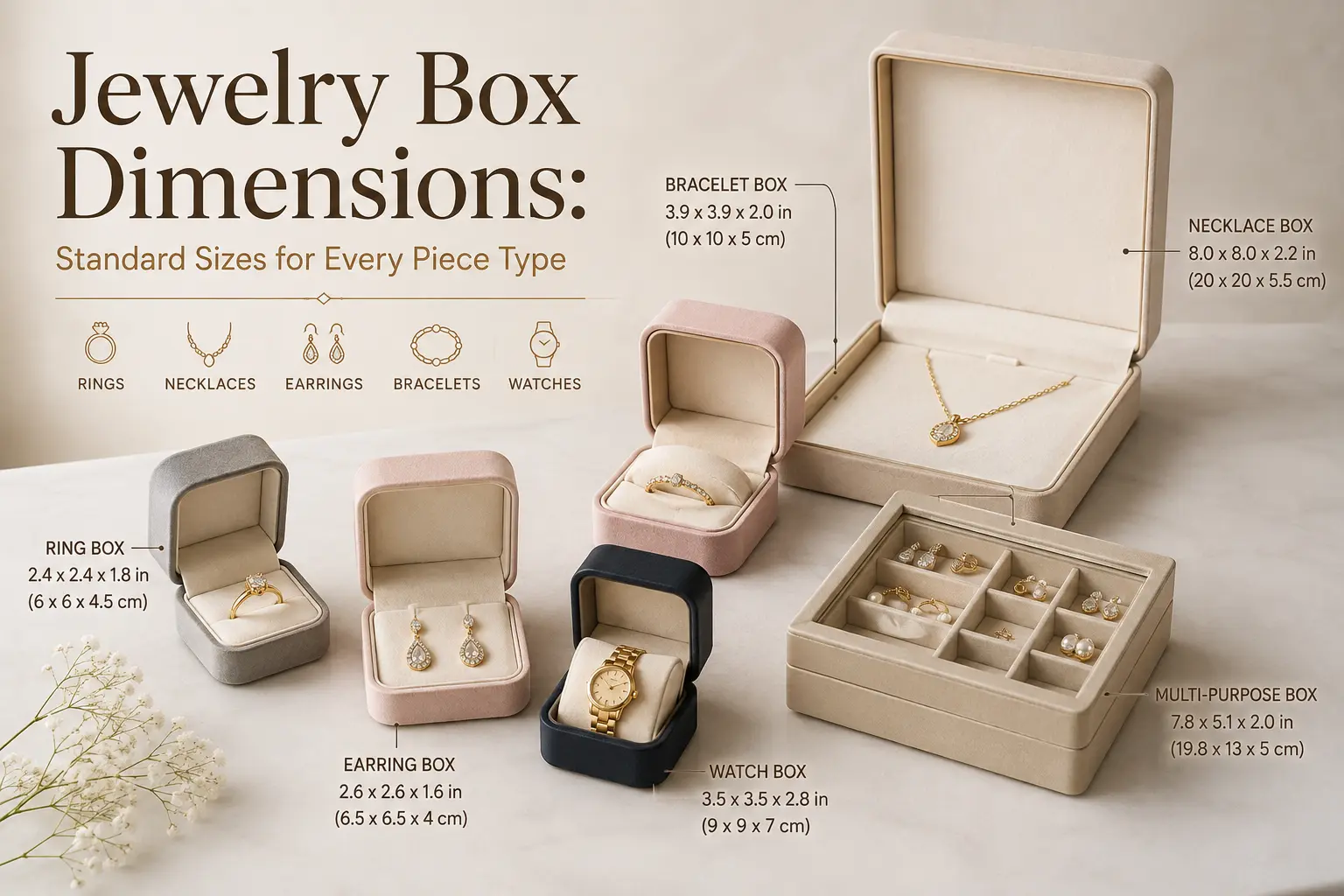
The table below covers typical outer box dimensions for common jewelry categories. These reflect standard insert-based construction, where the box is sized to comfortably house the insert style used for that piece type.
| Piece Type | Typical Box Dimensions (L x W x H) | Insert Style |
|---|---|---|
| Ring (single) | 2″ x 2″ x 1.5″ | Slotted ring mount with raised band holder |
| Ring (double/wedding set) | 3″ x 2″ x 1.5″ | Two-slot mount side by side |
| Stud Earrings | 2″ x 2″ x 1″ | Flat card with pierced posts |
| Drop or Dangle Earrings | 3″ x 2.5″ x 1″ | Hook-style card mount |
| Pendant Necklace | 3.5″ x 3.5″ x 1″ | Notched card or hook with chain wrap channel |
| Chain Necklace (no pendant) | 4″ x 4″ x 1″ | Full wraparound card or looped hook |
| Bracelet (chain-link) | 4″ x 3″ x 1″ | Wraparound mount or looped pegs |
| Bangle (rigid) | 3.5″ x 3.5″ x 1.5″ | Flat bed or raised cylindrical mount |
| Jewelry Set (necklace, earrings, ring) | 5″ x 4″ x 1.5″ | Multi-compartment insert |
| Watch | 3.5″ x 3.5″ x 2″ | Cushioned pillow mount |
Larger statement pieces, oversized cocktail rings, layered necklace sets, and cuff-style bracelets often exceed these standard footprints and are better suited to custom sizing rather than forcing them into a standard insert built for a smaller piece.
Ring Box Dimensions
Rings usually require the smallest jewelry boxes.
A standard ring box often has a square shape because the ring can be placed upright inside an insert.
Common Ring Box Sizes
Typical dimensions include:
- 2 × 2 × 1.5 inches
- 2.25 × 2.25 × 1.5 inches
- 2.5 × 2.5 × 2 inches
The best size depends on the ring design.
A simple engagement ring may fit inside a compact box. A large statement ring may require more internal height and width.
What to Consider When Choosing a Ring Box
Consider:
- Ring diameter
- Stone size
- Ring height
- Insert thickness
- Ring position
- Box opening style
A tall gemstone setting may need additional internal height.
Popular Ring Box Styles
Common options include:
- Two-piece boxes
- Hinged boxes
- Magnetic boxes
- LED ring boxes
- Velvet ring boxes
- Rigid ring boxes
The insert is especially important because it helps keep the ring positioned correctly.
Earring Box Dimensions
Earring boxes are usually compact but may need more width depending on the earring style.
Stud earrings require less space than long or oversized earrings.
Common Earring Box Sizes
Typical sizes include:
- 2 × 2 × 1 inches
- 2.5 × 2.5 × 1 inches
- 3 × 3 × 1.5 inches
For larger earrings, the box may need additional height or width.
Choosing the Right Earring Box
Measure:
- Total earring length
- Width
- Thickness
- Distance between the pair
- Insert requirements
Long drop earrings may need a rectangular box instead of a small square box.
The insert should securely hold both earrings while allowing customers to see the design clearly.
Pendant Box Dimensions
Pendant packaging needs space for both the pendant and its chain.
The box size depends on whether the chain is folded, wrapped, or displayed around an insert.
Common Pendant Box Sizes
Typical dimensions include:
- 2.5 × 2.5 × 1 inches
- 3 × 3 × 1.5 inches
- 4 × 4 × 1.5 inches
Small pendants may fit inside compact square boxes.
Larger pendants or presentation-style packaging may require a larger box.
Best Packaging for Pendants
A custom insert can help:
- Hold the pendant in place
- Keep the chain organized
- Prevent tangling
- Improve product presentation
The jewelry should be positioned securely without putting pressure on delicate parts.
Necklace Box Dimensions
Necklaces generally need larger packaging because of their chain length and presentation requirements.
A necklace can be folded inside a compact box, but premium brands may prefer a larger box that displays the necklace more openly.
Common Necklace Box Sizes
Typical sizes include:
- 5 × 5 × 1 inches
- 6 × 6 × 1.5 inches
- 7 × 7 × 2 inches
- 8 × 8 × 2 inches
Longer or larger necklaces may require custom dimensions.
What Affects Necklace Box Size?
The right size depends on:
- Chain length
- Pendant size
- Necklace thickness
- Display method
- Insert style
A delicate chain may need an insert with slots or hooks to reduce tangling.
Bracelet Box Dimensions
Bracelets usually require long rectangular boxes.
The exact size depends on whether the bracelet is flexible, rigid, thick, or wide.
Common Bracelet Box Sizes
Typical dimensions include:
- 7 × 2.5 × 1 inches
- 8 × 3 × 1.5 inches
- 9 × 3 × 2 inches
A thin chain bracelet may fit inside a smaller box, while a large cuff bracelet may require additional width and height.
Bracelet Packaging Considerations
Consider:
- Bracelet length
- Bracelet width
- Product thickness
- Closure
- Insert type
A custom insert can hold the bracelet in position and create a more premium presentation.
Bangle Box Dimensions
Bangles have a circular shape, so square or slightly rectangular boxes often work well.
The box needs enough internal width for the bangle diameter.
Common Bangle Box Sizes
Typical dimensions include:
- 3.5 × 3.5 × 1.5 inches
- 4 × 4 × 1.5 inches
- 5 × 5 × 2 inches
Measure the outside diameter of the bangle before selecting a box.
Always allow enough clearance for the insert and packaging material.
For multiple bangles, a larger box may be required.
Watch Box Dimensions
Watches usually need deeper boxes than rings or earrings.
The packaging may also include a watch cushion or custom insert.
Common Watch Box Sizes
Typical dimensions include:
- 4 × 4 × 3 inches
- 5 × 5 × 3 inches
- 6 × 6 × 4 inches
Larger watches or premium presentation boxes may require custom dimensions.
Watch Box Inserts
A watch insert can help:
- Hold the watch securely
- Support the watch strap
- Improve presentation
- Prevent unnecessary movement
Popular premium watch packaging includes rigid boxes with cushions or custom die-cut inserts.
Jewelry Set Box Dimensions
Jewelry sets can include multiple products, such as:
- Necklace
- Earrings
- Bracelet
- Ring
Because every set is different, custom dimensions are often the best option.
Common Jewelry Set Box Sizes
Typical sizes include:
- 6 × 6 × 1.5 inches
- 7 × 7 × 2 inches
- 8 × 8 × 2 inches
- 10 × 10 × 3 inches
The internal layout is often more important than the outside dimensions.
A custom insert can create separate spaces for every jewelry piece.
How to Measure Jewelry for the Right Box Fit
Measuring jewelry accurately requires a different approach depending on the piece type, since the measurement that matters is rarely just length and width.
For rings, measure the outer diameter of the band and the height of any raised setting, such as a stone or cluster, since the insert needs enough depth to clear the setting without the lid pressing against it. For earrings, measure the full drop length for dangle styles, including any chain or dangling element, and the width across the widest point of a stud or hoop. For necklaces, measure the full chain length when laid flat and the diameter or width of the pendant if one is attached, since the pendant, not the chain, typically determines how much depth the insert needs.
For bracelets and bangles, measure the inner diameter for rigid pieces like bangles, since this determines the mount size, and the full length when laid flat for chain-link bracelets. For watches, measure the case diameter and the full band length when laid flat, since watch inserts typically use a curved pillow mount that needs to accommodate the band’s natural curve rather than a flat length.
If you are unsure how your specific piece translates into insert and box dimensions, our team can review your item and recommend a fit before you commit to a production run. You can reach out through our contact page with your piece details.
Why Insert Depth Matters as Much as Footprint
A common sizing mistake with jewelry boxes is focusing entirely on length and width while treating height as an afterthought. In practice, insert depth is often the dimension most likely to cause a poor fit. A ring with a tall setting needs enough clearance between the insert surface and the lid that the stone or cluster does not press against the box when it closes. A pendant with dimension, rather than a flat charm, needs the same consideration.
Insert depth is typically built with two layers in mind: the base layer that holds the piece in its slot or mount, and the clearance layer above it that allows the lid to close without contact. For pieces with raised or three-dimensional elements, this clearance layer needs to be measured against the tallest point of the piece, not the average height.
Material and Insert Construction
Most jewelry boxes use a rigid or semi-rigid outer shell, since jewelry packaging is judged heavily on how it feels in the hand, and a flimsy folding carton undercuts the presentation regardless of how well the insert fits. Our Luxury Rigid Boxes use a wrapped rigid board construction that holds its shape and gives the weighted, premium feel associated with fine jewelry packaging.
Inserts themselves are typically built from molded foam, flocked plastic, or velvet-wrapped cardboard, depending on the price point and finish level of the brand. Flocked and velvet finishes are the most common choice for jewelry specifically, since the soft texture prevents metal pieces from scratching against a hard surface and adds to the tactile, high-end unboxing moment that most jewelry brands are trying to create.
For brands selling jewelry alongside a small accessory, such as a care card, cleaning cloth, or authenticity certificate, a Display Packaging style with a secondary compartment keeps the extra item from interfering with the main insert.
Custom Sizing for Statement and Multi-Piece Jewelry
Statement pieces, oversized cocktail rings, cuff bracelets, and multi-piece sets often do not fit within standard insert dimensions, either because the piece itself is unusually large or because the layout of multiple pieces together needs a custom compartment arrangement rather than a single standard slot.
Custom jewelry boxes are available starting from as few as 50 units, which makes fully custom insert design accessible even for small and independent jewelry brands rather than something reserved for large-volume orders.
Common Sizing Mistakes to Avoid
The most frequent mistake is sizing the box around the piece’s basic dimensions while ignoring the insert’s construction, which results in a box that fits the item on paper but does not actually hold it securely in practice. Another common issue is underestimating clearance height for pieces with raised settings or dimensional elements, leading to a lid that presses against the piece or will not close flush.
Some brands also try to use a single insert design across an entire jewelry line without accounting for size variation between pieces, which works for closely sized items but causes loose, rattling fits for anything meaningfully smaller than the insert was designed around. Each distinct piece size within a line generally needs its own insert variation, even if the outer box stays the same across the collection.
Getting a Sample Before Full Production
Because jewelry packaging depends so heavily on the insert holding the piece securely, ordering a sample before a full production run is especially important. A sample lets you confirm the piece sits correctly in its mount, check that the lid closes without pressure on the item, and catch any fit issues before a full batch of boxes and inserts is produced.
You can request a free quote and sample through our Get a Quote page, and our team can help finalize the right box and insert combination for your pieces.
Frequently Asked Questions
What is the standard box size for a single ring?
Most single ring boxes measure around 2 by 2 by 1.5 inches, though pieces with a taller setting may need additional insert clearance height.
Do necklaces need a different insert than earrings?
Yes. Necklaces typically use a hook or notched card that the chain wraps around to prevent tangling, while earrings use a flat or hook-style card sized to the specific earring style.
Can I get a custom box size for a statement or oversized piece?
Yes. Custom sizing is often the better option for statement pieces and multi-item sets, and it is available starting from as few as 50 units.
Why does insert depth matter more for jewelry than for other products?
Many jewelry pieces have raised or three-dimensional elements, such as a ring setting or a dimensional pendant, that need clearance between the insert surface and the lid so the piece is not pressed or damaged when the box closes.