

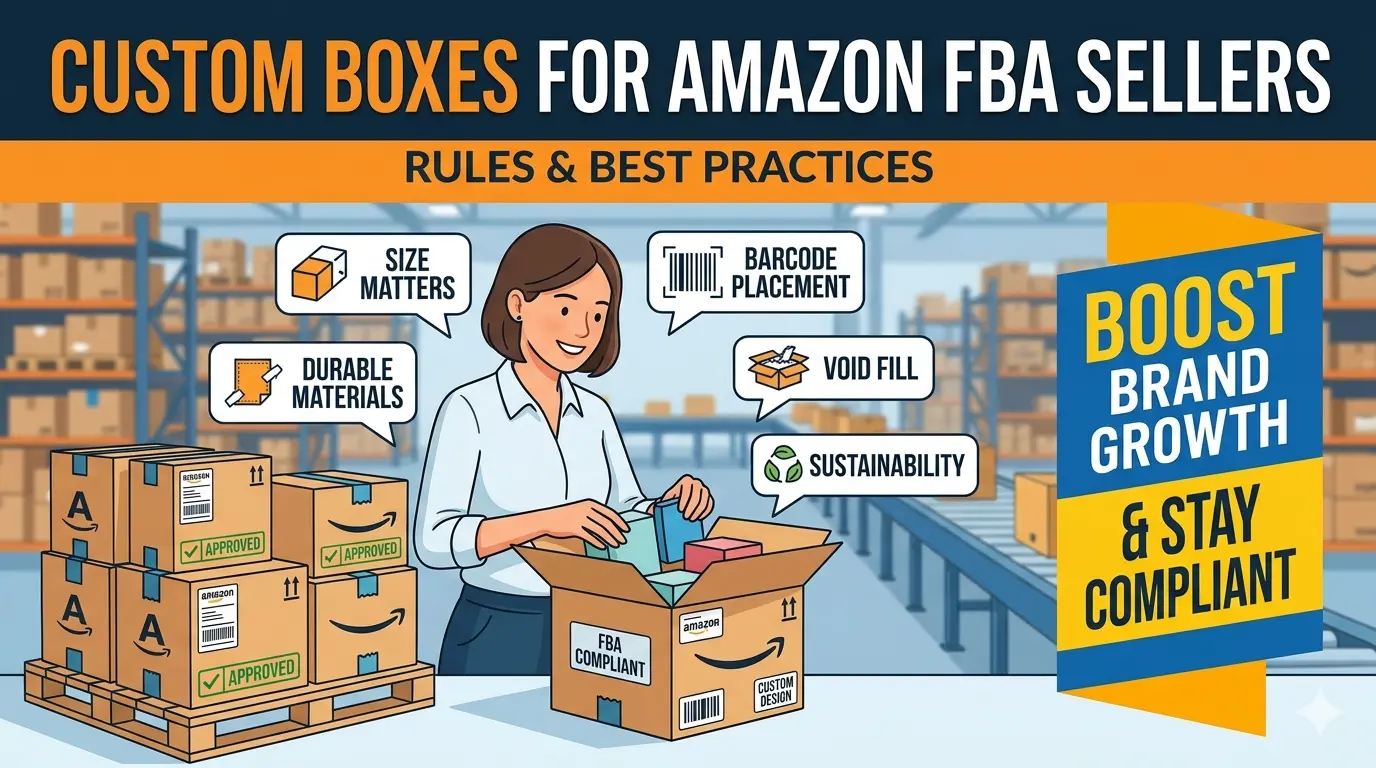
Selling on Amazon FBA comes with strict packaging requirements, and custom boxes can either help you scale efficiently—or get your inventory rejected if they are not designed correctly. For FBA sellers, packaging is not just branding; it is compliance, logistics efficiency, and cost control all at once.
If you are using custom boxes for Amazon FBA, you must balance Amazon’s strict inbound rules, product protection needs, and branding strategy. This guide breaks down exactly how to do it the right way.
Why Packaging Matters So Much for Amazon FBA Sellers
Amazon operates massive fulfillment centers with automated systems. Every box you send must be easy to scan, store, and ship.
Poor packaging can lead to:
- Inventory rejection at fulfillment centers
- Higher storage and shipping costs
- Product damage during handling
- Negative customer reviews
- Increased return rates
Good packaging, on the other hand, improves efficiency, protects your products, and strengthens your brand even within Amazon’s limitations.
Amazon FBA Packaging Rules You Must Follow
Amazon has clear FBA prep and packaging standards that all sellers must comply with.
1. Box Strength Requirements
Your custom boxes must be strong enough to survive:
- Long-distance shipping
- Automated warehouse handling
- Stack pressure in storage
Best Practice:
Use corrugated cardboard (at least E-flute or B-flute strength) for most products.
2. Weight Limits for Boxes
Amazon restricts heavy shipments for safety and handling efficiency.
General Guidelines:
- Standard boxes should not exceed ~50 lbs (22.6 kg)
- Overweight boxes require “Team Lift” labels
Best Practice:
Design packaging to stay under weight thresholds to avoid delays or penalties.
3. Proper Label Placement
Every FBA box must have:
- FNSKU labels (product identification)
- Shipping labels (Amazon inbound shipment labels)
- Barcode visibility (no covering or smudging)
Best Practice:
Leave a clean, flat surface area on your custom box design for label application.
4. No Obstructed Barcodes or Branding Confusion
Amazon requires scanning accuracy in fulfillment centers.
Avoid:
- Glossy surfaces that reflect scanners
- Overlapping graphics on barcode zones
- Confusing multiple product labels
Best Practice:
Keep one side of the box “Amazon-compliant clean zone.”
5. Poly Bag and Packaging Safety Rules
If products are inside poly bags:
- Bags must have suffocation warnings
- Must be sealed properly
- Must not exceed Amazon size regulations
Best Practices for Custom Amazon FBA Boxes
Now that you understand the rules, here’s how to design packaging that works with Amazon and still supports your brand.
1. Use Right-Sized Custom Boxes (Most Important Rule)
Oversized boxes increase:
- Shipping costs
- Dimensional weight fees
- Storage inefficiency
- Damage risk
Best Practice:
Design boxes based on exact product dimensions + minimal protective padding
This reduces cost and improves logistics performance.
2. Choose Durable Corrugated Material
For FBA, material strength matters more than visual design.
Recommended Materials:
- E-flute (lightweight products)
- B-flute (medium strength shipping)
- Double-wall corrugated (heavy or fragile items)
Stronger boxes reduce damage-related returns.
3. Keep Exterior Design Amazon-Friendly
Amazon warehouses prioritize scanning and processing speed.
Best Practice:
- Avoid excessive dark ink coverage
- Keep barcode zones clean
- Use minimal, functional branding
- Avoid reflective finishes on label areas
You can still include branding—but strategically.
4. Focus on Internal Branding Instead of External Overload
Since Amazon limits direct branding visibility, smart sellers shift branding inside the box.
Examples:
- Printed thank-you messages
- Inserts or discount cards
- Brand story on inner flaps
- QR codes for external engagement
This improves customer experience without violating FBA flow efficiency.
5. Design for Automation Handling
Amazon warehouses use conveyor belts and robotic systems.
Best Practice:
- Ensure boxes are rectangular and stackable
- Avoid irregular shapes
- Keep surfaces flat and stable
- Prevent weak edges or loose flaps
Uniform packaging improves acceptance speed and reduces damage.
6. Use Tamper-Evident Packaging for Trust
Even within Amazon FBA, tamper-proof design increases customer confidence.
Options:
- Security seals
- Adhesive locking flaps
- Tear strips for opening
This reduces refund claims and builds trust.
7. Optimize Packaging for Dimensional Weight (DIM)
Amazon shipping costs are heavily influenced by box size, not just weight.
Best Practice:
- Reduce empty space inside boxes
- Avoid oversized mailers
- Design tight-fit packaging
- Eliminate unnecessary fillers
Small improvements in size can lead to major cost savings.
8. Standardize Packaging Across Product Lines
If you sell multiple SKUs, consistency helps:
- Faster fulfillment prep
- Easier inventory management
- Reduced packaging errors
- Better cost control
Best Practice:
Use modular box sizes that fit multiple products.
9. Add Inserts for Product Protection
Custom inserts improve safety during Amazon handling.
Options:
- Cardboard dividers
- Foam inserts
- Molded pulp trays
This is especially important for fragile or high-value items.
10. Balance Branding With Compliance
Many FBA sellers make the mistake of over-branding their packaging.The Right Approach:
- Subtle branding outside
- Strong branding inside
- Compliance-first exterior design
- Customer-focused unboxing experience
This ensures you stay compliant while still building brand identity.
Common Mistakes FBA Sellers Should Avoid
- Using oversized stock boxes
- Ignoring barcode placement rules
- Overloading packaging with branding
- Using weak corrugated material
- Skipping product fit testing
- Not considering DIM weight costs
These mistakes often lead to higher costs and inventory rejection.
Final Thoughts
Custom packaging for Amazon FBA sellers is a balance between compliance, cost efficiency, and customer experience. Unlike regular eCommerce packaging, FBA boxes must meet strict operational standards while still supporting your brand identity.
The most successful sellers focus on:
- Right-sized packaging
- Strong corrugated materials
- Clean, Amazon-compliant exterior design
- Smart internal branding
- DIM weight optimization
When done correctly, custom FBA packaging doesn’t just protect your products—it improves profitability, reduces returns, and strengthens your long-term brand value.
Build FBA-Ready Custom Packaging That Scales
If you are an Amazon FBA seller, the right packaging strategy can help you:
- Lower fulfillment and shipping costs
- Reduce product damage and returns
- Improve inventory acceptance rates
- Enhance customer satisfaction
- Build a stronger brand presence
Smart packaging is not optional in FBA—it is a competitive advantage.