

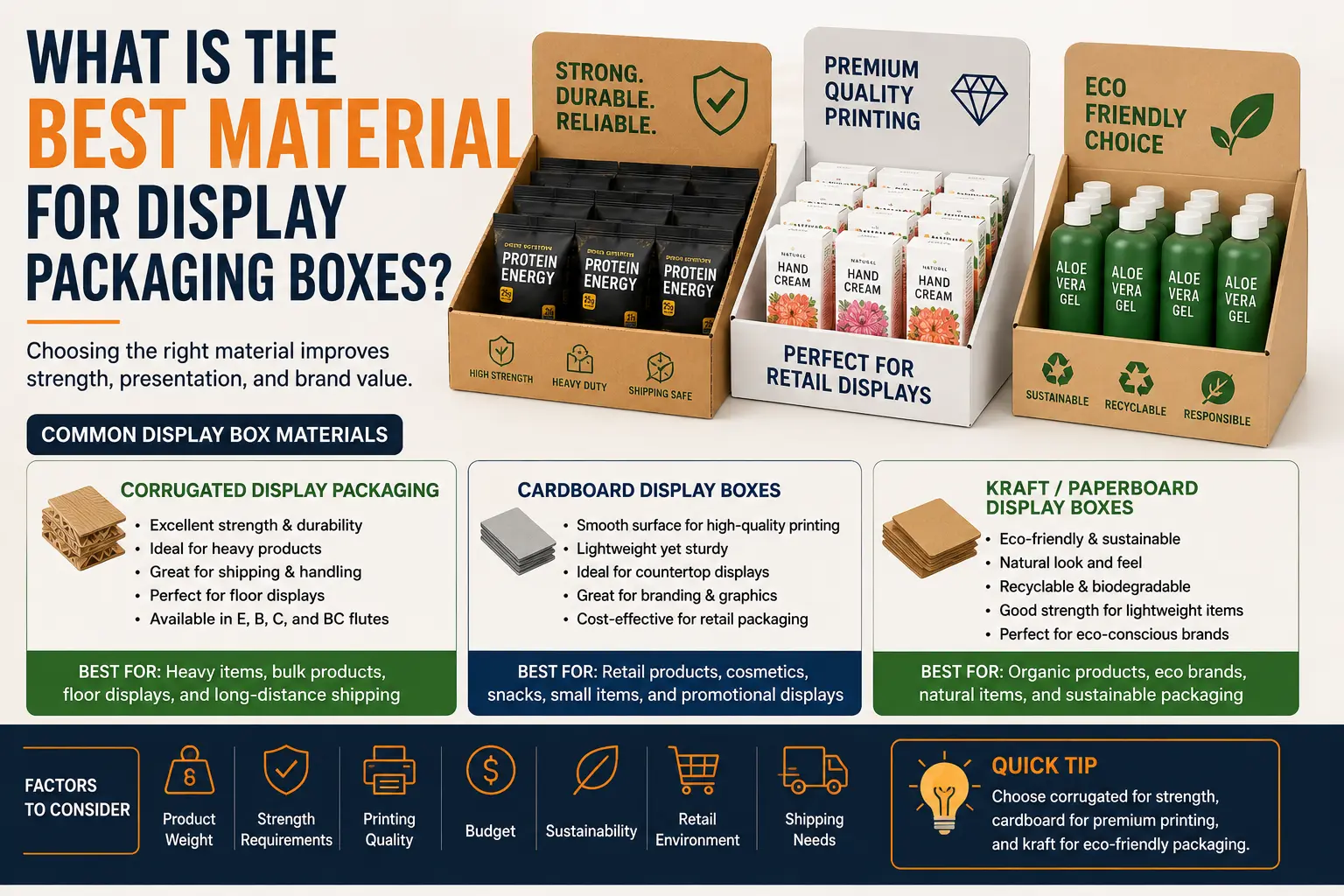
Display packaging plays a crucial role in how products are presented, noticed, and purchased especially in retail environments. Whether you’re showcasing cosmetics, candles, snacks, electronics, or promotional items, the material of your display box directly impacts durability, branding, and customer attraction.
Choosing the right display box materials is not just a design decision, it’s a strategic choice that affects product visibility, cost efficiency, and shelf performance.
This guide breaks down the best materials used in cardboard display boxes and corrugated display packaging, along with their advantages, limitations, and ideal use cases.
Understanding Display Packaging Boxes
Display packaging boxes are specially designed retail boxes that hold products while presenting them in an organized and visually appealing way.
They are commonly used in:
- Supermarkets
- Cosmetic stores
- Pharmacies
- Convenience stores
- Promotional counters
Their main purpose is to:
- Attract attention
- Encourage impulse buying
- Organize multiple products
- Strengthen brand visibility
Why Material Choice Matters in Display Packaging
The material used in display boxes affects far more than just appearance.
Key Factors Influenced by Material:
- Structural strength
- Product safety
- Printing quality
- Cost efficiency
- Shelf life durability
- Branding impact
A weak material can collapse under weight, while an overly expensive one can reduce profit margins unnecessarily.
Best Display Box Materials Explained
Let’s explore the most commonly used materials in display packaging and where each performs best.
Cardboard Display Boxes
Cardboard display boxes are one of the most widely used options in retail packaging due to their flexibility and print quality.
What They Are
Made from thick paperboard (also called folding carton board), these boxes are lightweight but strong enough for small to medium-weight products.
Advantages of Cardboard Display Boxes
Excellent Print Quality
Cardboard supports high-resolution printing, making it ideal for branding and marketing visuals.
Lightweight Structure
Easy to transport and assemble, reducing logistics costs.
High Customization
Can be cut, folded, and shaped into various display formats.
Cost-Effective
Affordable compared to rigid or plastic alternatives.
Limitations
- Not suitable for very heavy products
- Less moisture resistance
- Lower durability compared to corrugated materials
Best Use Cases
- Cosmetics and skincare products
- Candles and small retail goods
- Chocolates and snacks
- Promotional counter displays
👉 Ideal for brands focused on visual appeal and branding
Corrugated Display Packaging
Corrugated display packaging is one of the strongest and most reliable options for retail displays.
What It Is
Made using fluted (wavy) paper layers sandwiched between linerboards, corrugated material provides excellent structural strength.
Advantages of Corrugated Display Packaging
High Strength and Durability
Can hold heavier products without collapsing.
Excellent for Bulk Display
Perfect for multi-product retail arrangements.
Good Shipping Performance
Often used for display boxes that are shipped directly to stores.
Eco-Friendly
Usually recyclable and made from sustainable paper materials.
Limitations
- Slightly bulkier than cardboard
- Lower print sharpness compared to coated cardboard
- Can appear less “premium” if not designed properly
Best Use Cases
- Beverage displays
- Household goods
- Hardware or tools
- Bulk retail promotions
- Warehouse-to-store displays
👉 Ideal for brands needing strength and practicality
Rigid Display Boxes (Premium Option)
Although less common, rigid materials are used for high-end retail displays.
Advantages
- Extremely strong and premium-looking
- Ideal for luxury branding
- Long-lasting shelf presence
Limitations
- Expensive
- Heavier
- Not suitable for mass distribution displays
Best Use Cases
- Luxury cosmetics
- High-end gift items
- Limited edition products
Cardboard vs Corrugated: Which Is Better?
Choosing between the two depends on your product needs.
When Cardboard Display Boxes Are Better
Choose cardboard if you need:
- High-quality printing and branding
- Lightweight packaging
- Attractive retail presentation
- Lower production costs
👉 Best for marketing-driven retail displays
When Corrugated Display Packaging Is Better
Choose corrugated if you need:
- Strong structural support
- Heavy product display
- Shipping-friendly packaging
- Bulk product holding capacity
👉 Best for strength and logistics efficiency
Key Factors to Choose the Right Display Box Material
Selecting the best material requires balancing multiple factors.
Product Weight
- Lightweight products → cardboard
- Heavy products → corrugated
Retail Environment
- Indoor retail shelves → cardboard
- High-traffic or warehouse displays → corrugated
Branding Requirements
- Premium branding → cardboard or rigid
- Functional branding → corrugated
Budget Constraints
- Low budget → corrugated or basic cardboard
- Medium budget → printed cardboard
- High budget → rigid display packaging
Shipping Needs
- Direct shipping to stores → corrugated
- Pre-assembled shelf displays → cardboard
Trends in Modern Display Packaging Materials
Modern retail packaging is evolving rapidly.
Popular Trends:
Sustainable Materials
Brands are shifting toward recyclable and biodegradable options.
Minimalist Designs
Simple layouts with strong branding impact.
Hybrid Packaging
Combining cardboard aesthetics with corrugated strength.
Digital Printing Technology
Improved graphics even on eco-friendly materials.
Common Mistakes When Choosing Display Packaging Materials
Avoid these common errors:
Choosing Style Over Strength
A beautiful display that collapses is a loss for branding.
Ignoring Product Weight
Mismatch between material and product leads to damage.
Overpaying for Unnecessary Premium Materials
Not every product needs rigid or luxury-grade packaging.
Poor Print Material Matching
Some materials don’t support high-resolution branding effectively.
Conclusion
The best material for display packaging boxes depends entirely on your product type, branding goals, and retail environment.
- Cardboard display boxes are best for lightweight products and strong visual branding.
- Corrugated display packaging is best for durability, bulk displays, and shipping efficiency.
- Rigid display boxes are best for luxury and premium retail experiences.
In most cases, successful brands choose materials based on a balance of strength, cost, and presentation.
A well-chosen display material doesn’t just hold your product, it enhances its visibility, improves customer engagement, and directly influences sales performance in competitive retail spaces.
FAQs
What are the most common display box materials?
The most common display box materials include corrugated board, cardboard (paperboard), and kraft packaging materials.
Which material is best for heavy products?
Corrugated display packaging is generally the best option for heavy products because it offers superior strength and durability.
Are cardboard display boxes good for retail shelves?
Yes. Cardboard display boxes are widely used in retail environments because they provide excellent print quality and attractive product presentation.
Is kraft display packaging eco-friendly?
Yes. Kraft packaging is often recyclable and is commonly chosen by brands that prioritize sustainability and environmentally responsible packaging.
Which display box material offers the best printing quality?
Cardboard display boxes typically provide the smoothest surface and highest-quality printing results.
How do I choose the right display box material?
Consider factors such as product weight, retail environment, branding goals, durability requirements, sustainability preferences, and budget when selecting display box materials.