

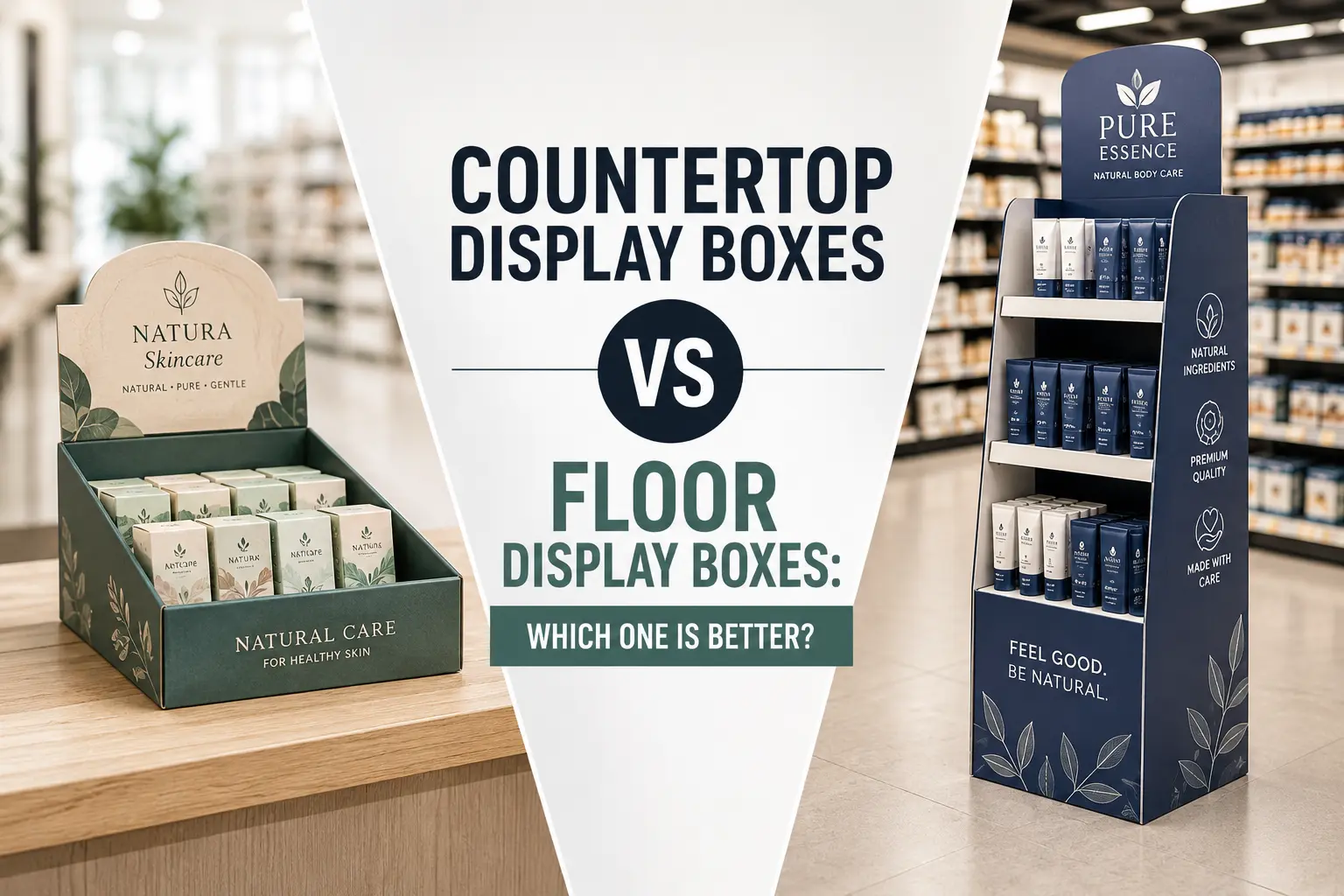
In retail marketing, display packaging is one of the most powerful tools for influencing customer buying decisions. Whether you’re selling cosmetics, snacks, candles, or small electronics, the way your products are displayed can directly impact sales.
Two of the most commonly used retail display solutions are countertop display boxes and floor display displays. While both serve the same purpose—promoting products—they differ significantly in size, placement, cost, and effectiveness.
This guide breaks down both options in detail so you can decide which display strategy works best for your product and retail goals.
What Are Countertop Display Boxes?
Countertop display boxes are compact retail displays designed to sit on counters, checkout desks, or small shelf spaces. They are used to encourage impulse buying by placing products directly in front of customers at the point of purchase.
Key Features of Countertop Display Boxes
- Small and compact structure
- Placed near billing counters or shelves
- Designed for lightweight products
- Easy to assemble and move
- Highly customizable for branding
Common Uses
Countertop displays are commonly used for cosmetics and skincare, small candles, chocolates and snacks, lip balms, and other small promotional items.
Advantages of Countertop Display Boxes
They are highly effective for impulse buying because they are placed at checkout points where final purchase decisions are made. They are also cost-effective since they require less material, and they are easy to set up and reposition. Despite their small size, they offer strong branding visibility at eye level.
Limitations
Countertop displays have limited product capacity and are not suitable for heavy or bulk items. They also offer less visibility compared to larger floor displays.
What Are Floor Display Boxes?
Floor display boxes are large freestanding retail units placed directly on the store floor. They are designed to hold multiple products and attract attention from a distance.
Key Features of Floor Display Boxes
- Large freestanding structure
- High product capacity
- Positioned in aisles or open retail spaces
- Strong branding surface area
- Used for promotional campaigns
Common Uses
Floor displays are commonly used for beverages, snacks, household goods, candles, home décor items, and seasonal promotions.
Advantages of Floor Display Boxes
Floor displays provide high visibility due to their size, making them noticeable from across the store. They offer large product capacity, allowing bulk display of items. They also provide strong brand presence with large printable areas and are ideal for promotional campaigns and product launches.
Limitations
They require more floor space and have higher production costs. They also involve more complex assembly and are not suitable for small retail stores.
Countertop Display Boxes vs Floor Display Boxes: Detailed Comparison
Placement and Space Usage
Countertop displays are placed on counters or shelves and require minimal space, making them ideal for small retail environments. Floor displays require dedicated floor space and are best suited for supermarkets and large retail stores.
Product Capacity
Countertop displays are designed for limited product quantities, while floor displays can hold significantly larger volumes of products.
Customer Engagement
Countertop displays target customers at the point of purchase and are highly effective for impulse buying. Floor displays attract customers during browsing and create strong visual impact across aisles.
Cost and Budget
Countertop display boxes are more cost-effective due to smaller size and reduced material usage. Floor displays are more expensive but offer higher marketing impact and product capacity.
Branding Impact
Countertop displays provide focused branding at checkout points, while floor displays offer large-scale visibility and stronger promotional storytelling opportunities.
When to Use Countertop Display Boxes
Countertop displays are best suited for businesses that want to increase impulse purchases at checkout points. They are ideal for small products, limited budgets, and retail environments where shelf space is restricted. They also work well for promotional or seasonal items.
When to Use Floor Display Boxes
Floor displays are ideal for large retail campaigns, product launches, and high-volume sales strategies. They work best in supermarkets, departmental stores, and retail spaces with high foot traffic. They are also a strong choice for brands looking to build dominant in-store visibility.
Final Verdict
There is no universal winner between countertop display boxes and floor display displays because each serves a different retail purpose.
Countertop displays are best for driving quick impulse purchases at checkout points, while floor displays are better for maximizing visibility and showcasing larger product ranges.
The most effective retail strategy often uses both together, placing floor displays to attract attention and countertop displays to convert final sales at the point of purchase.