

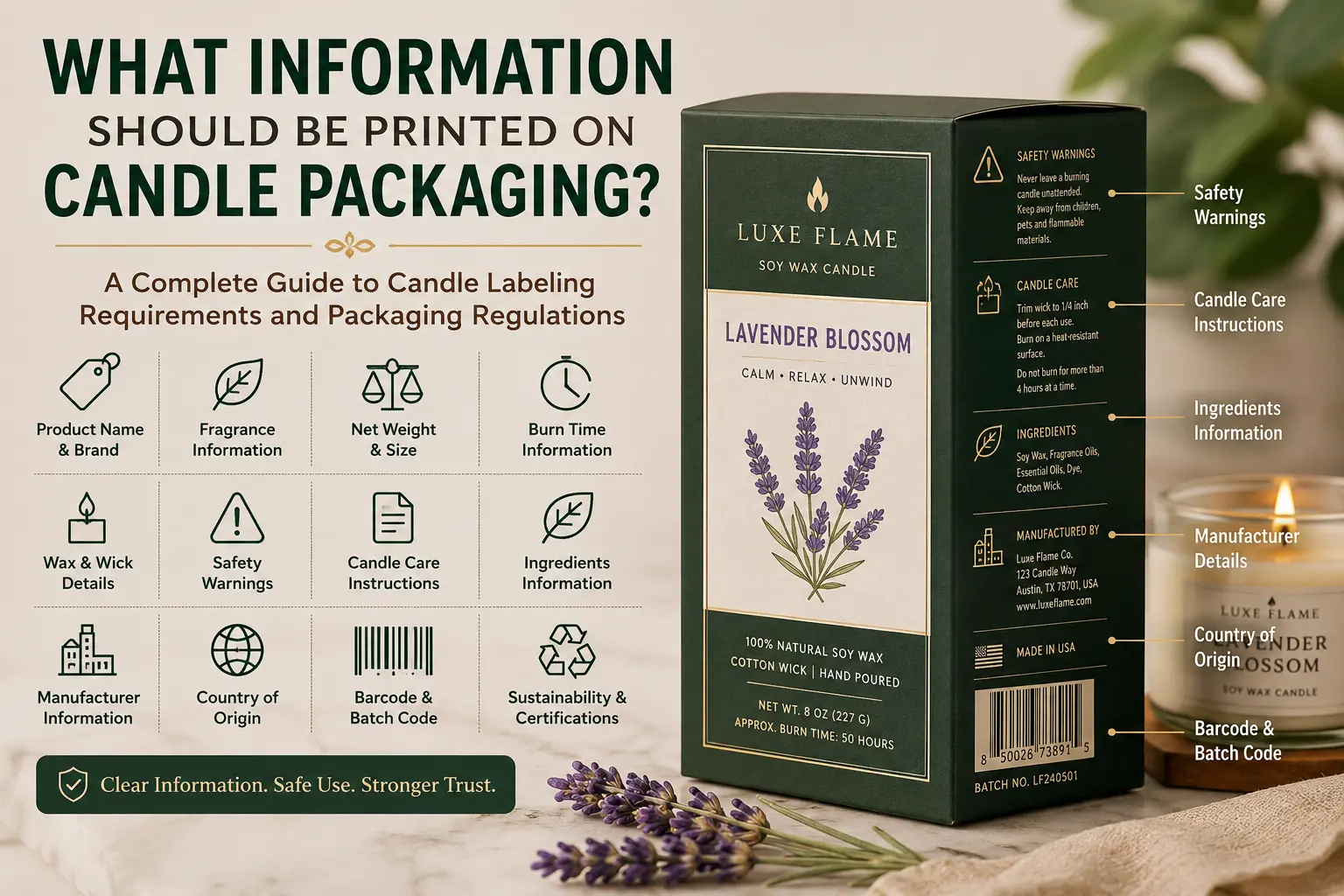
Candle packaging does more than protect a product—it communicates essential information to customers, supports brand identity, and helps businesses comply with legal requirements. Whether you’re selling handmade candles at local markets or distributing products nationwide, the information printed on your packaging can affect customer trust, safety, and regulatory compliance.
Many candle brands focus heavily on design and aesthetics but overlook important labeling details. Missing information can lead to customer confusion, safety concerns, and even compliance issues in certain markets.
This guide explains what information should be included on candle packaging, why it matters, and how proper candle box printing helps meet both branding goals and candle labeling requirements.
Why Printed Information on Candle Packaging Matters
The information displayed on a candle box serves multiple purposes. It helps customers understand what they are buying, provides safety guidance, supports brand recognition, and ensures compliance with applicable candle packaging regulations.
Well-designed packaging should balance visual appeal with practical information. A customer should be able to quickly identify the product, understand how to use it safely, and learn more about the brand.
For businesses, accurate labeling can reduce customer inquiries, improve trust, and demonstrate professionalism in a competitive market.
Product Name
The product name is one of the most important elements of candle packaging. It immediately tells customers what they are purchasing and helps differentiate products within a candle collection.
The product name should be easy to read and prominently displayed on the front of the packaging. Luxury brands often use elegant typography, while artisan brands may incorporate more creative naming conventions.
Examples include:
- Vanilla Bean Soy Candle
- Lavender Relaxation Candle
- Ocean Breeze Scented Candle
- Cedarwood & Amber Luxury Candle
A clear product name improves shelf recognition and enhances the overall shopping experience.
Brand Name and Logo
Your brand name and logo should be clearly visible on the packaging. Branding helps customers identify your products and builds familiarity over time.
Strong branding creates consistency across product lines and contributes to long-term customer loyalty. Customers who have a positive experience with one candle are more likely to purchase additional products when the branding is recognizable.
The logo placement should be balanced with other design elements and remain visible without overwhelming the overall packaging design.
Fragrance Information
Since fragrance is often the primary reason customers purchase candles, scent details should be clearly communicated.
Customers should know exactly what fragrance profile they can expect before making a purchase.
Depending on your branding strategy, fragrance information may include:
- Main scent name
- Fragrance family
- Key fragrance notes
- Seasonal scent descriptions
For example, a candle may feature:
Top Notes:
Bergamot and Lemon
Middle Notes:
Lavender and Jasmine
Base Notes:
Sandalwood and Musk
Providing fragrance details helps customers make informed purchasing decisions, particularly when buying online.
Candle Weight and Size
One of the most common candle labeling requirements is indicating the net weight of the candle.
Customers often compare products based on size and value, making this information essential.
Common measurements include:
- Net Weight: 8 oz (227 g)
- Net Weight: 12 oz (340 g)
- Net Weight: 16 oz (454 g)
Some brands also include:
- Jar dimensions
- Product dimensions
- Wax volume
Providing accurate measurements helps manage customer expectations and supports transparency.
Burn Time Information
Estimated burn time is highly valuable for consumers.
Customers often want to know how long a candle is expected to last before purchasing.
Examples include:
- Approximate Burn Time: 40 Hours
- Approximate Burn Time: 60 Hours
- Approximate Burn Time: 80 Hours
Although actual burn time may vary depending on usage conditions, providing an estimate helps customers evaluate value for money.
For premium candles, burn time can be a major selling point.
Wax Type Information
Modern consumers are increasingly interested in the materials used in candle production.
Including wax information can help attract environmentally conscious and health-conscious buyers.
Examples include:
- 100% Soy Wax
- Coconut Soy Blend
- Beeswax Candle
- Paraffin Wax
- Natural Wax Blend
Highlighting wax composition can also support premium positioning and product differentiation.
Wick Information
Many customers pay attention to wick materials because they influence performance and safety.
Packaging may specify:
- Cotton Wick
- Lead-Free Wick
- Wooden Wick
- Eco-Friendly Wick
Including wick information demonstrates transparency and helps customers make informed choices.
Safety Warnings
Safety information is among the most important components of candle packaging.
Because candles contain an open flame, clear warnings are essential for customer protection and compliance with various candle packaging regulations.
Common warnings include:
- Never leave a burning candle unattended.
- Keep away from children and pets.
- Burn candle on a heat-resistant surface.
- Keep away from flammable materials.
- Do not burn for more than four hours at a time.
These warnings should be easy to read and placed in a visible location on the packaging.
Candle Care Instructions
Proper candle care helps customers achieve better performance and extends product life.
Many brands include usage instructions such as:
- Trim wick to ¼ inch before each use.
- Allow wax to melt evenly across the surface during the first burn.
- Keep candle free of debris.
- Discontinue use when ½ inch of wax remains.
Providing care instructions helps reduce common issues such as tunneling, excessive soot, and uneven burning.
Ingredient Disclosure
Depending on your target market and applicable regulations, ingredient disclosure may be required or recommended.
Some brands choose to list:
- Wax type
- Fragrance oils
- Essential oils
- Dye information
Consumers increasingly value transparency regarding product ingredients, especially in premium and natural candle categories.
Manufacturer Information
Professional candle packaging should clearly identify the business responsible for the product.
This information often includes:
- Company name
- Business address
- Customer service contact information
- Email address
- Website
Including manufacturer details increases customer confidence and provides a direct communication channel if questions arise.
Country of Origin
Many brands include country-of-origin information as part of their packaging.
Examples include:
- Made in USA
- Made in Canada
- Made in UK
- Made in Pakistan
This information may be required in some markets and can also influence purchasing decisions.
Batch Number or Production Code
Batch tracking information is particularly important for larger candle manufacturers.
A batch code helps:
- Track production runs
- Manage quality control
- Address customer complaints
- Facilitate product recalls if necessary
Even small businesses can benefit from implementing batch identification systems.
Barcode and Retail Information
For candles sold through retail stores, a barcode is typically required.
Barcodes help retailers:
- Track inventory
- Process sales
- Manage stock levels
Retail packaging may also include:
- SKU numbers
- Product codes
- QR codes
QR codes are becoming increasingly popular because they can direct customers to websites, product pages, or candle care guides.
Sustainability and Recycling Information
Many consumers actively seek environmentally responsible products.
Including sustainability information can strengthen brand reputation and support purchasing decisions.
Examples include:
- Recyclable Packaging
- FSC-Certified Materials
- Eco-Friendly Packaging
- Soy-Based Inks
- Plastic-Free Packaging
These details help communicate a brand’s environmental commitment.
Certifications and Compliance Marks
Depending on your market and product claims, certifications may be displayed on packaging.
Examples include:
- FSC Certification
- Vegan Friendly
- Cruelty-Free
- Organic Ingredients
- Recyclable Packaging Symbols
These marks can add credibility and support premium positioning.
Marketing and Brand Story Elements
While regulatory information is important, packaging should also help sell the product.
Many successful candle brands include a brief brand story that explains:
- Company mission
- Product inspiration
- Craftsmanship approach
- Sustainability efforts
A concise brand story helps build emotional connections and enhances customer engagement.
Common Candle Labeling Mistakes to Avoid
Many businesses unintentionally create packaging issues by overlooking important details.
Common mistakes include:
- Missing safety warnings
- Small, difficult-to-read text
- Inaccurate burn time claims
- Incomplete manufacturer information
- Overcrowded packaging design
- Inconsistent branding
- Failure to meet market-specific labeling requirements
Avoiding these mistakes can improve both compliance and customer experience.
Creating Effective Candle Box Printing
Successful candle box printing combines essential information with attractive design.
The best candle packaging:
- Communicates product details clearly
- Meets safety and compliance requirements
- Supports brand identity
- Enhances shelf appeal
- Creates customer confidence
Information should be organized logically so customers can quickly find what they need without overwhelming the design.
Conclusion
Knowing what information should be printed on candle packaging is essential for both legal compliance and successful branding. Effective packaging goes beyond aesthetics by providing customers with the information they need to use the product safely and confidently.
From product names and fragrance descriptions to safety warnings, manufacturer details, and sustainability claims, every element plays a role in creating professional and compliant packaging. By following established candle labeling requirements, investing in quality candle box printing, and staying informed about relevant candle packaging regulations, candle brands can improve customer trust, strengthen their market presence, and create a better overall product experience.