

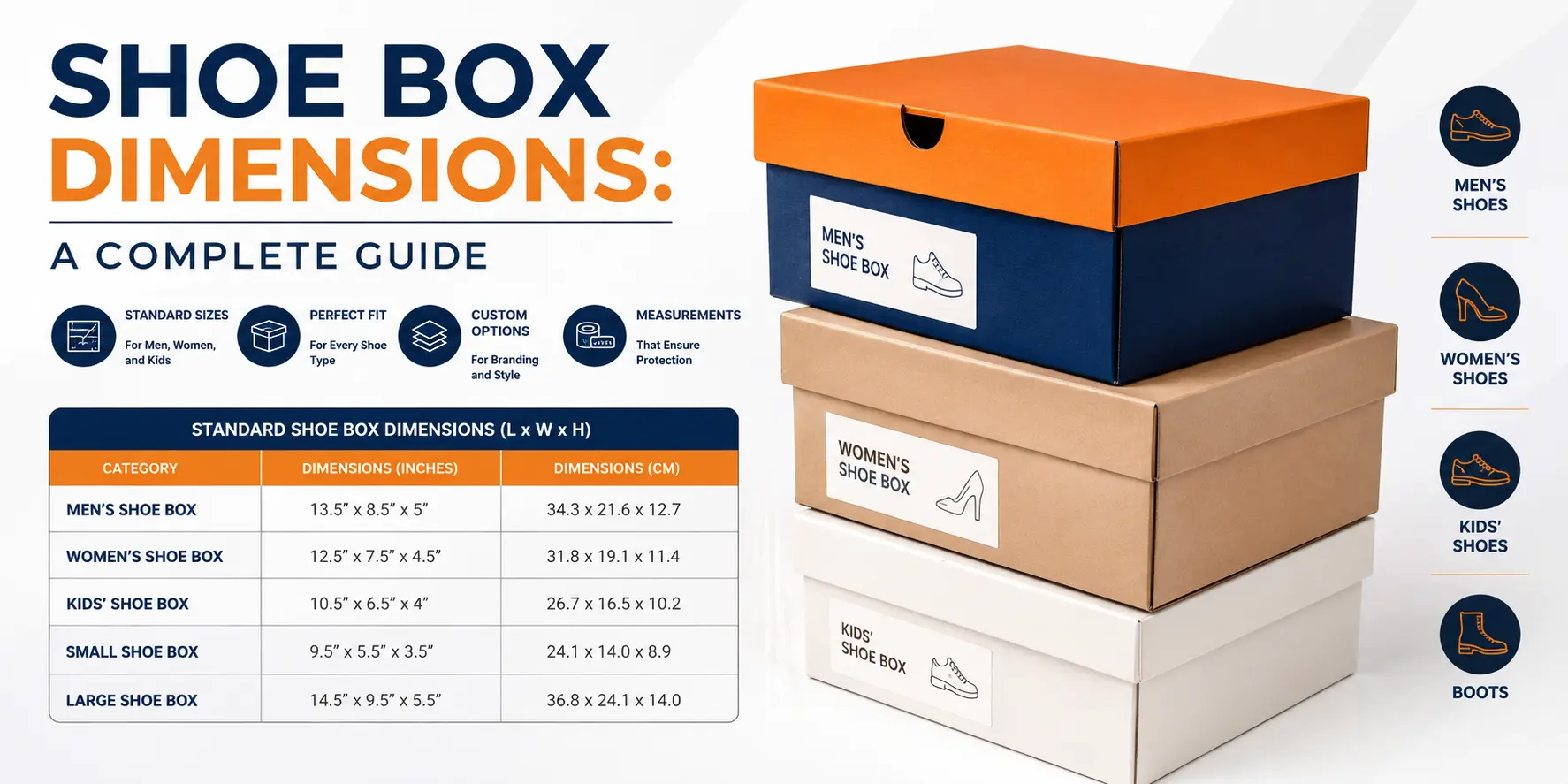
Maybe you’ve got a footwear brand, maybe you ship resold sneakers out of the garage, or maybe you just want your collection off the closet floor. Whichever it is, getting the right shoe box dimensions means cheaper shipping and fewer crushed toe boxes, and the lid comes off feeling like a little event instead of a chore.
We’ve pulled together the usual sizes (men’s, women’s, kids’, some specialty stuff), a handful of brand boxes, how we’d measure, and the shipping side of it.
What Are Standard Shoe Box Dimensions?
It mostly comes down to who the shoe’s for and what kind of shoe it is. These are the inside measurements most US footwear brands land on, give or take:
| Category | Length | Width | Height |
|---|---|---|---|
| Men’s (standard) | 14 in / 35.5 cm | 8 in / 20 cm | 5 in / 12.5 cm |
| Women’s (standard) | 12 in / 30.5 cm | 7 in / 17.5 cm | 4 in / 10 cm |
| Children’s (youth) | 10 in / 25 cm | 6 in / 15 cm | 4 in / 10 cm |
| Children’s (toddler) | 8.5 in / 21.5 cm | 5.5 in / 14 cm | 3.5 in / 9 cm |
| Children’s (infant) | 6 in / 15 cm | 4 in / 10 cm | 3 in / 7.5 cm |
Note: these are interior sizes. Measure the inside when you’re fitting shoes, and the outside when you’re working out shipping.
Shoe Box Dimensions by Shoe Type
A stiletto needs a deeper box than a ballet flat, and a boot needs way more height than either. So here’s how we’d size by type.
Men’s Shoe Box Sizes
| Shoe Type | Length | Width | Height |
|---|---|---|---|
| Dress shoes / loafers | 13 in | 8 in | 4.5 in |
| Sneakers / athletic | 14 in | 8 in | 5 in |
| High-tops / basketball | 14 in | 9 in | 6 in |
| Boots (ankle) | 14 in | 9 in | 7 in |
| Boots (knee-high) | 16 in | 10 in | 14 to 15 in |
| Size 13+ (large sizes) | 15 to 16 in | 9 to 10 in | 5.5 in |
Women’s Shoe Box Sizes
| Shoe Type | Length | Width | Height |
|---|---|---|---|
| Flats / loafers | 12 in | 7 in | 3.5 in |
| Sneakers | 12 in | 7.5 in | 4.5 in |
| High heels / stilettos | 12 in | 7 in | 5 to 6 in |
| Wedges / platforms | 12 in | 8 in | 5 in |
| Boots (ankle) | 12 in | 7.5 in | 6 in |
| Boots (knee-high) | 14 in | 8 in | 13 to 15 in |
Children’s Shoe Box Sizes
| Age Group | Length | Width | Height |
|---|---|---|---|
| Infant (0 to 2 yrs) | 6 in / 15 cm | 4 in / 10 cm | 3 in / 7.5 cm |
| Toddler (2 to 4 yrs) | 8 in / 20 cm | 5 in / 12.5 cm | 3.5 in / 9 cm |
| Kids (4 to 8 yrs) | 9.5 in / 24 cm | 5.5 in / 14 cm | 4 in / 10 cm |
| Youth (8 to 12 yrs) | 10.5 in / 26.5 cm | 6 in / 15 cm | 4.5 in / 11.5 cm |
Brand-Specific Shoe Box Dimensions
The big names all run their own sizes, a little off the industry standard. Here’s a rough reference for some popular ones (inside measurements, men’s US size 10 unless it says otherwise):
| Brand | Length | Width | Height |
|---|---|---|---|
| Nike | 13.4 in / 34 cm | 9.4 in / 24 cm | 4.7 in / 12 cm |
| Nike (women’s) | 12.2 in / 31 cm | 8.3 in / 21 cm | 4.3 in / 11 cm |
| Jordan | 13 in / 33 cm | 10.5 in / 26.5 cm | 5.5 in / 14 cm |
| Adidas (men’s) | 13.5 in / 34.5 cm | 8.5 in / 21.5 cm | 4.5 in / 11.5 cm |
| Adidas (women’s) | 12.6 in / 32 cm | 7.9 in / 20 cm | 4 in / 10 cm |
| New Balance | 13 in / 33 cm | 8 in / 20 cm | 4.5 in / 11.5 cm |
| Vans | 12.6 to 14 in | 7.9 to 8 in | 4 to 4.5 in |
| Puma | 13.5 in / 34 cm | 8.5 in / 21.5 cm | 4.5 in / 11.5 cm |
Heads up: brand sizes change by model and region. A Jordan 1 High, for instance, needs that full 5.5 inches of height or the lid won’t sit flat. Check before you order in bulk.
How to Measure a Shoe Box (Step-by-Step)
Four steps. Takes five minutes, saves a reprint.
Step 1: Measure the shoe, not the box. Set the shoe on a table and measure heel to toe, then the widest point, then the tallest point of the upper. A stiff ruler beats a floppy tape measure here, it really does.
Step 2: Add clearance. We’d add at least an inch to the length, about three quarters of an inch to the width, and anywhere from three quarters to an inch and a half on height, which leaves room for tissue and inserts and a bit of air. Pack them too tight and they show up creased across the toe.
Step 3: Measure both shoes. Left and right of the same pair can be up to 3mm apart thanks to how they’re made. Go with the bigger one.
Step 4: Write down inside, then outside. Inside tells you the shoe fits. Outside is what UPS and FedEx use for dimensional weight. You need both numbers, so keep them on the same sticky note.
Interior vs Exterior Shoe Box Dimensions: What’s the Difference?
This trips people up all the time, honestly more than anything else on this page.
| Dimension Type | What It Tells You | When to Use It |
|---|---|---|
| Interior (inside) | How much space the shoe has | Fitting, product design |
| Exterior (outside) | Total box footprint | Shipping, storage, DIM weight |
The gap between the two is just wall thickness. A regular cardboard shoe box has walls around 1 to 3mm thick, but a rigid luxury box can have walls up to 6mm, so the inside could be 12mm smaller than the outside across each dimension. Always ask your supplier which number they’re quoting (we’ll tell you without being asked, but not everyone does).
Shoe Box Dimensions for Shipping
UPS, FedEx and USPS all bill on dimensional weight, not just what’s on the scale. Bigger box, bigger bill.
Standard Shoe Box Shipping Sizes
| Shoe Type | Recommended Shipping Box Size |
|---|---|
| Standard shoes (men’s / women’s) | 14 × 10 × 5 in |
| Boots | 16 × 12 × 6 in |
| Multiple pairs | 20 × 14 × 8 in |
How to work out DIM weight (UPS/FedEx):
DIM Weight = (Length × Width × Height) ÷ 139
So a 14 × 10 × 5 inch box is 700 cubic inches, divided by 139, which is about 5.04 lbs DIM weight. Your sneakers might only weigh 2.5 lbs. You still pay for 5. That’s why we keep going on about right-sizing.
Shipping Tips
- Give the outer box 1 to 2 extra inches on each side of the retail box so there’s space for crumpled kraft or bubble wrap.
- For heavy boots or cross-country shipping we’d use double-wall corrugated boxes.
- Try to keep the outer box under 6 inches tall so it stacks nicely on shelves and in a truck.
Shipping a lot of pairs? Our custom shipping boxes can be cut to fit your retail box snugly, so it doesn’t slide around in the outer carton.
What Materials Do Shoe Boxes Use?
The board changes how thick the walls are, which changes how much room the shoe actually gets. Here’s what’s common:
| Material | Thickness | Best For | Notes |
|---|---|---|---|
| Paperboard / chipboard | 1.5 to 3 mm | Retail shoe boxes | Light and prints really well |
| Single-wall corrugated | 3 to 4 mm | E-commerce shipping | Fine for most sneakers in the mail |
| Double-wall corrugated | 6 to 7 mm | Boots, heavy shoes | Our pick for heavy boots going far |
| Rigid board | 2 to 4 mm | Luxury packaging | Feels expensive, doesn’t bend |
| Kraft paper | 2 to 3 mm | Eco-friendly brands | Sturdier than it looks, recyclable |
Which one’s right depends on how you sell. A boutique selling $300 heels probably wants rigid board. A direct-to-consumer brand shipping all over the country wants single or double-wall corrugated, maybe with a printed ecommerce mailer doing double duty as the shoe box and the shipper.
How Shoe Box Size Affects Your Brand
People get a feeling about the shoe before they’ve lifted the lid, and a lot of it comes from how the box is sized.
- Too big and the shoes slide around and thump against the walls. People notice, and it feels cheap.
- Too tight and they arrive creased or bent out of shape, and then you’re paying for return shipping.
- Just right, the shoe sits snug, the tissue lies flat and the lid closes with that nice soft “fwump”.
Look at Jordan. Those boxes run about 14 cm tall where most sit around 12, with a heavy two-piece lid, and the shoe doesn’t need any of that extra room, it’s there so the whole thing feels like a release day.
You don’t need Jordan money to pull off a bit of that. We’d just get the proportions right, a clean close and maybe a centimeter of space around the toe, and people tend to assume the shoe cost more than it did.
Frequently Asked Questions
What is the standard shoe box size in inches?
Most common is 14 × 8 × 5 inches for men’s and 12 × 7 × 4 inches for women’s, both measured inside.
What are the dimensions of a Nike shoe box?
A men’s Nike box for a US size 10 runs about 13.4 × 9.4 × 4.7 inches inside, and women’s Nike boxes are around 12.2 × 8.3 × 4.3 inches.
How big is a Jordan shoe box?
Roughly 13 × 10.5 × 5.5 inches for men’s styles. The Jordan 1 High uses all of that 5.5 inch height to fit the tall ankle collar.
What size box do I need to ship shoes?
For most regular shoes with some padding, a 14 × 10 × 5 inch box does it. Boots want more like 16 × 12 × 6, and we’d leave an inch or two of room for paper fill whichever you’re sending.
What is the difference between interior and exterior shoe box dimensions?
Wall thickness, basically. You fit the shoe to the inside number, and the carrier bills you off the outside one.
How do I measure shoe box dimensions?
Grab a ruler and the shoe (not the old box!), get heel to toe, the widest bit and sole to the top of the upper, then tack roughly an inch onto each and hold that up against the box’s inside size.
Are shoe box dimensions standard across all brands?
Nope. Every big brand does its own thing, a few millimeters here, half an inch there, so if you’re matching someone’s box check that exact one first.
Get Custom Shoe Boxes with the Perfect Dimensions
Stock boxes are close enough for a lot of things. For shoes, close enough usually means a sliding sneaker or a lid that won’t shut on a high-top.
So that’s what we do. Tell us the shoe (a women’s flat that wants a slim folding carton, a limited sneaker drop that deserves a rigid lid box, knee-high boots that need a long corrugated shipper) and we’ll build to your inside measurements, with low minimums that often start around 50 boxes depending on the style, free design help, free ground shipping in the USA and a digital proof before anything gets printed.
Get a free quote on custom shoe boxes
Keep Reading
Ready to order? Start with custom mailer boxes and product packaging boxes. For more background, read beer box dimensions: 6, 12 & 24 pack sizes explained and jewelry box dimensions: standard sizes for every piece type.
Shopping for something else too? Our guide to gift box sizes has the standard sizes in one place.