
If you have ever picked up a bottle of pills from a pharmacy, you have probably noticed something interesting: almost every medicine box feels “just right.” It is never too big, never too small, and it always fits neatly on a shelf next to hundreds of other boxes that look completely different. That is not an accident. It is the result of careful planning around medicine box dimensions.
Whether you are a pharmaceutical brand owner, a supplement company, or someone launching a new health product, understanding pill and bottle packaging sizes is one of the most important steps before you print a single box. Get the size wrong, and you either waste money on oversized packaging or end up with a box that cannot hold your product safely. Get it right, and you save money, protect your product, and make your brand look professional on the shelf.
In this guide, we will break down medicine box dimensions in simple, easy-to-understand language, covering pill bottles, tablet boxes, syrup packaging, and everything in between. If you want to see how these ideas come to life, you can explore real examples of custom pharmaceutical packaging boxes to get a feel for standard shapes and sizes used across the industry.
Why Medicine Box Dimensions Actually Matter
Before we get into numbers, let’s talk about why this topic deserves your attention in the first place.
1. Product Safety Medicines are sensitive. Pills can get crushed, capsules can get damaged, and liquid bottles can leak if the box is too loose or too tight. A properly sized box holds the product firmly in place, reducing movement during shipping and handling.
2. Regulatory Compliance Pharmaceutical packaging isn’t just about looks. It also needs to leave room for required information like dosage instructions, batch numbers, expiry dates, barcodes, and warning labels. If the box is too small, there simply won’t be enough space to print everything legally required.
3. Shelf Presentation Pharmacies and stores have limited shelf space. Boxes that are properly sized stack neatly, display clearly, and don’t waste valuable retail real estate.
4. Shipping Costs Oversized boxes mean wasted cardboard, extra weight, and higher shipping costs. Right-sized packaging is more cost-effective for bulk shipping and storage.
5. Brand Trust A well-fitted, clean box builds trust. When a package feels solid and well-made, customers subconsciously associate that quality with the medicine inside.
Common Types of Medicine Packaging
Before jumping into exact measurements, it helps to understand that “medicine box” isn’t just one thing. There are several common formats, and each has its own sizing logic.
1. Pill and Tablet Boxes
These are small folding cartons designed to hold blister packs or bottles of pills. They are usually rectangular and compact.
2. Bottle Boxes
These are boxes specifically shaped to hold cylindrical pill bottles or liquid medicine bottles upright and secure.
3. Syrup and Liquid Medicine Boxes
Taller and often narrower, these boxes are built to snugly fit glass or plastic bottles containing syrups, drops, or liquid suspensions.
4. Blister Pack Cartons
Flat, thin boxes designed to hold blister sheets of tablets or capsules, common for over-the-counter medicines.
5. Ampoule and Vial Boxes
Small, often compartmentalized boxes used for injectable medicines, designed to prevent glass vials from touching or breaking.
Standard Medicine Box Dimensions (General Guidelines)
Now let’s get into the actual numbers. Keep in mind these are general industry ranges. Your exact size will depend on the product itself, but these figures give you a solid starting point.
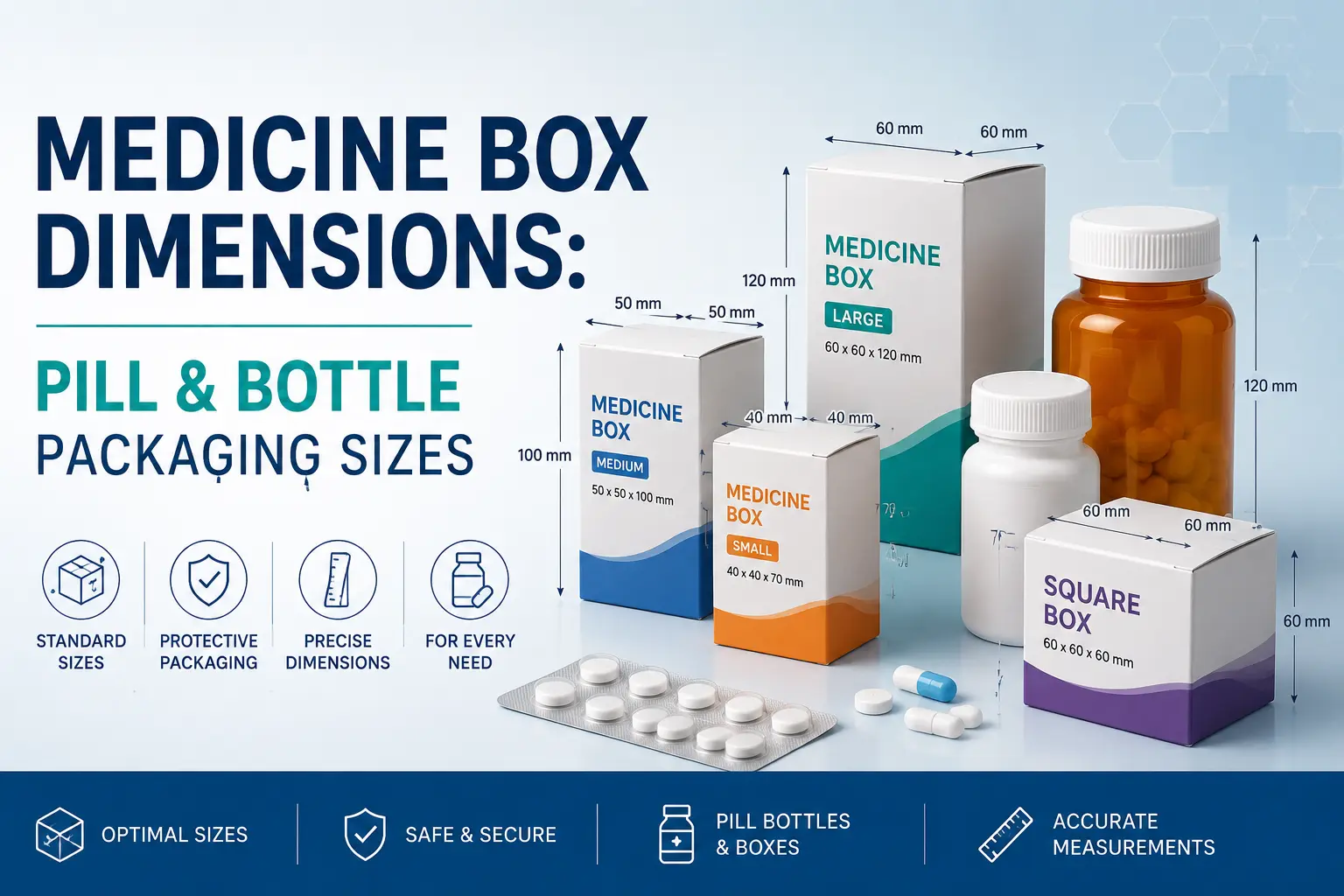
Small Pill/Tablet Boxes
- Length: 2 to 3 inches
- Width: 1 to 1.5 inches
- Height: 3 to 4 inches
These compact sizes are common for small bottles containing 30–60 tablets or capsules.
Medium Pill Bottle Boxes
- Length: 2.5 to 3.5 inches
- Width: 1.5 to 2 inches
- Height: 4 to 5 inches
Great for standard prescription bottles or supplement bottles holding around 60–120 pills.
Large Bottle Boxes (Bulk or Family Size)
- Length: 3.5 to 4.5 inches
- Width: 2 to 3 inches
- Height: 5.5 to 7 inches
Used for larger bottles that hold 200+ tablets or bulk supplement supplies.
Syrup Bottle Boxes
- Length: 2 to 3 inches
- Width: 2 to 3 inches
- Height: 4 to 6 inches (depending on bottle height, often 60ml–200ml capacity)
Blister Pack Cartons
- Length: 3 to 5 inches
- Width: 0.5 to 1 inch (thin profile)
- Height: 2 to 4 inches
These are flat by design since blister sheets don’t need much depth, just enough to hold the sheet flat and secure.
How to Measure Your Product Before Choosing a Box Size
If you already have your pill bottle or medicine container in hand, measuring it correctly will save you a lot of back-and-forth later. Here’s a simple step-by-step approach:
- Measure the bottle’s diameter (the widest circular point) using a ruler or measuring tape.
- Measure the bottle’s height, including the cap.
- Add a small buffer, typically 3 to 5 millimeters on each side, so the bottle isn’t jammed tightly into the box.
- Consider insert material. If you’re using foam inserts, cardboard dividers, or shrink wrap inside the box, factor that extra space into your measurements.
- Think about labeling space. Leave enough flat surface area for your label, barcode, and required medical information.
A helpful trick many packaging designers use is creating a paper mock-up first, folding it around the actual bottle to see how it fits before committing to a final print order. Many packaging companies also offer free 3D digital mock-ups so you can visualize the exact fit before production begins, which is a smart way to avoid costly resizing later. Somewhere in the middle of this process, it’s also worth thinking about protective packaging types like blister packaging, which is widely used for tamper-proof and scratch-resistant medicine packs and can influence the final box dimensions you choose.
Materials That Affect Box Dimensions
The material you choose doesn’t just affect durability. It can also affect the final size of your box, since thicker materials take up more internal space.
- Paperboard (Folding Cartons): Thin, lightweight, and the most common choice for tablet and capsule boxes. Minimal impact on internal dimensions.
- Corrugated Cardboard: Sturdier and used more for bulk shipping boxes rather than retail-facing medicine boxes.
- Rigid Boxes: Thicker walls, often used for premium or luxury health products, which slightly reduces internal space compared to the outer dimensions.
- Eco-Friendly Kraft Board: Increasingly popular for sustainable pharmaceutical brands, with similar thickness to standard paperboard.
Tips for Getting Medicine Box Dimensions Right the First Time
- Always account for tolerance. Printing and die-cutting can shift by a millimeter or two, so a snug-but-not-tight fit avoids problems.
- Don’t forget compliance space. Leave room for dosage charts, warnings, expiry dates, and barcodes required by health regulators.
- Test with a sample before bulk printing. A physical sample helps you catch sizing issues before committing to hundreds or thousands of units.
- Think about shipping efficiency. Boxes that stack well and use minimal excess space reduce shipping costs significantly over large orders.
- Match the box to your brand tier. A premium supplement brand might size its box slightly larger to accommodate soft-touch lamination or foil detailing, while a budget-friendly generic medicine brand may prioritize minimal, cost-efficient sizing.
Final Thoughts
Getting your medicine box dimensions right isn’t just a technical detail. It directly affects product safety, regulatory compliance, shipping costs, and how trustworthy your brand looks on the shelf. Whether you’re packaging small tablet bottles, larger supplement containers, or liquid syrups, the key is to measure carefully, leave a small buffer for comfort, and always account for labeling and compliance space.
If you’re ready to move from planning to production, it’s worth exploring custom sizing options built specifically for your product. You can request a custom size and style suited to your exact bottle or pill container, complete with free design support and a digital mock-up before printing, so you know your medicine box will fit perfectly before it ever goes into production.