

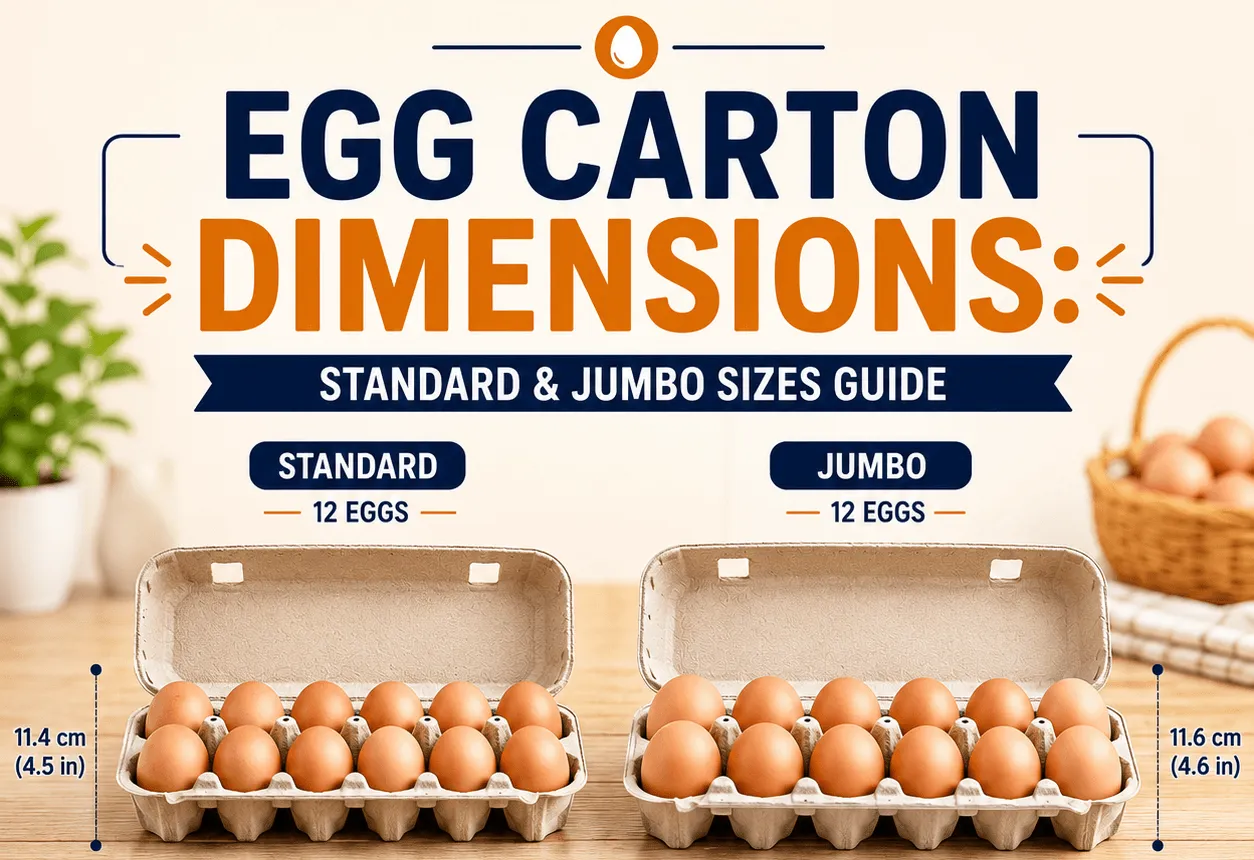
Egg cartons are one of the most engineered pieces of everyday packaging most people never think about. The familiar dimpled shape, the hinged lid, the way eggs sit snugly without touching each other. Every dimension of a standard egg carton was carefully calculated around the physical size of the eggs it holds, the forces it will experience during transport, and the retail shelving systems it needs to fit into.
For egg producers, small farm operators, farmers market sellers, specialty egg businesses, and anyone sourcing egg packaging for chickens, ducks, quail, or other poultry, understanding egg carton dimensions matters more than it might seem. The wrong carton size means eggs that move around and break. A carton that is too small means eggs that crack when the lid closes. A carton that is too large for the retail shelf loses the placement it needs to sell.
This guide covers every standard egg carton size in the US market, from the 6-count half dozen to the 18-count jumbo carton and beyond, explains how egg sizes drive carton dimensions, covers specialty egg carton formats for duck, quail, and jumbo eggs, and provides the practical dimension information that egg producers and packaging buyers actually need. Egg producers and food businesses looking for custom food packaging in any size can explore custom food and beverage packaging from The Pioneer Packaging, which offers full customisation with no minimum order and free USA shipping.
How Egg Sizes Drive Carton Dimensions
Before looking at carton dimensions, it helps to understand how the US egg grading system works and why egg size classifications matter so much for carton selection.
In the United States, egg sizes are not based on the physical dimensions of individual eggs but on the minimum net weight per dozen. The USDA sets these standards under the Agricultural Marketing Act. The six official US egg size grades are as follows.
Peewee eggs weigh a minimum of 15 ounces per dozen. Small eggs weigh a minimum of 18 ounces per dozen. Medium eggs weigh a minimum of 21 ounces per dozen. Large eggs weigh a minimum of 24 ounces per dozen. Extra Large eggs weigh a minimum of 27 ounces per dozen. Jumbo eggs weigh a minimum of 30 ounces per dozen.
The vast majority of eggs sold in US grocery stores are Large, Extra Large, or Jumbo. Most standard egg cartons are designed to hold Large eggs comfortably while also accommodating Medium and Extra Large eggs without issue. The critical dimension for carton fit is egg width, which is the diameter at the widest point of the egg, not egg length. Width determines whether an egg sits securely in the carton cell without being squeezed or wobbling with excessive clearance.
A standard Large chicken egg has an average width of approximately 1.75 to 1.87 inches (44 to 47.5mm) and a length of approximately 2.25 to 2.5 inches (57 to 63.5mm). Jumbo eggs are larger on both dimensions, typically 1.87 to 2 inches (47.5 to 51mm) wide and 2.5 to 2.75 inches (63.5 to 70mm) long.
This width difference is why jumbo eggs sometimes do not fit properly in standard cartons designed for Large eggs. The carton cells are dimensioned for a specific width range, and if the egg is wider than that range, it will not sit properly in the cell and the lid may not close flat.
Standard Egg Carton Count Sizes
Egg cartons in the US market come in several count configurations. The count refers to how many eggs the carton holds, and it determines the overall footprint and length of the carton.
6-Count Egg Carton (Half Dozen)
The 6-count egg carton holds half a dozen eggs arranged in a single row of six cells or two rows of three cells depending on the carton style.
Typical external dimensions for a standard 6-count egg carton holding Large chicken eggs:
Length: approximately 7.5 inches (190.5mm) Width: approximately 4 inches (101.6mm) Height closed: approximately 2.5 to 3 inches (63.5 to 76.2mm)
The 6-count carton is popular for small farm direct sales, farmers market operations, and specialty egg producers where customers prefer a smaller quantity. It is also used for specialty and premium eggs at higher price points where a smaller quantity is appropriate for the retail price of the carton.
The 6-count format is also widely used for non-egg applications. Many craft and baking supply businesses use standard 6-count egg carton dimensions as a reference for packaging small round items, cake pop holders, bath bomb packaging, and small craft kits.
12-Count Egg Carton (One Dozen)
The 12-count or one dozen egg carton is the most widely used egg carton format in the United States. It holds 12 eggs arranged in two rows of six cells.
Typical external dimensions for a standard 12-count egg carton holding Large chicken eggs:
Length: approximately 11.5 to 12 inches (292 to 305mm) Width: approximately 3.5 to 4 inches (89 to 101.6mm) Height closed: approximately 2.5 to 3 inches (63.5 to 76.2mm)
One widely referenced set of dimensions from a major US egg carton supplier lists the carton dimensions as 12 inches long by 4 inches wide, with individual cell dimensions of 1.75 inches wide by 2.75 inches tall. These cell dimensions accommodate Standard to Extra Large chicken eggs comfortably.
The 12-count carton is the standard retail format at virtually every US grocery store, wholesale club, and farmers market. It is the format around which egg retail shelving systems, refrigerator door egg storage, and delivery case configurations are designed.
18-Count Egg Carton
The 18-count egg carton holds one and a half dozen eggs arranged in three rows of six cells or two rows of nine cells depending on the carton style.
Typical external dimensions for a standard 18-count egg carton holding Large chicken eggs:
Length: approximately 13.5 to 14 inches (342.9 to 355.6mm) Width: approximately 4 to 4.5 inches (101.6 to 114.3mm) Height closed: approximately 2.5 to 3 inches (63.5 to 76.2mm)
The 18-count format is popular at warehouse clubs and with value-focused buyers who purchase eggs frequently. It is less commonly available than the 12-count at standard grocery retail but is widely found at Costco, Sam’s Club, and similar warehouse retailers.
The 18-count carton is notably longer than the 12-count and does not fit in standard refrigerator door egg storage designed for the 12-count format. Most buyers store the 18-count carton on a main refrigerator shelf rather than the door.
Standard Egg Carton Dimensions Quick Reference
| Count | Eggs Held | Length (inches) | Width (inches) | Height Closed (inches) |
|---|---|---|---|---|
| 6-count | Half dozen | 7.5 | 4 | 2.5 to 3 |
| 12-count | One dozen | 11.5 to 12 | 3.5 to 4 | 2.5 to 3 |
| 18-count | One and a half dozen | 13.5 to 14 | 4 to 4.5 | 2.5 to 3 |
Jumbo Egg Carton Dimensions
Jumbo eggs are the largest USDA-classified chicken egg size, weighing a minimum of 30 ounces per dozen. Their greater physical dimensions, particularly their width, mean that standard Large-egg carton cells may not accommodate them properly.
A carton designed for standard Large chicken eggs typically has cell dimensions of approximately 1.75 inches wide by 2.75 inches tall. A Jumbo egg with a width of 1.87 to 2 inches and a length of 2.5 to 2.75 inches may fit in the length dimension but can be too wide to sit comfortably in cells designed for Large eggs, causing the lid to dome upward or the eggs to crack against each other.
Jumbo-specific egg cartons use wider cell dimensions to accommodate the greater egg width while maintaining the same overall carton format. Some manufacturers produce a “standard footprint jumbo carton” that uses the same external dimensions as a standard 12-count carton but with reshaped cell geometry to allow jumbo eggs to fit properly without increasing the overall carton size. This is commercially important because a wider carton would not fit standard egg retail shelving systems designed around the standard 12-count footprint.
Typical external dimensions for a 12-count Jumbo egg carton:
Length: approximately 11.5 to 12 inches (292 to 305mm) Width: approximately 4 to 4.25 inches (101.6 to 107.95mm) Height closed: approximately 3 to 3.25 inches (76.2 to 82.55mm)
The height is the most consistently different dimension between a standard and jumbo carton. Because jumbo eggs are taller, the closed carton height increases to prevent the lid from pressing on the tops of the eggs, which would transfer pressure to the shell and increase breakage.
Egg Carton Dimensions for Specialty Egg Types
Beyond standard chicken eggs, specialty poultry operations produce eggs that require completely different carton dimensions. Duck eggs, quail eggs, and turkey eggs all have distinct physical sizes that standard chicken egg cartons cannot properly accommodate.
Duck Egg Carton Dimensions
Duck eggs are noticeably larger than chicken eggs. A standard domestic duck egg (from breeds like Khaki Campbell, Welsh Harlequin, or Indian Runner) is typically 2.25 to 2.5 inches wide and 2.75 to 3.25 inches long. The width is the critical dimension. A duck egg is often wider than a Jumbo chicken egg, which means standard jumbo carton cells are also frequently too narrow.
Duck-specific egg cartons use cell dimensions of approximately 2 inches wide or slightly larger to accommodate the greater duck egg width. The overall carton dimensions are also larger than chicken egg cartons.
Typical external dimensions for a 12-count duck egg carton:
Length: approximately 12 to 13 inches (305 to 330.2mm) Width: approximately 4.5 to 5 inches (114.3 to 127mm) Height closed: approximately 3.25 to 3.5 inches (82.55 to 88.9mm)
Some suppliers produce duck egg cartons in a 6-count configuration as standard, because duck egg buyers often purchase smaller quantities at higher per-egg prices than chicken egg buyers.
Duck egg carton cell dimensions are a frequently misunderstood specification. Many small farm operators purchase standard chicken egg cartons assuming they will work for duck eggs, only to find the eggs do not fit or the lid cannot close. Always verify cell dimensions against your specific egg measurements before ordering cartons in quantity.
Quail Egg Carton Dimensions
Quail eggs are dramatically smaller than chicken eggs. A standard Japanese quail egg is approximately 0.875 to 1 inch (22 to 25.4mm) wide and approximately 1.25 to 1.5 inches (31.75 to 38.1mm) long. Standard chicken egg cartons are completely unsuitable for quail eggs because the cells are far too large and the quail eggs would simply fall through or move around freely.
Quail-specific egg cartons are produced in configurations of 12, 18, 24, and 48 eggs. The cells are substantially smaller than chicken egg carton cells.
Typical quail egg carton cell dimensions: approximately 0.875 to 1 inch wide by 1.5 inches deep.
Typical external dimensions for a 12-count quail egg carton:
Length: approximately 5 to 5.5 inches (127 to 139.7mm) Width: approximately 3 to 3.5 inches (76.2 to 88.9mm) Height closed: approximately 2 to 2.25 inches (50.8 to 57.15mm)
Typical external dimensions for a 24-count quail egg carton:
Length: approximately 6.5 to 7 inches (165.1 to 177.8mm) Width: approximately 3.5 to 4 inches (88.9 to 101.6mm) Height closed: approximately 2 to 2.25 inches (50.8 to 57.15mm)
Turkey Egg Carton Dimensions
Turkey eggs are larger than duck eggs and require appropriately sized cartons. A standard turkey egg is approximately 2.25 to 2.5 inches wide and 3 to 3.5 inches long. Turkey eggs are rarely sold commercially and are typically only available through specialty farm operations, which means specialty turkey egg cartons are less standardised than other formats.
Some specialty poultry supply companies produce dedicated turkey egg cartons in 6-count configurations, given the lower production volumes and higher individual egg prices typical of turkey egg sales.
Typical external dimensions for a 6-count turkey egg carton:
Length: approximately 9 to 10 inches (228.6 to 254mm) Width: approximately 5 to 5.5 inches (127 to 139.7mm) Height closed: approximately 3.5 to 4 inches (88.9 to 101.6mm)
Specialty Egg Carton Sizes by Count
Beyond the standard 6, 12, and 18-count formats, several other count configurations are produced for specific markets and applications.
8-Count Egg Carton
The 8-count carton holds eight eggs arranged in two rows of four. It is less common than the 6 or 12-count formats but is used by some specialty producers and in some European and international markets. In the US it is occasionally used for premium or specialty eggs at higher price points where an 8-egg quantity is commercially appropriate.
Typical external dimensions: approximately 9 to 9.5 inches long by 4 inches wide by 2.75 to 3 inches tall closed.
10-Count Egg Carton
The 10-count carton holds ten eggs in two rows of five. Like the 8-count, it is not a dominant US retail format but is used by some specialty producers and in direct-to-consumer sales channels.
Typical external dimensions: approximately 10.5 to 11 inches long by 4 inches wide by 2.75 to 3 inches tall closed.
15-Count Egg Carton (Egg Flat)
The 15-count flat is a different style from the standard hinged-lid carton. It is a tray-style container holding 15 eggs in three rows of five, open at the top. Egg flats are used in foodservice, restaurant, and bakery applications where eggs are consumed in larger quantities and the individual egg protection of a closed carton is less important.
Typical external dimensions: approximately 11.5 inches long by 7.5 inches wide by 2.75 to 3 inches tall.
30-Count Egg Tray (Flat)
The 30-count flat holds 30 eggs in five rows of six. It is a standard format for farm-level handling and wholesale distribution. Thirty-count flats are used to move eggs from farm to processor, from processor to distributor, and in foodservice operations with high egg usage.
Typical external dimensions: approximately 11.5 to 12 inches long by 11.5 to 12 inches wide by 2.75 to 3 inches tall.
Thirty-count flats are the most commonly used format for non-retail egg handling in the US market. They are made from moulded pulp, plastic, or foam and are designed to stack efficiently on pallets for distribution.
Egg Carton Cell Dimensions: The Critical Measurement
For egg producers selecting cartons, the overall external dimensions of the carton matter less than the cell dimensions. The cell is the individual dimpled pocket that holds each egg. If the cell is too small, the egg cannot sit properly and the lid will not close without cracking the shell. If the cell is too large, the egg moves freely inside the cell and is more susceptible to damage from impact during transport.
Standard chicken egg carton cell dimensions (for Large eggs):
Cell width: approximately 1.75 inches (44.45mm) Cell depth: approximately 2.625 to 2.75 inches (66.67 to 69.85mm)
Jumbo chicken egg carton cell dimensions:
Cell width: approximately 2 inches (50.8mm) Cell depth: approximately 2.75 to 3 inches (69.85 to 76.2mm)
Duck egg carton cell dimensions:
Cell width: approximately 2 to 2.25 inches (50.8 to 57.15mm) Cell depth: approximately 3 to 3.25 inches (76.2 to 82.55mm)
Quail egg carton cell dimensions:
Cell width: approximately 0.875 to 1 inch (22.2 to 25.4mm) Cell depth: approximately 1.5 inches (38.1mm)
To select the correct cell size for your specific eggs, measure your eggs at their widest point. The carton cell should be approximately 0.125 to 0.25 inches larger than the widest egg width measurement, providing enough clearance for the egg to sit properly without excessive movement.
Egg Carton Materials and Their Dimensional Implications
The material an egg carton is made from affects its wall thickness, its overall external dimensions relative to internal cell dimensions, and its performance in different environments.
Moulded Pulp (Paper Pulp)
Moulded pulp is the most widely used material for retail egg cartons in the United States. It is made from recycled paper pulp formed into shape in a mould and dried. Moulded pulp cartons are biodegradable, compostable, recyclable, and made from post-consumer recycled content.
The wall thickness of moulded pulp is typically approximately 3 to 5mm, which is thicker than foam or clear plastic cartons. This adds slightly to the external dimensions relative to the cell dimensions but provides better cushioning and insulation for the eggs.
Moulded pulp cartons are rigid when dry but can lose structural integrity if exposed to moisture or condensation over extended periods. For eggs stored in refrigeration where condensation is common, this is worth considering. Most commercial moulded pulp cartons use a density and composition that resists moderate moisture exposure adequately for normal retail shelf life.
Foam (Expanded Polystyrene)
Foam egg cartons are made from expanded polystyrene, the same material used in foam coffee cups and food trays. Foam cartons are lightweight, excellent insulators, and have good moisture resistance. They were the dominant retail egg carton material in the US for several decades.
Foam carton wall thickness is typically 3 to 4mm, similar to moulded pulp, which means external dimensions are comparable. However, foam cartons are not biodegradable, are difficult to recycle in most municipal programs, and have faced increasing regulatory pressure in many US states. Several states including California, New Jersey, and New York have banned or restricted expanded polystyrene food packaging, which has driven a shift back toward moulded pulp in those markets.
Clear Plastic
Clear plastic egg cartons, made from PET or RPET (recycled PET), allow the eggs to be seen through the carton before purchase. They are popular in premium and specialty egg retail where the visual appearance of the eggs is a selling point.
Clear plastic carton walls are typically 1.5 to 2mm thick, making them thinner than foam or pulp cartons. This means a clear plastic carton with the same internal cell dimensions as a pulp carton will have slightly smaller external dimensions.
RPET cartons are recyclable in most US curbside recycling programs and are made from post-consumer recycled plastic bottles, giving them a more sustainable profile than virgin polystyrene foam.
Egg Carton Dimensions and US Regulatory Requirements
The USDA sets specific requirements for labelling information that must appear on retail egg cartons sold in the United States. These requirements affect how much label space must be available on the carton surface and therefore indirectly affect packaging design considerations.
Required information on US retail egg cartons includes the USDA grade shield and grade designation (Grade AA, A, or B) if the eggs are USDA-graded, the egg size classification (Jumbo, Extra Large, Large, Medium, Small, or Peewee), the net weight or count, safe handling instructions, producer or packer name and address, and the Julian date or pack date.
The Julian date is the three-digit code showing the day of the year the eggs were packed, where January 1 is 001 and December 31 is 365. The Julian date is required on all US commercially sold egg cartons and is typically printed on the short end of the carton.
For small farm and direct-to-consumer egg sales, requirements vary by state but most states require at minimum the producer name and address, the grade designation, the size classification, and a pack date or sell-by date. State agriculture departments are the correct source for specific requirements in each state, as they vary significantly.
For food businesses and producers looking to understand how labelling requirements interact with carton dimension decisions, custom product boxes from The Pioneer Packaging include design support that accounts for required labelling space within your overall packaging design.
How to Measure Your Eggs for the Right Carton
If you are a small farm operator, specialty egg producer, or home flock keeper sourcing egg cartons, the correct way to select a carton is to measure your eggs and compare those measurements against the cell dimensions of the cartons you are considering.
You need two measurements: the width of the egg at its widest point, and the length of the egg from tip to tip. Width is the most important measurement for cell fit. Length matters for whether the egg sits below the closed lid without the lid pressing on the top of the egg.
Measure a sample of your eggs across several flocks or laying cycles, because egg size varies between individual hens, between breeds, and seasonally. Measure the largest eggs you typically collect, not the average, because you need a carton that fits your largest eggs, not just your typical ones.
Compare your egg width measurement to the cell width of the carton you are considering. The carton cell should be approximately 0.125 to 0.25 inches (3 to 6mm) wider than your egg width measurement. This provides enough clearance for the egg to sit properly without excessive movement.
Compare your egg length to the cell depth. The cell depth should be approximately 0.25 to 0.5 inches (6 to 12mm) greater than your egg length to ensure the lid closes flat without pressing on the top of the egg.
If your eggs fall between two standard carton sizes, choose the larger one. A slightly too-large cell is less damaging than a slightly too-small one.
Egg Carton Dimensions for Non-Egg Applications
Egg cartons are used for a surprising variety of non-egg applications, and their dimensions make them useful for a range of packaging and craft purposes.
Bath bombs are a very common non-egg use for egg cartons. A standard bath bomb is typically 2 to 2.5 inches in diameter, which fits comfortably in a standard 12-count Large chicken egg carton cell. Many artisan bath bomb makers use egg cartons for market display, gift packaging, and retail sales.
Small chocolate truffles and confectionery are similarly sized and can be packaged in egg cartons for artisan retail presentation.
Paint-your-own egg craft kits use larger egg cartons with slightly oversized cells to accommodate plastic or ceramic eggs that are larger than standard chicken eggs.
Seedling and plant propagation uses egg carton cells as individual planting containers for seeds and small cuttings. The moulded pulp cartons are particularly useful because they are biodegradable and can be planted directly in the ground.
Jewellery and small accessories can be stored and presented in egg carton cells, which provide individual protection for small items. The 6-count format is particularly useful for this application.
For businesses that need custom packaging for products that happen to match egg carton cell dimensions, the overall carton configuration can be a starting reference point for custom packaging design.
FAQs
What are the standard dimensions of a 12-count egg carton?
A standard 12-count egg carton for Large chicken eggs measures approximately 11.5 to 12 inches long, 3.5 to 4 inches wide, and 2.5 to 3 inches tall when closed. Individual cell dimensions are approximately 1.75 inches wide by 2.625 to 2.75 inches deep.
How big is a Jumbo egg carton compared to a standard egg carton?
A Jumbo egg carton has the same overall length and width as a standard 12-count carton, approximately 11.5 to 12 inches by 4 inches, but is slightly taller when closed, approximately 3 to 3.25 inches compared to 2.5 to 3 inches for a standard carton. The cell dimensions are also wider, approximately 2 inches wide versus 1.75 inches for standard.
Will Jumbo eggs fit in a standard egg carton?
Often not properly. Standard Large egg carton cells are approximately 1.75 inches wide. Jumbo eggs are typically 1.87 to 2 inches wide. This width difference means Jumbo eggs often do not sit correctly in standard cells and the lid may not close flat. Using a carton specifically designed for Jumbo eggs is recommended.
What are the dimensions of a duck egg carton?
A 12-count duck egg carton is typically approximately 12 to 13 inches long, 4.5 to 5 inches wide, and 3.25 to 3.5 inches tall when closed. Cell dimensions are approximately 2 to 2.25 inches wide by 3 to 3.25 inches deep to accommodate the greater size of duck eggs compared to chicken eggs.
What are the dimensions of a quail egg carton?
A 12-count quail egg carton is typically approximately 5 to 5.5 inches long, 3 to 3.5 inches wide, and 2 to 2.25 inches tall. Cell dimensions are approximately 0.875 to 1 inch wide by 1.5 inches deep, reflecting the much smaller size of quail eggs.
What is the difference between an egg carton and an egg flat or tray?
An egg carton is a hinged-lid container typically holding 6, 12, or 18 eggs for retail sale. An egg flat or tray is an open, lidless tray typically holding 30 eggs in a 5×6 grid, used for farm-level handling, wholesale distribution, and foodservice operations rather than retail sale.
What size carton do I need for free-range large eggs?
Free-range Large eggs vary in physical size more than commercially standardised eggs because free-range hens have more variable diets and laying conditions. A standard Large-size carton works for most free-range Large eggs, but if your flock consistently produces eggs at the upper end of the Large size range, a Jumbo-compatible carton is worth considering to ensure proper fit.
Do 18-count egg cartons fit in refrigerator door storage?
No. Standard refrigerator door egg storage is designed around the 12-count carton footprint. An 18-count carton is approximately 13.5 to 14 inches long compared to 11.5 to 12 inches for a 12-count, making it too long for standard door egg storage bins. 18-count cartons should be stored on a main refrigerator shelf.
What material is best for egg cartons?
Moulded pulp is the most widely used and most sustainable material for retail egg cartons. It is biodegradable, compostable, made from recycled paper content, and provides good cushioning. Clear RPET plastic is a good choice where egg visibility matters. Foam (EPS) is being phased out in several US states due to recyclability concerns.
Quick Reference: Egg Carton Dimensions by Type and Count
| Carton Type | Count | Length (in) | Width (in) | Height Closed (in) | Cell Width (in) |
|---|---|---|---|---|---|
| Standard chicken (Large) | 6 | 7.5 | 4 | 2.5 to 3 | 1.75 |
| Standard chicken (Large) | 12 | 11.5 to 12 | 3.5 to 4 | 2.5 to 3 | 1.75 |
| Standard chicken (Large) | 18 | 13.5 to 14 | 4 to 4.5 | 2.5 to 3 | 1.75 |
| Jumbo chicken | 12 | 11.5 to 12 | 4 to 4.25 | 3 to 3.25 | 2 |
| Duck egg | 6 | 8 to 9 | 4.5 to 5 | 3 to 3.5 | 2 to 2.25 |
| Duck egg | 12 | 12 to 13 | 4.5 to 5 | 3.25 to 3.5 | 2 to 2.25 |
| Quail egg | 12 | 5 to 5.5 | 3 to 3.5 | 2 to 2.25 | 0.875 to 1 |
| Quail egg | 24 | 6.5 to 7 | 3.5 to 4 | 2 to 2.25 | 0.875 to 1 |
| Egg flat (open tray) | 30 | 11.5 to 12 | 11.5 to 12 | 2.75 to 3 | 1.75 |
For food businesses, specialty egg producers, and artisan brands looking to price and plan their custom packaging accurately, The Pioneer Packaging’s custom packaging cost calculator provides instant price estimates based on your specific dimensions, material choices, and quantity requirements, with no minimum order and free shipping across the USA.