

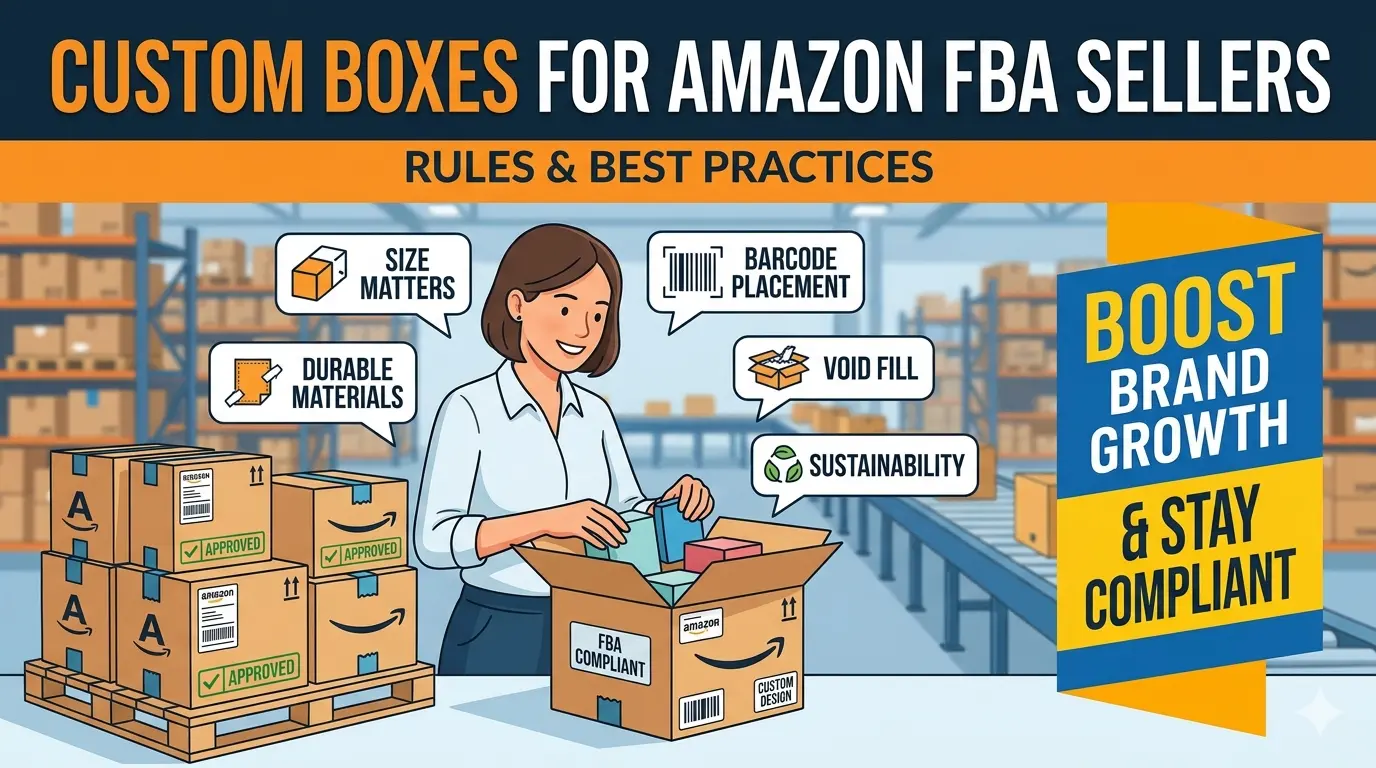
Amazon FBA is fussy about packaging, and your custom boxes will either make check-in easy or get the whole shipment bounced at the dock. Not much in between. The box is branding for an FBA seller, sure, though it’s mostly freight that has to play by Amazon’s rules without eating your margin.
Planning custom boxes for Amazon FBA means keeping the inbound team happy, getting the product there in one piece, and showing as much brand as they’ll let you. Here’s how we’d do it.
Why Packaging Matters So Much for Amazon FBA Sellers
Fulfillment centers are huge and mostly automated. Your box gets scanned, stacked, shelved and sent back out on a conveyor, and it can’t fall apart at any step.
Get it wrong and you’ll see:
- inventory refused or held at the fulfillment center
- higher storage and shipping bills
- crushed products, then bad reviews and returns
Amazon FBA Packaging Rules You Must Follow
Amazon updates its prep rules now and then. The basics stay put though.
1. Box Strength Requirements
Long truck rides, sorting arms, weeks under other cartons. A lot of abuse for a box you designed in an afternoon.
Our Recommendation:
Corrugated, almost always. E-flute for light stuff, B-flute when there’s weight, and our post on single, double and triple wall corrugated covers the rest.
2. Weight Limits for Boxes
Somebody has to lift these.
Roughly How It Works:
- For a standard carton the line is 50 lb, give or take the 22.6 kg you’ll see on the metric side.
- Heavier ones need a “Team Lift” label, sometimes more.
What We’d Do:
Plan the case pack so you land well under. 51 lb means a delay.
3. Proper Label Placement
FNSKU on each unit, the shipment label on the carton, barcodes clean. That’s the job.
Tip:
Leave one plain panel with zero artwork for labels.
4. No Obstructed Barcodes or Branding Confusion
If a scanner can’t read it, a person has to walk over. They don’t love that.
Avoid:
- high gloss on the barcode spot (glare under warehouse lights)
- artwork running under the barcode
- old barcodes still showing
Rule of Thumb:
One side of the carton is for labels. Only labels.
5. Poly Bag and Packaging Safety Rules
Bagging units? Bags with a big enough opening need a printed suffocation warning, have to be sealed, and must meet Amazon’s size and thickness specs (look up your exact bag size).
Best Practices for Custom Amazon FBA Boxes
That’s the rulebook. Now let’s make the box work for your brand too.
1. Use Right-Sized Custom Boxes (Most Important Rule)
Picture a candle shipped in a box twice the size of the jar, paying dimensional weight fees and extra storage, with cracked glass from all that room to bounce around. Bad size, three bills.
Best Practice:
So size it from the product’s real dimensions plus a little padding room. See measuring a box properly.
2. Choose Durable Corrugated Material
Board beats artwork here. Pretty doesn’t help if it’s crushed.
Recommended Materials:
- E-flute for lighter products
- B-flute for more crush strength
- double wall for heavy or fragile stuff (glass, ceramics)
We make custom corrugated shipping boxes in all of these.
3. Keep Exterior Design Amazon-Friendly
Warehouses want to scan fast. That’s all.
Our Advice:
- easy on dark flood ink
- plain barcode zones with nothing reflective nearby
- a logo and one color is plenty outside
4. Focus on Internal Branding Instead of External Overload
Outside is for Amazon. Inside is for your customer, which is where we’d spend the ink: a thank-you on the inner lid, a card with a discount or care tips, a QR code to a how-to video.
Examples:
Printed inner flaps with your brand story are cheap and people actually read them.
5. Design for Automation Handling
Conveyors like boring boxes.
What Survives the Belt:
Plain old rectangles that stack. Flaps that close tight matter more than people think, since one loose flap snagging on a belt is how a box ends up torn open somewhere in Kentucky with your product spilling out.
6. Use Tamper-Evident Packaging for Trust
Buyers get twitchy when a box looks like it’s been opened before, and a twitchy buyer files a “this looked used” refund claim, so we usually suggest a seal or a tear strip (a glued locking flap works too).
Options:
Add tear strips at the dieline stage. Later costs more.
7. Optimize Packaging for Dimensional Weight (DIM)
A light pillow in a big box still pays for the big box (formula’s in how packaging dimensions affect shipping cost).
Where to Trim:
Empty space first, then filler. You’d be surprised how often one inch off the height drops a product into a cheaper fee tier.
8. Standardize Packaging Across Product Lines
If you’ve got eight or ten SKUs and a different box for each, your prep person is going to grab the wrong one sooner or later, whereas a handful of shared sizes keeps things quick and boring.
How We’d Set It Up:
We’d pick two or three modular sizes and fill the gaps with inserts.
9. Add Inserts for Product Protection
Inserts hold things still while the box gets tossed around.
Options:
- cardboard dividers
- foam or molded pulp trays for fragile or pricey items
10. Balance Branding With Compliance
Honestly the outside is where most sellers overspend. Our rule is light branding on the outside and the good stuff inside, with the exterior planned around Amazon’s label rules before anyone opens a design file, and then the customer still gets a nice moment.
Common Mistakes FBA Sellers Should Avoid
- oversized stock boxes “because we had them”
- labels slapped over artwork
- board too thin for the weight
- never test packing a real unit
- forgetting DIM weight until the invoice lands
We’ve seen every one of these. They all cost money.
Final Thoughts
Custom packaging for Amazon FBA sellers flips the usual order. Warehouse first, looks second.
If we had to boil it down, we’d say fit the box to the product, use proper corrugated and not the thin stuff, keep one side clean for labels, put your branding on the inside and watch the DIM weight, and the box ends up paying for itself in returns you never have to deal with.
Build FBA-Ready Custom Packaging That Scales
Here’s how it works with us. Our team draws up the dieline at no charge and you get a digital proof to sign off on, then production takes 10 to 12 business days after approval, and since minimums are low (often around 50 boxes depending on the style) you can try one size on a small FBA shipment before you commit. Start with our custom shipping boxes or ask us for a quote.
Keep Reading
Ready to order? Start with custom mailer boxes and product packaging boxes. For more background, read packaging guide for amazon fba sellers and custom boxes for etsy handmade sellers.