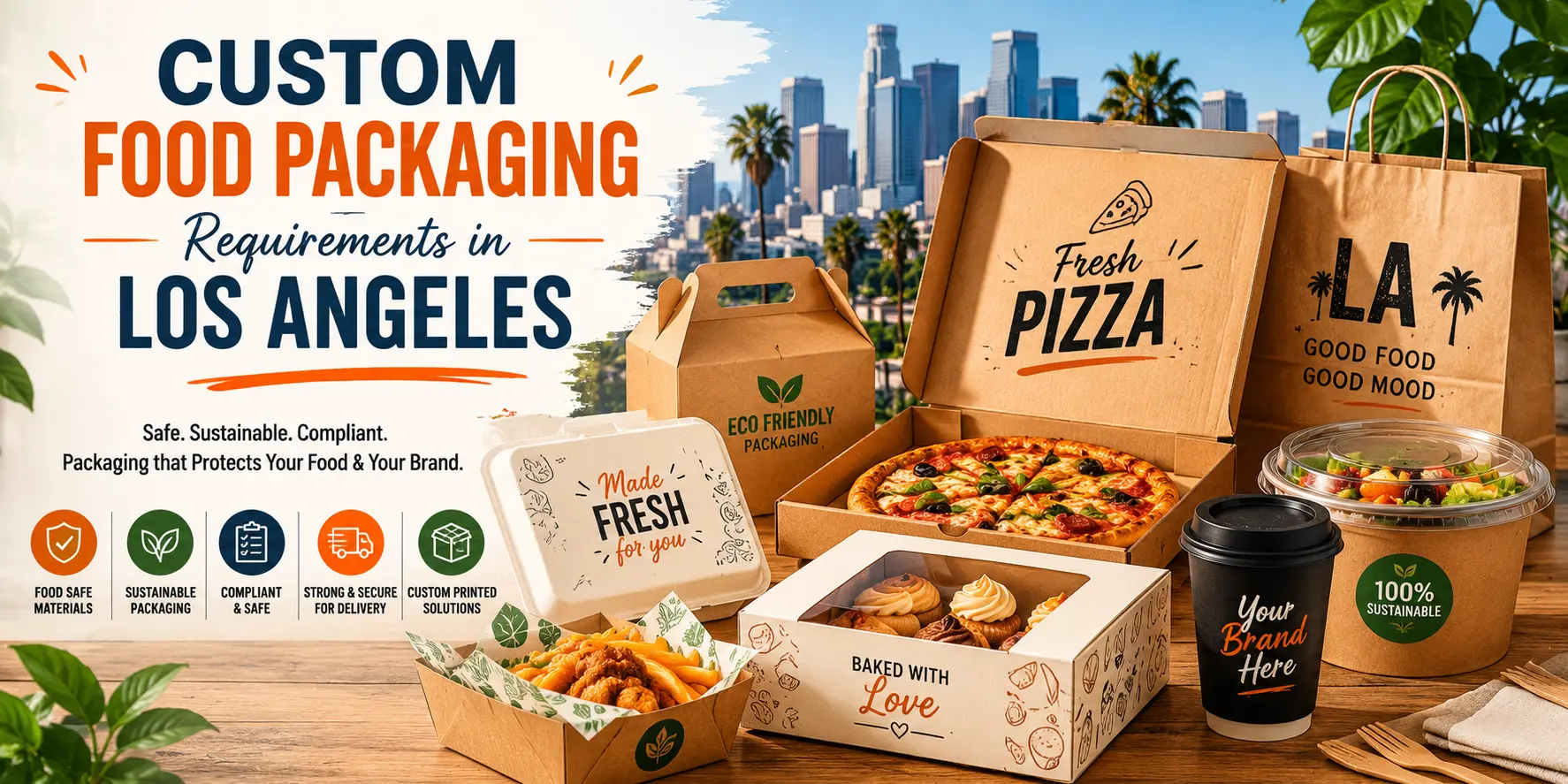
LA eats out a lot. We get calls from a guy with two taco trucks, a meal-prep kitchen near the 10 that does 600 lunches a day, a cookie brand that started in someone’s apartment, and what they all want to know first is pretty much the same, which is what the box legally and practically has to do before they start worrying about the logo. Fair question. Good food packaging keeps food safe and fresh first, looks good second.
Most food owners who look into custom packaging in Los Angeles already get that the box does two jobs. It has to protect the food. And it has to look like a brand people trust, which is a whole other thing.
Understanding Food Packaging Requirements
The short list, as we explain it on the phone: grease stays in, dust stays out, the food is still fresh when it’s eaten, the box makes it through a bumpy delivery ride, and somewhere on it there’s the info people expect, like ingredients and allergens. Oh, and it should look like you.
Frozen dumplings and fresh croissants don’t want the same box. Not even close. When brands order custom boxes in Los Angeles from us, the first questions are about the food. Wet or dry? Hot? How long does it hang around before someone eats it?
Food-Safe Packaging Materials
Rule one. If it touches the food, it has to be made for food contact, and that goes for the board, any coating, and ink on the inside face too.
So when you call a packaging company in Los Angeles, ask them straight out which of their stocks are fine for direct contact and which are only meant for an outer carton, because a lot of folks assume every box is food grade and it isn’t. Kraft board and coated board come up most, then corrugated for outers, and grease-resistant paper or a liner for anything oily.
Burger? Grease barrier, no question. Dry shortbread is easy though, plain kraft does the job.
The Growing Demand for Sustainable Packaging
LA shoppers ask about this constantly. Is it recyclable? Is it plastic? Can I compost it? Food brands hear it at the counter and in reviews, so sustainable packaging has moved way up the list.
A lot of brands ordering custom printed boxes in Los Angeles now go with recyclable board and plain, lighter designs. Sustainable packaging helps with the planet side, sure, but it also wins over the customer who actively looks for brands that bother.
What we see most is kraft packaging with a one or two color print, recyclable containers, and less stuff overall (fewer inserts, no plastic windows unless they’re needed). We print with soy-based and water-based inks, and most of our kraft and corrugated boxes are recyclable.
Packaging for Bakeries and Specialty Food Brands
Bakery stuff is fragile. A macaron that slides across a box is a sad macaron, and frosting that kisses the lid is worse, so with custom bakery packaging we usually add a half inch of headroom and an insert for anything round.
A window helps too, people like to peek. Most bakeries we work with end up with two or three sizes of custom bakery packaging boxes and one design across all of them, which keeps reorders cheap (and the counter looks tidy).
People also come back for a box they liked. We see it every holiday season.
Pizza Packaging Requirements
Pizza is still king for delivery in LA. It goes from a 700 degree oven into a box and then sits in a car for 25 minutes, so the box takes a beating, and if it fails the customer blames the pizzeria, not the box.
Restaurants want custom pizza boxes with vents (so the crust doesn’t steam itself soggy), enough board to hold the heat in, and corners that hold when you stack five boxes on a bike. The lid is also a big flat billboard for your logo and a promo code.
Every pizza that shows up at a door is a little ad. Use it.
Custom Food Boxes for Restaurants and Takeout Services
Delivery apps changed everything here. Restaurants now need custom food boxes that keep the meal together through a bumpy ride and still look decent when the bag gets opened at somebody’s desk.
Leaks are the big one, we hear about leaks more than anything, then soggy fries, then sauce that wandered over into the rice because the box had no divider, and honestly all three are fixable with the right board and a smarter layout.
Restaurants that care about packaging tend to get better reviews. Pretty simple, really.
Shipping Requirements for Packaged Food Products
Online food is its own headache. Your jar of chili crisp spends a July afternoon on a loading dock in Ontario, gets thrown onto a belt, and still has to arrive sealed and unbroken.
Our usual setup is a printed retail box inside corrugated shipping boxes. Why? We’ve watched corrugated packaging take a three foot drop with glass inside and come out fine, and it’s light enough that you’re not paying to ship cardboard.
For an online food brand the shipper basically is the first impression, since it’s what the customer touches first.
Managing Packaging Costs Through Wholesale Solutions
As a food business grows, packaging turns into a real line on the budget. A lot of owners look at wholesale packaging in Los Angeles to bring the cost per unit down without the quality dropping.
Bigger order, cheaper box. If you go through 2,000 clamshell-style takeout boxes a month, ordering a quarter’s worth at once usually beats ordering every two weeks, and you won’t run dry on a Friday night (it’s always a Friday).
Also, same supplier means your red stays the same red. Customers spot it when it doesn’t.
Packaging Trends Shaping the Los Angeles Food Industry
We’re seeing short runs printed nicer than big runs used to be, a lot more kraft, and seasonal sleeves slid over the same base box so a bakery can do a Halloween look without reprinting everything.
Food brands that start selling outside California usually want packaging that works the same everywhere, which is where custom packaging across the USA comes in. Same box in San Diego and in Chicago, same experience for the customer.
Brands that keep tweaking their packaging tend to keep their customers. We see it in reorders.
Final Thoughts
Packaging ends up being one of the bigger calls a food business makes. Safety and the rules come first, sure, but the box is also where your brand lives once the food leaves your kitchen.
Send us the product and a rough count and we’ll suggest a size and a board, that’s the easiest way to start with custom packaging in Los Angeles. Our minimums are low (often around 50 boxes depending on the style). Design help is free, so is ground shipping in the USA.
Frequently Asked Questions
What materials are commonly used for food packaging in Los Angeles?
Food-grade paperboard and kraft for the inner box, corrugated outside, and a grease-resistant liner if it’s oily. It really comes down to the food.
Does food packaging need to be food-safe?
Yes, anything touching the food directly. Not sure about a stock? Ask the supplier, a decent one will tell you right away.
Why is sustainable food packaging important?
Less waste, and a lot of customers now pick brands partly on this. Recyclable kraft is the easy starting point.
Can custom food packaging improve sales?
It can. People remember where the good cookies came from when the name is printed on the lid.
Is wholesale food packaging available for small businesses?
Yep. We take small first orders all the time, so you don’t need a warehouse to get branded boxes.
Keep Reading
Ready to order? Start with custom mailer boxes and product packaging boxes. For more background, read top 5 packaging companies in Los Angeles and custom packaging trends in Los Angeles.