

For bakeries, wholesale suppliers, and packaging buyers ordering in bulk, pallet quantity is not just a logistics detail. It affects freight cost, storage space, and how efficiently a shipment moves from the packaging manufacturer to the bakery floor. Yet most people never see the math behind it until they get a freight quote that is higher than expected or a shipment that takes up more warehouse space than planned.
This guide walks through how pallet quantities are calculated for common bakery box types, what typical counts look like across different box sizes, and what actually determines how many boxes fit on a standard pallet.
The Standard Pallet Size Used in the US
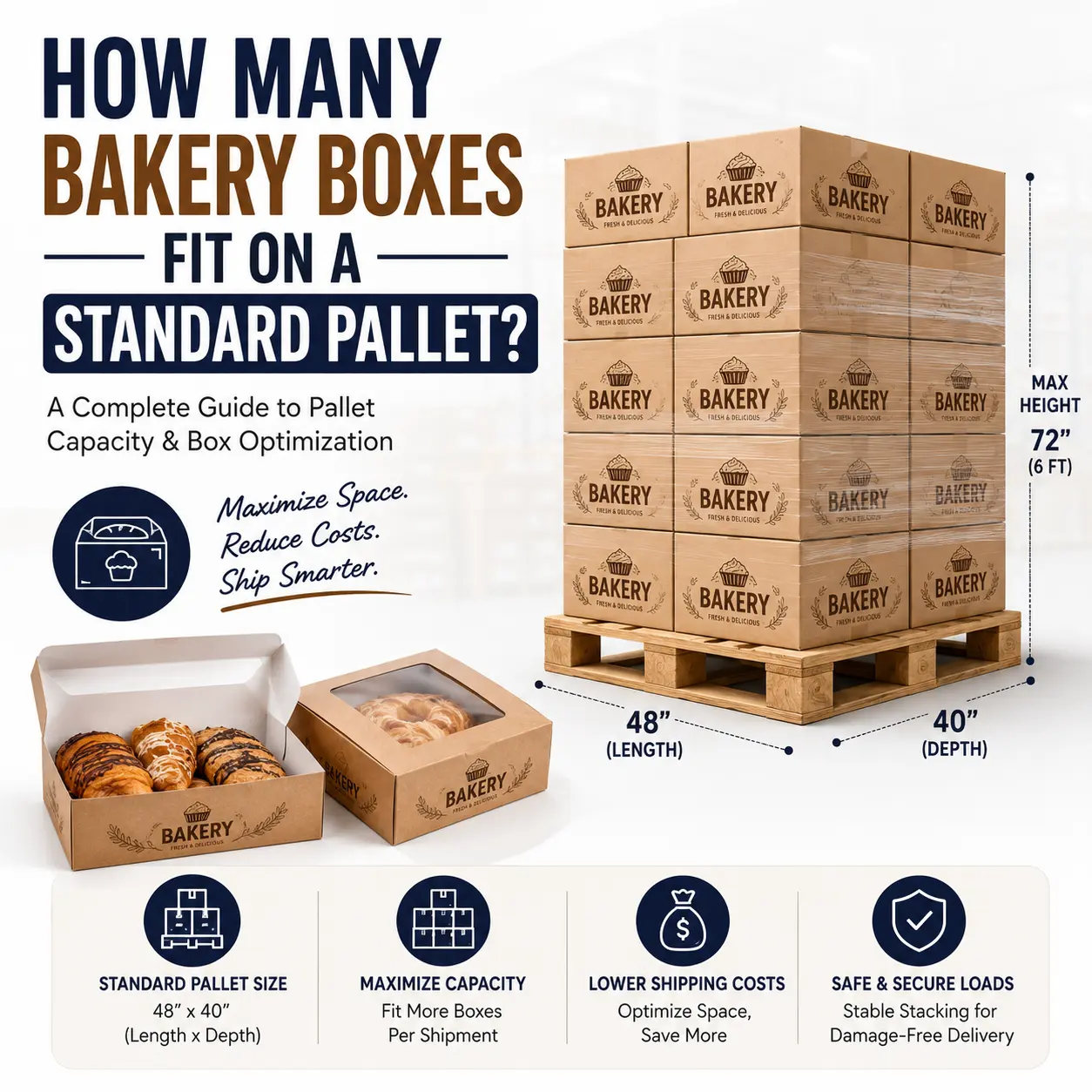
Nearly all bakery box shipments in the United States are built around the standard 48 by 40 inch pallet, commonly called the GMA pallet after the Grocery Manufacturers Association. This size is the default across food, retail, and packaging supply chains because most warehouses, trucks, and racking systems are built to accommodate it.
Pallet height also plays a role in total capacity. Most carriers and warehouses work with a maximum stack height of around 45 to 60 inches for the load itself, not including the pallet base, though this varies by shipping method and whether the load will be stacked with other pallets during transport.
How Pallet Quantity Is Calculated
Pallet quantity comes down to two numbers multiplied together: how many boxes fit in a single layer, and how many layers fit within the maximum stack height.
The layer count depends on the box’s footprint, meaning its length and width, and how efficiently that footprint tessellates across the 48 by 40 inch pallet surface. Boxes that divide evenly into the pallet dimensions waste less space than boxes with odd or non-divisible measurements. This is why many box manufacturers, including us, engineer bakery box dimensions with pallet efficiency in mind rather than picking round numbers arbitrarily.
The layer count within stack height depends on the box’s own height plus, in most cases, a thin layer of slip sheet or cardboard between layers to keep the stack stable during transport. Flat-packed boxes, which ship unassembled, allow far more units per layer than pre-assembled boxes, which is why most bakery box orders ship flat.
Pallet Quantities by Common Bakery Box Type
The table below gives typical pallet quantities for common bakery box formats, assuming boxes ship flat, which is standard for most wholesale bakery packaging orders. These numbers are meant as a planning reference. Actual counts vary based on the specific manufacturer’s dimensions and board thickness.
| Bakery Box Type | Typical Flat Dimensions | Approximate Quantity per Pallet |
|---|---|---|
| Standard Dozen Donut Box | 14.5″ x 11″ x flat | 2,000 to 2,500 units |
| Cookie Box (dozen size) | 9″ x 9″ x flat | 3,000 to 3,500 units |
| Cupcake Box (4-count) | 8″ x 8″ x flat | 3,500 to 4,000 units |
| Cupcake Box (12-count) | 14″ x 10″ x flat | 2,200 to 2,600 units |
| Bakery Pie Box | 10″ x 10″ x flat | 2,500 to 3,000 units |
| Small Pastry Box | 6″ x 6″ x flat | 5,000 to 6,000 units |
| Large Sheet Cake Box | 19″ x 14″ x flat | 1,200 to 1,500 units |
Smaller boxes generally allow significantly more units per pallet, both because more fit in each layer and because flat-packed smaller boxes take up far less stack height per unit than larger formats.
Assembled vs Flat-Packed: Why It Matters So Much
The difference between shipping boxes flat versus pre-assembled is one of the biggest factors in pallet quantity, often more significant than the box’s footprint alone. A flat-packed box collapses down to a thin, nearly two-dimensional shape, which allows hundreds of units to stack within a few inches of height. An assembled box, even a relatively small one, takes up its full three-dimensional volume, which drastically reduces how many fit on a single pallet.
For this reason, almost all wholesale bakery box orders ship flat, with assembly happening at the bakery before use. This is standard practice across the industry and is one of the simplest ways to reduce freight cost per unit, since more product fits into each shipment.
Case Packing and Why It Matters for Pallet Math
Bakery boxes are rarely loaded onto a pallet as loose, individual units. Instead, they are typically bundled into cases or cartons of a set quantity, commonly 50, 100, or 250 units per case depending on box size, and those cases are what actually get stacked and counted toward pallet totals.
Case pack quantity is chosen specifically to produce case dimensions that tessellate well on the pallet footprint, similar to how individual product boxes are engineered to fit shelves efficiently. A case size that leaves significant gaps on the pallet surface wastes both space and freight cost, so manufacturers generally standardize case counts around what fits most efficiently rather than picking a number for convenience alone.
How Box Dimensions Affect Shipping Cost
Because freight for palletized shipments is often priced by dimensional weight rather than actual weight, especially for lightweight, low-density items like flat-packed cardboard boxes, the physical footprint of your box choice has a direct effect on cost per unit shipped. A box designed with pallet efficiency in mind can meaningfully lower per-unit freight cost compared to a box with the same functional capacity but a less efficient footprint.
This is one of the reasons packaging buyers ordering at scale should think about pallet quantity early in the design process rather than after a box design is finalized. A small adjustment to box dimensions, even a fraction of an inch, can change how boxes tessellate across a pallet layer and shift the total units per shipment meaningfully at high volume.
Storage Considerations Beyond Shipping
Pallet quantity also affects how much warehouse or back-of-house storage space a bakery needs to hold its packaging inventory. A bakery working with limited storage may prefer ordering box types with higher pallet density, since this allows more inventory to be held in the same physical footprint, reducing how often reorders are needed.
For seasonal bakeries or those with sharp demand spikes, such as around major holidays, understanding pallet quantities in advance helps with planning how much floor space to allocate for a pre-season packaging order versus relying on smaller, more frequent restocks.
Getting an Accurate Pallet Count for Your Order
Because exact pallet quantities depend on your specific box dimensions, board thickness, and case pack size, the numbers in this guide should be treated as a planning range rather than a precise figure for your order. If you are placing a bulk or wholesale order and need an exact pallet count for freight planning, our team can calculate this directly from your box specifications.
You can request a quote with exact pallet and case pack numbers through our Get a Quote page. If you have not finalized your box style yet, our Bakery Packaging Boxes category page shows the available styles before you move into bulk ordering.
Common Mistakes When Estimating Pallet Quantities
A common mistake is estimating pallet quantity based on assembled box dimensions when the boxes will actually ship flat, which significantly undercounts how many units fit per pallet and can lead to overordering freight capacity. Another frequent issue is not accounting for case packing when calculating totals, since cases add their own dimensional footprint that affects how efficiently the pallet layer tessellates.
Some buyers also assume pallet quantity scales in a straight line with box size, but height, footprint, and whether the box ships flat all interact with each other, so two boxes with similar volume can have meaningfully different pallet counts depending on their proportions.
Frequently Asked Questions
How many donut boxes fit on a standard pallet?
A standard dozen donut box, roughly 14.5 by 11 inches when flat-packed, typically yields around 2,000 to 2,500 units per pallet, though exact counts depend on board thickness and case packing.
Do bakery boxes ship flat or assembled?
The large majority of wholesale bakery box orders ship flat, with assembly happening at the bakery. Flat-packed boxes allow far more units per pallet than pre-assembled boxes.
What is the standard pallet size used for bakery box shipments?
Most bakery box shipments in the United States use the standard 48 by 40 inch GMA pallet, which is the default size across most food and packaging supply chains.
Does box size affect shipping cost beyond just pallet count?
Yes. Because freight for lightweight packaging is often priced by dimensional weight, a more pallet-efficient box design can lower per-unit shipping cost even at the same production volume.
How can I get an exact pallet count for my order?
Exact pallet counts depend on your specific box dimensions and case pack size, so it is best to request a quote directly so the number can be calculated from your actual specifications.