

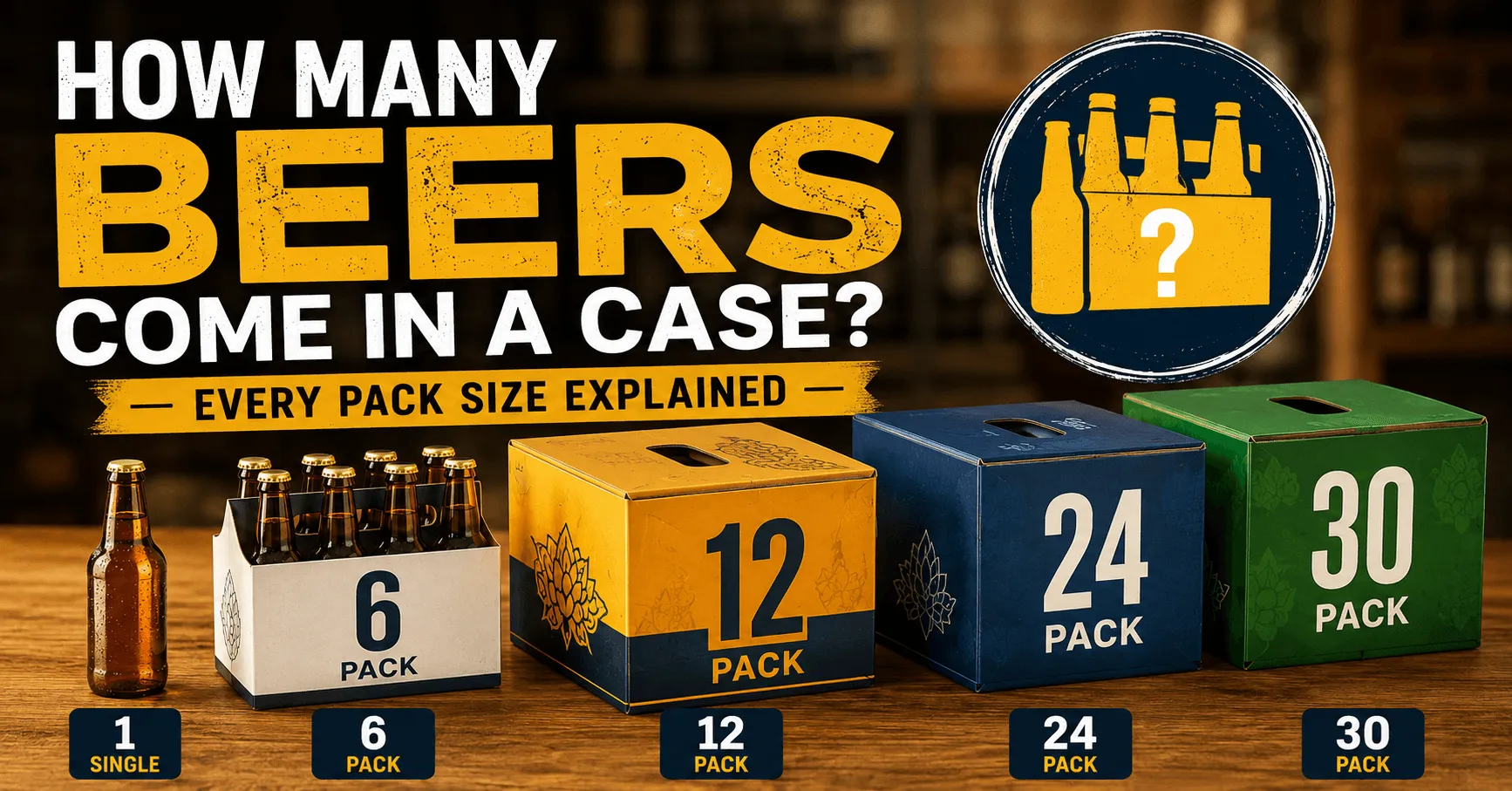
A beer case can hold different numbers of cans or bottles depending on the brewery, container size, retail format, and packaging design.
Common beer pack sizes include 4, 6, 12, and 24 beers. Some breweries also sell 18-packs, 30-packs, variety packs, and other custom configurations.
For breweries and beverage brands, the pack count is more than a number on the box. It affects the box dimensions, total weight, internal arrangement, protection, shipping, and printing area.
Beverage brands and breweries looking for custom packaging for their products can explore custom beer boxes from The Pioneer Packaging.
If you are choosing packaging for a beer brand, understanding the common pack sizes can help you select the right custom beer box.
How Many Beers Are Usually in a Case?
There is no single standard case size for every beer product.
The most common configurations are:
| Pack Size | Common Use |
|---|---|
| 4-pack | Craft beer, specialty releases, premium products |
| 6-pack | Retail beer and craft beer |
| 12-pack | Larger retail packs |
| 18-pack | Family-size or larger retail packs |
| 24-pack | Full cases and distribution |
| 30-pack | Large-volume retail packs |
The right format depends on your product, customers, sales channel, and distribution model.
For example, a craft brewery may prefer a 4-pack or 6-pack to create a premium presentation, while a larger beer brand may use a 12-pack or 24-pack for high-volume retail sales.
What Is the Difference Between a Beer Pack and a Case?
The terms pack and case can be used differently depending on the brewery, distributor, and market.
A pack generally describes the number of individual beers sold together, such as a 4-pack, 6-pack, or 12-pack.
A case can refer to a larger shipping or distribution unit, but the exact quantity is not universal.
For packaging purposes, it is better to specify the exact number of cans or bottles that the box needs to hold.
Instead of simply requesting:
“A beer case box”
provide:
- Container type
- Container dimensions
- Number of containers
- Product weight
- Box style
- Distribution method
This gives the packaging manufacturer enough information to develop the correct structure.
Beer Can Packaging vs. Beer Bottle Packaging
Cans and bottles need different packaging considerations.
Beer Can Boxes
Cans are lightweight and have a cylindrical shape.
Custom can packaging may use:
- Partitions
- Slots
- Paperboard carriers
- Corrugated dividers
- Custom-fit structures
Common can formats include:
- Standard cans
- Tallboy cans
- Slim cans
- Variety packs
- Seasonal releases
The internal dimensions should keep the cans properly positioned without creating unnecessary movement.
Beer Bottle Boxes
Glass bottles are heavier and more fragile than cans.
Bottle packaging may require:
- Corrugated cells
- Dividers
- Partitions
- Protective inserts
- Stronger board construction
Separating bottles can help reduce contact between them during transportation.
For breweries shipping beer, the packaging should be designed around the actual bottle dimensions and distribution conditions.
Why Pack Count Matters When Designing Beer Boxes
The number of beers in the box affects much more than the outside dimensions.
It can change:
Box Weight
More cans or bottles mean a heavier package.
Box Strength
Larger packs may need stronger materials and construction.
Internal Layout
The pack count determines how cans or bottles are arranged.
Carrying
A heavier pack may require a handle or other carrying solution.
Shipping
The overall dimensions and weight can affect transportation and handling.
Retail Presentation
Different pack sizes create different opportunities for branding and product visibility.
That’s why custom beer packaging should be designed around the complete product configuration.
How to Choose the Right Beer Box Size
Don’t choose a beer box based only on the number of products.
Start with the actual container.
Measure:
- Length or diameter
- Height
- Container weight
- Number of containers
- Closure or cap dimensions
- Any unusual bottle shape
Then decide how the products should be arranged inside the box.
For example, two 6-packs can require different packaging if one uses standard cans and the other uses large glass bottles.
Beer Box Dimensions
There is no single universal dimension for a 6-pack, 12-pack, or 24-pack.
The final dimensions depend on:
- Can or bottle size
- Pack count
- Product arrangement
- Internal dividers
- Wall thickness
- Closure style
- Handle design
- Required clearance
A custom packaging supplier can develop the box dimensions from your actual product measurements.
This is usually more reliable than selecting a generic stock box.
Custom Beer Boxes for Breweries
Custom beer boxes allow breweries to create packaging around their exact products.
You can customize:
- Box length
- Box width
- Box height
- Pack count
- Box structure
- Material
- Printing
- Handles
- Dividers
- Inserts
- Finishes
At The Pioneer Packaging, custom beer packaging can be produced for cans, bottles, variety packs, seasonal releases, gift sets, and other beer products.
Custom Beer Boxes With Handles
A handle can make a multi-pack easier to carry.
Handle styles can be incorporated into suitable carton or carrier structures.
Handles are particularly useful for:
- 4-packs
- 6-packs
- Craft beer
- Taproom products
- Promotional releases
The handle design should account for the finished package weight so the box remains comfortable and secure during carrying.
Beer Boxes With Dividers
Dividers can be useful when packaging glass bottles.
A divider creates separate spaces for individual bottles and can help reduce contact during handling.
Depending on the design, you can use:
- Corrugated cells
- Paperboard dividers
- Die-cut partitions
- Custom inserts
The right structure depends on the bottle shape, number of bottles, box material, and transportation requirements.
Custom Printed Beer Boxes
Beer packaging is also a branding surface.
A custom printed beer box can include:
- Brewery logo
- Beer name
- Beer style
- Product artwork
- Brewery story
- Tasting information
- Ingredients
- Barcode
- QR code
- Website
- Social media information
- Required product information
The front of the package can focus on the beer name and brewery branding, while the sides and back can provide additional information.
For regulated alcoholic products, always review final packaging artwork against the applicable labeling and regulatory requirements for your market.
Beer Box Materials
The right material depends on the pack size, product weight, shipping method, and desired presentation.
Paperboard
Paperboard can work well for lighter retail cartons and printed beer packaging.
It provides a smooth surface for detailed artwork and branding.
Kraft
Kraft packaging can provide a natural appearance that works well for craft breweries and brands with a simple visual identity.
Corrugated
Corrugated board provides additional structural strength and can be useful for larger packs, shipping, and bottle packaging.
Rigid Board
Rigid boxes can be used for premium beer gift sets, special releases, collector packaging, and promotional products where presentation is a major priority.
Beer Case Dimensions
The physical dimensions of a standard beer case vary between brands and between can versus bottle formats.
A standard 24-pack of 12-ounce cans is typically arranged in a 4 × 6 grid within a flat rectangular cardboard box. A commonly cited example is the Bud Light 24-pack, which measures approximately 15.96 inches wide by 10.75 inches tall by 4.95 inches deep.
A 30-pack of 12-ounce cans is typically arranged in a 5 × 6 grid within a wider flat cardboard box and measures approximately 19 to 20 inches wide by 5 to 6 inches tall by 10 to 11 inches deep.
A 12-pack of 12-ounce cans is typically approximately 10 to 11 inches wide by 4 to 5 inches tall by 8 to 9 inches deep.
These dimensions affect how cases are stored in refrigerators, displayed on retail shelves, and transported in vehicles. The flat, wide profile of the 30-pack means it fits well in the trunk of a car or on a low shelf but may not fit standing upright in a standard refrigerator door.
For breweries and beverage brands looking at retail display packaging for their cases, tear away display boxes from The Pioneer Packaging convert shipping cases directly into retail display units, eliminating the need for separate display packaging and reducing retail labour costs for store staff.
How Much Do Custom Beer Boxes Cost?
There is no single price for custom beer boxes.
The final cost can depend on:
- Box dimensions
- Pack count
- Material
- Quantity
- Printing
- Box structure
- Dividers
- Handles
- Inserts
- Finishes
- Shipping requirements
A simple printed 4-pack carton can have very different production costs from a heavy-duty 24-bottle shipping box.
For an accurate quote, provide:
- Can or bottle dimensions
- Number of products per box
- Quantity required
- Preferred material
- Box style
- Artwork
- Shipping requirements
This allows the packaging manufacturer to recommend an appropriate structure and prepare a more accurate quote.
Which Beer Pack Size Is Best for Your Brand?
There is no universal best pack size.
Consider your customers and sales channel.
Choose a 4-pack if:
You sell premium, specialty, seasonal, or craft products.
Choose a 6-pack if:
You want a familiar retail format with a manageable package size.
Choose a 12-pack if:
You sell a core beer line for regular retail purchases.
Choose an 18-pack if:
You want a larger quantity without moving to a full 24-pack.
Choose a 24-pack if:
You need a larger retail or distribution format.
Choose a 30-pack if:
You serve customers who prefer high-volume purchases.
The right choice depends on your product, market, distribution, and packaging budget.
Custom Beer Boxes for Different Brewery Needs
Custom packaging can be designed for:
- Craft breweries
- Regional breweries
- Beer distributors
- Taprooms
- Seasonal releases
- Limited-edition beers
- Variety packs
- Brewery gift sets
- Beer subscription services
- Promotional beer products
A small craft brewery may need a custom 4-pack with premium artwork, while a larger brewery may need strong 12- or 24-pack cartons for retail distribution.
The packaging should match the actual business need.
How to Order Custom Beer Boxes
Before requesting a quote, prepare the following information:
1. Container type
Tell the supplier whether you use cans or bottles.
2. Container dimensions
Provide the actual dimensions of the can or bottle.
3. Pack count
Specify whether you need 4, 6, 12, 18, 24, 30, or another quantity.
4. Box style
Tell the supplier whether you prefer a carrier, carton, wraparound box, shipper, gift box, or another structure.
5. Quantity
Provide your expected order quantity.
6. Artwork
Send your logo and packaging artwork if available.
7. Distribution
Explain whether the packaging will be used for retail, taproom sales, local delivery, or shipping.
This information helps the packaging team understand your actual requirements before production.
Frequently Asked Questions
How many beers are usually in a case?
Common beer pack sizes include 4, 6, 12, and 24 beers. Some brands also sell 18- and 30-packs or other configurations.
Is a 12-pack a case of beer?
A 12-pack can be sold as a retail pack, but the word “case” can mean different things depending on the brewery, distributor, and market. Always specify the exact number of cans or bottles when ordering packaging.
Are beer boxes made for cans and bottles?
Yes. Custom packaging can be designed for both cans and bottles, but the internal structure may be different because bottles are heavier and more fragile.
Do beer boxes need dividers?
Dividers are particularly useful for glass bottles because they can separate individual bottles and reduce bottle-to-bottle contact during transportation. They may not be necessary for every can package.
Can I get custom beer boxes with my brewery logo?
Yes. Custom beer packaging can be printed with your brewery logo, artwork, beer name, product information, and other approved packaging details.
Can beer boxes include handles?
Yes. Suitable box structures can include integrated handles or carrying openings, depending on the pack size and weight.
What is the best material for beer boxes?
The best material depends on the product and application. Paperboard can work well for some retail cartons, while corrugated board may be better suited to heavier packs, shipping, or bottle protection.
Can I order custom beer boxes in different pack sizes?
Yes. Custom packaging can be developed for different quantities, including 4-, 6-, 12-, and 24-pack formats.
How much do custom beer boxes cost?
Pricing depends on the box size, material, quantity, structure, printing, inserts, handles, finishes, and shipping requirements.
Final Thoughts
A beer case can contain different numbers of cans or bottles, with 4-, 6-, 12-, and 24-packs among the most common formats.
But choosing a beer box is not only about fitting the right number of products inside. The packaging also needs to account for container size, total weight, internal arrangement, protection, carrying, storage, shipping, and branding.
For breweries, the best approach is to design the packaging around the actual beer container and the way customers receive the product.
The Pioneer Packaging creates custom beer boxes for cans, bottles, multi-packs, variety packs, gift sets, and other brewery packaging needs. You can customize the size, material, structure, printing, dividers, handles, and finishes to fit your product.
Ready to create custom beer packaging? Request a quote with your container dimensions, pack count, quantity, and preferred box style.