

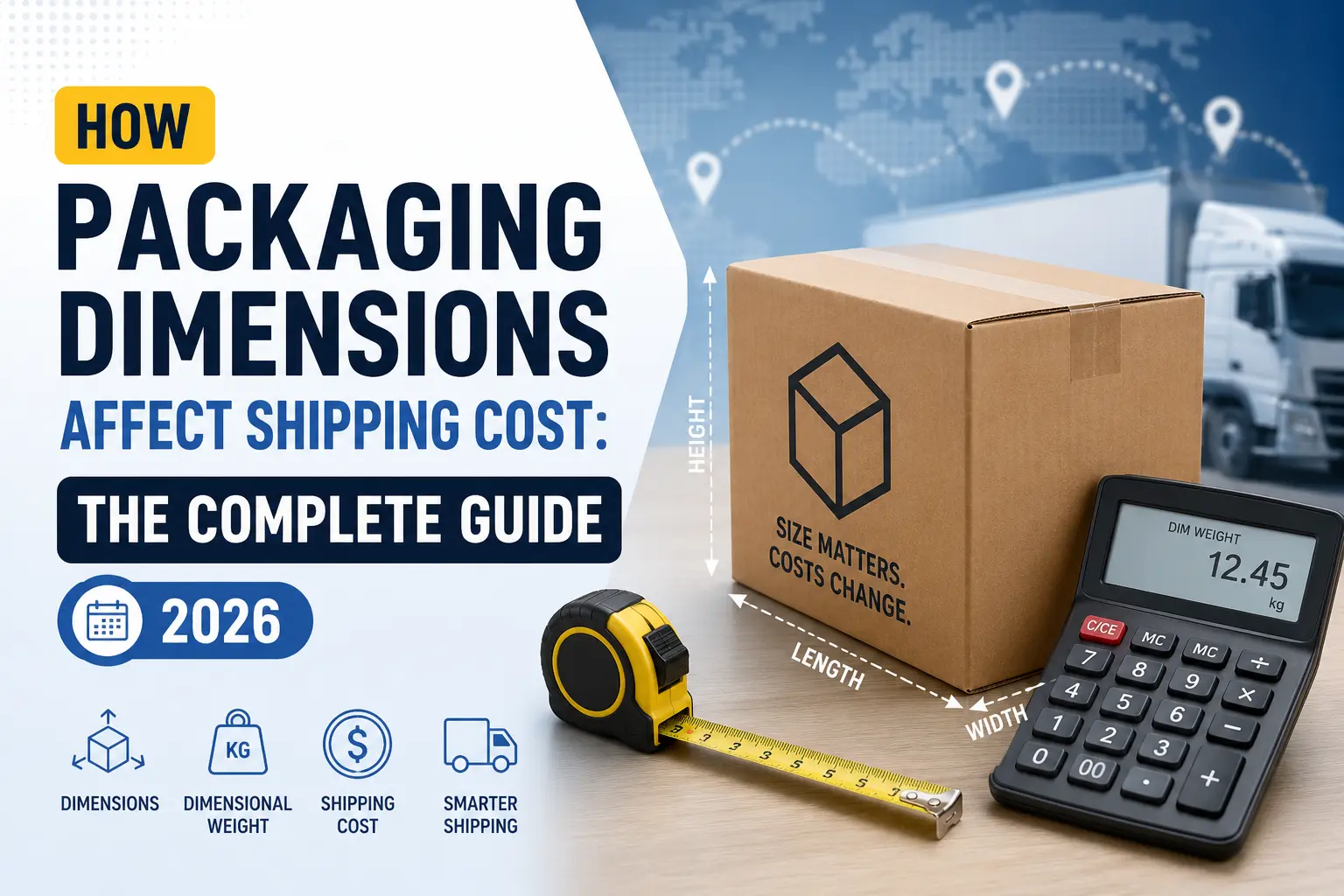
Most businesses focus on product weight when calculating shipping costs. But here’s the reality: the size of your box can cost you more than its weight ever will.
Carriers like FedEx, UPS, and DHL don’t just charge by how heavy your parcel is. They charge by how much space it takes up in their trucks and planes. This concept called dimensional weight pricing, catches thousands of businesses off guard every year, turning seemingly cheap shipments into expensive surprises.
This guide breaks down exactly how packaging dimensions affect what you pay to ship, how to calculate it yourself, and what practical steps you can take to stop paying more than you need to.
Why Packaging Size Matters More Than You Think
Imagine shipping a pillow. It weighs less than a kilogram, but it’s large and bulky. For decades, carriers charged only for weight which meant shipping a big, light item cost almost nothing compared to a small, heavy one. Carriers realized they were filling their vehicles with large, near-weightless packages and losing revenue on every cubic inch of unused capacity.
In response, major carriers shifted to a pricing model that accounts for both weight and volume. Today, if your package is large but light, you’ll be charged as if it weighed more than it actually does.
This affects every business that ships products from e-commerce sellers to manufacturers, from custom box suppliers to pharmaceutical companies. Getting your packaging dimensions right isn’t just about protecting your product; it’s a direct lever on your shipping budget.
What Is Dimensional Weight Pricing?
Dimensional weight (also called DIM weight, volumetric weight, or cubed weight) is a pricing method used by shipping carriers to account for the space a package occupies relative to its actual weight.
The core idea: carriers have limited space in their vehicles and aircraft. A truck filled with large, lightweight boxes is just as full and costs just as much to operate as one filled with heavy packages. Dimensional weight pricing ensures that large-but-light packages contribute appropriately to the carrier’s revenue.
The formula:
Dimensional Weight = (Length × Width × Height) ÷ DIM Divisor
The DIM divisor (also called the DIM factor) is a number set by the carrier. The lower the divisor, the higher the dimensional weight and the more expensive your shipment.
Carriers compare dimensional weight to actual weight and charge whichever is greater. This is called the billable weight.
How to Calculate Dimensional Weight (With Examples)
All measurements should be in the same unit (inches or centimetres) and rounded up to the nearest whole number before calculating.
Formula for Inches (US Carriers)
Dimensional Weight (lbs) = (L × W × H) ÷ 139
Most US domestic carriers, including FedEx and UPS, use a DIM divisor of 139 for domestic shipments (as of 2025–2026).
Formula for Centimetres (International / Metric)
Dimensional Weight (kg) = (L × W × H) ÷ 5,000
Most international carriers and European couriers use a divisor of 5,000 for centimetre-based calculations.
Worked Example 1: Light and Large (DIM Weight Wins)
Package: A box of foam padding Dimensions: 24 in × 18 in × 12 in Actual weight: 3 lbs
DIM weight calculation: 24 × 18 × 12 = 5,184 cubic inches 5,184 ÷ 139 = 37.3 lbs → rounds up to 38 lbs
Billable weight: 38 lbs (not 3 lbs)
You’re being billed for more than 12× the actual weight of the package. This is where businesses bleed money without realising it.
Worked Example 2: Heavy and Dense (Actual Weight Wins)
Package: A box of metal hardware Dimensions: 10 in × 8 in × 6 in Actual weight: 22 lbs
DIM weight calculation: 10 × 8 × 6 = 480 cubic inches 480 ÷ 139 = 3.45 lbs → rounds up to 4 lbs
Billable weight: 22 lbs (actual weight wins)
Here, the package is small and dense. Actual weight governs the cost which is exactly how you want it.
Worked Example 3: The Break-Even Point
The break-even point is when dimensional weight equals actual weight. At this threshold, it doesn’t matter which formula you use, they produce the same billable weight.
For a DIM divisor of 139:
If your package weighs 1 lb per 139 cubic inches, you’re at the break-even point.
Any package with a lower density than this will be charged on dimensional weight. Any denser package will be charged on actual weight.
Actual Weight vs. Dimensional Weight: Which One Do You Pay?
The carrier always charges whichever is greater, actual weight or dimensional weight. This is your billable weight.
| Scenario | Actual Weight | DIM Weight | Billable Weight |
|---|---|---|---|
| Large, light box | 2 lbs | 28 lbs | 28 lbs |
| Small, heavy box | 15 lbs | 4 lbs | 15 lbs |
| Perfectly dense box | 10 lbs | 10 lbs | 10 lbs |
| Medium box, average density | 8 lbs | 6 lbs | 8 lbs |
The practical implication: every unnecessary centimetre of empty space in your box is costing you money. Air inside a box isn’t free to ship.
How Each Major Carrier Handles Dimensional Weight
Different carriers apply dimensional weight differently. Understanding each carrier’s rules is essential for accurate cost estimation.
FedEx
- Domestic (US): DIM divisor of 139 (cubic inches to pounds). Applies to all packages, regardless of size.
- International: Uses a divisor of 5,000 (cm³ to kg) for most international shipments.
- Applies to: All FedEx Ground, Home Delivery, Express, and Freight shipments.
UPS
- Domestic (US): DIM divisor of 139. Applies to all packages.
- International: DIM divisor of 5,000 (cm³ to kg).
- Applies to: All UPS Ground and Air services.
- Note: UPS also applies dimensional weight to packages over a certain size threshold on some services.
USPS (United States Postal Service)
- Priority Mail and Ground Advantage: Dimensional weight applies only to packages measuring more than 1 cubic foot (1,728 cubic inches).
- DIM divisor: 166 for Priority Mail (more favourable than FedEx/UPS).
- First-Class Package Service: No dimensional weight priced on actual weight only (for packages under 16 oz).
- Key advantage: USPS is often the most cost-effective carrier for small, lightweight packages and offers a more generous dimensional weight threshold than commercial carriers.
DHL Express
- International shipments: DIM divisor of 5,000 (cm³ to kg).
- Domestic: Varies by country.
- Dimensional weight applies from the first cubic centimetre.
Amazon Logistics / Fulfilled by Amazon (FBA)
For sellers using Fulfillment by Amazon, Amazon applies its own dimensional weight formula for storage and shipping fees. FBA fees are calculated on unit size tiers based on dimensions and weight combined, which effectively means oversized packaging dramatically increases per-unit fees.
Summary Table: DIM Divisors by Carrier
| Carrier | Domestic DIM Divisor | International DIM Divisor | Threshold |
|---|---|---|---|
| FedEx | 139 (cubic in / lb) | 5,000 (cm³ / kg) | All packages |
| UPS | 139 (cubic in / lb) | 5,000 (cm³ / kg) | All packages |
| USPS | 166 (cubic in / lb) | 5,000 (cm³ / kg) | >1 cubic foot only |
| DHL | Varies | 5,000 (cm³ / kg) | All packages |
How Box Shape Affects Shipping Costs
It’s not just the total volume that matters, the shape of the box determines how efficiently it fits within a carrier’s packaging infrastructure.
Rectangular Boxes (Most Efficient)
Standard rectangular boxes are the most economical shape for shipping. They stack cleanly, utilise trailer space efficiently, and are easy for automated sorting systems to handle. Carrier pricing is designed around the rectangular box as the baseline assumption.
Irregular and Cylindrical Packages
Tubes, cylinders, and irregular shapes are charged on their bounding box, the smallest rectangular box that would fully contain the package. A 60 cm tube shipped horizontally is charged as if it were a 60 × diameter × diameter rectangular box, even though much of that space is air.
This means cylindrical packaging is almost always more expensive per unit of product than an equivalent rectangular box.
Square Boxes vs. Elongated Boxes
Consider two boxes with identical volume of 1,000 cubic inches:
- Box A: 10 in × 10 in × 10 in (cube)
- Box B: 20 in × 10 in × 5 in (elongated)
Both have the same dimensional weight. However, elongated boxes are harder to stack, may trigger oversized surcharges on some carriers, and are more susceptible to damage during transit, leading to higher breakage rates and returns costs. Compact, proportional boxes generally ship more economically.
Oversized Package Surcharges
Carriers apply additional surcharges to packages exceeding certain dimension thresholds, regardless of weight or DIM weight calculations:
FedEx / UPS Oversize Triggers (approximate, 2025–2026):
- Additional Handling Surcharge: Longest side > 48 inches, or second-longest side > 30 inches
- Large Package Surcharge: Length + girth > 130 inches (FedEx) or 165 inches (UPS)
- Over Maximum Limits: Length > 108 inches (FedEx); Length + girth > 165 inches (UPS), these may be refused or incur very large fees
These surcharges can add $30–$150+ per package and are applied on top of dimensional weight charges. Avoiding them through packaging redesign can yield significant savings.
The Hidden Cost of Excess Packaging
When businesses add unnecessary bulk to their packaging like oversized boxes, excess filler, thick polystyrene inserts, they pay for it in three ways:
Direct Shipping Cost Increase
Every unnecessary inch of box adds to the dimensional weight calculation. A product that fits in a 10 × 8 × 6-inch box, shipped in a 14 × 12 × 10-inch box “just to be safe,” produces a dimensional weight nearly 4× higher.
The comparison:
- 10 × 8 × 6 = 480 cubic inches → 3.45 lbs DIM weight
- 14 × 12 × 10 = 1,680 cubic inches → 12.09 lbs DIM weight
If your product weighs 4 lbs, the first box ships at 4 lbs (actual weight governs). The second box ships at 12 lbs (DIM weight governs). At $0.50 per pound, that’s a difference of $4 per shipment. At 1,000 shipments per month, that’s $4,000 in unnecessary spend every single month.
Material and Storage Costs
Larger boxes consume more cardboard, more void fill, more tape, and more warehouse space. These are real, compounding costs that scale directly with order volume.
Returns and Damage Costs
Counter-intuitively, oversized packaging doesn’t always protect better. Products that move around inside oversized boxes are more prone to damage from impact. A well-fitted box with appropriate internal support typically provides better protection than a large box filled with loose void fill.
Packaging Materials and Their Weight Impact
The packaging material itself contributes to actual weight and depending on the product, can shift the billable weight calculation.
| Material | Approx. Weight per Sheet / Unit | Notes |
|---|---|---|
| Single-wall corrugated box (small) | 100–200g | Standard e-commerce shipping box |
| Double-wall corrugated box | 300–500g | Used for heavier or fragile items |
| Polybag / poly mailer (A4 size) | 10–20g | Minimal weight contribution |
| Bubble wrap (per metre) | 40–80g | Adds up quickly for multiple layers |
| Foam insert (custom-cut) | 50–300g | Depends on thickness and density |
| Air pillow fill (per unit) | ~5g | Very light; good for void fill |
| Styrofoam / EPS moulded insert | 100–400g | Heavy relative to protection provided |
| Crinkle paper fill (per handful) | 30–80g | Moderate weight; biodegradable options available |
For lightweight products already near the DIM weight threshold, heavy packaging materials can push actual weight above DIM weight and adding cost unnecessarily.
Rule of thumb: For lightweight products (under 2 lbs), prioritise packaging materials that minimise actual weight. For heavy, dense products, packaging weight matters less because actual weight will govern billing regardless.
Zone-Based Pricing: Why Distance Multiplies Dimensional Costs
Shipping carriers divide geographic areas into zones based on distance from the origin. The further a package travels, the higher the zone number and the higher the cost per billable pound.
In the US, FedEx and UPS use zones 1 through 8, where Zone 2 is a short regional shipment and Zone 8 spans coast to coast.
Why this matters for packaging dimensions:
Dimensional weight creates a cost penalty. Zone pricing multiplies that penalty based on distance. An inefficiently sized box shipping across the country (Zone 8) can cost 3–4× more than the same box shipping regionally (Zone 2).
Example:
A 5 lb actual weight package with a 12 lb DIM weight shipping from New York to California (Zone 8):
- You pay for 12 lbs × Zone 8 rate
- If the Zone 8 rate is $1.20/lb, you pay $14.40
- If the box were optimized to produce a 6 lb DIM weight, you’d pay $7.20 half the cost
- Over 500 monthly shipments to Zone 8, that’s $3,600/month saved by box optimisation alone
This is why high-volume shippers investing in packaging dimension audits consistently find significant savings especially if their products ship nationally or internationally.
How to Optimise Your Packaging Dimensions to Reduce Costs
Optimising packaging dimensions is one of the highest-return activities for any shipping-intensive business. Here’s how to approach it systematically:
Step 1: Audit Your Current Packaging
List every box size you currently use. For each, calculate:
- Actual weight of the packed product
- Dimensional weight of the box
- Billable weight
- Identify where DIM weight is governing, those are your cost reduction opportunities
Step 2: Measure Your Products Accurately
Measure each product (or common product combinations for multi-item orders) at their maximum dimensions. Include any rigid inserts or components that can’t compress.
Step 3: Design the Minimum Viable Box
The ideal box leaves enough clearance for protective packaging (typically 2–5 cm on each side for standard fragile items) but no more. Use the formula:
Ideal box size = Product dimension + (2 × protection clearance) per side
For example, a product measuring 15 × 10 × 8 cm with 2 cm clearance needs a box of approximately 19 × 14 × 12 cm not a standard 30 × 20 × 20 cm generic box.
Step 4: Reduce the Number of Box Sizes
Many businesses use too many different box sizes, some are duplicative, and having too many creates picking errors and inventory complexity. Consolidate to a focused range of sizes that cover your product range efficiently. Typically 4–7 sizes covers most e-commerce product ranges.
Step 5: Consider Adjustable or Scored Boxes
Scored or perforated corrugated boxes can be folded down to different heights, effectively creating one flexible box size that adapts to product dimensions. This reduces excess height, a major source of unnecessary volume.
Step 6: Switch Products to Poly Mailers Where Appropriate
For non-fragile, non-rigid products, clothing, soft goods, flat accessories and poly mailers eliminate box volume entirely. A poly mailer adds minimal weight and takes up almost no dimensional volume, meaning you pay close to actual product weight.
Step 7: Run a Carrier Rate Comparison
Once you’ve optimised your box dimensions, rerun your shipping cost estimates across multiple carriers using the new dimensions. For some package profiles, USPS may now be cheaper (due to its more favourable DIM divisor and thresholds). For others, a regional carrier may offer better rates.
When to Use Poly Mailers vs. Boxes
The choice between a poly mailer and a rigid box is one of the most impactful packaging decisions for shipping cost.
| Situation | Best Choice | Reason |
|---|---|---|
| Clothing, textiles, soft goods | Poly mailer | Negligible DIM weight; product conforms to envelope |
| Books, flat documents | Rigid mailer or padded envelope | Low profile; actual weight governs |
| Electronics with screens | Rigid box with inserts | Protection required; invest in correct box size |
| Jewellery | Small rigid box | Size is small; DIM weight impact minimal |
| Cosmetics (bottles) | Custom-fit rigid box | Fragile; fit tightly to avoid movement |
| Toys / games | Tight-fitting corrugated box | Avoid excessive void fill |
| Supplements / powder products | Poly mailer (pouches) or small box | Dense; actual weight governs |
| Fragile ceramics / glass | Double-wall box with custom inserts | Protection first; optimise insert thickness |
Key principle: If the product is soft and non-fragile, a poly mailer almost always produces lower shipping costs than a box. If the product is rigid or fragile, a box is necessary but make it fit the product.
Packaging Dimension Mistakes That Cost Businesses Money
These are the most common and costly packaging dimension errors seen across e-commerce and manufacturing businesses:
Using one generic box size for everything. A single “safe” large box is applied to all products regardless of size. Result: constant overpayment on DIM weight for smaller items.
Prioritising cheap boxes over correctly sized ones. Bulk-buying large boxes because they’re cheap per unit, without factoring in the DIM weight cost per shipment. The “cheap” box often costs far more in carrier fees than a correctly sized box would.
Not accounting for insert thickness. Adding 5 cm foam inserts to a box that’s already sized for a product creates a box much larger than necessary. Design the insert and the box together.
Ignoring carrier surcharge thresholds. Shipping a 49-inch box when a 47-inch box would work, triggering an Additional Handling Surcharge that wipes out any savings from using fewer materials.
Failing to renegotiate carrier contracts. High-volume shippers can negotiate custom DIM divisors with carriers. A divisor of 200 instead of 139 dramatically lowers dimensional weight charges. Many businesses never ask.
Not reassessing packaging when product lines change. A box that was correctly sized for a product two years ago may be oversized for a new, smaller version of the same product.
Adding excessive void fill instead of resizing the box. Void fill adds weight and takes up space. Resizing the box eliminates the need for fill and reduces DIM weight simultaneously.
Tools and Resources to Calculate Shipping Costs
Several tools can help you calculate dimensional weight and compare carrier rates:
Carrier calculators:
- FedEx Rate Finder (fedex.com/en-us/online/rating.html)
- UPS Calculate Time and Cost (ups.com)
- USPS Postage Price Calculator (postcalc.usps.com)
- DHL Rate Quote (dhl.com)
Third-party shipping rate comparators:
- Shippo – compares rates across multiple carriers in real time
- EasyPost – API-based rate comparison for developers
- Pirateship – specializes in USPS discounted rates for small businesses
- ShipBob – logistics platform with built-in DIM weight optimization
Dimensional weight calculators: Most carrier websites include a DIM weight calculator. You can also calculate manually using the formulas in Section 3 of this guide.
Packaging audit services: Large carriers (FedEx, UPS) offer free packaging consultations for high-volume shippers. These often include a shipment profile analysis that identifies where dimensional weight is adding cost and what packaging changes would reduce it.
FAQs
What is dimensional weight in shipping?
Dimensional weight (DIM weight) is a calculated weight based on a package’s size rather than its actual mass. Carriers charge the greater of actual weight or dimensional weight to account for the space a package occupies in their vehicles.
How do I calculate dimensional weight?
Multiply the length × width × height of your box (in inches), then divide by 139 for US domestic carriers (FedEx, UPS). For international shipments, use centimetres and divide by 5,000 to get kilograms.
Does USPS charge dimensional weight?
Yes, but only for packages over 1 cubic foot (1,728 cubic inches). Below this threshold, USPS charges only actual weight, which makes it a cost-effective choice for small, lightweight packages.
What is the DIM divisor?
The DIM divisor is a number set by each carrier that converts cubic size into a weight equivalent. A higher divisor means a lower dimensional weight which is better for shippers. USPS uses 166, while FedEx and UPS use 139.
Can I negotiate a better DIM divisor with carriers?
Yes. High-volume shippers can often negotiate a custom DIM divisor as part of a carrier contract. Even moving from 139 to 150 can meaningfully reduce shipping costs across large volumes.
What is billable weight?
Billable weight is the greater of actual weight or dimensional weight. It’s the number the carrier uses to calculate your shipping charge.
Does the shape of my box matter for shipping cost?
Yes. Irregular shapes are charged on their bounding box dimensions. Oversized dimensions trigger additional handling and large package surcharges. Compact, proportional rectangular boxes ship most economically.
How much can I save by optimising my packaging?
This varies by business, but companies shipping large numbers of light-to-medium weight products routinely report 10–30% reductions in shipping costs after packaging dimension audits. For businesses with high Zone 7–8 shipment volumes, savings can be even greater.
What is girth in shipping?
Girth is 2 × (width + height). Carriers use length + girth as one of the measurements for oversized package surcharges. It measures how large a package is around its circumference.
Are there minimum size requirements for shipping?
Yes. All major carriers have minimum size requirements. FedEx and UPS require packages to be at least 1 inch in any dimension. USPS has minimum size requirements that vary by service class. Packages below minimum sizes may be refused or require specific packaging.
Summary: Key Principles to Remember
Getting packaging dimensions right is one of the most overlooked and highest-return areas of shipping cost management.
The core principles:
Billable weight = the greater of actual weight or dimensional weight. Always check both before shipping.
Every unnecessary inch of box volume costs money. Size your box to your product, not to a generic “safe” estimate.
Shape matters. Irregular and cylindrical packages are charged on bounding box dimensions. Rectangular is almost always most economical.
Oversized surcharges are binary. Crossing a threshold by one inch costs the same as crossing it by ten inches, so measure carefully.
Zone pricing multiplies every dimensional weight inefficiency. The further your packages travel, the more expensive oversized packaging becomes.
USPS has the most generous DIM rules for small parcels. For packages under 1 cubic foot, USPS charges only actual weight, a major advantage for small, lightweight products.
High-volume shippers should negotiate DIM divisors. Most carriers will negotiate for accounts shipping significant weekly volume.
The businesses that master packaging dimensions don’t just save on shipping, they gain a structural cost advantage that compounds with every order shipped.