

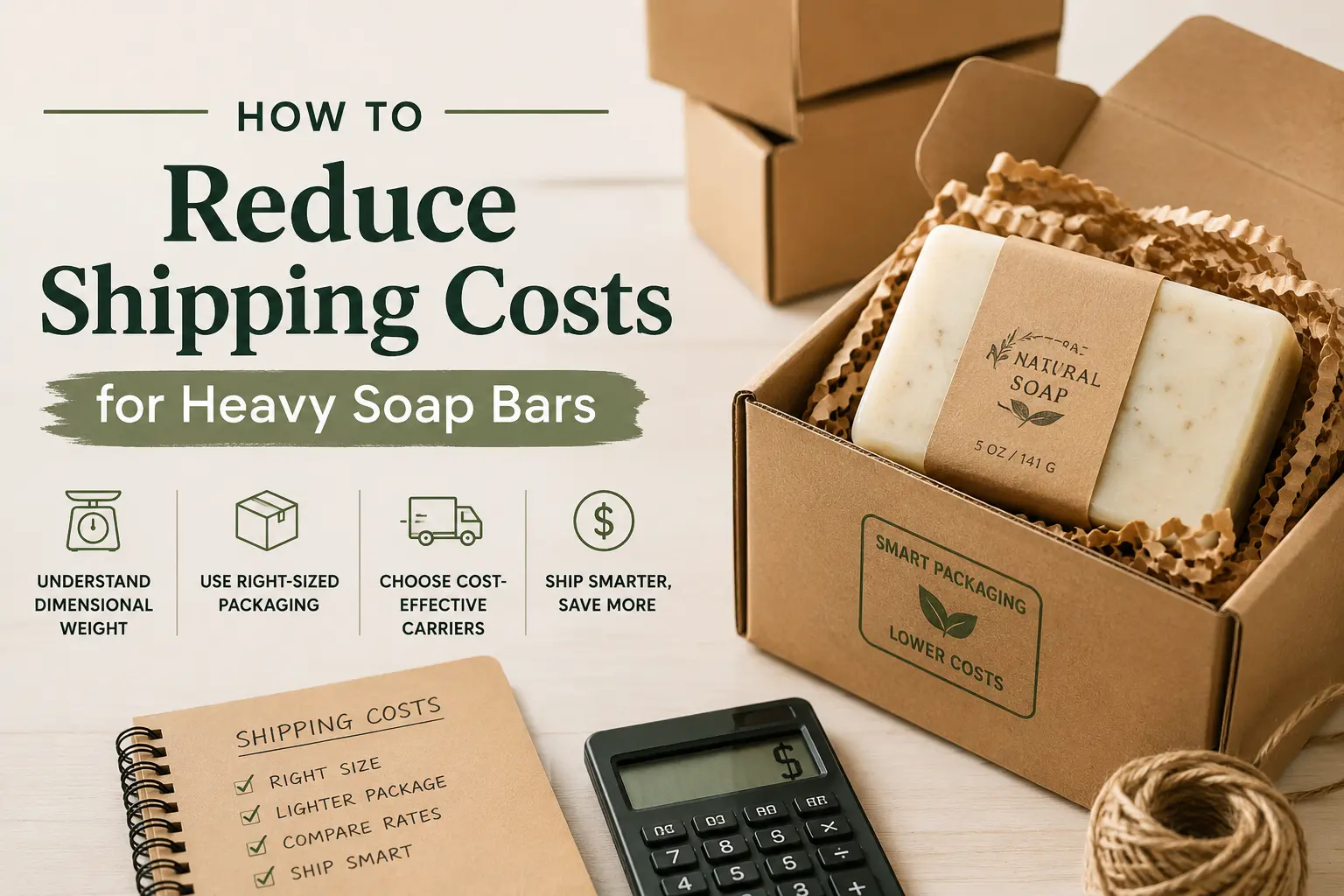
Shipping soap sounds simple. It is a small, solid product with no fragile parts and no hazardous materials. But anyone who has run a soap business for more than a few months knows the uncomfortable truth: soap is heavy, and heavy products can cost a surprising amount to ship.
A single bar of handmade cold process soap typically weighs between 4 and 6 ounces. A three-bar order comes in at roughly 12 to 18 ounces, which is well over a pound by the time you add packaging. A six-bar order can easily weigh 2.5 pounds or more. And unlike light products where dimensional weight is the enemy, with soap the actual weight is the real cost driver. Carriers charge by whichever is higher, actual weight or dimensional weight, and with dense soap bars, actual weight usually wins.
For small soap businesses, shipping often eats 15 to 25 percent of every order’s revenue. That is a significant margin leak that compounds with every sale. The good news is that there are practical, proven strategies to bring that number down without sacrificing product protection or the customer experience.
This guide covers every effective strategy for reducing shipping costs on heavy soap bars, from choosing the right carrier and service to right-sizing your packaging. If you are also looking for luxury soap boxes that are precisely sized to your soap dimensions and reduce unnecessary packaging weight, The Pioneer Packaging offers custom soap packaging with no minimum order and free USA shipping.
Understand Why Soap Ships Expensively
Before looking at solutions, it helps to understand exactly why soap shipping costs add up the way they do.
Soap is dense. A typical 5-ounce bar of cold process soap occupies a relatively small volume but weighs significantly more per cubic inch than most other products shipped by e-commerce brands. This density means that for soap, unlike light products such as clothing or cosmetics, the actual weight of the shipment rather than its size tends to govern the carrier’s pricing.
Soap orders also tend to be multi-bar orders. Most soap customers do not order a single bar. They order three, four, six, or more bars at once, which is part of what makes the soap category appealing for direct-to-consumer selling. But multi-bar orders accumulate weight quickly. A four-bar order at 5 ounces per bar plus 8 ounces of packaging material and outer box is a 1.75-pound shipment. A six-bar order becomes 2.5 pounds or more.
The packaging itself adds weight. Tissue paper, crinkle paper void fill, cardboard boxes, and mailer boxes all add ounces to the total shipment weight. For a product as heavy per unit as soap, every gram of unnecessary packaging material is a direct shipping cost.
Use USPS Priority Mail Cubic for Dense, Heavy Soap Orders
This is the single most effective tip for soap brands shipping in the United States, and it is the strategy that most soap businesses do not know about or are not using.
USPS Priority Mail Cubic is a pricing model that charges based on the dimensions of your package rather than its weight, as long as the package weighs 20 pounds or less. Because soap is dense and heavy relative to its size, most soap shipments have an actual weight that significantly exceeds what you would expect to pay under a dimension-based pricing model.
Here is how it works. USPS divides Priority Mail Cubic into five pricing tiers based on the cubic volume of the package in cubic feet. The tiers are 0.1, 0.2, 0.3, 0.4, and 0.5 cubic feet. You pay a flat rate for each tier regardless of how many pounds are in the package, up to the 20-pound limit.
For a box measuring 6 × 4 × 3 inches, the cubic volume is 72 cubic inches, which converts to 0.042 cubic feet, placing it in the Tier 0.1 category. You pay the Tier 0.1 rate no matter whether the box contains 8 ounces of soap or 20 pounds of soap.
A typical four-bar soap order in a small corrugated mailer box measuring 6 × 4 × 3 inches might weigh 1.5 pounds. Under standard USPS Priority Mail pricing, this might cost $8 to $12 depending on the zone. Under Priority Mail Cubic Tier 0.1, it might cost $8 to $9 regardless of zone. The savings per shipment may seem small but they add up significantly across hundreds of orders per month.
The key to maximising the benefit of Priority Mail Cubic is using the smallest box that safely fits your soap. The smaller the box, the lower the cubic tier, and the lower the flat rate. This is the opposite of many other shipping situations and creates a strong incentive to right-size your soap packaging as tightly as possible.
Priority Mail Cubic is not available directly on the USPS website at standard retail rates. To access it, you need to ship through a third-party shipping platform like Pirateship, Shippo, or ShipStation, which have negotiated access to Priority Mail Cubic pricing. Pirateship in particular is popular with small soap businesses because it offers Priority Mail Cubic at competitive rates with no monthly fees.
Right-Size Your Soap Packaging
The relationship between packaging dimensions and shipping cost is direct and significant for soap brands. Every unnecessary centimetre of box size increases either the dimensional weight cost on services that use DIM pricing or the cubic tier on USPS Priority Mail Cubic.
For most soap orders, the packaging size goal is to find the smallest box that holds the soap securely without the bars moving around during transit. Movement inside the box causes the corners of soap bars to chip and the surfaces to scuff, which generates customer complaints and costly replacements.
A well-fitted soap box leaves approximately 5 to 10mm of clearance on each side between the soap and the box wall. This is enough clearance to insert a thin tissue paper wrap or kraft paper wrap around the bar without creating excessive void space.
For multi-bar orders, using a box sized specifically for the number of bars being shipped rather than a single generic box for all order sizes is more efficient. A two-bar order in a box sized for four bars has unnecessary void space that adds dimensional weight cost and requires additional void fill material, which adds actual weight.
Consider developing a small range of box sizes tailored to your most common order configurations. If most of your orders are one bar, two bars, or four bars, having three box sizes that fit each configuration precisely will reduce shipping costs across your order volume more effectively than using a single large box for every order.
Compare Carriers for Every Weight Bracket
No single carrier is cheapest for every soap shipment. The best carrier and service for a given shipment depends on the weight, dimensions, and destination zone. Soap brands that default to a single carrier for all shipments without comparing rates are almost certainly overpaying on at least some orders.
For most US domestic soap shipments under 2 pounds, USPS tends to be the most cost-effective carrier, particularly with Priority Mail Cubic or USPS Ground Advantage for non-time-sensitive orders.
For shipments between 2 and 5 pounds, USPS Priority Mail Flat Rate boxes can be competitive depending on the destination zone. The USPS Regional Rate Box A, which measures approximately 10 × 7 × 4.75 inches for the top-loading version, is particularly cost-effective for heavier soap orders shipping within short regional distances.
For shipments above 5 pounds, UPS and FedEx become increasingly competitive compared to USPS, particularly for longer-distance zones where USPS rates escalate more steeply. UPS Ground in particular offers competitive rates on heavier packages for zones 2 through 5.
Using a multi-carrier shipping platform like Pirateship, Shippo, or Easyship allows you to compare rates across USPS, UPS, and FedEx for each shipment before purchasing the label, ensuring you always pay the lowest available rate for each specific order.
Use USPS Flat Rate Boxes Strategically
USPS Priority Mail Flat Rate boxes charge a fixed price regardless of weight, as long as the package fits in the box and is under 70 pounds. This makes them excellent for heavy soap orders where the actual weight would otherwise make standard pricing expensive.
The most commonly used Flat Rate boxes for soap are the Small Flat Rate Box at approximately $9.95 to $10.40 (retail rate) or less with discounted commercial pricing, the Medium Flat Rate Box at approximately $15.05 to $16.10, and the Large Flat Rate Box at approximately $21.90 to $22.80.
Flat Rate pricing is most advantageous for heavy orders shipping to distant zones. If you are shipping a 3-pound soap order from California to New York, the Zone 8 distance would make standard pricing expensive, but Flat Rate pricing is the same regardless of distance.
However, Flat Rate is not always the cheapest option. For lighter orders or shorter-distance shipments, Priority Mail Cubic or USPS Ground Advantage may be less expensive. Always compare the Flat Rate option against alternatives before assuming it is the best choice.
One practical consideration: USPS provides Flat Rate boxes free of charge at any post office or through free delivery from usps.com. For soap brands that want to avoid the cost of purchasing custom boxes for every order, Flat Rate boxes eliminate the box cost entirely. The trade-off is that you cannot brand the exterior of a Flat Rate box beyond a shipping label, which may matter for brands where the unboxing experience is part of the brand identity.
Reduce Packaging Weight Without Reducing Protection
Every ounce of packaging material you can eliminate from a soap shipment without compromising protection is an ounce you are not paying to ship. Packaging weight reduction is one of the most overlooked strategies for reducing shipping costs on heavy products.
The most common sources of unnecessary packaging weight in soap shipping are oversized outer boxes that require excessive void fill, heavy rigid boxes where a lighter corrugated alternative would provide equivalent protection, and excessive tissue paper or crinkle paper used to fill void space that a better-fitted box would eliminate.
For most soap bars, a single layer of lightweight tissue paper or kraft paper wrap around each bar provides adequate surface protection against scuffing during transit. Multiple layers of tissue or thick crinkle paper add weight without meaningfully improving protection for a product as robust as soap.
Using a corrugated cardboard mailer box rather than a rigid chipboard box for shipping reduces the weight of the packaging unit. Corrugated provides excellent crush resistance and impact protection for shipping, while rigid boxes are designed for retail presentation rather than shipping performance. For orders where the retail presentation box is important to the brand, consider using a lightweight fitted soap box inside a corrugated outer shipping box rather than using a heavy rigid box as both the retail presentation and the shipping container.
For soap brands using custom product boxes from The Pioneer Packaging, choosing the right board weight for your specific soap weight and order configuration can meaningfully reduce packaging material weight while maintaining full protection. The Pioneer Packaging offers custom soap boxes in lightweight paperboard grades suitable for retail display and in corrugated grades for direct shipping applications.
Encourage Multi-Bar Orders to Improve Shipping Efficiency
The shipping cost per bar of soap decreases significantly as the number of bars in a single order increases. A one-bar order might cost $8 to ship while a four-bar order might cost $10, meaning the four-bar order costs $2.50 per bar in shipping compared to $8 per bar for the single-bar order.
This shipping economics structure is a strong argument for encouraging customers to order multiple bars per transaction. Strategies that soap brands use effectively to do this include offering free shipping above a minimum order value, which incentivises customers to add bars to reach the threshold. Offering a small per-bar discount for orders of three or more bars makes the bundle economics transparent to the customer. Curating themed gift sets of three or four bars packaged together in a single gift box presents multi-bar purchasing as a natural choice rather than requiring the customer to actively decide to add items.
The free shipping threshold strategy is particularly effective when the threshold is set slightly above your average single-bar order value, nudging customers who were going to buy one or two bars to add one more to qualify. Research on e-commerce customer behaviour consistently shows that free shipping thresholds increase average order value and that customers will often pay more total for the same product when shipping appears free versus paying a lower product price plus visible shipping.
Choose Packaging Materials That Protect Without Excess Weight
The choice of protective material inside a soap shipping box affects both the quality of protection and the weight of the shipment. Not all protective materials offer the same weight-to-protection ratio.
Crinkle paper is a popular void fill for soap brands because of its attractive appearance and natural aesthetic, but it is relatively heavy per unit of void filling capacity compared to air-based alternatives. A handful of crinkle paper filling a cubic inch of void space weighs several times more than an air pillow filling the same space.
Air pillows are the lightest void fill option available. They weigh almost nothing individually and provide excellent cushioning against impact. They are less aesthetically appealing than crinkle paper or tissue paper for brands focused on the unboxing experience, but for orders where shipping cost reduction is the priority, air pillows deliver significant weight savings.
Biodegradable packing peanuts, particularly those made from cornstarch rather than polystyrene, offer a good combination of lightweight void fill and environmental credentials. They are slightly heavier than air pillows but lighter than crinkle paper.
For soap-to-soap protection in multi-bar orders, thin kraft paper sheets placed between bars prevent surface contact without adding meaningful weight. A single sheet of lightweight kraft paper weighs a fraction of the crinkle paper or bubble wrap that brands often use for the same purpose.
Negotiate Carrier Rates Based on Volume
Every major carrier offers discounted rates for businesses that ship consistent volumes. The discount thresholds and the process for accessing them vary by carrier, but the savings can be substantial for growing soap brands.
UPS and FedEx both offer negotiated rate programmes accessible to businesses shipping as few as 25 to 50 packages per week. The typical discount range for small businesses negotiating directly is 10 to 25 percent off standard rates depending on volume and the specific services used.
USPS Commercial Plus pricing, accessible through shipping platforms like Pirateship, already provides discounts of 30 to 40 percent below retail USPS rates for small businesses without any formal negotiation. This is one reason why USPS is typically the first carrier choice for small soap brands before they reach the volumes needed to negotiate meaningfully with UPS or FedEx.
To prepare for carrier rate negotiations, compile six to twelve months of shipping data including your total shipment volume, average package weight, average package dimensions, and the distribution of destination zones. This data demonstrates consistent shipping activity and allows you to make a specific case for the rate discount you are seeking.
Consider Using Poly Mailers for Single Soap Bar Orders
For soap brands that receive a significant volume of single-bar orders, poly mailers are worth serious consideration as a shipping format. A poly mailer adds almost no dimensional weight and weighs a fraction of an ounce itself, compared to a corrugated cardboard box that weighs several ounces.
A single bar of soap in a retail tuck end box, wrapped in tissue, and placed in a poly mailer with a rigid mailer insert for protection creates a total package weight close to the soap’s own weight. The same soap in a corrugated cardboard mailer box might add 6 to 8 ounces of packaging weight.
The trade-off is protection. Poly mailers provide no crush protection and minimal impact resistance compared to a corrugated box. For soap bars, which are dense solids unlikely to be crushed but susceptible to surface damage if the mailer is compressed against a sharp surface during sorting, this trade-off is worth evaluating.
For brands using this approach, the soap should be in a rigid retail box inside the mailer rather than in the mailer directly, and the retail box should be wrapped in bubble wrap or similar cushioning to protect the corners during sorting. This combination keeps total package weight low while providing adequate protection for most postal journey conditions.
Build Shipping Cost Into Your Pricing Strategy
One of the most effective ways to reduce the perceived and actual burden of soap shipping costs is to incorporate shipping into your product pricing from the start. This is the strategy used by the largest e-commerce retailers and is increasingly expected by online shoppers.
Research consistently shows that customers who see a product listed at a higher price with free shipping convert at higher rates and abandon carts less frequently than customers who see a lower product price plus a visible shipping charge at checkout. The shipping charge at checkout triggers a psychological resistance that free shipping eliminates.
For soap brands, the calculation is straightforward. If your average order ships for $9 and your average order contains three bars at $8 each for a $24 order, you could reprice to $11 per bar for a $33 order with free shipping. Many customers will prefer the higher-price free-shipping option even though they are paying more in total.
The minimum order for free shipping approach is an alternative that works well for brands that do not want to raise prices universally. Setting a free shipping threshold at two or three times your single-bar price creates an incentive for customers to add bars, increasing average order value and reducing shipping cost per bar simultaneously.
Audit Your Shipping Invoices Regularly
Carrier billing errors are more common than most businesses realise. Address correction charges, incorrect zone billing, duplicate charges, and applied surcharges that do not apply to your shipment type all appear on carrier invoices and go unnoticed by most small businesses.
For soap brands using UPS or FedEx at meaningful volumes, auditing your shipping invoices monthly against the charges you expect to pay can identify recoverable billing errors. Carriers provide credits for confirmed billing errors when they are reported within the claim window, typically 30 to 60 days from the invoice date.
Several third-party shipping audit services will audit your carrier invoices on a contingency basis, charging a percentage of the refunds they recover on your behalf. For brands shipping more than 100 packages per month, a shipping audit service typically pays for itself many times over in recovered billing errors.
USPS billing errors are less common than UPS or FedEx errors but can still occur, particularly around dimensional weight calculations and surcharge applications. If your shipping platform shows a different rate than what was billed, it is worth investigating.
Offer Local Pickup for Nearby Customers
For soap brands that sell at farmers markets, craft fairs, or through a local retail presence, offering local pickup to customers in your immediate area eliminates shipping costs entirely for those orders.
A local pickup option in your online store allows customers who are geographically near your fulfilment location to select pickup rather than shipping, paying only for the product itself. This is zero shipping cost for you and zero shipping charge for them.
Even a small percentage of orders converting from shipped to local pickup creates a meaningful saving across a month of orders. If five percent of your orders convert to local pickup at an average shipping cost of $9, and you process 200 orders per month, that five percent saves you $90 per month or $1,080 per year with no change to any other part of your operation.
FAQs
What is the cheapest way to ship soap bars? USPS Priority Mail Cubic is typically the cheapest option for most soap orders under 20 pounds when shipped through a discount platform like Pirateship. It charges based on box dimensions rather than weight, which benefits dense products like soap. For heavier multi-bar orders, USPS Priority Mail Flat Rate boxes can also be cost-effective, particularly for longer-distance zones.
How much does it cost to ship a bar of soap? Shipping a single bar of soap domestically in the US typically costs between $5 and $12 depending on the carrier, service, destination zone, and packaging. A small corrugated mailer containing one bar weighing approximately 8 ounces shipped via USPS Ground Advantage costs approximately $5 to $8 to most US zones.
Does soap count as a heavy item for shipping? Soap is denser than most e-commerce products of comparable size, so multi-bar orders can accumulate significant weight. A six-bar order can weigh 2.5 pounds or more, which is considered a moderately heavy small package. Unlike very large or bulky products, soap typically stays within weight ranges where dimensional weight does not govern pricing, meaning actual weight is the primary cost driver.
Is USPS or UPS cheaper for shipping soap? For most soap orders under 2 pounds shipping domestically, USPS is typically cheaper, especially with Priority Mail Cubic or Ground Advantage accessed through a discount platform. For heavier orders above 3 to 5 pounds, UPS Ground becomes increasingly competitive, particularly for shorter-distance zones. Always compare rates across both carriers for your specific weight, dimensions, and destination before purchasing a label.
What box size is best for shipping soap to reduce costs? The smallest box that holds your soap securely is the best size for cost reduction. For a single bar, a box approximately 4.5 × 3.5 × 1.5 inches internal dimensions works well. For three bars, approximately 5.5 × 3.5 × 1.5 inches. For six bars, approximately 9 × 3.5 × 1.5 inches arranged in a row or approximately 6 × 5 × 1.5 inches in a 2 × 3 arrangement. Smaller boxes achieve lower cubic tiers on USPS Priority Mail Cubic.
Should I offer free shipping on my soap orders? Free shipping, funded by incorporating shipping cost into product pricing, typically increases conversion rates and reduces cart abandonment compared to showing a shipping charge at checkout. If your margins allow it, free shipping above a minimum order threshold is a particularly effective strategy for soap brands because it incentivises multi-bar orders that reduce your shipping cost per bar.
How do I access USPS Priority Mail Cubic pricing? Priority Mail Cubic is not available at post office counter rates. It is accessible through third-party shipping platforms that have negotiated commercial rates with USPS. Pirateship is the most popular option for small soap businesses. Shippo and ShipStation also provide access. These platforms typically offer Priority Mail Cubic at rates significantly below what you would pay at a post office counter.
What packaging reduces shipping weight for soap? Using lightweight paperboard boxes rather than heavy rigid chipboard boxes reduces packaging weight. Replacing crinkle paper void fill with air pillows reduces fill weight. Right-sizing your box to eliminate excessive void space eliminates both void fill weight and dimensional size. A well-fitted soap box in lightweight corrugated or paperboard with minimal tissue paper wrap is the lightest practical protective configuration for most soap orders.
The Bottom Line
Shipping costs for heavy soap bars are one of the most controllable cost variables in a soap business. The strategies that make the biggest difference are using USPS Priority Mail Cubic through a discount platform, right-sizing your packaging to the smallest safe dimensions for each order configuration, comparing carrier rates for every shipment rather than defaulting to a single carrier, and structuring your pricing and minimum order incentives to encourage multi-bar orders that reduce the per-bar shipping cost.
Packaging plays a central role in the cost equation. A precisely fitted soap box eliminates void fill, reduces dimensional size, and presents your product professionally, all at the same time. For soap brands ready to reduce their packaging footprint and improve their unboxing experience simultaneously, custom soap packaging from The Pioneer Packaging is available in custom dimensions sized to your exact soap bars, with full printing customisation, low minimums, and free USA shipping that keeps your packaging costs as predictable as possible.