Grab any pill bottle box off a pharmacy shelf and you’ll notice it just sort of fits your hand, and it sits there in a row with a hundred other brands without poking out or leaning over. Somebody planned that. Before the first sheet went through the press, they worked out the medicine box dimensions around the bottle, the label text and the shelf.
We make custom medicine boxes and vial boxes sized to your bottle, with space left for dosage and warnings.
Pharma brand, supplement company, somebody launching a new health product out of a garage in Boulder? Sizing is one of the first things to nail down. Too big and you’re paying to ship cardboard and air, and too small means the bottle won’t go in, or it goes in so tight the flaps bow out, which is a lousy thing to discover once 5,000 boxes are sitting in your hallway.
So below we go through medicine box sizes the way we’d explain them at the counter, covering pill bottles, tablet cartons, syrup boxes and a few others. If you’d like to see real shapes first, our custom pharmaceutical packaging boxes page has the common styles.
Why Medicine Box Dimensions Actually Matter
A quick word on why, then numbers.
1. Product Safety Tablets chip. Put a syrup bottle in a box maybe half an inch too roomy and send it down I-70, and there’s a fair chance the cap works itself loose on the way, sticky everywhere.
2. Room for Required Information Ever tried fitting dosage, batch, expiry, a barcode and three warnings onto a panel the size of a stick of gum? Your logo ends up the size of a pea. Leave room.
3. Shelf Presentation Shelf space at a pharmacy is tight, like, really tight. A sensibly sized box stands straight and faces forward and takes only the room it needs, which store buyers like.
4. Shipping Costs Oversized cartons mean more board and more truck space, and across a full pallet you will see it on the freight bill.
5. Brand Trust A snug, solid box reads as “careful company.” A rattly one makes people wonder, fair or not.
Common Types of Medicine Packaging
“Medicine box” actually means a handful of formats, each sized its own way.
1. Pill and Tablet Boxes
The little rectangular cartons you’ve seen a thousand times, holding a bottle or a couple of blister strips.
2. Bottle Boxes
Made around a round bottle (pills or liquid) so it stays standing and can’t roll.
3. Syrup and Liquid Medicine Boxes
These run taller and slimmer, for cough syrup, drops, that kind of thing, and we nearly always add a fitted insert because a dropped glass bottle with nothing around it is a sticky disaster.
4. Blister Pack Cartons
Flat and thin. Your average box of ibuprofen.
5. Ampoule and Vial Boxes
Each vial gets its own little slot. Glass touching glass is how you lose a batch.
Standard Medicine Box Dimensions (General Guidelines)
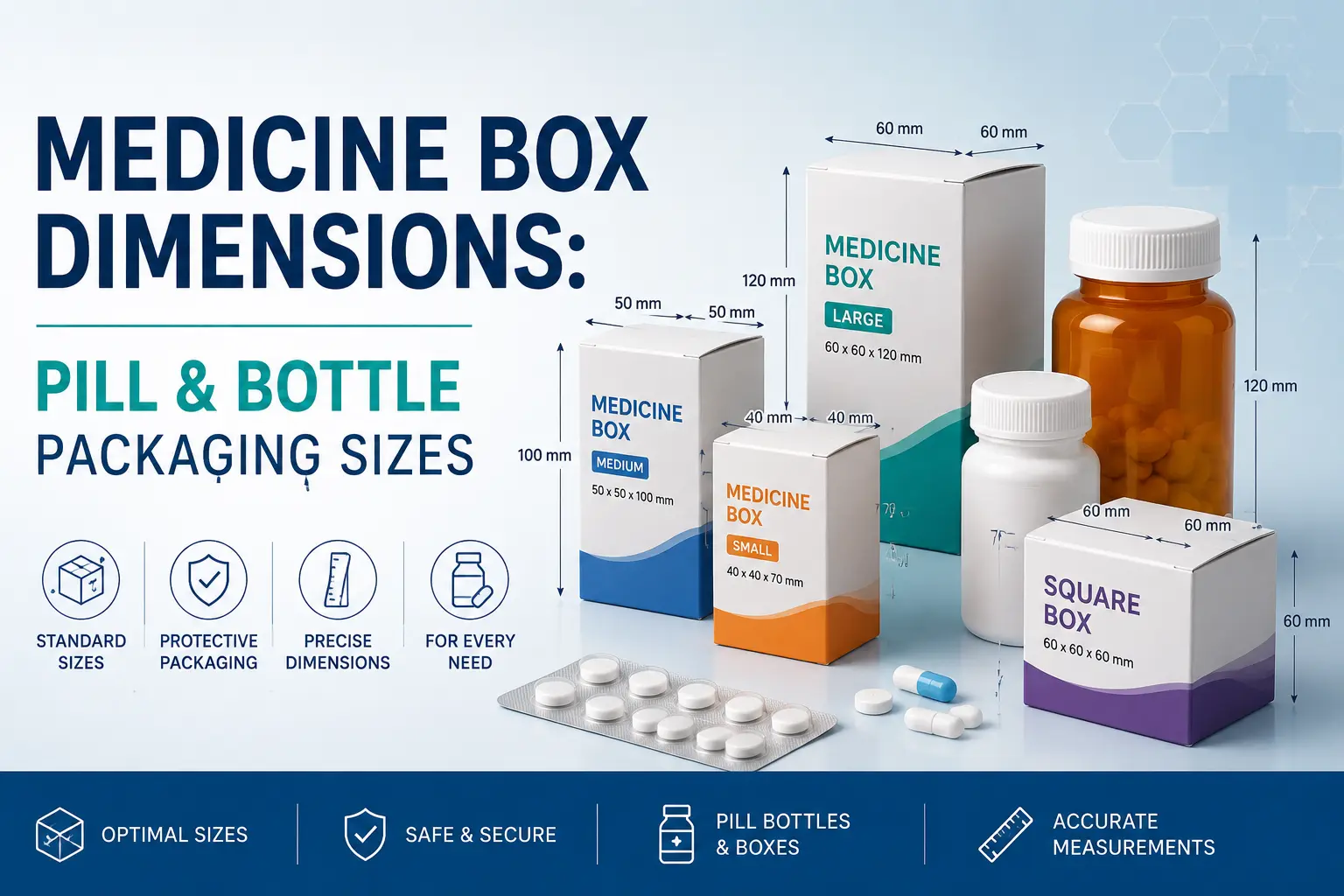
Okay, the numbers. They’re typical industry ranges and we’d still tweak them to your bottle.
Small Pill/Tablet Boxes
Usually somewhere around 2 to 3 inches long, 1 to 1.5 inches wide and 3 to 4 inches tall. That’s what a small bottle of 30 to 60 tablets or capsules tends to need.
Medium Pill Bottle Boxes
Go up a step and you’re at about 2.5 to 3.5 inches long by 1.5 to 2 wide, with height from 4 to 5 inches, which covers most prescription-style and supplement bottles holding 60 to 120 pills.
Large Bottle Boxes (Bulk or Family Size)
Big bottles, 200 tablets and up? Think 3.5 to 4.5 inches long, 2 to 3 wide, and anywhere from 5.5 up to 7 inches tall.
Syrup Bottle Boxes
Most syrup boxes we see are close to square at the base, 2 to 3 inches each way, and 4 to 6 inches tall depending on the bottle (a lot of them hold between 60ml and 200ml).
Blister Pack Cartons
Long and skinny. Typically 3 to 5 inches long but only half an inch to an inch wide, and 2 to 4 inches tall, because a blister sheet just needs to lie flat without bending, it doesn’t need depth.
How to Measure Your Product Before Choosing a Box Size
If the bottle’s on your desk right now, measure it properly and you’ll save yourself a pile of back-and-forth emails. This is how we’d do it:
- Diameter at the widest spot (sometimes that’s the cap, people miss this one).
- Full height with the cap screwed on.
- Then add 3 to 5mm or so per side so it slides in without a wrestling match.
- Using foam, a paperboard divider or shrink wrap? Add that in too.
- Last, check there’s enough flat panel for the label, barcode and required info.
Our favorite trick costs nothing. Cut a paper mock-up, fold it around the real bottle with some tape, and you’ll catch most mistakes in about ten minutes, and after that we send a digital proof before printing and can make a physical sample if you ask, which is a lot cheaper than reprinting. While you’re measuring, think about whether blister packaging goes inside, since a blister card changes the inside measurements a fair bit and it’s the usual route for tamper-evident tablet packs.
Materials That Affect Box Dimensions
Thicker board eats inside space. Simple as that, though people forget it all the time.
- Paperboard folding cartons are thin and what most tablet boxes use, so they barely change the inside size.
- Corrugated is chunkier, and we’d keep it for bulk shipping boxes, not the box the customer sees.
- Rigid boxes have thick walls, great for premium health products, but measure from the inside because it’s noticeably smaller than the outside.
- Kraft is about as thick as regular paperboard, a good pick for the eco crowd.
Tips for Getting Medicine Box Dimensions Right the First Time
- Leave tolerance, because the die and the folder can each drift a millimeter (we aim for snug and avoid tight).
- Sketch the text layout before the dieline gets locked, since your product’s rules decide what’s mandatory and it’s usually more than you think.
- Get a sample before the full run (a real box with the real bottle in it tells you more than any screen).
- Look at how the boxes pack into a shipping case, since a neat fit there knocks real money off freight on a big order.
- Size to your brand. A premium supplement might go slightly bigger to show off soft-touch and foil, while a budget generic keeps it lean, and honestly both are smart.
Final Thoughts
Look, nobody gets excited about medicine box dimensions. But this boring step is where it’s settled whether the bottle arrives intact and the warnings fit and the freight bill stays sane, and whether your little brand looks as trustworthy as the big one next to it. Measure twice, buffer a bit, plan the label on day one.
Got your measurements? Pick a custom size and style and we’ll build it around that bottle. Our design help costs nothing extra and there’s always a digital proof first, so you’ll know it fits before production starts.
Keep Reading
Ready to order? Start with custom mailer boxes and product packaging boxes. For more background, read beer box dimensions: 6, 12 & 24 pack sizes explained and jewelry box dimensions: standard sizes for every piece type.
Want a price? Tell us your size and quantity on our quote page and we will send a free quote and proof.