Milk cartons are one of the most recognised pieces of packaging in the world. They sit in nearly every refrigerator in America, appear on school lunch trays across the country, and line grocery store dairy aisles in sizes ranging from a small single-serve school box to a full gallon family carton.
But the dimensions of those cartons are more carefully engineered than most people realise. Every millimetre of a milk carton’s height, width, and depth serves a purpose. The dimensions determine how much product it holds, how efficiently it fits on a refrigerator shelf, how many units stack on a pallet during shipping, and how much surface area is available for brand communication and regulatory labelling.
For dairy brands, food beverage businesses, packaging buyers, and anyone sourcing liquid food packaging, understanding standard milk carton dimensions is essential practical knowledge. Whether you are designing packaging for a new dairy product or simply curious about why milk cartons are the shape and size they are, this guide covers everything you need to know. Dairy brands and beverage businesses looking for custom food and beverage packaging can explore custom milk and beverage packaging solutions from The Pioneer Packaging, which offers full customisation with no minimum order and free USA shipping.
A Brief History of Milk Carton Dimensions
Understanding why milk carton dimensions are standardised the way they are today requires a brief look at how the format developed.
Before cartons, milk was sold in glass bottles that were heavy, fragile, and expensive to transport. In 1915, John Van Wormer patented the first paper milk carton design, which he called the Pure-Pak. It was made from paperboard with a distinctive gable-top, the triangular peaked closure that most people still associate with a traditional milk carton today.
For decades, paper cartons competed with glass bottles and early plastic jugs. The carton won out in most markets because of its lighter weight, lower cost, and the ability to print brand graphics and nutritional information directly on its surface.
Tetra Pak, the Swedish company, introduced its first aseptic carton in the 1950s. The aseptic process, which sterilises both the product and the packaging separately before filling, extended the shelf life of liquid products from weeks to months without refrigeration. This was a significant breakthrough that eventually led to the shelf-stable milk cartons and plant-based beverage cartons that are now standard globally.
Today, the milk carton industry is a multi-billion dollar global market, and the dimensions that have emerged as standard reflect a century of practical refinement around filling equipment, retail shelving standards, refrigerator door dimensions, school cafeteria requirements, and consumer handling expectations.
The Two Main Milk Carton Structural Styles
Before getting into specific dimensions, it is important to understand the two main structural formats used in milk carton packaging, because each format has different dimensional characteristics.
Gable Top Cartons
The gable top carton is the classic milk carton shape most Americans grew up with. It has a peaked roof-like top with two angled panels that fold together and a flat rectangular base. The base dimensions are square or very nearly square, and the height includes both the body of the carton and the gable fold at the top.
Gable top cartons are made from multi-layer paperboard with a polyethylene coating on both sides to prevent moisture penetration. They require refrigeration and have a shelf life of approximately two to three weeks. Gable top is the dominant retail format in the United States for fresh dairy milk.
The gable top adds approximately 1 to 1.5 inches to the overall height of the carton beyond the liquid-holding body, which is important to account for when calculating refrigerator shelf clearance and retail planogram dimensions.
Flat Top or Aseptic Cartons
Flat top cartons, also called Tetra Pak or aseptic cartons, have a fully sealed rectangular top with no peaked fold. They use a six-layer material construction combining paperboard, polyethylene, and aluminium foil, which blocks oxygen and light completely and allows the product to be stored without refrigeration for six to twelve months before opening.
Flat top aseptic cartons are widely used for shelf-stable milk, plant-based milks including almond, oat, and soy, juice, and other beverages. They are the dominant format for plant-based beverages in the United States and for ambient dairy in international markets.
Because flat top cartons have no gabled peak, their overall height is shorter than a gable top carton of the same volume. Their fully rectangular profile also means they tessellate more efficiently on pallets and shelves.
Standard Milk Carton Sizes and Dimensions
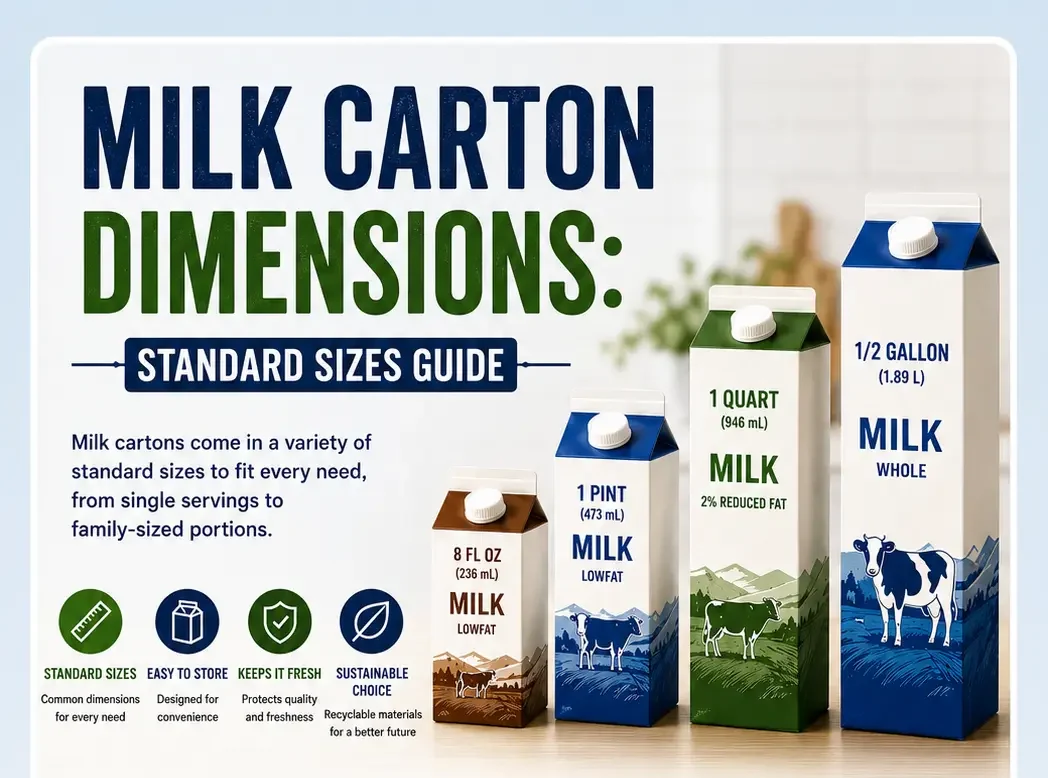
Milk cartons in the United States come in four primary standard sizes based on volume. Here are the standard dimensions for each size in both inches and centimetres.
Half Pint (8 oz / 236 ml)
The half pint is the smallest standard milk carton size in the United States. It holds 8 fluid ounces, which equals one cup of milk or 236 millilitres.
The half pint is the carton most people remember from school lunches. It is specifically designed to meet the requirements of the USDA National School Lunch Program, which serves more than 30 million children daily. The size provides a single age-appropriate serving and fits easily in small hands.
Standard half pint gable top dimensions:
External dimensions: approximately 2.25 × 2.25 × 3.75 inches (57 × 57 × 95 mm)
Some sources reference slightly different dimensions of 2.25 × 2.25 × 2.75 inches for the body alone, with the full height including the gable fold reaching approximately 3.75 inches. The 2.25 × 2.25 inch base is highly standardised across virtually all brands and manufacturers because the filling line equipment and school cafeteria handling systems are calibrated around this footprint.
The half pint is also used in hospitals, airlines, hotels, and food service operations that require portion-controlled single servings.
Pint (16 oz / 473 ml)
The pint holds 16 fluid ounces, which equals two cups or 473 millilitres. It is a step above the half pint for individual use and is popular in coffee shops, cafes, specialty food stores, and food service settings where a single serving is more than 8 oz but a full quart is unnecessary.
Standard pint gable top dimensions:
External dimensions: approximately 2.75 × 2.75 × 5.75 inches (70 × 70 × 146 mm)
Pint cartons are less common in standard grocery retail than the other sizes but are widely used in food service and in premium or specialty dairy products where smaller quantities command higher per-unit prices.
Quart (32 oz / 946 ml)
The quart holds 32 fluid ounces, which equals four cups or approximately 946 millilitres. It is sometimes called the middle-child of milk carton sizes. It is larger than the pint, holds enough for a small household over several days, and takes up significantly less refrigerator space than a half gallon.
The quart is popular for people living alone or with limited refrigerator space, for households that use milk infrequently, and for specialty milk products like heavy cream, half-and-half, and flavoured milks where a full half gallon would be excessive.
Standard quart gable top dimensions:
External dimensions: approximately 3.5 × 3.5 × 7.25 inches (89 × 89 × 184 mm)
The square 3.5 × 3.5 inch base and the approximately 7.25 inch total height including the gable fold are highly consistent across brands. The quart carton fits upright in a standard refrigerator door shelf with adequate clearance.
Half Gallon (64 oz / 1.89 litres)
The half gallon holds 64 fluid ounces, which equals eight cups or approximately 1.89 litres. It is the most widely purchased milk carton size in American households. It represents the best balance between volume, manageability, freshness retention after opening, and refrigerator space efficiency.
The half gallon is the size most people picture when they think of buying milk at the grocery store. It fits in the door of virtually every standard home refrigerator. It lasts a typical household of two to four people several days to a week after opening.
Standard half-gallon gable top dimensions:
External dimensions: approximately 3.875 × 3.875 × 9.5 inches (98.4 × 98.4 × 241 mm)
Some manufacturers use slightly different dimensions. Common variations include 4 × 3.875 × 9.5 inches or 3.875 × 3.875 × 9.25 inches. The base footprint is the most standardised element, typically within the range of 3.75 to 4 inches square across all major brands, because it is dictated by filling line equipment standards.
Gallon (128 oz / 3.785 litres)
The gallon holds 128 fluid ounces, which equals 16 cups or approximately 3.785 litres. It is the largest standard milk carton size and is designed for large households and high-consumption families.
In the United States, the gallon is actually more commonly sold in high-density polyethylene plastic jugs than in paperboard cartons. The gallon paperboard carton exists but is less common than the plastic jug format because the weight and handling requirements of a full gallon of milk present challenges for the gable top paperboard carton construction.
Standard gallon gable top dimensions (where used):
External dimensions: approximately 4.5 × 4.5 × 10.5 inches (114 × 114 × 267 mm)
Some sources reference a gallon milk carton as 7.5 × 4.5 × 8 inches, which suggests a wider, lower format compared to the taller square footprint format above. This variation reflects differences between manufacturers.
The plastic gallon jug, which is the more common format, typically measures approximately 6.75 × 4.5 × 9.5 inches for a standard HDPE jug.
Standard Milk Carton Dimensions Quick Reference Table
| Size | Volume | Gable Top External Dimensions (inches) | Dimensions (mm) | Common Use |
|---|---|---|---|---|
| Half pint | 8 oz / 236 ml | 2.25 × 2.25 × 3.75 | 57 × 57 × 95 | Schools, food service, hospitals |
| Pint | 16 oz / 473 ml | 2.75 × 2.75 × 5.75 | 70 × 70 × 146 | Cafes, specialty products, food service |
| Quart | 32 oz / 946 ml | 3.5 × 3.5 × 7.25 | 89 × 89 × 184 | Small households, limited fridge space |
| Half gallon | 64 oz / 1.89 L | 3.875 × 3.875 × 9.5 | 98 × 98 × 241 | Most popular household retail size |
| Gallon | 128 oz / 3.79 L | 4.5 × 4.5 × 10.5 | 114 × 114 × 267 | Large households, wholesale |
Aseptic and Flat Top Carton Dimensions
Aseptic cartons for shelf-stable milk and plant-based beverages follow different dimensional conventions from gable top fresh milk cartons. The most common aseptic formats are produced by Tetra Pak and SIG, which have developed their own standardised dimension ranges.
Tetra Brik Aseptic (most common format)
The Tetra Brik is the brick-shaped aseptic carton that has become familiar across juice, plant-based milk, and shelf-stable dairy globally.
| Volume | External Dimensions (mm) | Notes |
|---|---|---|
| 200 ml | 95 × 55 × 65 | Single serve, common in Europe and school programs |
| 330 ml | 110 × 60 × 75 | Popular in food service |
| 500 ml | 125 × 65 × 90 | Common for juice and plant milk |
| 1 litre | 195 × 70 × 95 | Standard retail size internationally |
| 1.5 litre | 225 × 70 × 110 | Larger retail format |
| 2 litre | 255 × 75 × 125 | Family size in some markets |
The Tetra Brik’s rectangular flat-topped profile means it can be stacked directly on top of itself without wasted headspace, which makes it highly efficient for retail shelving and pallet shipping compared to gable top cartons whose peaked tops create non-stackable space.
How to Measure a Milk Carton
Whether you are verifying a carton from a supplier or measuring existing packaging for competitive analysis, here is the correct way to measure a milk carton.
You need three measurements: height, width, and length (or depth).
Height is measured from the very base of the carton to the very top of the carton including the gable fold or any spout. For gable top cartons, this includes the full triangular peak at the top. Do not exclude the gable fold from the height measurement unless you are specifically measuring the liquid-holding body height for fill volume calculations.
Width is measured across the front face of the carton at the base, from left to right.
Length (also called depth) is measured from the front face to the back face of the carton at the base, perpendicular to the width.
For gable top cartons, the width and length at the base are typically equal because most milk cartons have a square base. However, some novelty or custom formats use rectangular bases.
Wall thickness should be measured separately if you need internal volume dimensions. Standard milk carton paperboard is 18 to 24 point (approximately 0.45 to 0.61mm) in thickness with additional polyethylene coating layers. The wall construction is thin enough that internal and external base dimensions are typically within 1 to 2mm of each other and are generally treated as equivalent for most purposes.
Common measurement mistakes to avoid include measuring the width at the gable fold rather than at the base. The gable fold narrows at the peak, so measuring there will give a smaller number than the true carton width. Also avoid measuring height without including the gable peak, which underestimates the full footprint the carton occupies on a refrigerator shelf.
Milk Carton Dimensions by Use Environment
Milk carton dimensions must be considered not just in isolation but in the context of where the carton will be used and stored.
Refrigerator Door Shelves
Standard US refrigerator door shelves are designed around common milk carton dimensions. A half gallon carton at approximately 3.875 inches wide and 9.5 inches tall fits comfortably on most standard door shelves, which typically have an interior depth of approximately 4.5 to 5 inches and a clearance height of 10 to 11 inches. A gallon carton at 4.5 inches wide often does not fit in the door shelf and must be placed on a main interior shelf.
School Cafeteria Requirements
The half pint carton’s dimensions were specifically developed around school cafeteria handling requirements. The 2.25 × 2.25 inch base fits in standard cafeteria tray cup holders. The total height of approximately 3.75 inches fits in cafeteria cold-service equipment designed for the format. The USDA National School Lunch Program guidelines effectively standardise the half pint as the required format for school milk service.
Retail Grocery Shelving
Grocery store refrigerated dairy cases are planned around standard milk carton footprints. A standard grocery gondola refrigerated case section of 48 inches accommodates approximately 12 half gallon cartons arranged side by side in a single row. The 9.5 inch height of the half gallon carton dictates the minimum shelf spacing in the dairy case, which is typically set at 10 to 11 inches per shelf tier.
Shipping Pallet Configuration
A standard US pallet at 48 × 40 inches accommodates milk cartons in configurations determined by their base dimensions. Half gallon cartons at approximately 3.875 × 3.875 inches can be arranged approximately 12 across by 10 deep per pallet layer in a standard configuration, giving approximately 120 cartons per layer. With 8 layers per pallet, a standard pallet holds approximately 960 half gallon cartons. The flat top aseptic Tetra Brik at 70 × 95mm tessellates more efficiently on international standard pallets.
Milk Carton Materials and Their Effect on Dimensions
The material construction of a milk carton directly influences its dimensional specifications, particularly the wall thickness and the minimum practical base dimensions.
Standard Fresh Milk Cartons (Gable Top)
Standard fresh milk cartons are made from multi-layer paperboard consisting of a base paperboard layer, typically 300 to 400 GSM food-grade SBS board, coated on both sides with low-density polyethylene film at approximately 15 to 25 grams per square metre per side. The polyethylene layer creates the moisture barrier that prevents liquid from penetrating the paperboard walls.
The overall wall thickness of a standard fresh milk carton is approximately 0.6 to 0.8mm including both polyethylene coating layers. This is thin enough that the wall thickness has minimal effect on the external versus internal dimensions.
Aseptic Cartons (Tetra Pak and Similar)
Aseptic carton material is a six-layer composite consisting of paperboard, polyethylene, and aluminium foil layers in a specific sequence. The aluminium foil layer is the key component that blocks oxygen and light penetration, which is what allows the product to be stored without refrigeration. The overall material thickness is slightly greater than a standard fresh milk carton, typically approximately 0.8 to 1.0mm.
HDPE Plastic Jugs
High-density polyethylene plastic jugs are the dominant format for gallon milk in the United States. HDPE is used because it is food-safe, resistant to the slightly acidic pH of milk, relatively rigid at the wall thicknesses used, and recyclable. The wall thickness of a standard milk jug is approximately 0.8 to 1.2mm.
Recyclability Considerations
The recyclability of different milk carton materials varies significantly and is an important consideration for dairy brands making sustainability claims. Paperboard gable top cartons are accepted in most municipal recycling programs in the United States when flattened. Aseptic Tetra Pak cartons are increasingly accepted in curbside recycling, though acceptance rates vary by municipality. HDPE plastic jugs are among the most widely recyclable plastic packaging formats. The Carton Council of North America reports that carton packaging generates significantly lower greenhouse gas emissions per unit of liquid packaged compared to glass alternatives.
Plant-Based Milk Carton Dimensions
Plant-based milks including almond, oat, soy, and coconut milk are packaged in carton formats that largely mirror dairy milk carton dimensions, though the shelf-stable aseptic format is more prevalent in plant-based than in conventional dairy.
The most common plant-based milk retail format in the US is the 32 oz aseptic Tetra Brik carton, which typically measures approximately 3.875 × 2.5 × 7.25 inches. This is slightly narrower than a quart gable top dairy carton because the rectangular Tetra Brik has different proportions from the square-based gable top.
The 64 oz half gallon plant-based milk carton, used by brands like Oatly, Silk, and Califia Farms, typically measures approximately 3.875 × 3.875 × 9.5 inches in its gable top refrigerated format, making it dimensionally identical to a conventional dairy half gallon carton. This equivalence is intentional because plant-based milks are designed to sit on the same dairy case shelves as conventional milk and must fit the same shelf slot dimensions.
Milk Carton Dimensions for Custom and Specialty Products
Beyond the standard sizes, several specialty applications use custom or non-standard milk carton dimensions.
Mini Milk Cartons for Events and Weddings
Small decorative milk cartons, typically 2 × 2 × 3.5 inches, are used as favour boxes at weddings, birthday parties, and events. These are not actual beverage containers but decorative packaging inspired by the school milk carton format. They are available in paperboard construction without any liquid barrier and are used to hold small gifts, candy, or party favours.
Premium and Artisan Dairy Cartons
Premium and artisan dairy brands sometimes use custom carton dimensions that differentiate them from standard commodity milk packaging. A slightly taller, narrower carton profile creates a different shelf presence from a standard half gallon. Some premium brands use a 5 × 3 × 8 inch half gallon format rather than the standard 3.875 × 3.875 × 9.5 inch square footprint, which gives a slimmer, more elegant appearance on the shelf.
Cream and Half-and-Half Cartons
Heavy cream, whipping cream, and half-and-half products are typically sold in pint or half pint cartons because they are used in smaller quantities than whole milk. Their carton dimensions match the standard pint and half pint dimensions described above.
Coffee Creamer Cartons
Individual coffee creamer mini cartons used in food service and hospitality are extremely small, typically approximately 1.5 × 1.25 × 1.25 inches holding approximately 0.375 oz (11ml) of creamer. These are specialty formats far outside standard milk carton dimensions and are designed specifically for the food service and hospitality channel.
For dairy brands and beverage businesses that need packaging in standard or custom dimensions, custom milk cartons from The Pioneer Packaging are available in any size with full printing customisation, low minimums, and free USA shipping.
Printing and Labelling on Milk Carton Dimensions
The dimensions of a milk carton determine the available print surface for brand communication and regulatory labelling. Understanding how the printable area relates to the carton dimensions helps packaging designers and dairy brands plan their artwork effectively.
A standard half gallon gable top carton has four main printable panels. The front and back panels each measure approximately 3.875 inches wide by approximately 8 inches tall from the base to the shoulder where the gable fold begins. The two side panels each measure approximately 3.875 inches wide by approximately 8 inches tall.
The gable fold area, approximately 3.875 inches wide by 1.5 to 2 inches tall on each side, provides additional print surface that is visible from above, which is relevant for eye-level shelf display where consumers look slightly down at the product.
FDA regulations require that specific information appear on milk carton labelling, including the product name, volume in fluid ounces and millilitres, nutrition facts panel, ingredient list, allergen information, processor name and address, and pasteurisation declaration. The nutrition facts panel has a minimum required type size that effectively sets a minimum panel width for compliant labelling. For a half-pint school milk carton at 2.25 inches wide, the panel dimensions are tight enough that some brands use a simplified nutrition facts format approved for small packages.
For dairy brands interested in understanding how to maximise shelf impact through carton design and custom printing options, The Pioneer Packaging’s custom packaging cost calculator provides instant price estimates based on your specific carton dimensions, materials, and print specifications.
Common Mistakes When Specifying Milk Carton Dimensions
Several common errors occur when dairy brands and packaging buyers specify or interpret milk carton dimensions. Being aware of these avoids expensive ordering mistakes.
Confusing gable height with body height. The gable fold adds approximately 1 to 1.5 inches to the total carton height beyond the liquid-holding body. Specifying body height when total height is needed, or vice versa, results in cartons that do not fit the intended shelf or refrigerator space.
Not accounting for headspace. Milk cartons are filled to leave approximately 5 to 8 percent headspace at the top. This headspace allows for thermal expansion during temperature changes and prevents the carton from leaking when shaken or tilted. Designing a carton where the intended fill volume leaves no headspace creates a product that leaks or bulges.
Ignoring regional dimension standards. US milk carton dimensions are based on fluid ounce volumes and inch-based filling equipment. European and international dimensions are based on metric volumes and millimetre-based equipment standards. A carton designed for a US filling line will not necessarily run on a European filling line without adjustment.
Measuring at the wrong point. The gable fold narrows as it rises to the peak, so measuring width at the gable rather than at the base understates the carton’s true width. Always measure width and length at the base.
Assuming square base. Most standard milk cartons have a square base, but not all. Some specialty formats use rectangular bases. Confirming both the length and width at the base rather than assuming they are equal prevents dimension specification errors.
FAQs
What are the dimensions of a standard milk carton?
The most common standard milk carton in the US is the half gallon gable top carton, which measures approximately 3.875 × 3.875 × 9.5 inches externally including the gable fold. The half pint school carton measures approximately 2.25 × 2.25 × 3.75 inches. The quart carton measures approximately 3.5 × 3.5 × 7.25 inches.
How tall is a half gallon milk carton?
A standard half gallon gable top milk carton is approximately 9.5 inches tall, including the gable fold at the top. The liquid-holding body below the gable fold is approximately 8 inches tall.
How tall is a school milk carton?
A standard school half pint milk carton is approximately 3.75 inches tall including the gable fold. The base measures approximately 2.25 × 2.25 inches.
What are the dimensions of a quart milk carton?
A standard quart milk carton measures approximately 3.5 × 3.5 × 7.25 inches externally including the gable fold.
What is the difference between a gable top and a Tetra Pak carton?
A gable top carton has a peaked triangular fold at the top and requires refrigeration, with a shelf life of 2 to 3 weeks. A Tetra Pak or aseptic flat top carton is fully sealed with a rectangular top, uses aluminium foil layers, and can be stored without refrigeration for 6 to 12 months before opening.
What are the dimensions of a Tetra Pak one litre carton?
A standard one litre Tetra Brik aseptic carton measures approximately 195 × 70 × 95 mm or approximately 7.67 × 2.75 × 3.74 inches.
Why are most milk cartons square at the base?
The square base optimises space efficiency for both filling line equipment and retail shelf display. It allows cartons to be packed tightly against each other in rows without wasted space between units. Round or rectangular base formats leave dead space that reduces how many units fit per shelf and per pallet.
What size carton is used for school milk?
School milk in the United States is standardised at 8 fluid ounces, packaged in a half pint gable top carton measuring approximately 2.25 × 2.25 × 3.75 inches. This size meets USDA National School Lunch Program requirements.
How do milk carton dimensions affect shipping costs?
Milk cartons, particularly fresh gable top cartons, are dense and heavy enough that actual weight typically governs shipping cost rather than dimensional weight. However, optimising carton dimensions for efficient pallet packing reduces the number of pallet positions needed per shipment, which reduces per-unit logistics cost at scale.
What are the dimensions of a gallon milk carton?
A paperboard gallon milk carton, where used, measures approximately 4.5 × 4.5 × 10.5 inches. The more common HDPE plastic gallon jug measures approximately 6.75 × 4.5 × 9.5 inches.