

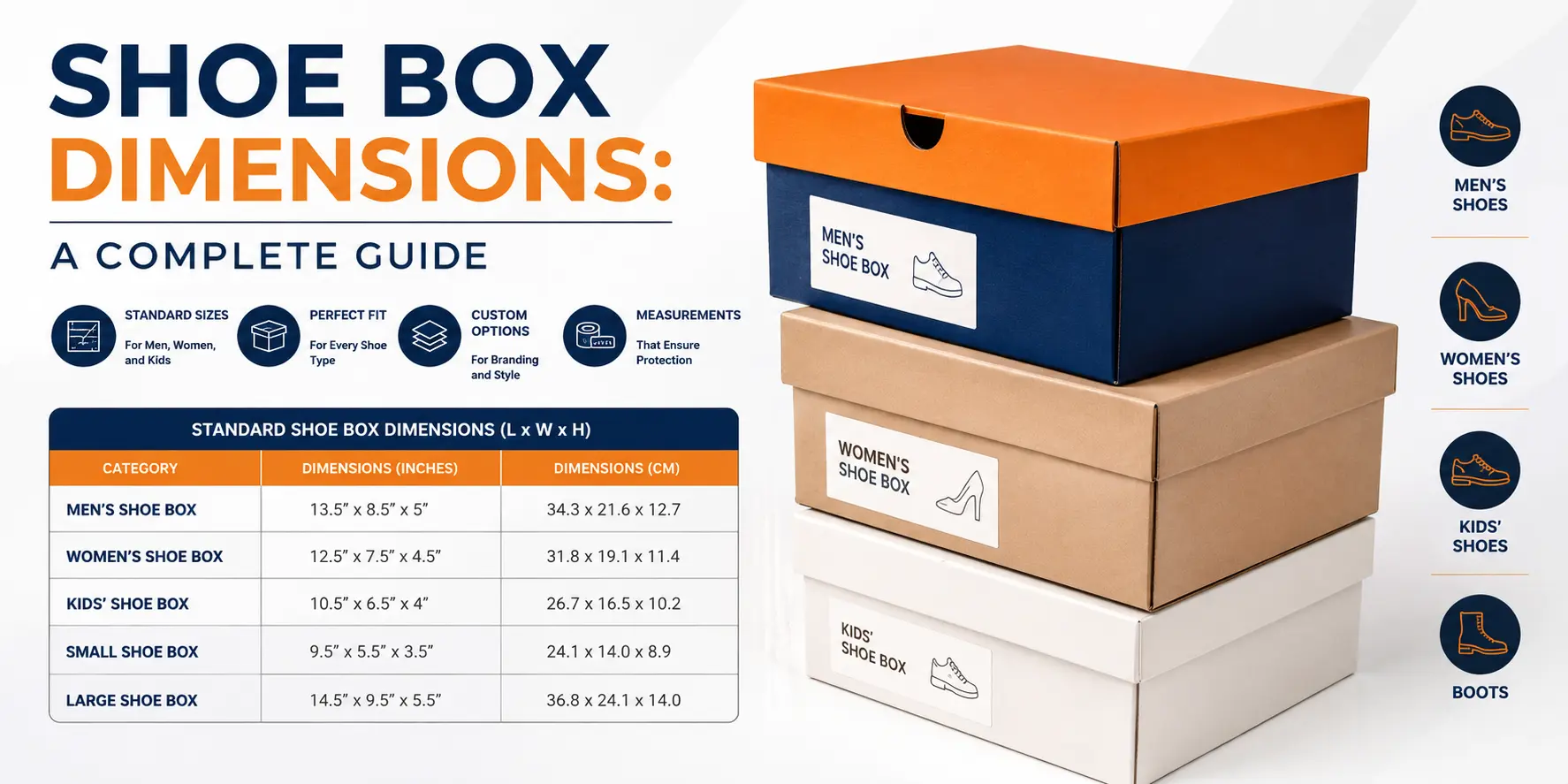
Whether you run a footwear brand, ship shoes online, or just want to store your collection properly knowing the right shoe box dimensions saves you money, prevents damage, and improves your customer’s unboxing experience.
In this guide, you’ll find exact shoe box sizes for men, women, kids, and specialty shoe types, plus brand-specific dimensions, shipping tips, and a step-by-step measurement guide.
What Are Standard Shoe Box Dimensions?
Standard shoe box dimensions vary by gender and shoe type. Most US shoe brands follow these widely accepted interior measurements:
| Category | Length | Width | Height |
|---|---|---|---|
| Men’s (standard) | 14 in / 35.5 cm | 8 in / 20 cm | 5 in / 12.5 cm |
| Women’s (standard) | 12 in / 30.5 cm | 7 in / 17.5 cm | 4 in / 10 cm |
| Children’s (youth) | 10 in / 25 cm | 6 in / 15 cm | 4 in / 10 cm |
| Children’s (toddler) | 8.5 in / 21.5 cm | 5.5 in / 14 cm | 3.5 in / 9 cm |
| Children’s (infant) | 6 in / 15 cm | 4 in / 10 cm | 3 in / 7.5 cm |
Note: These are interior (inside) measurements. Always measure the inside of the box when fitting shoes, the outside is used for shipping calculations.
Shoe Box Dimensions by Shoe Type
Not all shoes are the same shape. A high heel needs a deeper box. A boot needs more height. Here are the recommended dimensions by shoe type:
Men’s Shoe Box Sizes
| Shoe Type | Length | Width | Height |
|---|---|---|---|
| Dress shoes / loafers | 13 in | 8 in | 4.5 in |
| Sneakers / athletic | 14 in | 8 in | 5 in |
| High-tops / basketball | 14 in | 9 in | 6 in |
| Boots (ankle) | 14 in | 9 in | 7 in |
| Boots (knee-high) | 16 in | 10 in | 14–15 in |
| Size 13+ (large sizes) | 15–16 in | 9–10 in | 5.5 in |
Women’s Shoe Box Sizes
| Shoe Type | Length | Width | Height |
|---|---|---|---|
| Flats / loafers | 12 in | 7 in | 3.5 in |
| Sneakers | 12 in | 7.5 in | 4.5 in |
| High heels / stilettos | 12 in | 7 in | 5–6 in |
| Wedges / platforms | 12 in | 8 in | 5 in |
| Boots (ankle) | 12 in | 7.5 in | 6 in |
| Boots (knee-high) | 14 in | 8 in | 13–15 in |
Children’s Shoe Box Sizes
| Age Group | Length | Width | Height |
|---|---|---|---|
| Infant (0–2 yrs) | 6 in / 15 cm | 4 in / 10 cm | 3 in / 7.5 cm |
| Toddler (2–4 yrs) | 8 in / 20 cm | 5 in / 12.5 cm | 3.5 in / 9 cm |
| Kids (4–8 yrs) | 9.5 in / 24 cm | 5.5 in / 14 cm | 4 in / 10 cm |
| Youth (8–12 yrs) | 10.5 in / 26.5 cm | 6 in / 15 cm | 4.5 in / 11.5 cm |
Brand-Specific Shoe Box Dimensions
Top footwear brands use their own custom box sizes that differ slightly from industry standards. Here’s a quick-reference chart for the most popular brands (interior measurements, men’s US size 10):
| Brand | Length | Width | Height |
|---|---|---|---|
| Nike | 13.4 in / 34 cm | 9.4 in / 24 cm | 4.7 in / 12 cm |
| Nike (women’s) | 12.2 in / 31 cm | 8.3 in / 21 cm | 4.3 in / 11 cm |
| Jordan | 13 in / 33 cm | 10.5 in / 26.5 cm | 5.5 in / 14 cm |
| Adidas (men’s) | 13.5 in / 34.5 cm | 8.5 in / 21.5 cm | 4.5 in / 11.5 cm |
| Adidas (women’s) | 12.6 in / 32 cm | 7.9 in / 20 cm | 4 in / 10 cm |
| New Balance | 13 in / 33 cm | 8 in / 20 cm | 4.5 in / 11.5 cm |
| Vans | 12.6–14 in | 7.9–8 in | 4–4.5 in |
| Puma | 13.5 in / 34 cm | 8.5 in / 21.5 cm | 4.5 in / 11.5 cm |
Important: Brand dimensions can vary by model and region. Jordan 1 High models, for example, need the full 5.5 inch height to close flat. Always verify before bulk ordering.
How to Measure a Shoe Box (Step-by-Step)
Follow these four steps to get the correct measurements every time:
Step 1 – Measure the shoe, not the box Place your shoe heel-to-toe on a flat surface. Measure the length, widest point (width), and the highest point of the upper (height). Use a rigid ruler, not a tape measure, for accuracy.
Step 2 – Add clearance Add at least 1 inch to the length, 0.75 inch to the width, and 0.75–1.5 inches to the height. This gives room for tissue paper, inserts, and air circulation. Shoes packed too tightly arrive creased.
Step 3 – Measure both shoes Left and right shoes of the same model can differ by up to 3 mm due to manufacturing tolerances. Always use the larger measurement.
Step 4 – Record inside, then outside Interior dimensions confirm the shoe fits. Exterior dimensions are what carriers use to calculate dimensional (DIM) weight charges. Both matter.
Interior vs Exterior Shoe Box Dimensions: What’s the Difference?
This is one of the most common sources of confusion in shoe packaging.
| Dimension Type | What It Tells You | When to Use It |
|---|---|---|
| Interior (inside) | How much space the shoe has | Fitting, product design |
| Exterior (outside) | Total box footprint | Shipping, storage, DIM weight |
The difference between interior and exterior depends on wall thickness. Standard cardboard shoe boxes have walls 1–3 mm thick. Rigid luxury shoe boxes can have walls up to 6 mm thick which means the interior could be 12 mm smaller than the exterior on all sides. Always confirm which measurement your supplier is quoting.
Shoe Box Dimensions for Shipping
Shipping carriers like UPS, FedEx, and USPS charge based on dimensional weight (DIM weight), not just actual weight. That means the size of the box directly impacts your shipping cost.
Standard Shoe Box Shipping Sizes
| Shoe Type | Recommended Shipping Box Size |
|---|---|
| Standard shoes (men’s / women’s) | 14 × 10 × 5 in |
| Boots | 16 × 12 × 6 in |
| Multiple pairs | 20 × 14 × 8 in |
How to calculate DIM weight (UPS/FedEx):
DIM Weight = (Length × Width × Height) ÷ 139
Example: A 14 × 10 × 5 inch box = 700 ÷ 139 = 5.04 lbs DIM weight
If your actual shoes weigh 2.5 lbs, you still pay for 5 lbs. This is why right-sizing your box cuts real costs.
Shipping Tips
- Add 1–2 inches to each dimension of the retail box to allow room for bubble wrap or crumpled paper.
- Use double-wall corrugated boxes for heavy boots or long-distance shipping.
- Keep the exterior box under 6 inches in height to stack efficiently on retail shelves and in shipping containers.
What Materials Do Shoe Boxes Use?
The material affects both wall thickness and interior space. Here are the most common options:
| Material | Thickness | Best For | Notes |
|---|---|---|---|
| Paperboard / chipboard | 1.5–3 mm | Retail shoe boxes | Lightweight, printable |
| Single-wall corrugated | 3–4 mm | E-commerce shipping | Good protection |
| Double-wall corrugated | 6–7 mm | Boots, heavy shoes | Best for long transit |
| Rigid board | 2–4 mm | Luxury packaging | Premium feel, no flex |
| Kraft paper | 2–3 mm | Eco-friendly brands | Biodegradable, sturdy |
The right material depends on your distribution channel. A luxury boutique brand needs rigid board. A direct-to-consumer brand shipping nationwide needs single or double-wall corrugated.
How Shoe Box Size Affects Your Brand
The size of your shoe box sends a signal before the customer even opens it.
- Too large – Shoes rattle inside. Customers notice. It feels cheap.
- Too tight – Shoes arrive creased or misshapen. Returns go up.
- Just right – The shoe sits snugly. Tissue paper lies flat. The lid closes cleanly.
Brands like Jordan use oversized, heavier boxes with a two-piece lid construction specifically to signal exclusivity. The extra height (14 cm vs the industry standard 12 cm) is a deliberate branding decision, not a functional requirement.
Even for smaller brands, a well-proportioned box with a clean close and 1 cm of breathing room consistently raises the perceived value of the product inside.
Frequently Asked Questions
What is the standard shoe box size in inches?
The most common sizes are 14 × 8 × 5 inches for men’s shoes and 12 × 7 × 4 inches for women’s shoes. These are interior measurements.
What are the dimensions of a Nike shoe box?
A Nike men’s shoe box (US size 10) measures approximately 13.4 × 9.4 × 4.7 inches (interior). Women’s Nike boxes measure about 12.2 × 8.3 × 4.3 inches.
How big is a Jordan shoe box?
Jordan shoe boxes measure approximately 13 × 10.5 × 5.5 inches for men’s styles. Jordan 1 High models use the full 5.5 inch height to fit the ankle collar.
What size box do I need to ship shoes?
Use a 14 × 10 × 5 inch box for most standard shoes with padding. Use 16 × 12 × 6 inches for boots. Always leave 1-2 inches of clearance for protective fill.
What is the difference between interior and exterior shoe box dimensions?
Interior dimensions tell you whether the shoe fits inside the box. Exterior dimensions are used by shipping carriers to calculate dimensional weight charges. The difference is the wall thickness of the box material.
How do I measure shoe box dimensions?
Measure length (heel to toe), width (widest point), and height (outsole to top of upper) on the shoe itself. Add 1 inch to each measurement for clearance, then check that figure against your box’s interior dimensions.
Are shoe box dimensions standard across all brands?
No. Nike, Adidas, Jordan, and New Balance all use slightly different proprietary dimensions. Always verify the brand-specific box size before placing a bulk order.
Get Custom Shoe Boxes with the Perfect Dimensions
Every shoe brand is different. Stock sizes rarely give you the exact fit, the exact finish, or the exact unboxing experience your customers expect.
At The Pioneer Packaging, we manufacture custom shoe boxes with no minimum order quantity (MOQ), free design support, and free shipping across the USA. Whether you need a folding carton for a women’s flat, a rigid lid box for a luxury sneaker, or a corrugated shipper for knee-high boots, we build it to your exact interior dimensions.