

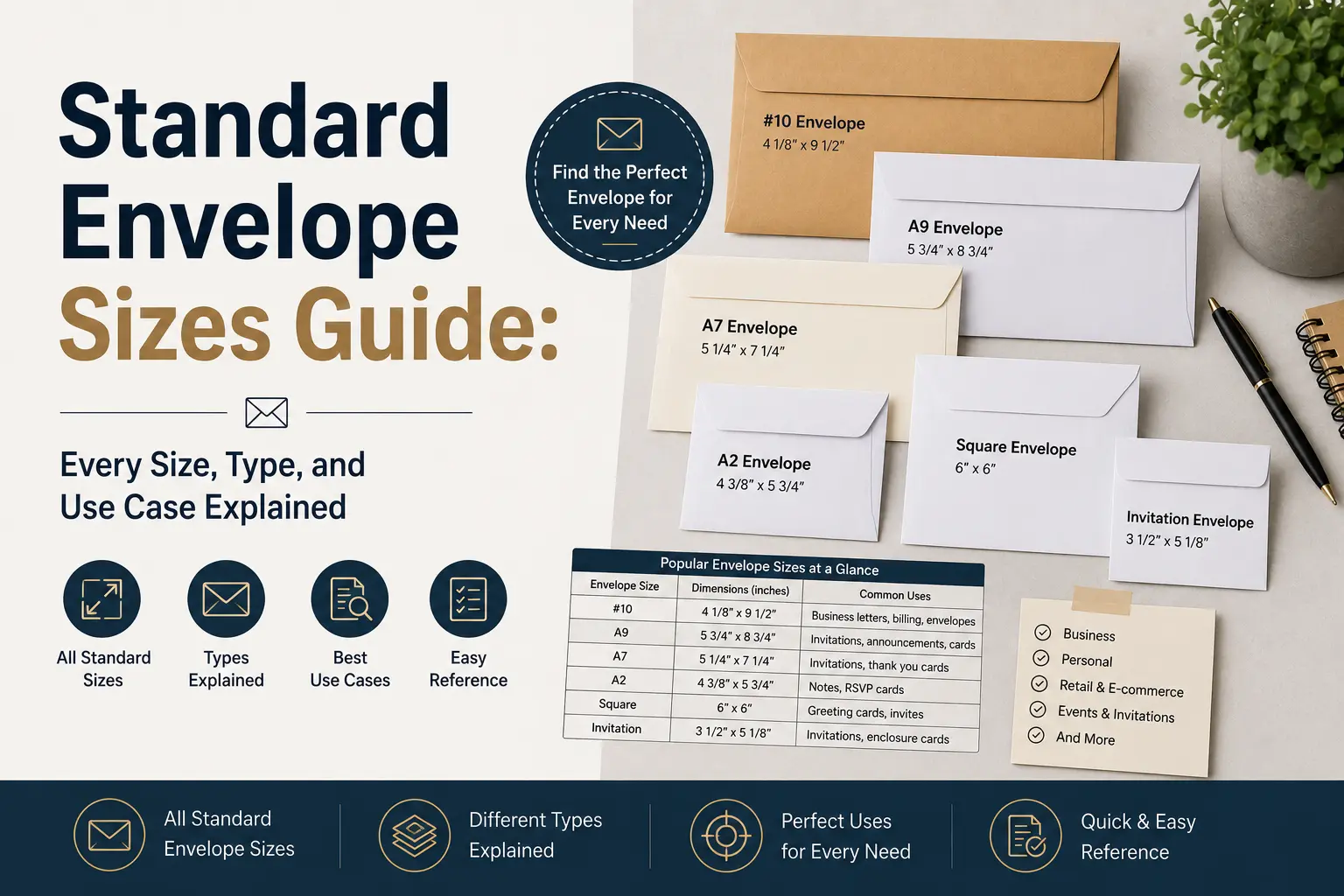
Envelopes are one of those things most people use without thinking twice. You grab one from a drawer, stuff something inside, seal it, and drop it in the mail. But walk into a print shop, talk to a commercial printer, or try to order custom envelopes for a business mailing, and you quickly discover that envelope sizing is a surprisingly complex system with its own terminology, measurement conventions, and industry standards that vary between countries.
Understanding envelope sizes matters more than most people realise. The wrong envelope size means documents that crease, don’t fit, or look unprofessional. It means postage surcharges for oversized or non-machinable mail. It means invitations that arrive bent because the envelope was too large for the card inside. And for businesses sending high volumes of direct mail, it means the difference between a piece that processes smoothly through automated sorting equipment and one that causes problems at every stage.
This guide covers every standard envelope size used in the United States and internationally, explains the naming and numbering conventions, maps each size to its most common applications, and covers the practical details that determine whether your mailing goes smoothly or creates unnecessary complications.
How Envelope Sizes Are Named and Measured
Before diving into specific sizes, it helps to understand how envelopes are measured and why the naming systems exist.
In the United States, envelopes are measured by their external dimensions in inches, listed as width first, then height. Width is the longer dimension of the envelope opening edge. Height is the shorter dimension from the opening to the bottom fold. This convention trips up many people because it is the opposite of how most other rectangular items are measured, where height typically refers to the longer dimension.
Outside the United States, particularly in Europe, envelopes follow ISO standards where the designation refers to the paper size the envelope is designed to hold rather than the envelope’s own dimensions. A C4 envelope, for example, holds an A4 sheet unfolded. A C5 envelope holds an A4 sheet folded in half. A DL envelope holds an A4 sheet folded in thirds.
In the US, commercial envelopes are grouped into series identified by letters and numbers, such as the No. 10 commercial envelope, the A-series announcement envelopes, and the Baronial series. Each series has specific dimensional conventions and typical applications.
Knowing which system a supplier is using is essential when ordering envelopes, because a “No. 10” means something very specific in American commercial printing but nothing at all in European stationery.
US Commercial Envelope Sizes
Commercial envelopes are the most commonly used envelopes in American business correspondence. They are designed to hold standard letter-size paper folded in thirds, making them the default choice for invoices, statements, contracts, letters, and any standard business communication.
No. 6 3/4 Envelope
Dimensions: 3 5/8 × 6 1/2 inches
The No. 6 3/4 is the standard personal correspondence envelope and is also widely used as a remittance envelope inserted inside a larger mailing. It holds a standard letter folded in quarters or a check folded once. It is the envelope commonly found inside utility bills and donation requests, allowing the recipient to return a payment or response. It processes through USPS automated sorting equipment without surcharge when properly addressed.
No. 7 Envelope
Dimensions: 3 3/4 × 6 3/4 inches
The No. 7 is used for personal correspondence and is slightly larger than the No. 6 3/4. It is less common in commercial applications but occasionally used for personal letters and cards.
No. 7 3/4 (Monarch) Envelope
Dimensions: 3 7/8 × 7 1/2 inches
The Monarch envelope is associated with executive correspondence and personal business stationery. It holds Monarch-size letterhead (7 1/4 × 10 1/2 inches) folded in thirds. It conveys a more formal and prestigious impression than the standard No. 10 and is used by executives, law firms, and high-end professional services firms for personal correspondence.
No. 9 Envelope
Dimensions: 3 7/8 × 8 7/8 inches
The No. 9 is slightly smaller than the No. 10 and is designed specifically to fit inside a No. 10 envelope. This makes it the standard business reply envelope (BRE) and return envelope format. Direct mail pieces, subscription renewals, and billing statements frequently include a No. 9 pre-addressed return envelope tucked inside a No. 10 outer envelope.
No. 10 Envelope
Dimensions: 4 1/8 × 9 1/2 inches
The No. 10 is the most widely used business envelope in the United States. It holds a standard 8.5 × 11 inch letter folded in thirds. It is the default envelope for virtually all American business correspondence, direct mail, billing, statements, and official communications. Window versions of the No. 10 are extensively used for automated mailing where the recipient’s address is printed on the enclosed document and shows through the envelope window, eliminating the need for separate envelope addressing.
No. 11 Envelope
Dimensions: 4 1/2 × 10 3/8 inches
The No. 11 is slightly larger than the No. 10 and is used when the contents need a little more room, such as when enclosing a folded document along with a cover letter. It is less common than the No. 10 but available from most commercial envelope suppliers.
No. 12 Envelope
Dimensions: 4 3/4 × 11 inches
The No. 12 is used for bulkier business mailings and for enclosing multiple documents together. It provides extra room compared to the No. 10 or No. 11.
No. 14 Envelope
Dimensions: 5 × 11 1/2 inches
The No. 14 is a large commercial envelope used for documents that are slightly too thick or wide to fit comfortably in a No. 10. It is also used for computer printouts and longer documents that cannot be folded to standard letter thirds.
US Announcement and Invitation Envelope Sizes
Announcement envelopes, also called A-series envelopes, are designed for greeting cards, invitations, announcements, and personal correspondence. They are squarer in proportion than commercial envelopes, which suits card-format content, and they are available in a range of sizes corresponding to standard greeting card and notecard dimensions.
A2 Envelope
Dimensions: 4 3/8 × 5 3/4 inches
The A2 is one of the most popular sizes for personal correspondence, thank you notes, and RSVP cards. It holds a 4.25 × 5.5 inch notecard or a folded standard letter. It is widely used for wedding response cards and small social stationery.
A4 Envelope
Dimensions: 4 1/4 × 6 1/4 inches
The A4 announcement envelope holds a 4 × 6 inch card or photograph. It is used for photo mailers, small invitations, and notecards. Note that this is a US envelope designation and should not be confused with the ISO A4 paper size used internationally.
A6 Envelope
Dimensions: 4 3/4 × 6 1/2 inches
The A6 is one of the most popular invitation envelope sizes in the United States. It comfortably holds a 4.5 × 6.25 inch invitation card, making it the standard choice for wedding invitations, birthday party invitations, baby shower announcements, and graduation announcements. Its proportions are well-suited to formal social stationery.
A7 Envelope
Dimensions: 5 1/4 × 7 1/4 inches
The A7 is the most widely used size for standard greeting cards and formal invitations in the United States. It holds a 5 × 7 inch card, which is the most common size for greeting cards, wedding invitations, and event invitations. If someone says they need an envelope for a standard greeting card, the A7 is almost always the correct answer.
A8 Envelope
Dimensions: 5 1/2 × 8 1/8 inches
The A8 is used for larger cards and invitations, holding a 5.25 × 7.75 inch card. It is used for oversized greeting cards, large-format invitations, and programs.
A9 Envelope
Dimensions: 5 3/4 × 8 3/4 inches
The A9 is a large announcement envelope used for substantial invitation suites that include multiple enclosures, such as a wedding invitation with a separate reception card, response card, and accommodation card. The larger footprint accommodates the multiple-piece suite without needing to fold any element.
A10 Envelope
Dimensions: 6 × 9 1/2 inches
The A10 is used for oversized invitations and announcements and for mailing items that are too large for the A9. It approaches the dimensions of a small catalog envelope.
Baronial Envelope Sizes
Baronial envelopes are distinguished by their deep pointed flap, which gives them a classic, formal appearance associated with traditional social correspondence. They are used for formal invitations, wedding stationery, and high-end personal correspondence where the envelope’s appearance is as important as its function.
Lee Envelope (No. 5 Baronial)
Dimensions: 4 1/8 × 5 1/8 inches
The Lee is a small baronial envelope used for response cards, small invitations, and enclosure cards within larger invitation suites.
No. 5 1/2 Baronial
Dimensions: 4 3/8 × 5 3/4 inches
Similar in size to the A2 announcement envelope, the No. 5 1/2 Baronial is used for thank you notes, RSVP cards, and small personal correspondence.
No. 5 3/4 Baronial
Dimensions: 4 1/2 × 5 7/8 inches
Used for social invitations and correspondence cards.
No. 6 Baronial
Dimensions: 5 × 6 inches
A popular size for personal correspondence and informal invitations.
No. 6 1/4 Baronial
Dimensions: 5 × 6 1/4 inches
Slightly larger than the No. 6, used for formal social stationery and personal letterheads.
Catalog and Booklet Envelope Sizes
Catalog envelopes open on the short side (the width edge), while booklet envelopes open on the long side (the length edge). This distinction affects how contents are inserted and how the envelope sits when addressed. Catalog envelopes are typically used for mailing materials that lie flat, such as catalogs, magazines, and multi-page documents. Booklet envelopes are used for materials that are inserted lengthwise, such as booklets, brochures, and reports.
No. 1 Catalog
Dimensions: 6 × 9 inches
The 6 × 9 catalog envelope is one of the most widely used sizes in direct mail, marketing campaigns, and business mailings. It holds an 8.5 × 11 inch sheet folded in half without creasing it in thirds, giving the contents a cleaner, more professional presentation than a letter-folded piece in a No. 10. It is large enough to include a brochure, a reply card, and a cover letter together without overcrowding.
No. 3 Catalog
Dimensions: 7 × 10 inches
The 7 × 10 catalog envelope holds legal-size documents folded once, large brochures, and multi-piece direct mail packages. It is a popular size for proposal mailings and professional solicitation packages.
No. 9 1/2 Catalog
Dimensions: 9 × 12 inches
The 9 × 12 is one of the most commonly used flat document envelopes in American business. It holds an 8.5 × 11 inch document completely flat without any folding. This makes it the standard choice for contracts, legal documents, certificates, photographs, and any materials that must not be creased. It is available at virtually every office supply store and from all commercial envelope suppliers.
No. 10 1/2 Catalog
Dimensions: 9 × 12 inches with a top-opening configuration, or 10 × 13 inches in the larger variant.
The 10 × 13 catalog envelope is used for slightly larger flat documents, oversize brochures, and multi-piece mailers with several enclosures. It accommodates legal-size paper flat without folding.
No. 13 1/2 Catalog
Dimensions: 10 × 13 inches
This is effectively the same size as the 10 × 13 and is used interchangeably with it depending on the supplier’s catalog nomenclature.
6 × 9 Booklet Envelope
Dimensions: 6 × 9 inches
Opening on the long side, the 6 × 9 booklet envelope is used for booklets, brochures, and documents that are inserted lengthwise. It is a common format for marketing materials and annual report mailings.
9 × 12 Booklet Envelope
Dimensions: 9 × 12 inches
The 9 × 12 booklet envelope holds letter-size materials flat with the opening on the long edge. It is used for large format print pieces, magazines, and multi-page marketing packages.
ISO International Envelope Sizes
Outside the United States, envelope sizes largely follow the ISO 269 standard, which is based on the ISO 216 paper size series (the A, B, and C series). This system is used across Europe, Australia, and much of the rest of the world.
The ISO envelope sizes are designated with a C prefix, referring to the envelope size standard. The key relationship to understand is that ISO C-series envelopes are designed to hold ISO A-series paper.
DL Envelope
Dimensions: 110 × 220 mm
The DL (which stands for Dimension Lengthwise, not Deutsche Letter as often stated) is the most widely used envelope in Europe and internationally for business correspondence. It holds an A4 sheet (210 × 297 mm) folded into thirds lengthwise. It is the international equivalent of the American No. 10 envelope in terms of function, though its dimensions are different. The DL is also used with A5 paper folded in half.
C6 Envelope
Dimensions: 114 × 162 mm
The C6 holds an A4 sheet folded in quarters, or an A5 sheet folded in half, or an A6 card flat. It is used for personal correspondence, greeting cards, and invitations across European markets.
C5 Envelope
Dimensions: 162 × 229 mm
The C5 holds an A4 sheet folded in half or an A5 sheet flat. It is widely used for invoices, statements, greeting cards, and personal correspondence where the contents should not be folded into thirds.
C4 Envelope
Dimensions: 229 × 324 mm
The C4 holds an A4 sheet completely flat without folding. It is the international equivalent of the American 9 × 12 catalog envelope and is used for contracts, legal documents, certificates, reports, and any material that must not be creased.
C3 Envelope
Dimensions: 324 × 458 mm
The C3 holds an A3 sheet flat. It is used for architectural drawings, large format documents, and oversized materials.
B4 Envelope
Dimensions: 250 × 353 mm
B-series envelopes are slightly larger than the corresponding C-series and are used when the C-series envelope is too tight. The B4 comfortably holds a C4 envelope inside it, making it useful for mailing packages that include a pre-addressed return envelope.
B5 Envelope
Dimensions: 176 × 250 mm
The B5 holds a C5 envelope and is used for situations requiring a slightly larger envelope than the C5 provides.
E4 Envelope
Dimensions: 280 × 400 mm
The E4 is a large envelope that holds A4 documents flat with considerable room to spare. It is used for thick documents, padded mailers, and multi-component packages.
Window Envelope Sizes and Configurations
Window envelopes have a transparent panel cut into the front face of the envelope, allowing the recipient’s address printed on the enclosed document to show through. This eliminates the need to separately address the envelope and is essential for high-volume automated mailing operations.
Window envelopes are available in virtually every standard size but are most commonly produced in commercial sizes, particularly the No. 10 and DL formats.
The window itself is specified by its dimensions (width × height) and its position on the envelope face, measured from the left edge and the bottom edge. Standard No. 10 window positions vary by application. A single window in the lower left area of the envelope is the most common configuration for letter mailings. A double window configuration shows both the recipient’s address and the return address through two separate windows, used for check mailings and financial statements where both addresses need to be visible without additional printing on the envelope.
Window material is typically glassine (a transparent paper) or polyfilm. Glassine windows are recyclable with the envelope. Polyfilm windows are plastic and complicate recycling, which is pushing many mailers toward glassine. Some manufacturers now produce window-free envelopes with translucent panels formed from the envelope paper itself, maintaining full recyclability.
The position and size of the window must be precisely matched to the document it will be used with. A window that is too small will not fully expose the address at the extremes of document shift during handling. A window positioned incorrectly will show part of the letter text rather than the address. Most commercial printers and mailing service providers have standard window specifications that their document templates are designed to match.
Specialty and Oversized Envelope Sizes
Beyond the standard commercial and announcement sizes, there are several specialty formats used for specific applications.
Square Envelopes
Square envelopes are popular for wedding invitations, greeting cards, and premium social stationery because of their distinctive, non-standard proportions. Common sizes include 5.5 × 5.5 inches, 6 × 6 inches, and 6.5 × 6.5 inches. USPS classifies square envelopes as non-machinable because they cannot be automatically sorted by standard equipment, resulting in a surcharge applied to each piece. This surcharge should be factored into budget planning for any campaign using square envelopes.
Remittance Envelopes
Remittance envelopes are small envelopes designed to be included inside a larger outer envelope as a return mechanism for payments or responses. They often have a perforated or wide open-mouth design to make insertion of checks or coupons easier. The No. 6 3/4 is the standard remittance size in the United States.
Policy Envelopes
Policy envelopes are very long, narrow envelopes used by insurance companies for mailing policy documents. They hold unfolded documents that are too long for a standard No. 10 but narrow enough to mail efficiently.
Coin Envelopes
Coin envelopes are very small envelopes used for coins, seeds, small parts, jewellery, and other tiny items. Common sizes range from No. 1 (2.25 × 3.5 inches) to No. 7 (3.5 × 6.5 inches). They have a simple open-end or side-seam construction.
Clasp and String-and-Button Envelopes
These are large, heavy-duty envelopes with a metal clasp or string closure used for internal office routing of documents. They are reusable and available in sizes from about 6 × 9 inches up to 12 × 15.5 inches.
Bubble Mailer Envelopes
Bubble mailers are padded envelopes lined with bubble wrap for cushioning, used to ship small, moderately fragile items like books, jewellery, electronics accessories, and cosmetics. They are sized similarly to catalog envelopes but are measured by inner usable dimensions rather than outer dimensions. Common sizes range from the No. 000 (approximately 4 × 8 inches internal) through No. 7 (approximately 14.25 × 20 inches internal).
USPS Size and Mailing Requirements for Envelopes
Understanding USPS size requirements is essential for anyone mailing in the United States, because envelopes outside the acceptable range incur surcharges or may not be accepted for standard mail processing.
Minimum size requirements for First-Class Mail letters:
Length must be at least 5 inches. Height must be at least 3.5 inches. Thickness must be at least 0.007 inches.
Maximum size for First-Class Mail letters:
Length must not exceed 11.5 inches. Height must not exceed 6.125 inches. Thickness must not exceed 0.25 inches.
Aspect ratio requirement:
The length divided by the height must be between 1.3 and 2.5. Envelopes that are too square or too elongated relative to their other dimension fall outside this range.
Non-machinable surcharge triggers:
Several envelope characteristics cause USPS to classify a piece as non-machinable, meaning it cannot be processed by automated sorting equipment and requires manual handling. This triggers a surcharge per piece. Non-machinable characteristics include being square (or nearly square), having a thickness greater than 0.25 inches but within the flat mail range, having a rigid or lumpy enclosure, having clasps or buttons, and having an aspect ratio outside the standard range. Square envelopes, thick greeting card envelopes, and envelopes with wax seals are common triggers.
Flat mail:
Pieces larger than letter size but within a defined range are classified as flats and are subject to different pricing. Flats must be flexible, at least 6.125 inches tall or 11.5 inches long or more than 0.25 inches thick, and must not exceed 12 inches in height, 15 inches in length, or 0.75 inches in thickness.
Choosing the Right Envelope for Your Application
Matching the envelope to the content and application correctly avoids unnecessary costs, presentation problems, and mailing complications.
For standard business letters and correspondence in the United States, the No. 10 envelope is the correct choice in almost all cases. For return envelopes included within a No. 10 mailing, the No. 9 fits inside and is the standard remittance format.
For greeting cards and social invitations, the A7 is the most versatile size, fitting standard 5 × 7 inch cards used for the majority of greeting cards and invitations. For wedding invitation suites with multiple enclosures, the A9 provides more room for a full suite without overcrowding.
For flat document mailing without folding in the United States, the 9 × 12 catalog envelope is the standard. For the same application internationally, the C4 is the equivalent.
For European and international business correspondence, the DL is the equivalent of the American No. 10 and is the correct default choice.
For high-volume direct mail where processing efficiency matters, always verify that the chosen envelope size and aspect ratio fall within USPS (or the relevant postal service’s) machinable range to avoid surcharges. A surcharge of even a few cents per piece becomes significant at volumes of tens of thousands of pieces.
For premium and luxury applications, the choice of envelope influences the recipient’s perception before they even open it. Heavier paper stock (24lb or 28lb text weight, or higher), deckled edges, lining papers, and distinctive closures all signal quality. Baronial envelopes with pointed flaps convey formality. Square envelopes stand out but incur postal surcharges.
Paper Weight and Envelope Quality
Envelope quality is determined not just by size but by the weight and quality of the paper it is made from. Paper weight for envelopes is measured in pounds (in the US) based on the weight of 500 sheets of the base sheet size for that paper category, or in GSM internationally.
Standard commercial envelopes are typically made from 24lb bond paper, which is adequate for everyday business use. Premium envelopes use 28lb or heavier stock, which feels noticeably more substantial and conveys quality. Announcement and social envelopes often use text-weight papers (60lb to 80lb text, equivalent to roughly 90 to 120 GSM) which have a different character than bond paper, with a softer drape more suited to personal correspondence.
Cotton content papers (25% or 100% cotton) produce envelopes with a distinctive texture and exceptional durability. They are used for the most formal correspondence, legal documents, and premium stationery.
Envelope linings, applied to the interior of the envelope, serve both functional and aesthetic purposes. Tissue linings protect confidential contents from being read through the envelope. Decorative linings in pattern papers or metallic designs add a visual surprise when the envelope is opened and are popular for wedding stationery and high-end invitations.
FAQs
What size envelope fits a standard letter?
In the United States, a standard 8.5 × 11 inch letter folded in thirds fits in a No. 10 envelope (4 1/8 × 9 1/2 inches). In Europe and internationally, an A4 sheet folded in thirds fits in a DL envelope (110 × 220 mm).
What envelope fits a 5 × 7 inch card?
A 5 × 7 inch card fits in an A7 announcement envelope (5 1/4 × 7 1/4 inches), which is the standard size for greeting cards and invitations in the United States.
What is the difference between a catalog envelope and a booklet envelope?
A catalog envelope opens on the short edge (width side). A booklet envelope opens on the long edge (length side). Catalog envelopes are used for materials inserted horizontally. Booklet envelopes are used for materials inserted vertically.
What is a DL envelope?
A DL envelope measures 110 × 220 mm and holds an A4 sheet folded in thirds. It is the standard business envelope in Europe and most of the world outside the United States.
Why does USPS charge extra for square envelopes?
Square envelopes cannot be processed by USPS automated sorting equipment because their aspect ratio falls outside the required range. Pieces that require manual handling are classified as non-machinable and incur a surcharge per piece.
What envelope fits an A4 sheet flat without folding?
In the United States, a 9 × 12 catalog envelope holds an A4 (or US letter) sheet flat. In Europe, a C4 envelope (229 × 324 mm) holds an A4 sheet flat.
What is a window envelope?
A window envelope has a transparent panel cut into its front face, allowing the recipient’s address printed on the enclosed document to show through. This eliminates the need to separately address each envelope and is used extensively in high-volume business and direct mail operations.
What does non-machinable mean for an envelope?
Non-machinable means the envelope cannot be processed by automated postal sorting equipment. This occurs when an envelope is square, too thick, has rigid contents, or falls outside the acceptable aspect ratio range. Non-machinable pieces require manual handling and incur a postal surcharge.
What is the standard window size for a No. 10 envelope?
The most common window size for a No. 10 envelope is 1 1/8 × 4 1/2 inches, positioned 7/8 inch from the left edge and 1/2 inch from the bottom of the envelope.
What is the difference between 24lb and 28lb envelope paper?
These numbers refer to paper weight, with higher numbers indicating heavier, more substantial paper. 24lb bond is standard for commercial envelopes. 28lb bond feels noticeably thicker and more premium. The difference is clearly perceptible when handling envelopes side by side.
Quick Reference Size Charts
US Commercial Envelope Sizes
| Envelope | Dimensions (inches) | Common Use |
|---|---|---|
| No. 6 3/4 | 3 5/8 × 6 1/2 | Personal mail, remittance envelopes |
| No. 7 3/4 Monarch | 3 7/8 × 7 1/2 | Executive correspondence |
| No. 9 | 3 7/8 × 8 7/8 | Business reply, return envelope inside No. 10 |
| No. 10 | 4 1/8 × 9 1/2 | Standard US business correspondence |
| No. 11 | 4 1/2 × 10 3/8 | Bulkier business mailings |
| No. 12 | 4 3/4 × 11 | Multiple document enclosures |
| No. 14 | 5 × 11 1/2 | Oversized business documents |
US Announcement Envelope Sizes
| Envelope | Dimensions (inches) | Card Size It Fits |
|---|---|---|
| A2 | 4 3/8 × 5 3/4 | 4.25 × 5.5 inch card |
| A4 | 4 1/4 × 6 1/4 | 4 × 6 inch card |
| A6 | 4 3/4 × 6 1/2 | 4.5 × 6.25 inch card |
| A7 | 5 1/4 × 7 1/4 | 5 × 7 inch card (most greeting cards) |
| A8 | 5 1/2 × 8 1/8 | 5.25 × 7.75 inch card |
| A9 | 5 3/4 × 8 3/4 | 5.5 × 8.5 inch card or full suite |
| A10 | 6 × 9 1/2 | Oversized invitations |
US Catalog Envelope Sizes
| Envelope | Dimensions (inches) | Common Use |
|---|---|---|
| 6 × 9 | 6 × 9 | Direct mail, half-folded letter |
| 7 × 10 | 7 × 10 | Proposals, brochures |
| 9 × 12 | 9 × 12 | Flat letter-size documents |
| 10 × 13 | 10 × 13 | Flat legal-size documents |
ISO International Envelope Sizes
| Envelope | Dimensions (mm) | Holds |
|---|---|---|
| DL | 110 × 220 | A4 folded in thirds |
| C6 | 114 × 162 | A4 folded in quarters / A6 flat |
| C5 | 162 × 229 | A4 folded in half / A5 flat |
| C4 | 229 × 324 | A4 flat |
| C3 | 324 × 458 | A3 flat |
| B5 | 176 × 250 | C5 envelope |
| B4 | 250 × 353 | C4 envelope / A4 with padding |