

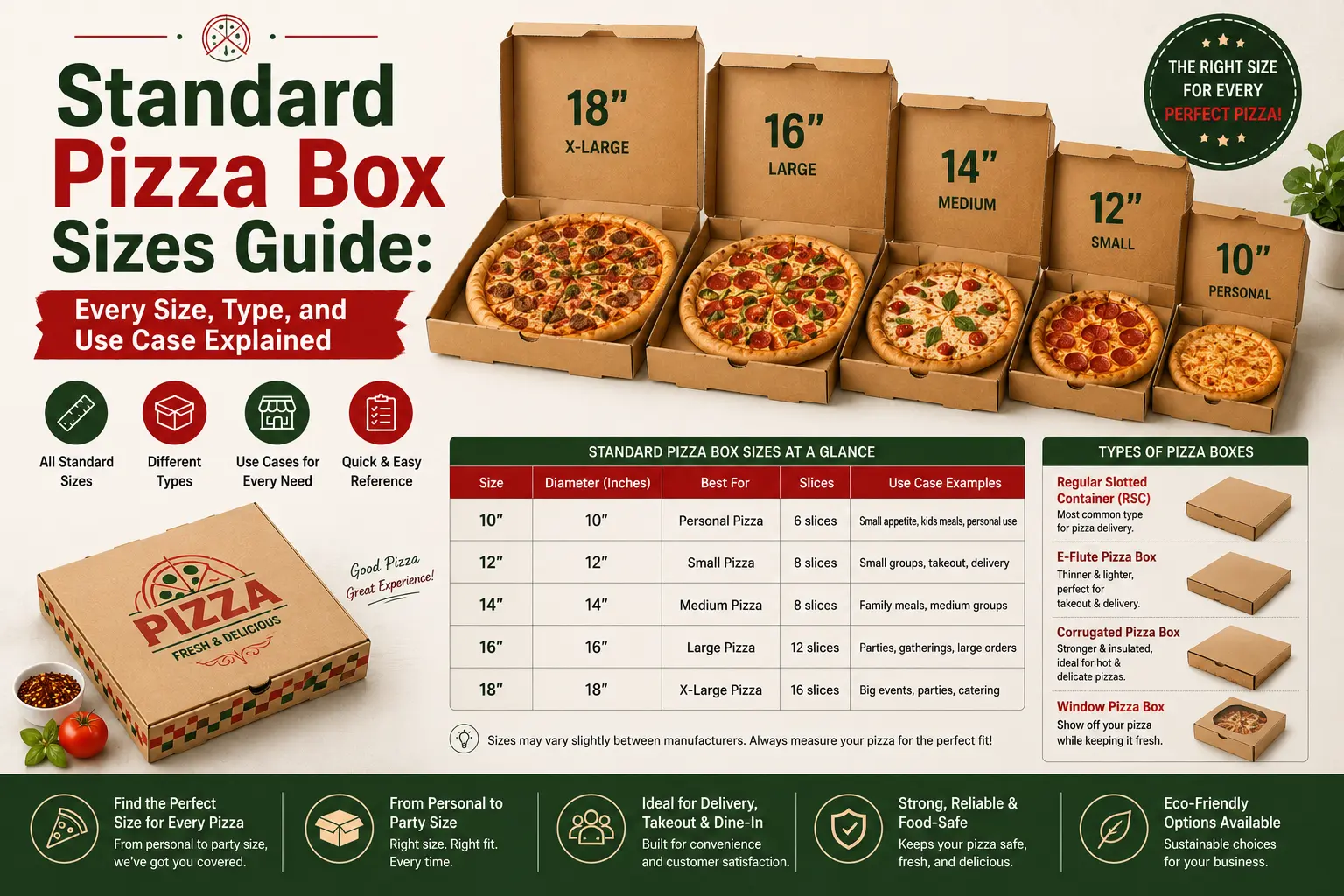
Pizza is one of the most widely consumed foods on the planet, and the box it arrives in is one of the most recognised pieces of packaging in the world. Yet despite its familiarity, the pizza box is a far more considered piece of engineering than most people realise. Its dimensions are not arbitrary. Its construction is the result of decades of practical refinement. And for pizzerias, restaurant chains, and food packaging buyers, getting the size and specification right has direct consequences for food quality, delivery success, operational efficiency, and cost.
This guide covers everything about standard pizza box sizes, from the most common dimensions used across the industry to the reasoning behind those dimensions, the different box types available, how size affects shipping and delivery, and what to look for when buying pizza boxes at any scale.
Why Pizza Box Sizing Matters More Than Most People Think
At first glance, sizing a pizza box seems straightforward. You make a pizza of a certain diameter, you put it in a box slightly larger than that diameter, done. But the reality of pizza packaging involves several competing demands that make size selection more nuanced than it appears.
The box must be large enough to hold the pizza without the lid pressing down on the toppings. It must be small enough that the pizza does not slide around and lose its shape during delivery. It must stack efficiently in the kitchen and delivery vehicle without toppling. It must insulate adequately to maintain temperature from oven to customer. It must be strong enough to support the weight of additional boxes stacked on top of it. And it must fold flat for storage before use, because a busy pizzeria may need hundreds of flat boxes stored in a compact space.
Each of these requirements influences the optimal dimensions of the box. Getting it wrong in any direction creates real operational problems. A box that is too large means a pizza that arrives with all the toppings slid to one side. A box that is too small means a lid that presses into the cheese and ruins the presentation. A box that is too tall wastes stack space in the delivery bag. A box that is too short traps steam against the pizza surface and makes the crust soggy.
For pizza chains and independent pizzerias alike, the box is not just packaging. It is a component of the food quality and customer experience that the brand delivers.
Standard Pizza Box Sizes
Pizza boxes are sized to match standard pizza diameters, and the pizza industry has largely converged on a set of standard pizza sizes that drive the corresponding box dimensions. The box is always slightly larger than the pizza it contains, with the pizza sitting in the centre of the box base and a small gap between the pizza edge and the box wall.
The most widely used convention is for the box to be approximately 1 inch larger in each dimension than the pizza it holds. A 12-inch pizza goes in a 12-inch box, where the 12 inches refers to the internal dimension of the box, not the box itself. This convention varies slightly between manufacturers and regions, but the principle of a snug fit with minimal movement is consistent.
All dimensions below refer to the internal base dimensions of the box unless otherwise noted. Pizza boxes are square, so a single measurement refers to each side of the square base.
Personal Size Pizza Box (6 inch)
Internal dimensions: approximately 6 × 6 × 1.75 inches (15.2 × 15.2 × 4.4 cm)
The 6-inch pizza box is used for personal-size pizzas, individual portion flatbreads, and single-serving artisan pizzas. It is the smallest standard pizza box in commercial use. Personal pizzas are popular in fast casual dining formats, lunch service, and portion-controlled menus. These boxes are also used for individual dessert pizzas and small appetiser flatbreads.
The small footprint of the 6-inch box makes it well suited to single-person delivery orders and to minimising packaging waste on small portion items. It stacks efficiently with larger boxes in delivery bags designed for multi-item orders.
Small Pizza Box (8 inch)
Internal dimensions: approximately 8 × 8 × 1.75 inches (20.3 × 20.3 × 4.4 cm)
The 8-inch box is used for small pizzas, which are popular for individual servings in sit-down restaurant formats, appetiser portions, and kids’ meal options. Some pizzerias use the 8-inch as their smallest standard size rather than offering a 6-inch personal size.
The 8-inch box is also used for packaging other square or round food items of similar dimensions, including large cookies, small cakes, and individual pastries. Its compact dimensions make it efficient to store and transport.
Small-Medium Pizza Box (10 inch)
Internal dimensions: approximately 10 × 10 × 1.75 to 2 inches (25.4 × 25.4 × 4.4 to 5.1 cm)
The 10-inch box serves what many pizzerias designate as their small pizza, typically a two to three serving portion. It is one of the most widely used sizes in independent pizzerias offering multiple size options. The 10-inch size is popular for lunch specials, smaller household orders, and individual orders from customers with larger appetites than a personal pizza satisfies.
The height of 10-inch boxes varies slightly more than smaller sizes because some deep-dish and thick-crust 10-inch pizzas require additional clearance between the pizza surface and the lid.
Medium Pizza Box (12 inch)
Internal dimensions: approximately 12 × 12 × 1.75 to 2 inches (30.5 × 30.5 × 4.4 to 5.1 cm)
The 12-inch pizza box is one of the two most commonly used sizes in the pizza industry globally. It accommodates a pizza typically described as a medium, usually cut into 6 to 8 slices and serving two to three people. The 12-inch is the standard size for a wide range of pizza offerings, from thin-crust Neapolitan styles to pan pizzas and deep-dish variants.
Many delivery-focused pizzerias use the 12-inch as their primary size because it balances portion size, price point, and delivery efficiency effectively. Twelve-inch boxes stack well in standard delivery bags and in the thermal carriers used by delivery drivers.
Large Pizza Box (14 inch)
Internal dimensions: approximately 14 × 14 × 2 inches (35.6 × 35.6 × 5.1 cm)
The 14-inch box is the other most commonly used size in the pizza industry and is the dominant size for large pizza orders in the United States. A 14-inch pizza is typically cut into 8 slices and serves three to four people. It is the most popular delivery size at major pizza chains including Domino’s, Papa John’s, and Pizza Hut in many markets.
The 14-inch box begins to approach the size at which stacking stability in delivery bags becomes a consideration. Most standard delivery thermal bags are designed to accommodate 14-inch boxes efficiently.
Extra Large Pizza Box (16 inch)
Internal dimensions: approximately 16 × 16 × 2 inches (40.6 × 40.6 × 5.1 cm)
The 16-inch box serves extra large pizzas, which are popular for group orders, party settings, and value-focused customers. A 16-inch pizza is typically cut into 8 to 10 slices and comfortably serves four to five people. Some pizzerias designate this as their large size, with the 14-inch being medium.
The 16-inch box requires delivery bags designed to accommodate its larger footprint. Standard compact delivery bags may not fit a 16-inch box without compression, which can damage the pizza. Many high-volume delivery operations use larger thermal carriers specifically sized for 16-inch and larger orders.
Extra Extra Large Pizza Box (18 inch)
Internal dimensions: approximately 18 × 18 × 2 inches (45.7 × 45.7 × 5.1 cm)
The 18-inch box is used for party-size pizzas and is at the upper end of what most standard commercial pizzerias offer. An 18-inch pizza typically serves five to six people and is cut into 10 to 12 slices. It is popular for catering, group dining, and value-conscious consumers who prioritise cost per slice over other considerations.
Handling an 18-inch box requires care because the large, loaded box is awkward to carry with one hand. Delivery of 18-inch pizzas requires appropriately sized thermal carriers and is more demanding physically than delivering smaller sizes.
Party Size Pizza Box (20 inch and above)
Internal dimensions: 20 × 20 inches and larger (50.8 × 50.8 cm and larger)
Some specialty pizzerias and pizza-focused catering operations offer 20-inch, 24-inch, and even larger pizzas for special events and large gatherings. These require correspondingly large boxes that are outside the standard commercial range. Boxes at this size are typically produced by specialty packaging suppliers rather than being stocked as standard items.
A 20-inch pizza weighs considerably more than a standard delivery pizza and requires robust box construction to prevent the base from sagging under the weight of the loaded pizza. Double-wall corrugated is sometimes used for very large pizza boxes to provide adequate support.
Pizza Box Height Dimensions
While the base dimensions of a pizza box are driven primarily by pizza diameter, the height of the box is driven by the pizza’s thickness and topping profile.
Standard thin-crust and New York style pizzas typically require a box height of 1.75 to 2 inches. This provides enough clearance for the toppings without creating excessive empty space that wastes packaging material and reduces stacking efficiency.
Deep-dish, pan pizza, and Chicago-style pizzas have significantly greater height and require deeper boxes. Deep-dish pizza boxes typically have a height of 2.5 to 3.5 inches depending on the specific pizza style and portion size.
Stuffed crust and double-decker pizzas may require even greater box heights, and some specialty pizza formats use custom box heights outside the standard range.
The height of the box also affects how boxes stack in delivery bags and in kitchen storage. Taller boxes reduce the number of pizzas that can be carried in a single thermal bag, which is a meaningful operational consideration for high-volume delivery operations.
Pizza Box Sizes by Major Pizza Chains
While exact proprietary dimensions vary and are not always publicly disclosed, the general size conventions used by major pizza chains provide useful reference points for understanding how the industry approaches standardisation.
Domino’s Pizza uses a range that spans personal through extra large sizes, with their most popular delivery sizes being 12-inch and 14-inch pizzas. Their boxes are designed specifically for their delivery system, including compatibility with their insulated delivery bags.
Pizza Hut offers personal, small, medium, large, and extra large options that correspond broadly to 6, 8 or 9, 12, 14, and 16-inch diameters depending on the market. Their deep-dish and pan varieties use deeper boxes than their thin and hand-tossed equivalents.
Papa John’s similarly uses a range from small through extra large, with their large being 14 inches in most markets. Their box design includes specific ventilation considerations to manage steam from their hand-tossed dough.
Papa Murphy’s, which sells take-and-bake pizzas that are cooked at home, uses a different box design from hot-delivery pizzas. Their boxes must hold an uncooked pizza and maintain its integrity during transport but do not need to retain heat. Their large pizza is 16 inches and their extra large is 18 inches, which are somewhat larger than the equivalent hot-delivery sizes at other major chains.
Independent pizzerias vary considerably more in their size conventions, which is why the general industry size ranges rather than specific chain dimensions are the more useful reference for most packaging decisions.
Types of Pizza Boxes
Beyond their dimensions, pizza boxes come in several structural and material configurations. Understanding these options is important for pizzerias and packaging buyers choosing between them.
Standard Single Wall Corrugated Box
The vast majority of pizza boxes worldwide are made from single wall corrugated cardboard, typically B flute. This construction provides the right balance of rigidity, insulation, lightweight handling, and cost efficiency for standard pizza delivery. Single wall corrugated pizza boxes are the baseline against which other formats are measured. They are available from virtually every food packaging supplier, can be custom printed, and are recyclable after use.
Double Wall Corrugated Box
Double wall corrugated pizza boxes are used for very large pizzas, heavy deep-dish varieties, and catering applications where the base must support substantial weight without sagging. They are more expensive than single wall boxes but provide meaningfully better base support for heavy loads. Some premium pizzerias use double wall for their standard range as a quality signal, appreciating the more substantial feel when the box is handled.
Microflute Corrugated Box
Microflute boxes use very fine fluting (E or F flute) that produces a smoother surface than standard B flute while maintaining reasonable rigidity. The smoother surface is more compatible with high-quality printing, making microflute attractive for premium pizza brands and chains focused on brand presentation. The trade-off is slightly reduced insulation compared to B flute.
Kraft Pizza Box
Some artisan and premium pizzerias use natural unbleached kraft boxes rather than the standard white or printed corrugated boxes. The brown kraft aesthetic aligns with artisan, natural, and premium brand positioning. Kraft pizza boxes are available in both standard and recycled content variants and carry a natural sustainability signal that resonates with environmentally conscious consumers.
Eco and Recycled Content Box
Growing consumer and regulatory pressure on food packaging sustainability has driven significant adoption of pizza boxes with high recycled content, often 80% to 100% recycled corrugated. These boxes are functionally equivalent to standard boxes for most pizza delivery applications and are now offered as standard options by most major packaging suppliers.
Compostable Pizza Box
Some packaging suppliers offer pizza boxes certified as compostable. These boxes are made from materials that break down in industrial composting environments within defined timeframes. However, food-contaminated pizza boxes, particularly those with grease staining, are generally not accepted in standard paper recycling streams, making compostability a more relevant end-of-life route for pizza packaging than recycling in many cases.
Ventilated Pizza Box
Ventilation holes or perforations in the lid and sometimes the sides of a pizza box allow steam to escape from the hot pizza. This reduces condensation on the inside of the lid, which would otherwise drip back onto the pizza surface and make the crust soggy. Many pizza box designs incorporate small vent holes near the top edges of the lid. Some designs use more extensive ventilation patterns. The optimal level of ventilation involves a trade-off between steam escape and heat retention, and different pizza styles benefit from different ventilation levels.
Double Deck or Two-Compartment Box
Some innovative pizza box designs incorporate two separate compartments stacked vertically, allowing two different pizzas or a pizza and a side dish to be packaged in a single box footprint. These designs reduce the number of boxes needed for a multi-item order but are less common than standard single-pizza boxes due to their higher cost and more complex construction.
Square vs Octagonal Box
Most pizza boxes are square, but octagonal pizza boxes exist as a specialty format. They are sometimes used for round pizzas because the cut corners bring the box walls closer to the pizza edges, reducing the gap between the pizza and the box and thereby reducing movement. They also reduce material use slightly compared to a fully square box of equivalent internal dimension. Octagonal boxes are less common than square because they are more expensive to produce and do not stack as efficiently.
Pizza Box Materials in Detail
The materials used in pizza boxes affect their performance across several dimensions that matter directly to pizza quality and food safety.
Corrugated Board Grade
Standard pizza boxes use single wall B flute corrugated, which provides good rigidity, adequate insulation, and efficient stackability. The board weight (measured in ECT or burst strength) is selected to match the weight of the pizza being held. A very heavy deep-dish pizza requires a higher ECT board than a thin-crust pizza of the same diameter to prevent base sag.
Food Safety and Grease Resistance
Pizza boxes must comply with food contact regulations in their respective markets. In the United States, this means compliance with FDA food contact material requirements. The inner surface of the box must not transfer harmful substances to the food. Many pizza boxes incorporate a food-grade barrier treatment on the inner surfaces to resist grease penetration, which both protects the food contact surface and prevents grease from weakening the structural integrity of the corrugated board.
Bleached vs Unbleached Board
The inner liner of a pizza box may be white (bleached) or natural brown (unbleached). White liners are more common in branded pizza boxes because they provide a cleaner, more premium appearance and can accept printed graphics on the inside of the lid. Unbleached liners are used in cost-focused and sustainability-focused applications. Some manufacturers specifically produce food-grade unbleached kraft liners certified safe for direct food contact.
Recycled Content and Food Safety
A longstanding challenge in food packaging has been the use of recycled content in food contact applications. Recycled paper fibres can contain trace mineral oil hydrocarbons (MOAH and MOSH) from printing inks used in previous product cycles. Food safety regulations in the EU and increasingly other markets restrict the transfer of these compounds to food. This has driven the development of functional barriers in pizza box inner liners that allow high recycled content in the outer structural layers while maintaining a safe food contact surface.
How to Choose the Right Pizza Box Size
Selecting the correct pizza box for a given pizza requires matching the box to both the pizza diameter and the pizza style.
For diameter matching, the box internal dimension should equal the pizza diameter. A 12-inch pizza goes in a 12-inch box. There is enough natural variation in hand-stretched pizza diameters and in box manufacturing tolerances that this relationship works in practice without requiring additional clearance. Some pizzerias prefer to go one size up from the pizza diameter to give additional clearance for thick toppings, but this increases the risk of pizza movement during delivery.
For height matching, a standard thin-crust pizza requires a 1.75 to 2-inch box height. A standard hand-tossed pizza typically requires 2 inches. A deep-dish or pan pizza requires 2.5 to 3.5 inches. A stuffed crust may require up to 3 inches. Ordering a box with insufficient height results in the lid pressing into the toppings, which ruins presentation and causes topping displacement. Ordering a box with excess height wastes material and reduces stacking efficiency.
For weight considerations, the structural specification of the box (measured by ECT rating or board weight) must be adequate to support the pizza weight plus the weight of additional boxes stacked on top during delivery. Most standard commercial pizza boxes are rated for their intended pizza weight plus normal delivery stack loads. Very heavy pizzas or long stack heights in catering applications may require upgraded structural specifications.
Pizza Box Dimensions and Delivery Thermal Bags
The compatibility between pizza box dimensions and delivery thermal bags is a practical operational consideration that is often overlooked when pizza box sizes are first selected.
Standard insulated pizza delivery bags are designed around the most common pizza box sizes, typically accommodating boxes from 12 to 16 inches. Many standard bags hold up to three 12-inch or 14-inch boxes stacked. Bags intended for large-scale catering delivery accommodate 16-inch and larger boxes.
When a pizzeria changes its standard box size, it may also need to change its delivery bags to maintain compatibility. A 16-inch box that fits loosely in a bag designed for 14-inch boxes will allow the box to shift and tilt during transit, which is as damaging to the pizza as an oversized box.
Delivery bags also have a height capacity that limits how many boxes can be stacked inside. A bag designed for three 2-inch deep boxes will not accommodate three 3-inch deep-dish boxes without compression. This is why deep-dish pizzerias often use larger, taller delivery bags than thin-crust focused operations.
For electric vehicle and bicycle delivery, which is increasingly common in urban markets, bag capacity and weight are additional constraints. Smaller pizza sizes and lower stack heights are sometimes preferred in these delivery models to manage weight and bag size on two-wheeled vehicles.
Pizza Box Sizes for Catering and Bulk Orders
Catering and bulk pizza orders introduce additional sizing and logistics considerations beyond standard delivery operations.
For catering, pizzerias often prepare multiple large pizzas simultaneously. The logistics of transporting 10, 20, or more pizza boxes requires careful planning around box dimensions, delivery vehicle capacity, and insulated carrier capacity.
Half-sheet and full-sheet pizza boxes are used for rectangular party-cut pizzas served at events and in school cafeteria settings. A half-sheet box is typically 13 × 18 inches internally, while a full-sheet box is typically 16 × 22 to 18 × 26 inches. These sizes are distinct from round pizza boxes and serve a different market segment focused on volume and cost per serving rather than individual delivery.
Catering also commonly uses pizza box inserts and dividers to separate different pizza varieties within a single box or to hold side items alongside the pizza. These inserts are sized to fit specific box dimensions and must be specified alongside the box when ordering.
Sustainability and Pizza Boxes
Pizza boxes sit in an interesting position in the packaging sustainability debate. Corrugated cardboard is generally recyclable, but pizza boxes are often contaminated with grease and food residue, which can compromise the recycling process.
The conventional guidance that grease-stained pizza boxes cannot be recycled has been revised by many municipalities and recycling organisations in recent years. Research has shown that moderate grease contamination does not significantly affect the quality of recycled paper pulp produced from pizza boxes in most cases. Many recycling programs now accept pizza boxes with light to moderate grease staining. Only heavily saturated boxes, where grease has soaked through the entire board, are typically excluded from recycling.
This has led to clearer guidance from many waste management authorities: the greasy parts of a pizza box can be torn off and composted while the clean parts are recycled, or the whole box can be composted if a food waste composting system is available.
The sustainability focus in pizza box development has shifted toward increasing recycled content in the board, eliminating unnecessary plastic components such as the small plastic table used to prevent the lid from contacting the pizza surface (called a pizza saver), and developing certified compostable box variants for markets where composting infrastructure is available.
Several major pizza chains have made public commitments to 100% recyclable or compostable packaging within defined timeframes, which is driving meaningful change in the specifications used by the broader industry.
Customisation and Printing for Pizza Boxes
For pizzerias and pizza brands, the pizza box is one of the most visible brand surfaces in their marketing mix. Every delivered pizza arrives in a box that sits on the customer’s table, counter, or lap for the duration of the meal, providing extended brand exposure.
Custom printed pizza boxes are available from most commercial food packaging suppliers. Printing options range from basic one or two-colour flexographic printing on kraft or white board to full-colour high-definition printing on premium microflute or litho-laminated board.
The design area available on a pizza box includes the lid top, which is the most visible surface and the primary brand canvas, plus the four sides of the lid and potentially the four sides of the base. Most standard pizza box branding focuses on the lid top and the two long sides of the lid, which are visible when the box is carried.
For independent pizzerias with lower order volumes, generic printed pizza boxes with a simple logo or stamp-based identification are a cost-effective alternative to fully custom boxes. These are available from packaging distributors and allow personalisation without the minimum order quantities required for fully custom printing.
Minimum order quantities for custom printed pizza boxes vary by supplier and print method. Flexographic printing typically requires a minimum of 500 to 1,000 boxes to amortise the plate cost economically. Digital printing allows lower minimums, sometimes as few as 50 to 100 boxes, though at a higher per-unit cost.
FAQs
What are the standard pizza box sizes?
The most commonly used standard pizza box sizes are 10 inch, 12 inch, 14 inch, and 16 inch, referring to the internal base dimension. These correspond to small, medium, large, and extra large pizzas in most pizzeria sizing conventions. Personal size 6-inch and 8-inch boxes are also widely used, and 18-inch and 20-inch boxes are available for party-size pizzas.
What size box does a 12-inch pizza go in?
A 12-inch pizza goes in a 12-inch box, where the internal base dimension of the box matches the pizza diameter. The box internal dimension is 12 × 12 inches, with a height of 1.75 to 2 inches for thin-crust or 2.5 to 3 inches for deep-dish varieties.
What size box does a 16-inch pizza go in?
A 16-inch pizza goes in a 16-inch box with internal base dimensions of 16 × 16 inches. The height is typically 2 inches for standard crust and up to 3 or more inches for thick-crust varieties.
Are pizza boxes square or round?
Pizza boxes are almost universally square rather than circular, even though most pizzas are round. A square box is significantly cheaper to manufacture than a round box, stacks more efficiently, and requires simpler manufacturing equipment. The corners of the box provide structural support that a round box would lack.
Why is there a small plastic table in the middle of some pizza boxes?
The small plastic tripod placed in the centre of some pizza boxes is called a pizza saver or box saver. Its purpose is to prevent the lid of the box from sagging down and contacting the top of the pizza, which would pull off toppings when the lid is opened. Many pizzerias have moved away from plastic pizza savers due to their environmental impact and because properly designed boxes with adequate height do not require them.
Can pizza boxes be recycled?
Pizza boxes with light to moderate grease staining are accepted by many recycling programs. Heavily grease-soaked boxes are generally not accepted. The clean lid portion of a lightly soiled box can often be recycled separately from the grease-stained base. Composting is an alternative end-of-life route for food-contaminated pizza boxes.
What is the most popular pizza box size?
The 14-inch pizza box is the most widely used size in the United States, corresponding to the large pizza that is the most popular order size in American pizza delivery. Globally, the 12-inch box is also extremely common and is the dominant size in many markets outside the United States.
How deep should a pizza box be?
A standard thin-crust pizza box should be 1.75 to 2 inches deep. A hand-tossed pizza requires approximately 2 inches. A deep-dish or pan pizza requires 2.5 to 3.5 inches. Insufficient box depth causes the lid to press into the toppings.
How many pizza boxes fit on a standard pallet?
A standard 48 × 40 inch pallet can accommodate approximately 12 to 16 flat 14-inch pizza boxes per layer depending on orientation. With typical pallet stack heights of 6 to 8 layers, a full pallet holds approximately 72 to 128 boxes of flat 14-inch pizza boxes. Smaller boxes fit more per layer; larger boxes fit fewer.
What is the difference between a pizza box and a pizza tray?
A pizza tray is a rigid, flat base without a lid, used for carrying and serving pizza rather than for delivery packaging. Pizza trays are used in sit-down restaurants and buffet settings. A pizza box is the full lidded packaging format used for delivery and takeaway.
Quick Reference: Standard Pizza Box Sizes
| Pizza Size | Box Internal Dimension | Standard Height | Serves |
|---|---|---|---|
| Personal | 6 × 6 inches (15.2 × 15.2 cm) | 1.75 inches | 1 person |
| Small | 8 × 8 inches (20.3 × 20.3 cm) | 1.75 inches | 1 to 2 people |
| Small-Medium | 10 × 10 inches (25.4 × 25.4 cm) | 1.75 to 2 inches | 2 to 3 people |
| Medium | 12 × 12 inches (30.5 × 30.5 cm) | 1.75 to 2 inches | 2 to 3 people |
| Large | 14 × 14 inches (35.6 × 35.6 cm) | 2 inches | 3 to 4 people |
| Extra Large | 16 × 16 inches (40.6 × 40.6 cm) | 2 inches | 4 to 5 people |
| Extra Extra Large | 18 × 18 inches (45.7 × 45.7 cm) | 2 to 2.5 inches | 5 to 6 people |
| Party Size | 20 × 20 inches and above (50.8 × 50.8 cm) | 2.5 inches | 6 or more |
| Half Sheet | 13 × 18 inches (33 × 45.7 cm) | 2 inches | Large group |
| Full Sheet | 16 to 18 × 22 to 26 inches | 2 inches | Very large group |
| Deep Dish (any) | Same as standard by diameter | 2.5 to 3.5 inches | Same as standard |