

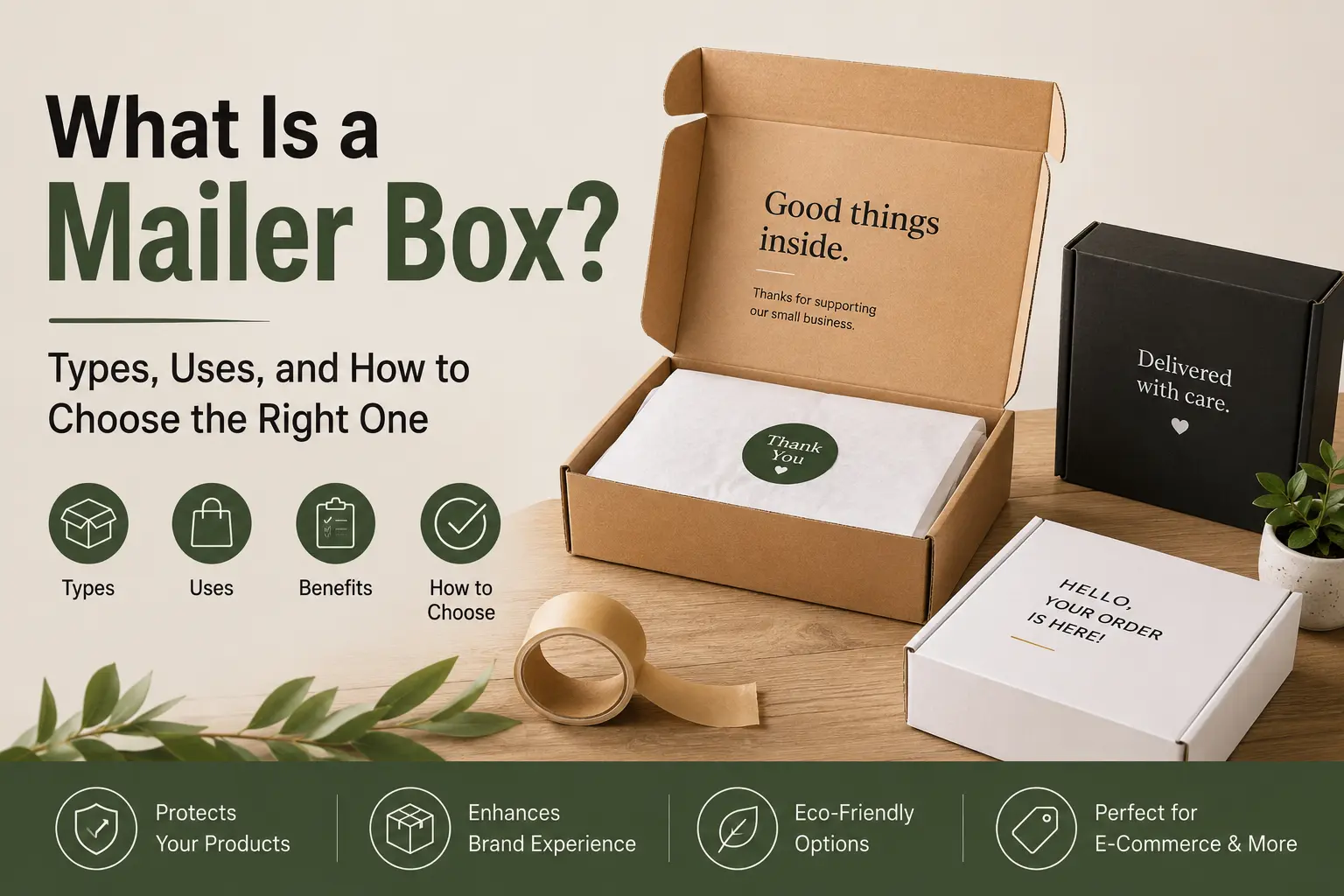
The way a product arrives at a customer’s door has become as important as the product itself. In an era where unboxing videos attract millions of views and first impressions shape brand loyalty, the humble shipping container has transformed into a deliberate marketing tool. At the centre of this shift is the mailer box.
Mailer boxes are now one of the most popular packaging formats in e-commerce, subscription services, and direct-to-consumer brands. Yet there is genuine confusion about what a mailer box actually is, how it differs from a regular shipping box, what types exist, and how to decide whether it is the right choice for a given product and business.
This guide answers all of those questions thoroughly, covering construction, types, materials, sizing, printing, costs, and the key decision factors that determine whether a mailer box earns its place in your packaging strategy.
What Is a Mailer Box?
A mailer box is a self-locking, single-piece corrugated or rigid paperboard box that does not require tape, glue, or staples to stay closed. It is designed to be assembled and sealed quickly, to protect its contents during shipping, and increasingly to create a positive opening experience for the recipient.
The defining structural feature of a mailer box is its interlocking tuck closure system. The lid and base of the box are formed from a single die-cut blank that folds into shape, with the lid closing securely by tucking into the base or locking through a tab-and-slot mechanism. This design means the box holds itself together under normal shipping conditions without any additional sealing materials.
Most mailer boxes are made from corrugated cardboard, typically single wall E flute or B flute, which provides a good balance of protection, lightweight construction, and a smooth printable surface. Some premium mailer boxes use rigid chipboard for an even more substantial feel and appearance.
The term “mailer box” is sometimes used interchangeably with “shipping box” or “e-commerce box,” but there are meaningful differences. A standard shipping box (typically a Regular Slotted Container or RSC) requires tape to close and is optimised purely for protection and cost efficiency. A mailer box prioritises ease of assembly, no-tape closure, and the opening experience, often at a slightly higher material cost.
How a Mailer Box Is Constructed
Understanding the construction of a mailer box helps clarify why it behaves differently from other box types and why it suits certain applications better than others.
A mailer box is cut from a single flat sheet of corrugated or paperboard material using a precision steel rule die. This cutting and scoring process creates a flat blank with all the fold lines, cut lines, and lock tabs pre-formed. The blank ships and stores flat, which is a significant logistical advantage. A stack of flat mailer box blanks occupies a fraction of the storage space of pre-assembled boxes.
When it is time to pack a product, the person assembling the box folds along the scored lines to form the base, inserts the product, and then folds and tucks the lid into place. A well-designed mailer box can be assembled in under ten seconds by someone familiar with the format.
The interlocking lid closure works because the lid panel is slightly larger than the base, with tuck-in flaps that slide between the inner and outer walls of the base when the lid is closed. Friction and the stiffness of the material hold the closure securely without adhesive. For added security, particularly for heavier contents, a small piece of tape can be applied across the seam, though this is optional rather than structurally necessary.
The corrugated material used in most mailer boxes is typically E flute, which has a very fine wave pattern that produces a smooth, near-flat outer surface ideal for printing. Some heavier-duty mailer boxes use B flute for greater crush resistance, while very lightweight or premium-feel mailer boxes use rigid chipboard laminated with a decorative outer layer.
Types of Mailer Boxes
Mailer boxes come in several configurations, each suited to different products, price points, and branding objectives.
Standard Mailer Box (Tuck-Top Auto-Lock)
This is the most common mailer box configuration. The base assembles using an auto-lock bottom, where the base panels interlock automatically when folded, creating a strong floor without any tape. The top closes by tucking a flap into the front of the box. It is fast to assemble, secure in transit, and the most cost-effective mailer box format. It is used across a very wide range of products from cosmetics to electronics accessories to subscription boxes.
Two-Piece Mailer Box (Lid and Tray)
This format consists of a separate tray base and a telescoping lid that slides over the top. It provides a more premium unboxing experience than a tuck-top box because the lid lifts cleanly off the base in one smooth motion. It is commonly used for high-end cosmetics, premium food products, gift boxes, and luxury goods. The trade-off is slightly higher material cost and longer assembly time compared to a single-piece tuck-top box.
Snap-Lock Mailer Box
A snap-lock base uses a series of interlocking panels that snap together to form a rigid, flat-bottomed base without tape or glue. Combined with a tuck-top lid, this creates a very sturdy structure suited to heavier products. Snap-lock bases take marginally longer to assemble than auto-lock bases but produce a stronger floor panel.
Full Overlap Mailer Box
In this configuration, the lid flaps fully overlap each other when closed, creating a double layer of material across the entire top of the box. This significantly increases resistance to the lid popping open under impact or pressure. It is used for heavier contents and for products that will experience rough handling in the supply chain.
Rigid Mailer Box (Rigid Setup Box)
Rigid mailer boxes are constructed from thick chipboard that does not fold flat. They are permanently assembled and shipped nested rather than flat. This produces a noticeably more substantial and premium feel than corrugated mailer boxes, with sharper corners and a heavier overall weight. They are used almost exclusively for luxury and premium products where the box itself is part of the product experience, such as high-end jewellery, watches, premium spirits, and luxury cosmetics. The significantly higher cost and inability to ship flat make them impractical for high-volume everyday shipping.
Corrugated Mailer Box with Interior Printing
This is not a distinct structural type but a specification choice worth noting separately. Many brands print the interior of their mailer boxes as well as the exterior, creating a full-colour branded experience when the box is opened. Since the interior surface of a corrugated box is typically a different paper grade than the exterior, the printing characteristics differ, and the design must account for this. Interior printing adds cost but is one of the most impactful ways to elevate the unboxing experience.
Common Mailer Box Sizes
Mailer boxes are available in a very wide range of sizes, and choosing the correct size for a product is one of the most important decisions in the packaging design process. An oversized mailer box requires void fill to prevent product movement, increases dimensional weight charges, and looks careless to the recipient. An undersized box may not close properly or may damage the product.
Most packaging suppliers offer a range of standard mailer box sizes that cover the majority of common product dimensions. Common standard sizes in inches include formats suited to small accessories, mid-size apparel items, books, multi-product subscription boxes, and larger gift sets.
For e-commerce businesses shipping large volumes of a single product or a defined product range, custom-sized mailer boxes are typically more economical in the long run than adapting products to standard sizes. Custom sizing eliminates excess void fill, reduces dimensional weight, and creates a tighter, more professional fit.
When sizing a mailer box, the internal dimensions are what matter for product fit. A box specified as 12 × 9 × 4 inches refers to the internal dimensions. The external dimensions will be larger by the thickness of the corrugated material on each side, typically adding between 3mm and 8mm per side depending on flute type and board grade.
A useful sizing rule is to allow 5 to 10mm of clearance on each side between the product and the box wall for products that do not require internal protective packaging. For fragile products requiring foam, tissue, or other inserts, the clearance should be calculated based on the thickness of the insert material rather than the product dimensions alone.
Mailer Box Materials and Specifications
The performance and appearance of a mailer box depend significantly on the materials used in its construction.
Corrugated board is the most widely used material for mailer boxes. The most common grades are E flute and B flute. E flute produces thinner, lighter board with a smoother print surface, well suited to lighter products and retail-quality printing. B flute is thicker and stronger, better suited to heavier products but with a slightly less smooth print surface. Some heavier-duty mailer boxes use EB flute, combining both layers for maximum strength.
The liner paper on the outer surface of the corrugated board determines print quality more than any other material factor. A coated white top liner (CTWT) provides a bright white surface that produces the most vibrant and accurate colour printing. A kraft liner produces the natural brown surface associated with the sustainable aesthetic popular with eco-conscious brands. The choice between these has significant impact on both the visual appearance of the finished box and its printing cost.
The fluting medium (the wavy inner layer) in most mailer boxes is made from semi-chemical or recycled fibre. This does not significantly affect the external appearance but contributes to the overall strength and weight of the board.
Rigid chipboard used in premium setup boxes is graded by thickness, typically measured in points or millimetres. Common thicknesses for mailer-style rigid boxes are 1.5mm and 2mm board. Thicker board produces a more substantial feel but adds weight and cost.
Recycled content varies widely between suppliers. Many standard mailer boxes use a combination of recycled and virgin fibre. For brands with sustainability commitments, it is worth verifying the recycled content percentage and whether the board is FSC-certified.
Printing Options for Mailer Boxes
One of the primary reasons brands choose mailer boxes over standard shipping cartons is the opportunity to use the box as a brand communication surface. The exterior of a mailer box is a printable canvas that travels directly to the end customer.
Flexographic printing is the most cost-effective printing method for corrugated mailer boxes at medium to high volumes. Flexo uses flexible relief plates to transfer ink onto the box surface, producing consistent results at high speeds. It is well suited to bold graphics, spot colours, and text but has limitations with fine detail and photographic imagery. Most custom mailer boxes ordered in quantities above a few hundred units are printed using flexography.
Digital printing has become increasingly viable for corrugated packaging in recent years. Digital printing requires no printing plates, making it cost-effective at very low volumes and enabling high levels of customisation, including personalised individual boxes. Print quality is excellent and supports photographic imagery and fine detail. The trade-off is higher per-unit cost at larger volumes compared to flexography, though this gap has been narrowing as digital printing technology improves.
Lithographic lamination (litho-lam) produces the highest quality print result on corrugated packaging. A separately printed paper sheet is lithographically printed to magazine-quality standards and then laminated onto the corrugated board. The result is exceptional colour accuracy, fine detail, and a finish quality that rivals folding carton packaging. It is used for premium retail mailer boxes where appearance is paramount. The cost is significantly higher than direct flexographic printing and requires minimum order quantities that may not suit small businesses.
Surface finishes applied after printing include gloss lamination, matte lamination, soft-touch lamination, spot UV coating, embossing, and foil stamping. These finishes add visual and tactile interest to the box exterior and are widely used for premium and gift-oriented products. Many of these finishes reduce or eliminate recyclability, which is a growing consideration for brands with sustainability commitments.
Interior printing can be applied to the inside surfaces of a mailer box, typically using a kraft or white inside liner as the base. Interior printing is often deliberately contrasted with the exterior, using bright brand colours, patterns, or messaging to create a surprise when the box is opened. This technique is particularly common in subscription box packaging, where the interior is designed to generate social media sharing.
The Unboxing Experience and Why It Matters
The concept of the unboxing experience has moved from a niche marketing observation to a mainstream business consideration. Research and commercial evidence consistently show that packaging quality affects customer perception, brand recall, and likelihood of repeat purchase.
A well-designed mailer box contributes to this experience in several ways. The resistance of a quality mailer box when the lid is lifted creates a physical signal of quality. The reveal of a well-presented interior, with tissue paper, custom inserts, and interior printing, transforms the functional act of opening a package into an experience worth remembering and sharing.
For direct-to-consumer brands, the mailer box is often the only physical touchpoint between the brand and the customer. Unlike retail products that sit on a shelf surrounded by other brands and can be physically examined before purchase, e-commerce products arrive in a box that is the first tangible expression of the brand the customer encounters. Making that expression positive and consistent with the brand’s values and aesthetics is a genuine competitive advantage.
The growth of unboxing content on social media platforms has amplified the value of packaging design. A significant percentage of consumers have watched unboxing content, and attractive, distinctive packaging measurably increases the likelihood of being featured in user-generated content. This is essentially free marketing, generated by packaging that the customer finds worth sharing.
When to Use a Mailer Box vs. Other Packaging Formats
A mailer box is not always the right choice. Understanding where it fits relative to alternative formats helps make the decision straightforward.
A mailer box is the right choice when the product benefits from a quality unboxing experience, when the brand wants to use the shipping package as a brand expression surface, when the product does not require the maximum structural protection of a heavy-duty shipping carton, and when the convenience of a no-tape closure is valued by the packing team.
A standard RSC shipping box is more appropriate for very heavy products that require maximum compressive strength, for products that will be packed into outer shipper cartons for bulk distribution, and for businesses where cost per unit is the primary consideration and brand presentation is secondary.
A poly mailer is more appropriate for soft, non-fragile items like clothing, where the primary packaging requirement is simply containing the product, and where dimensional weight is a significant cost factor. Poly mailers add almost no dimensional weight and are the most economical format for these applications, though they offer no unboxing experience value.
A rigid setup box is appropriate when the box will be retained and reused by the customer, when the product itself is at a price point that justifies premium packaging investment, and when the box needs to convey luxury through its physical weight and rigidity.
Padded mailers and bubble mailers are appropriate for small, moderately fragile items like jewellery, glasses, or small electronics, where the product needs some cushioning but does not justify the volume or cost of a full mailer box.
Cost Considerations for Mailer Boxes
Mailer boxes cost more per unit than equivalent-sized standard RSC cartons. This premium reflects the more complex die-cut design, the typically higher-quality board and liner specifications, and the printing that most brands apply. Understanding what drives the cost helps make informed decisions.
Board grade and flute type are the primary material cost drivers. B flute board costs more than E flute. Double wall board costs significantly more than single wall. Upgrading from a kraft liner to a coated white top liner adds both material and printing cost.
Print coverage and colours affect cost significantly for flexographic printing. Each additional colour requires an additional printing plate and an additional pass through the press. Full-coverage printing on all panels costs more than partial-coverage printing. For digital printing, coverage affects ink cost but not plate cost.
Printing plates for flexographic printing are a fixed setup cost that is amortised across the print run. At low volumes, the plate cost is a significant portion of the total cost per unit. At high volumes, it becomes negligible. This is why unit costs for mailer boxes typically decrease substantially as order quantities increase.
Surface finishes such as lamination, spot UV, and foil stamping add both material and processing costs. Matte lamination is generally less expensive than gloss. Soft-touch lamination and foil stamping are among the most expensive finishing options.
Custom sizing typically adds tooling cost for a custom die but may reduce ongoing material cost if the custom size is significantly more efficient than the nearest standard size.
For businesses evaluating the return on investment of premium mailer boxes, the calculation should account not just for the box cost itself but for the reduction in void fill requirements from a well-fitted box, the potential reduction in damage rates from better-fitting packaging, and the brand value generated through a superior unboxing experience and the social sharing it encourages.
Sustainability Considerations for Mailer Boxes
As consumer and regulatory pressure on packaging sustainability increases, mailer boxes made from corrugated board are in a favourable position relative to many alternatives.
Corrugated board is widely recycled, made from renewable wood fibre, and typically contains a high proportion of recycled content. A plain or flexo-printed corrugated mailer box is fully recyclable in standard paper recycling streams and is compostable.
The main sustainability complications arise from finishing treatments. Gloss or matte lamination, spot UV coating, and wax coatings make the box difficult or impossible to recycle through standard streams. Foil stamping introduces metallic materials. Brands with strong sustainability commitments are increasingly choosing water-based coatings and unlaminated finishes that preserve recyclability while still achieving a premium visual result.
The elimination of tape from the mailer box closure is itself a meaningful sustainability benefit. Polypropylene tape is a contaminant in paper recycling streams. A tapeless mailer box that arrives at the recycling facility needs no preparation before being processed, unlike a taped RSC that must have the tape removed.
Some brands specify minimum recycled content percentages for their mailer boxes and require FSC certification to verify responsible forest sourcing. These requirements are increasingly standard among larger e-commerce businesses and are becoming expected supplier qualifications rather than premium differentiators.
FAQs
What is the difference between a mailer box and a shipping box?
A mailer box is a self-locking box that requires no tape to close, is designed for a quality opening experience, and is typically printed with brand graphics. A shipping box (usually an RSC) requires tape to seal, is optimised for cost and structural protection, and is typically unprinted or minimally printed. Mailer boxes prioritise presentation; shipping boxes prioritise economy and protection.
Can mailer boxes be recycled?
Yes, corrugated mailer boxes without lamination, wax coating, or foil stamping can be recycled through standard cardboard recycling streams. Boxes with plastic lamination or foil finishes may not be accepted by standard recycling facilities.
Do mailer boxes need tape?
No. The defining feature of a mailer box is its tuck-and-lock closure that holds without tape. However, tape can optionally be added for additional security, particularly for heavier contents or longer supply chains.
What is the minimum order quantity for custom printed mailer boxes?
This varies by supplier and printing method. Digital printing typically allows orders from as few as 25 to 50 units. Flexographic printing usually requires a minimum of 250 to 500 units to amortise the plate costs economically, though some suppliers accept lower minimums at a higher unit price.
What flute is best for mailer boxes?
E flute is the most popular choice for mailer boxes because it produces a thin, smooth board with excellent printability while providing adequate protection for most light-to-medium weight products. B flute is better for heavier products requiring greater crush resistance. EB flute combines both properties for demanding applications.
How do I measure the right size mailer box for my product?
Measure the product at its maximum dimensions including any inner packaging, tissue paper, or inserts. Add 5 to 10mm clearance on each side for a snug fit without inner packaging, or the thickness of your inner packaging material if you are using inserts. The resulting internal dimensions are your target box size.
What is the difference between a rigid mailer box and a corrugated mailer box?
A rigid mailer box is made from thick chipboard and is permanently assembled, not folding flat for storage. It has a substantially heavier, more premium feel. A corrugated mailer box is made from fluted corrugated board, ships flat, and is folded into shape for packing. Rigid boxes cost significantly more and are used for luxury products. Corrugated boxes are used for the broad range of everyday e-commerce shipping applications.
Can the inside of a mailer box be printed?
Yes. Interior printing is a popular way to elevate the unboxing experience. It typically uses the inside liner as the print surface and can include brand colours, patterns, messaging, or instructions. Interior printing adds cost but is one of the highest-impact ways to differentiate packaging.
Key Takeaways
The mailer box has evolved from a purely functional shipping container into one of the most strategically important touchpoints in direct-to-consumer brand building. Its self-locking construction, flat-pack logistics efficiency, printable surfaces, and adaptability to almost any product category and brand aesthetic make it the format of choice for e-commerce businesses that take their customer experience seriously.
Choosing the right mailer box involves matching the structural specification to the product’s weight and fragility, sizing it accurately to minimise void fill and dimensional weight costs, selecting a print and finish specification that reflects the brand’s positioning and sustainability commitments, and ordering at a volume that makes the unit economics work.
When all of these factors are aligned, a mailer box does something that almost no other packaging format can do equally well: it protects the product, reduces shipping costs through efficient sizing, communicates the brand, and creates a moment of positive feeling for the person opening it. That combination of functional and emotional value is why the mailer box has become the defining packaging format of the e-commerce.