

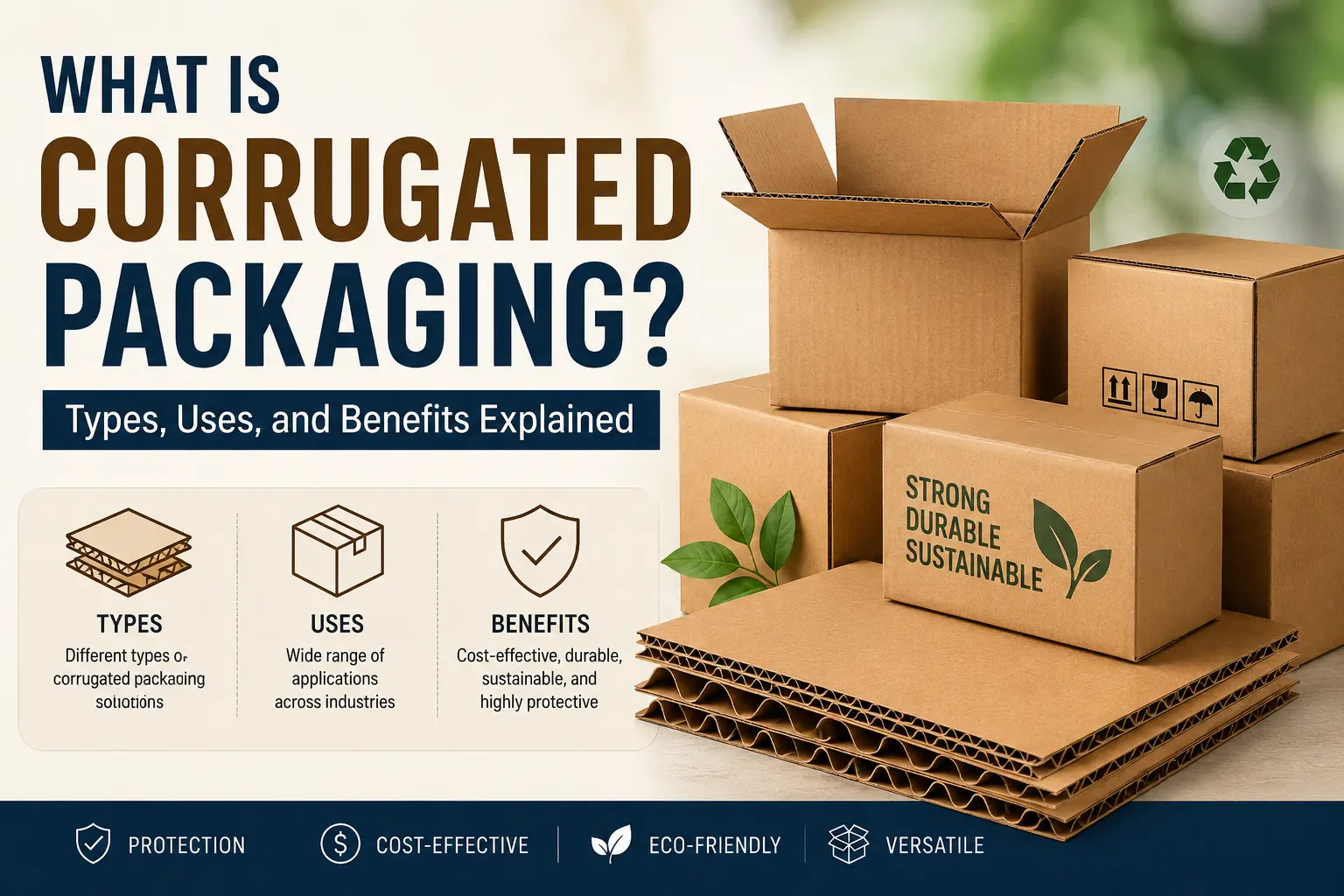
Walk into any warehouse, open any delivered parcel, or visit any grocery store’s back room, and you will find corrugated packaging everywhere. It is the most widely used packaging material in the world, responsible for protecting everything from fragile electronics to fresh produce to industrial machinery parts during transit.
Yet most people, including many business owners, use the terms “corrugated” and “cardboard” interchangeably. They are not the same thing, and understanding the difference matters more than you might expect when it comes to choosing the right packaging for your products.
This guide covers what corrugated packaging actually is, how it is made, the different types and flute grades available, where it is used across industries, and why it remains the dominant packaging choice globally despite decades of alternative materials competing against it.
What Is Corrugated Packaging?
Corrugated packaging is a type of packaging material made from three or more layers of paper, with at least one wavy, arched inner layer (called the flute) sandwiched between flat outer layers (called liners). This fluted structure is what gives corrugated packaging its defining characteristics: strength, rigidity, cushioning ability, and light weight relative to its protective capacity.
The term “corrugated” refers specifically to the wave-like fluted medium in the middle of the board. This is what separates corrugated material from plain cardboard, which is a single solid sheet of thick paper with no internal structure.
When most people say “cardboard box,” they almost always mean a corrugated box. True cardboard is the material used in cereal boxes, greeting cards, and paperback book covers. Corrugated is what your Amazon delivery arrives in.
The difference matters because corrugated board can withstand significantly greater compressive, bending, and impact forces than plain cardboard of equivalent weight. The arch structure of the flute distributes load across the material in the same way that a Roman arch distributes the weight of a building. This geometry is the source of corrugated packaging’s strength.
How Corrugated Packaging Is Made
Understanding the manufacturing process helps explain why corrugated board behaves the way it does and why different types suit different applications.
The process begins with paper rolls, typically made from recycled fibre, virgin kraft pulp, or a combination of both. These rolls feed into a machine called a corrugator.
The corrugator heats the middle paper layer with steam until it becomes pliable, then runs it through a set of meshing fluted rollers that press the wave pattern into it. This fluted medium is then glued to flat liner sheets on one or both sides using a starch-based adhesive. The assembled board is then cut, scored, and converted into flat sheets or directly into box blanks.
The entire process is highly automated and can run at speeds exceeding 300 metres per minute in modern facilities. The speed, scalability, and relatively low raw material cost of this process are core reasons why corrugated packaging is so economically accessible across virtually every industry.
After conversion, the flat board is die-cut and scored into specific box shapes, which are then folded, glued, or stitched into the finished packaging. The scoring lines are precisely placed to ensure clean, accurate folds that maintain the structural integrity of the finished box.
The Anatomy of a Corrugated Board
A corrugated board consists of three fundamental components:
The outer liner is the flat outer facing of the board that you see on the outside of a finished box. It provides the printable surface for branding, labelling, and regulatory information.
The inner liner is the flat facing on the inside of the box, in contact with the product. It contributes to stacking strength and overall rigidity.
The fluting medium is the wavy, corrugated paper layer between the two liners. Its height, thickness, and wave frequency (flute type) determine how much cushioning and compression resistance the board provides.
The quality and weight of each of these layers, measured in grams per square metre (GSM), directly affects the strength and performance of the finished board. Higher GSM liners produce stronger, stiffer board. The choice of recycled versus virgin fibre affects both strength and moisture resistance.
Types of Corrugated Board
Corrugated board comes in several structural configurations depending on how many liners and fluted layers are combined. Each configuration has a different strength profile and is suited to different applications.
Single Face Corrugated consists of one flat liner glued to one fluted medium, with no second liner. This produces a flexible, one-sided corrugated sheet rather than a rigid board. Single face corrugated is used primarily as a wrapping material to protect cylindrical or irregular products, as an inner layer in packaging systems, and as surface protection during shipping and storage.
Single Wall Corrugated (also called double face or three-layer board) is the most common corrugated board configuration. It consists of two flat liners with a single fluted medium between them. This is the standard material for most e-commerce shipping boxes, retail packaging, and general-purpose cartons. It offers a good balance of strength, printability, and cost.
Double Wall Corrugated consists of three liners and two fluted layers. This produces a significantly stronger and thicker board than single wall. It is used for heavier products, longer supply chains, international shipping, and situations where stacking strength is critical. Industrial equipment parts, heavy food products, and bulky consumer goods are commonly shipped in double wall boxes.
Triple Wall Corrugated consists of four liners and three fluted layers. This is an industrial-grade material that can approach the load-bearing capacity of light wooden crates at a fraction of the weight. Triple wall corrugated is used for extremely heavy products, industrial machinery components, and as a replacement for wooden pallets and crates in some applications.
Flute Types and What They Mean
The flute is the wave pattern in the corrugated medium, and its characteristics significantly affect the performance of the finished board. Flutes are classified by letter grades based on their height (the distance between the top and bottom of the wave) and their frequency (the number of waves per linear foot).
A Flute is the tallest flute type, with a height of approximately 4.8mm and around 33 flutes per linear foot. Its tall arch structure provides the greatest cushioning and resistance to vertical compression. A flute is used for fragile products, heavy items, and packaging that needs to absorb significant impact energy. However, its height means it produces thicker board, which takes up more storage and shipping space.
B Flute has a height of approximately 2.4mm and around 47 flutes per linear foot. Its shorter, more frequent arches produce a stiffer board with better puncture resistance than A flute, though with less cushioning capacity. B flute is widely used for canned goods, glass bottles, retail display boxes, and products that need stiffness and resistance to crushing from the side rather than vertical loads.
C Flute sits between A and B in both height (approximately 3.6mm) and frequency (around 39 flutes per linear foot). It combines reasonable cushioning with good stacking strength and printability. C flute is the most widely used flute type globally, accounting for the majority of corrugated shipping boxes in general commerce.
E Flute is a very fine flute with a height of approximately 1.2mm and around 90 flutes per linear foot. Its tight wave pattern produces a smooth, near-flat surface that is ideal for high-quality printing. E flute is used primarily for retail packaging, cosmetic boxes, food packaging, and premium product presentation boxes where appearance matters as much as protection.
F Flute is even finer than E flute, with a height of approximately 0.75mm. It produces very thin, lightweight board that is used for small retail packaging, cigarette boxes, and other applications where the box needs to be compact and printable but does not require significant structural strength.
BC Flute (Double Wall) combines a layer of B flute and a layer of C flute in a double wall configuration. This is one of the most common double wall grades, offering a balance of crush resistance from the B layer and cushioning from the C layer. It is widely used for heavy products and export packaging.
A useful way to remember flute characteristics: taller flutes cushion better; shorter, more frequent flutes are stiffer and print better.
Common Types of Corrugated Boxes
The corrugated board itself is the raw material. It is converted into a wide variety of box styles and structures, each suited to different packaging needs.
Regular Slotted Container (RSC) is the most common corrugated box style in the world. It consists of a single piece of corrugated board scored and folded into a box with four flaps on both the top and bottom. When the flaps are folded in, the outer flaps meet in the middle to close the box. RSCs are cost-effective, easy to assemble, and available in virtually any size. They are the default shipping box for e-commerce, retail distribution, and industrial shipping.
Full Overlap Slotted Container (FOL) is similar to the RSC but with longer outer flaps that fully overlap when closed, creating a double layer on the top and bottom of the box. This significantly increases stacking strength and makes the box more resistant to moisture penetration. FOL boxes are used for heavy or moisture-sensitive products.
Half Slotted Container (HSC) has flaps on only one end, leaving the other end open. It is used as a lid or sleeve over another box, or for products that need to be accessed from the top without a bottom flap in the way.
Telescope Boxes consist of two separate pieces: a tray base and a separate lid that slides over the top. This style is used for pizza boxes, product display boxes, and retail packaging where a clean opening experience is important.
Die Cut Boxes are custom-cut boxes produced using a steel rule die, allowing for almost any shape, opening style, or structural configuration. Die cut boxes include auto-bottom boxes, snap-lock bases, tuck-top boxes, and many other retail-oriented formats. They require tooling investment but allow for precise fits and high-quality presentation.
Corrugated Trays and Pads are flat or low-sided corrugated pieces used for product separation, layer pads in palletised loads, and inner packaging supports. They protect products during transit and distribute load evenly across stacked units.
Corrugated Mailers are small, compact corrugated boxes designed for mailing individual items. They typically have a peel-and-seal closure strip and are popular for e-commerce shipments of books, small electronics, cosmetics, and other products that need more protection than a padded envelope but less than a full shipping box.
Industries That Use Corrugated Packaging
Corrugated packaging touches almost every industry that moves physical products. Its versatility, strength, and cost-effectiveness make it adaptable to an enormous range of applications.
E-commerce and retail fulfilment is the largest and fastest-growing end use for corrugated packaging globally. The surge in online shopping has driven massive demand for corrugated shipping boxes at every volume level, from small boutique sellers to large fulfilment warehouses processing millions of shipments per month. The shift toward right-sized packaging in this sector is one of the biggest drivers of packaging innovation today.
Food and beverage is one of the oldest and largest users of corrugated packaging. Produce, dairy products, beverages, frozen foods, dry goods, and processed foods all rely on corrugated boxes for distribution. Corrugated is used in the food sector both for primary retail packaging (such as pizza boxes and cereal multipack shippers) and for secondary and tertiary distribution packaging.
Electronics and technology products demand packaging that protects against static, impact, vibration, and moisture. Corrugated boxes, often combined with foam inserts, custom trays, or suspension packaging, are the standard solution for everything from smartphones to large home appliances. The precision engineering of the insert system inside the box is as important as the box itself in electronics packaging.
Pharmaceuticals and healthcare use corrugated packaging extensively for distribution packaging of medical devices, pharmaceutical products, and healthcare supplies. The regulatory requirements in this sector mean that corrugated packaging must meet strict traceability and tamper-evidence standards.
Industrial and manufacturing companies use heavy-duty corrugated, including double and triple wall configurations, to ship components, machinery parts, tools, and raw materials. In many cases, corrugated has replaced wooden crates and wooden pallets for lighter industrial applications.
Agriculture relies heavily on corrugated boxes for fresh produce distribution. Specialised wax-coated or water-resistant corrugated boxes protect fresh fruit and vegetables in refrigerated supply chains, where moisture resistance is critical.
Automotive manufacturers and parts suppliers use corrugated packaging extensively for just-in-time parts delivery. Custom-designed corrugated inserts and partitioned boxes protect precision components during transport between manufacturing facilities.
Key Benefits of Corrugated Packaging
Corrugated packaging has remained dominant for well over a century of industrial packaging because it genuinely excels across the criteria that matter most to businesses and supply chains.
Structural strength relative to weight is perhaps the defining advantage of corrugated packaging. The arch geometry of the fluted medium creates a structure that is disproportionately strong relative to the weight of the material. A standard single wall corrugated box can protect products far heavier than the box itself weighs, which keeps shipping costs low while maintaining protection.
Cushioning and impact resistance comes from the air trapped within the fluted cells. When a corrugated box is impacted, the fluted structure absorbs and dissipates energy, protecting the contents from sharp shocks. This cushioning property is what makes corrugated suitable for fragile products without always requiring additional foam or bubble wrap.
Customisation flexibility is unmatched by most alternative packaging materials. Corrugated can be cut, folded, scored, perforated, laminated, and printed in almost limitless configurations. A packaging engineer can design a corrugated solution for virtually any product geometry, weight, or distribution requirement.
Printability allows corrugated boxes to serve as effective marketing surfaces. Modern digital and flexographic printing techniques can produce high-resolution brand graphics, product information, and regulatory labelling directly on the corrugated surface. E flute corrugated, in particular, offers an almost flat surface that rivals the print quality of solid paperboard.
Sustainability is increasingly important to both businesses and consumers, and corrugated packaging performs strongly here. Corrugated board has a recycling rate of over 90% in the United States and over 80% across Europe, making it one of the most recycled packaging materials in the world. It is made from renewable wood fibre, often using a high percentage of recycled content, and is fully compostable when it cannot be recycled.
Cost effectiveness across the entire supply chain makes corrugated accessible even for small businesses. The raw materials are relatively inexpensive, the manufacturing process is efficient and scalable, the boxes are lightweight (reducing shipping costs), and they can be shipped flat to reduce storage volume until they are needed.
Stackability is a critical logistics property that corrugated excels at. Corrugated boxes are designed to stack efficiently on pallets, in warehouses, and in retail backrooms. Stacking strength, measured in edge crush test (ECT) or burst strength ratings, is one of the primary specifications used to select the correct corrugated grade for a given application.
How to Choose the Right Corrugated Packaging
Selecting the appropriate corrugated packaging for a product involves balancing several factors.
Product weight is the starting point. Heavier products require higher ECT ratings, stronger liner grades, and often double wall or triple wall construction. As a rough guide, single wall C or BC flute corrugated handles products up to around 20–30 kg in standard distribution, while heavier items require double wall or triple wall.
Fragility determines how much cushioning the flute needs to provide. Highly fragile items benefit from A flute’s superior cushioning or from custom foam inserts within a corrugated outer. Robust non-fragile items can use stiffer B or E flute without additional internal protection.
Distribution environment matters because the conditions a package experiences in transit vary significantly. Cold chain distribution exposes boxes to moisture, which weakens standard corrugated board. Longer supply chains with more handling touchpoints require stronger boards to withstand accumulated impact and compression. International shipping typically requires heavier duty corrugated than domestic distribution.
Stacking requirements determine the necessary compressive strength. A box that will sit at the bottom of a pallet stack carrying several hundred kilograms needs much higher compressive strength than one that will ship individually in an e-commerce mailer.
Printing and presentation requirements affect the choice of flute type and liner quality. If the box is primarily a shipping container, print quality matters less and a cost-effective single wall with basic printing may be sufficient. If the box doubles as retail display or consumer-facing packaging, a fine flute like E or F with a high-quality printed outer liner will produce better results.
Sustainability goals may influence material choices. Recycled-content liner grades are widely available and certified by organisations like the Forest Stewardship Council (FSC). Water-based inks and starch-based adhesives make the finished box easier to recycle. Avoiding lamination, coatings, and plastic tape helps maintain the recyclability of corrugated packaging.
Corrugated Packaging vs. Other Packaging Materials
Corrugated competes with several other packaging materials across different applications. Understanding where each material fits helps clarify why corrugated dominates in the applications it does.
Compared to plastic packaging, corrugated is heavier for comparable volume but offers far superior recyclability and compostability. Plastic rigid containers provide better moisture resistance but are more expensive to produce and far less sustainable. For most shipping and distribution applications, corrugated is the preferred choice from both cost and environmental standpoints.
Compared to foam packaging (EPS/styrofoam), corrugated is much more sustainable and nearly as effective at cushioning when properly designed. The packaging industry has been actively replacing foam with corrugated alternatives, including moulded corrugated cushions and honeycomb corrugated inserts, in response to increasing restrictions on foam packaging globally.
Compared to wooden crates and pallets, corrugated is far lighter, much cheaper, and recyclable. Heavy-duty triple wall corrugated can replace light wooden crates in many applications, providing significant weight and cost savings. However, wood retains advantages for very heavy loads and long-term outdoor storage.
Compared to poly mailers, corrugated offers far greater protection but at higher material and dimensional weight cost. Poly mailers are superior for non-fragile soft goods where protection requirements are low and dimensional weight is a primary concern.
FAQs
What is the difference between corrugated and cardboard?
Cardboard is a single, solid sheet of thick paper. Corrugated board consists of multiple layers, including a wavy fluted medium between flat liners. Most shipping boxes are corrugated, not cardboard. The terms are commonly confused but refer to different materials with different structural properties.
What does ECT mean on a corrugated box?
ECT stands for Edge Crush Test. It measures the compressive strength of corrugated board when force is applied to the edge, simulating the pressure a box experiences at the bottom of a stack. A higher ECT rating means greater stacking strength. Common ratings include 32 ECT (standard single wall) and 44 ECT (heavy duty single wall).
What does burst strength mean?
Burst strength (measured in pounds per square inch or kilopascals) measures how much pressure the face of a corrugated board can withstand before puncturing. It is an older testing standard that has been largely replaced by ECT in modern specifications, but many customers still request it for legacy compliance reasons.
Can corrugated packaging be recycled?
Yes. Corrugated packaging is one of the most recycled materials in the world. It can be placed in standard paper and cardboard recycling streams. Corrugated is recycled into new corrugated board, tissue, and other paper products. It should be free of food contamination and plastic tape for optimal recyclability.
What is the maximum weight a standard corrugated box can hold?
This varies by box dimensions, wall configuration, and board grade. A standard single wall 32 ECT corrugated box with dimensions of 30 × 30 × 30 cm can typically hold products up to 20–25 kg. Heavier products require heavier board grades, double wall construction, or both. Always check the manufacturer’s weight limit guidelines for the specific box.
Is corrugated packaging moisture resistant?
Standard corrugated board loses significant strength when exposed to moisture. For applications requiring moisture resistance, wax-coated corrugated, water-resistant liners, or clay-coated board can be specified. However, these coatings reduce recyclability, so alternatives such as PE-free moisture-resistant coatings are increasingly preferred.
What is honeycomb corrugated packaging?
Honeycomb packaging is a variant where the internal structure is a hexagonal cell pattern rather than a traditional wave flute. This structure provides exceptional compressive strength relative to material weight and is used for heavy industrial applications, edge protectors, and pallet boards as an alternative to solid corrugated or wood.
What is FSC-certified corrugated packaging?
FSC (Forest Stewardship Council) certification means the wood fibre used to make the corrugated board comes from responsibly managed forests. Many large retailers and brands now require FSC-certified packaging from their suppliers as part of their sustainability commitments.
Key Takeaways
Corrugated packaging is not simply “the brown box.” It is a sophisticated, engineered material system with a wide range of structural configurations, flute types, and design options that can be tailored to almost any product, weight, fragility, or distribution requirement.
Its dominance across global supply chains is not accidental. Corrugated offers a combination of strength, lightness, customisability, printability, and sustainability that no other single packaging material matches across such a broad range of applications.
For businesses choosing packaging, understanding the basics of corrugated construction, flute types, and board grades is the foundation for making smarter decisions about protection, cost, and presentation. The right corrugated specification for a product is not simply the cheapest or the strongest available. It is the one that precisely balances the protection the product needs, the cost the business can afford, and the sustainability commitments that increasingly matter to customers and regulators alike.