

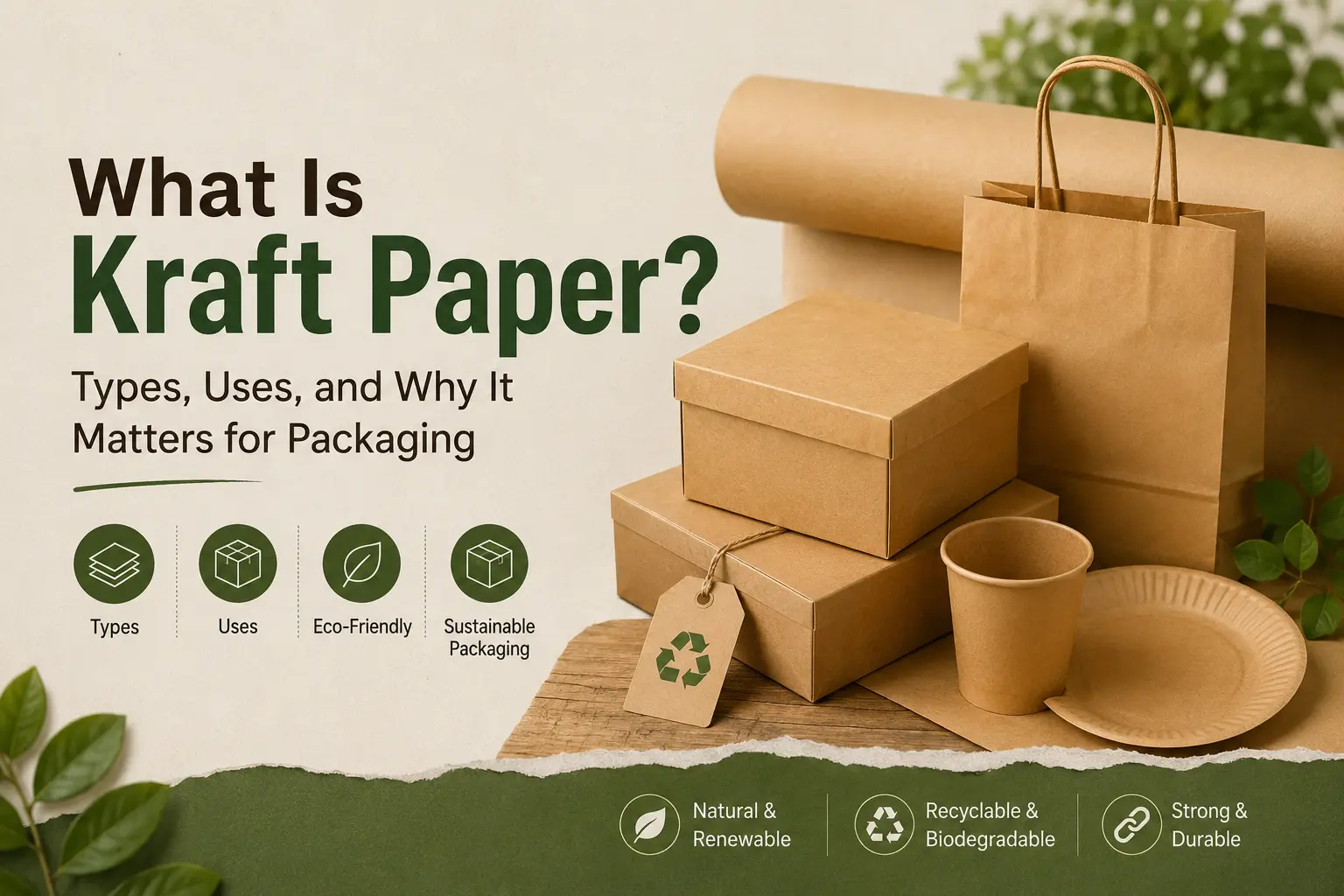
If you have ever received a brown paper bag from a grocery store, unwrapped a package padded with crinkled brown paper, or noticed the rough, natural-looking wrapping on artisan food products, you have already interacted with kraft paper. It is one of the most widely used materials in the global packaging industry, and its popularity is accelerating rather than declining as businesses shift away from plastic toward more sustainable alternatives.
Yet despite its ubiquity, most people know very little about what kraft paper actually is, how it is made, why it comes in different types and grades, or how to choose the right variant for a specific packaging application. This guide answers all of those questions in detail.
What Is Kraft Paper?
Kraft paper is a type of paper produced through a manufacturing process called the kraft process, also known as the sulfate process. The word “kraft” comes from the German and Swedish word for strength, which is a direct reference to the material’s most defining characteristic.
Compared to paper produced through other pulping methods, kraft paper is significantly stronger, more tear-resistant, and more durable. This is because the kraft process preserves more of the long cellulose fibres in the wood pulp, and it is these long fibres that give the finished paper its tensile strength.
The result is a paper product that can withstand the mechanical stresses of packaging, shipping, and handling that would tear or disintegrate ordinary paper. Kraft paper is used as a packaging material in its own right, as the raw material for corrugated board and paper bags, and as a component within multi-layer packaging systems.
Its natural brown colour comes from the unbleached wood pulp. Bleached versions of kraft paper are white or near-white, but unbleached brown kraft remains the most widely produced and recognised variant.
How Kraft Paper Is Made
The kraft process was developed in the 1880s and has remained the dominant method of producing strong paper ever since. Understanding it gives important context for why kraft paper behaves the way it does.
The process begins with wood chips, which are cooked under high temperature and pressure in a chemical solution called white liquor, composed primarily of sodium hydroxide and sodium sulfide. This cooking process, known as digestion, breaks down the lignin that binds the wood fibres together, freeing the individual cellulose fibres without significantly degrading their length or strength.
This is the critical distinction between kraft pulping and older acidic pulping methods. Acid processes degrade the cellulose fibres significantly during pulping, resulting in shorter fibres and weaker paper. The alkaline kraft process is far gentler on the fibres, preserving their length and therefore the strength of the finished sheet.
After digestion, the pulp is washed, screened to remove any undigested material, and then refined to improve the bonding between fibres. The refined pulp is then fed onto a paper machine, where it is formed into a continuous sheet, pressed to remove water, and dried. The resulting paper is wound into large reels and then converted into finished products.
The chemicals used in the cooking stage are recovered and recycled through a chemical recovery loop, making the kraft process one of the more resource-efficient large-scale manufacturing processes in the materials industry. Modern kraft mills typically recover over 95% of the cooking chemicals for reuse.
Types of Kraft Paper
Kraft paper is not a single uniform product. It comes in a range of types and grades, each suited to different applications based on weight, surface treatment, and whether it has been bleached or left unbleached.
Unbleached Kraft Paper is the most widely produced form. It retains the natural brown colour of the wood pulp and has the highest tensile strength of any kraft variant because the bleaching process, even when done carefully, causes some fibre degradation. Unbleached kraft is used for grocery bags, wrapping paper, corrugated board liners, sacks, and industrial packaging. Its natural appearance has also made it popular for artisan, craft, and eco-conscious retail branding.
Bleached Kraft Paper undergoes an additional chemical process to remove the lignin colour and produce a white or off-white sheet. It is used where appearance and printability matter more than maximum strength, such as in food packaging, retail bags, and premium wrapping applications. Bleached kraft is also used as the outer liner in corrugated board when a clean white surface for printing is required.
Recycled Kraft Paper is produced wholly or partially from recycled fibre rather than virgin wood pulp. It is typically weaker than virgin kraft because recycled fibres are shorter due to having been processed before, but it is significantly more sustainable in terms of raw material consumption. Many packaging applications that do not require maximum tensile strength use recycled kraft to reduce environmental footprint.
Wet Strength Kraft Paper is treated with wet strength resins that allow it to maintain structural integrity when exposed to moisture. Standard kraft paper loses most of its strength when wet. Wet strength kraft is used for applications like produce bags, beverage carriers, outdoor packaging, and any situation where the paper may encounter condensation, rain, or high humidity.
Coated Kraft Paper has a surface coating applied to one or both sides to improve printability, moisture resistance, or barrier properties. Clay-coated kraft provides a smooth, high-quality print surface. Polyethylene-coated kraft acts as a moisture barrier and is used for food packaging, though this coating reduces recyclability. Newer water-based barrier coatings have been developed to provide moisture resistance without sacrificing recyclability.
Waxed Kraft Paper is impregnated with wax for superior moisture and grease resistance. It is used for food wrapping, particularly for deli products, cheese, and baked goods. Like PE-coated kraft, waxed kraft is difficult to recycle, which is pushing many applications toward water-based coatings.
Extensible Kraft Paper (also called extensible sack kraft) is produced with a creping or extensibility treatment that allows it to stretch under tension before tearing. This makes it ideal for multi-wall paper sacks used for heavy powders, cement, chemicals, and pet food, where the sack must absorb the impact of being dropped without splitting.
MG Kraft Paper (machine glazed) has a very smooth, glossy surface on one side, achieved by pressing the paper against a large heated cylinder during manufacturing. The other side remains rough and fibrous. MG kraft is used for food wrapping, butter papers, and applications where one smooth, barrier-capable surface is needed.
Key Properties and How to Measure Them
When selecting kraft paper for a packaging application, several technical properties determine whether it will perform as needed.
Basis weight (also called grammage) is measured in grams per square metre (GSM) and describes how heavy the paper is per unit area. Higher GSM kraft papers are heavier, thicker, and generally stronger. Common kraft paper grades range from around 40 GSM for lightweight wrapping applications up to 150 GSM or more for heavy-duty industrial applications. Sack kraft used for multi-wall bags typically ranges from 70 to 100 GSM per ply.
Tensile strength measures how much force the paper can withstand before tearing when pulled from both ends. It is measured separately in the machine direction (along the direction the paper travels on the paper machine) and the cross direction (perpendicular to travel). Machine direction tensile strength is typically higher. This is one of the most critical properties for bags, sacks, and wrapping applications.
Tear strength measures the force required to propagate an existing tear through the paper. It is particularly important for packaging that may be cut or perforated during use. Unbleached kraft paper excels in tear strength relative to its weight.
Burst strength measures the pressure required to puncture the paper surface and is particularly relevant for sacks and bags that will be subjected to internal pressure during filling.
Elongation is how much the paper can stretch before tearing and is critical for extensible sack kraft, which must absorb the energy of impact without splitting.
Moisture content and resistance matter significantly for food applications and outdoor use. Standard kraft paper absorbs moisture and loses strength when wet. For applications where moisture exposure is expected, wet strength treatment, coating, or waxing is essential.
Porosity determines how much air can pass through the paper. Low-porosity papers provide better moisture and gas barriers. High-porosity papers allow products to breathe, which is useful for fresh produce packaging.
Common Uses of Kraft Paper in Packaging
The range of applications for kraft paper in packaging is broader than most people realise.
Paper bags and carrier bags are one of the most visible applications. Grocery bags, retail shopping bags, takeaway food bags, bread bags, and produce bags are all commonly made from kraft paper. The shift away from single-use plastic bags across Europe, North America, and increasingly Asia has driven significant growth in kraft paper bag production.
Wrapping and void fill for e-commerce and shipping is a major and rapidly growing application. Kraft paper is used as wrapping paper for individual items, as crinkle-cut void fill inside boxes, and as cushioning wadding. It is increasingly replacing bubble wrap and foam peanuts in these roles, driven by both consumer demand for sustainable packaging and retailer mandates from companies like Amazon and Walmart.
Corrugated board liners represent the single largest use of kraft paper by volume globally. The flat liner layers on the outside and inside of corrugated board are made from kraft paper, as is the fluted medium in many applications. The strength of corrugated board is directly tied to the quality and grade of kraft paper used in its construction.
Multi-wall paper sacks for industrial products like cement, flour, fertiliser, animal feed, chemicals, and construction materials are made from multiple plies of sack kraft paper. These sacks must withstand the weight of their contents, the impact of being dropped, and exposure to outdoor conditions. This is one of the most technically demanding applications of kraft paper.
Food packaging uses kraft paper extensively for direct food contact applications. Butcher paper, deli wrap, sandwich wrap, bakery bags, and burger wrappers are commonly made from food-grade kraft, often with a grease-resistant or moisture-resistant treatment. The natural aesthetic of kraft paper also aligns with consumer perceptions of artisan, natural, and clean-label food products.
Protective wrapping for industrial products such as metal parts, glass, ceramics, and machinery components uses kraft paper as an interleaving and surface protection material. The natural pH neutrality of kraft paper (when properly manufactured) makes it suitable for wrapping metals without causing corrosion.
Paper tape used for sealing cardboard boxes is frequently made from kraft paper, particularly water-activated kraft tape (also called gummed tape), which creates an extremely strong bond with corrugated surfaces when moistened.
Labels and tags for products, prices, and shipping sometimes use kraft paper as a base material, particularly for products targeting a natural or craft aesthetic.
Kraft Paper and Sustainability
Sustainability is one of the primary reasons kraft paper is gaining commercial ground against plastic alternatives. Its environmental credentials are genuinely strong, though not without nuance.
Recyclability is a core advantage. Kraft paper, particularly unbleached and uncoated grades, can be recycled through standard paper recycling streams. It is one of the most recycled materials in the global packaging supply chain. However, coated, waxed, or laminated kraft papers are more difficult to recycle and may be rejected by standard recycling facilities.
Compostability means that uncoated, food-grade kraft paper can be composted in both home and industrial composting systems. This is a meaningful end-of-life advantage over plastic packaging, which persists in the environment for hundreds of years.
Renewable raw material is another fundamental advantage. Kraft paper is made from wood fibre, which is renewable when forests are managed responsibly. Certification schemes like the Forest Stewardship Council (FSC) and the Programme for the Endorsement of Forest Certification (PEFC) provide third-party verification that the wood fibre comes from sustainably managed forests.
Recycled content can be incorporated into kraft paper production to reduce demand for virgin wood fibre. Many kraft papers used in non-demanding applications are made entirely from recycled fibre. The trade-off is reduced tensile strength, since recycled fibres are shorter than virgin fibres.
Carbon considerations are more complex. The kraft manufacturing process is energy-intensive, though modern mills typically generate a significant portion of their own energy from burning the recovered lignin from the pulping process (called black liquor), making them largely self-sufficient in energy. The carbon sequestered in sustainably grown trees also partially offsets the carbon emissions from manufacturing and transport.
The overall environmental picture for kraft paper is substantially better than for most plastic alternatives when the full lifecycle is considered, particularly for applications where end-of-life recyclability or compostability is achievable.
Kraft Paper vs. Other Packaging Papers
Kraft paper shares shelf space with several other paper types in the packaging industry. Understanding where it fits relative to these alternatives clarifies when it is and is not the right choice.
Newsprint is a very low-cost, low-strength paper used primarily in the newspaper and publishing industry. It is sometimes used as lightweight void fill but has minimal tensile strength and yellows and becomes brittle quickly. It is not suitable for any structural packaging application.
Tissue paper is a fine, lightweight paper used primarily for gift wrapping and as a luxury product presentation material. It has very low strength and no structural packaging function but is used as a surface protection layer for delicate products like clothing, jewellery, and accessories.
Greaseproof and glassine paper are highly refined papers with dense, smooth surfaces that provide grease and moisture resistance without coatings. They are used for food wrapping applications but have significantly lower tensile strength than kraft paper.
Duplex and triplex board are multi-layer paperboard materials used for cartons and folding boxes. They offer stiffness and printability suited to retail packaging but do not offer the same tensile and tear strength as kraft paper for applications involving mechanical stress.
MG sulphite paper is a finer, more printable paper than kraft, used for labels and food wrapping, but with lower strength. It is made through a sulfite rather than sulfate process.
For applications requiring strength, durability, and sustainability in combination, kraft paper typically outperforms these alternatives. For applications requiring premium printability, high gloss, or folding rigidity, other paper grades may be more appropriate.
How to Choose the Right Kraft Paper Grade
Selecting the correct kraft paper for a packaging application involves matching the paper’s properties to the demands of the application.
For e-commerce void fill and wrapping, standard unbleached kraft paper in the 60 to 90 GSM range is typically appropriate. It needs to be strong enough to resist tearing during packing and unpacking but does not need to meet industrial strength specifications.
For retail bags and carrier bags, the choice of GSM depends on the weight of products being carried. Lightweight retail bags use 70 to 90 GSM kraft. Heavy-duty bags designed to carry groceries or heavier retail products use 100 to 120 GSM, often with reinforced handles or gussets.
For food wrapping and direct food contact, food-grade kraft paper certified for food contact is essential. The appropriate GSM and treatment (plain, grease-resistant, wet strength) depends on the specific food product and expected moisture or grease exposure.
For industrial sacks, extensible sack kraft in the 70 to 100 GSM range per ply is standard, with multiple plies laminated together to achieve the required total strength for the product weight and filling method.
For corrugated board liners, the specification is driven by the required ECT or burst strength of the finished board. Heavier liner papers produce stronger corrugated board. The choice between recycled and virgin fibre liners depends on the strength requirements and sustainability targets of the application.
For premium retail and presentation packaging, bleached or natural kraft with a surface suitable for high-quality printing is appropriate. E-commerce brands focused on unboxing experience often use bleached kraft or natural unbleached kraft with custom printing for their outer tissue layer or inner wrap.
Current Trends Shaping the Kraft Paper Market
The kraft paper market is being shaped by several forces that are accelerating its growth and driving product innovation.
The most significant driver is the global movement away from single-use plastic packaging. Regulatory bans and restrictions on plastic bags, foam packaging, and plastic void fill across the EU, UK, India, and many other markets are creating structural demand shifts toward paper-based alternatives. Kraft paper is one of the primary beneficiaries of this transition.
Consumer sentiment is also pushing in the same direction. Research consistently shows that consumers perceive paper packaging as more sustainable than plastic, which influences purchasing decisions and brand perceptions. Brands that switch to kraft paper packaging often report positive consumer response to the change.
E-commerce growth continues to drive demand for kraft-based void fill, wrapping paper, and mailer solutions. The shift toward sustainable e-commerce packaging is being accelerated by retailer programmes such as Amazon’s Frustration-Free Packaging initiative, which actively incentivises brands to move to recyclable paper-based packaging.
Innovation in barrier coatings is addressing the historical trade-off between functionality and recyclability for kraft paper used in food packaging. New water-based and bio-based barrier coatings are being commercialised that provide moisture, grease, and oxygen resistance comparable to PE coatings but without sacrificing recyclability. This is expanding the application range for kraft paper in food service and retail food packaging.
Recycled content requirements are becoming more common as part of corporate sustainability commitments and emerging regulations. This is driving investment in recycled-fibre kraft paper production and in the separation and collection infrastructure needed to supply high-quality recycled fibre to paper mills.
FAQs
Is kraft paper the same as brown paper?
Kraft paper and brown paper are often used interchangeably in everyday language, but not all brown paper is kraft paper. Brown paper produced through other pulping methods exists, though it is less common. In most practical packaging contexts, brown paper refers to unbleached kraft paper.
Is kraft paper food safe?
Food-grade kraft paper, specifically manufactured and certified for food contact, is food safe. Not all kraft paper is automatically food safe. Paper intended for food contact must be produced without harmful additives and must meet food safety regulations in the relevant jurisdiction. Always confirm food-grade certification before using kraft paper in direct food contact applications.
Can kraft paper be recycled?
Yes, uncoated kraft paper can be recycled through standard paper recycling streams. Coated, waxed, or laminated kraft papers may not be recyclable through standard streams and should be checked against local recycling guidelines.
What is the difference between kraft paper and butcher paper?
Butcher paper is a type of kraft paper specifically produced for food applications. It is food-grade, often treated for moisture and grease resistance, and used for wrapping raw and cooked meat, fish, and other deli products. All butcher paper is a form of kraft paper, but not all kraft paper is suitable for butcher paper applications.
What GSM is standard kraft paper?
Standard kraft paper for general packaging and wrapping applications typically ranges from 60 to 90 GSM. Industrial sack kraft ranges from 70 to 100 GSM per ply. Heavy-duty wrapping or protective kraft can reach 120 to 150 GSM or more. There is no single standard GSM for all kraft paper.
Why is kraft paper brown?
The brown colour comes from the lignin remaining in the wood pulp after the kraft pulping process. Lignin is a natural polymer in wood that acts as a binding agent between fibres. The kraft process removes most of the lignin but not all of it, and the residual lignin gives unbleached kraft its characteristic brown colour.
What is the difference between kraft paper and kraft board?
Kraft paper generally refers to thinner, more flexible grades, typically under 250 GSM. Kraft board (also called kraft paperboard) refers to heavier, stiffer grades typically over 250 GSM, used for applications requiring structural rigidity such as box construction. The distinction is more of a continuum than a sharp boundary.
How long does kraft paper take to decompose?
Uncoated kraft paper typically decomposes within two to six weeks in a composting environment. In landfill conditions without oxygen, decomposition is much slower, potentially taking months to years. Coated or laminated kraft papers take longer to decompose due to the coating layers.
Key Takeaways
Kraft paper is far more than the humble brown bag most people associate it with. It is a sophisticated, engineered material available in a wide range of grades, treatments, and constructions, each tailored to specific applications across packaging, food service, industrial supply chains, and retail.
Its core strengths are consistent across all its forms: high tensile and tear strength relative to weight, compatibility with sustainable sourcing and end-of-life recycling, versatility across an enormous range of applications, and a natural aesthetic that resonates with both consumers and brands committed to more sustainable packaging.
The growing momentum against single-use plastic is not a temporary trend. It represents a structural, regulatory, and cultural shift in how products are packaged and shipped globally. Kraft paper is at the centre of this transition, and understanding its properties, types, and applications is increasingly valuable knowledge for anyone involved in product development, packaging design, logistics, or supply chain management.