

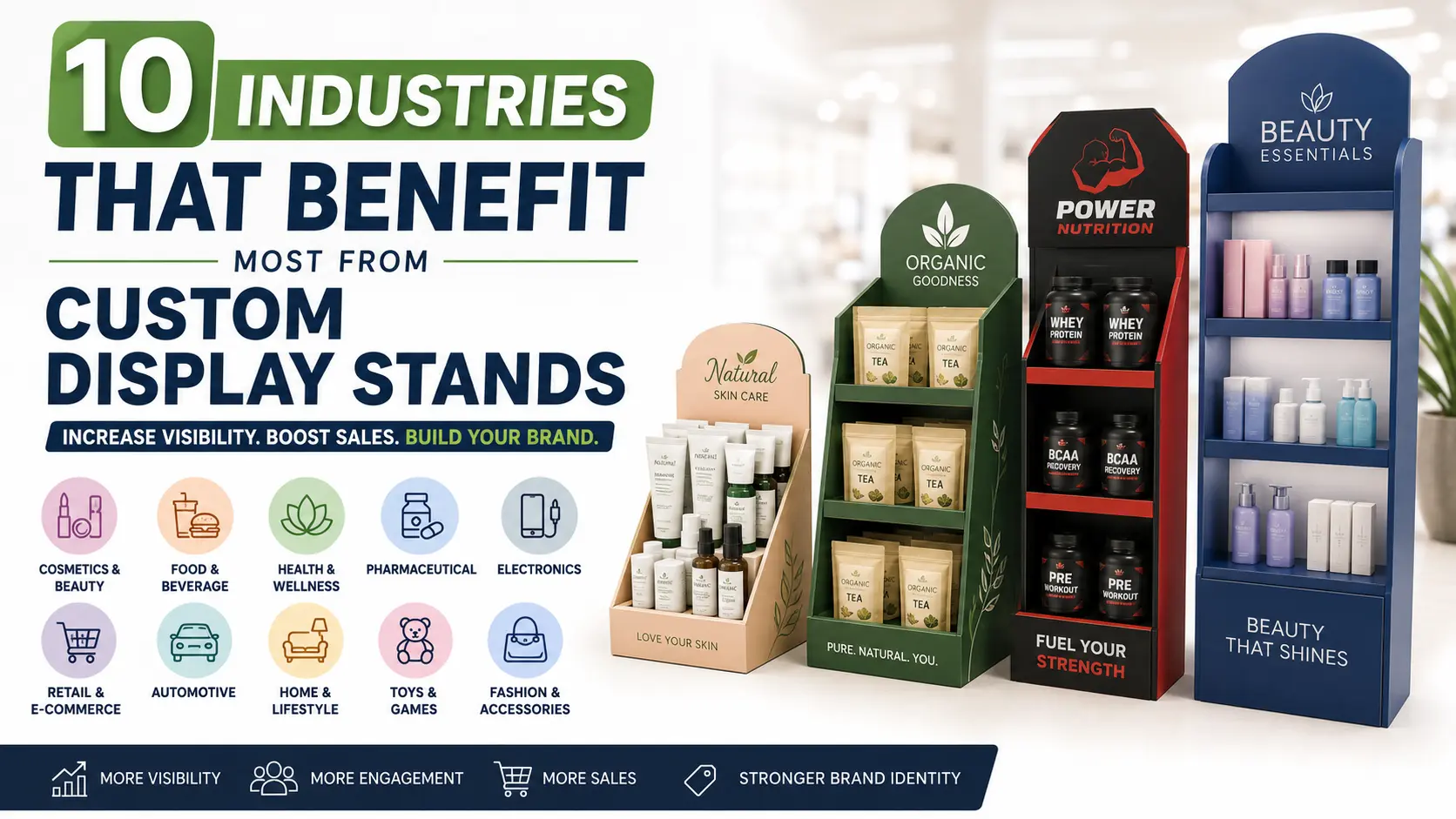
Picture this.
You walk into a store. There are hundreds of products on every shelf. Things are stacked up and lined up in every direction. You do not know where to look.
Then something catches your eye.
A display stand, standing tall, full of color, showing off one product in a way that makes everything else fade into the background. You walk toward it. You pick up the product. And you buy it.
That is the power of a custom display stand.
72% of purchase decisions are made right at the point of purchase. That means most customers decide what to buy when they are already standing in the store, not before they walk in. A custom display stand puts your product right at that exact moment of decision.
And the market proves it. The global custom display packaging market is valued at USD 24.7 billion in 2025 and is forecast to reach USD 39.7 billion by 2035. Brands across the USA are pouring money into display stands because display stands work.
But which industries get the MOST out of them?
We looked at the data. We studied how different industries across the USA use display stands every day. And we picked the 10 industries that benefit the most.
Here they are.
1. Food and Beverage – The Biggest User of Custom Display Stands in the USA
No industry in the USA uses custom display stands more than food and beverage.
The food and beverage sector accounts for 38.2% of the entire custom display packaging market in the USA, driving impulse purchases, new launch visibility, and promotional campaign support across grocery, convenience, and mass retail.
Think about the last time you grabbed a snack from a display stand at a checkout counter. Or the last time you noticed a new chip flavor on a floor display at the end of a grocery aisle. That was not an accident. That was a food brand putting their product exactly where you would see it.
Why food and beverage brands love display stands
They drive impulse buys. Most snack and candy purchases are NOT planned. The customer walks past the display, sees the product, and grabs it without thinking. A display stand in the right spot creates that moment.
They launch new products fast. When a food brand launches a new flavor or a new product, they need people to notice it. A floor-standing display in the middle of a store aisle gets a new product seen by every single customer who walks by, far faster than slipping it onto a regular shelf.
They work in every store type. Grocery stores. Convenience stores. Gas stations. Club stores. Specialty food retailers. Custom display stands work everywhere food is sold.
What display types food brands use most
- Counter display stands (CDU): Candy, gum, energy bars, single-serve snacks at checkout
- Floor standing displays (FSDU): New product launches, seasonal promotions, bulk snack packs
- PDQ trays: Shelf-ready snack packaging that sits directly on existing grocery shelves
- Pallet displays: High-volume products at Costco, Sam’s Club, and Walmart
2. Cosmetics and Beauty – Where Display Stands Create Luxury Out of Thin Air
Walk into any Ulta, CVS, or Target beauty section and look around. Almost every brand uses some form of custom display stand. Some are simple counter units. Some are tall floor displays with lights and mirrors. Some are sidekick displays hanging off a shelf.
This is not by accident. Custom display stand solutions are used across counter display units and floor stands for skincare, makeup, and fragrance at specialty retail, pharmacy, and department store channels.
Why beauty brands depend on display stands
Shelf space is fiercely competitive. Dozens of brands compete for the same 3 feet of shelf space. A custom display stand gives a beauty brand its own dedicated space separate from the shelf clutter where their products stand alone.
The product needs to be touched. Beauty customers want to test products before buying. A display stand positions the product at the right angle and the right height so customers can pick it up, open it, and try it without awkward reaching or bending.
Premium packaging signals premium product. A beauty brand with a soft-touch coated display stand in rose gold and matte black signals luxury to every customer who walks past. The display stand IS the brand promise before the customer even touches the product.
What display types beauty brands use most
- Counter display units (CDU): Lip gloss, nail polish, mascara, travel-size skincare at checkout counters
- Floor standing displays (FSDU): New launch hero products, seasonal collections, fragrance
- Sidekick displays: Add-on products next to a skincare shelf or a hair care section
3. Health and Wellness / Supplements – The Fastest Growing Display Stand Category in the USA
The health and wellness industry in the USA is booming. Vitamins, protein powders, collagen supplements, greens powders, CBD products, and wellness shots are flying off shelves.
And they all need custom display stands.
The US market for custom display stands is projected to grow at 6.5% CAGR from 2025 to 2035 and the health and wellness category is one of the main drivers of that growth.
Why supplement brands need display stands
Pharmacy shelves are crowded. Walk into a Walgreens or CVS and try to find a specific supplement without help. The supplement aisle is overwhelming: hundreds of bottles, dozens of brands, no clear organization. A custom display stand gives a supplement brand their own dedicated space where their products are organized, branded, and visible.
The product story needs to be told. A supplement customer has questions. What does this do? How many do I take? What is it made from? A floor display stand gives the brand space to answer those questions right on the display panels, without the customer needing to read the back of the bottle in small print.
Impulse purchases happen for wellness too. A single-serve protein bar or a shot of liquid vitamins at a checkout counter sells because the display stand puts it right in front of the customer at the moment they are waiting. That single placement drives real revenue.
What display types wellness brands use most
- Floor standing displays (FSDU): Supplement tubs and bottles at pharmacy and health food stores
- Counter display units (CDU): Single-serve packets, shots, bars at checkout
- PDQ trays: Shelf-ready supplement cartons in grocery health sections
4. Electronics and Tech Accessories – Where Display Stands Justify the Price Tag
Cables. Earbuds. Phone cases. Chargers. Power banks. Screen protectors.
The tech accessories market in the USA generates billions of dollars every year, and most of it is sold from display stands in retail stores.
Why tech accessory brands rely on display stands
The product is small, but the price can be high. A phone cable might cost $30. A pair of earbuds might cost $80. Those price points feel very different when the product is in a premium display stand with good photography and clear feature callouts versus sitting loose on a generic shelf.
Customers need to compare. Tech shoppers compare products before buying. A display stand that organizes product options by category “USB-C cables,” “wireless chargers,” “screen protectors” makes comparison easy and increases the chance that the customer buys something.
Peg hooks and Euro slots make retail peg display work. Tech accessories hang on peg hook displays in most retail stores. Custom printed card backing with a Euro slot gives a tech accessory brand a branded hanging display without needing a full floor stand. These work at Best Buy, Target, and any electronics specialty retailer.
What display types tech brands use most
- Counter display units (CDU): Cables, adapters, and small accessories at checkout counters
- Sidekick/power wing displays: Complementary accessories next to device shelves
- Euro hook hanging displays: Phone cases, screen protectors, small gadgets on peg hook walls
5. Toy and Game Industry – Where Display Stands Create Magic at Eye Level
Children do not ask for toys they cannot see. And children see everything at their eye level, which is about 36 to 42 inches from the floor.
Toy brands know this. That is why the toy industry has mastered the art of the custom display stand.
Why toy brands love display stands
Children make purchase requests – parents make purchase decisions. A toy display stand at a child’s eye level creates the request. The child sees the toy, gets excited, and tells the parent. The parent sees the display branding and reads the age guidance, safety features, and product description. Both of them are sold at the same moment by the same display.
Seasonal timing is everything. The toy industry lives by seasons. Christmas. Easter. Back to school. Birthday party season. A custom display stand lets a toy brand put a seasonal product in front of shoppers exactly when the buying window is open and take it down just as fast when the season ends.
Display stands create perceived toy value. A toy in a plain brown box on a regular shelf feels like an ordinary product. The same toy in a bright, colorful floor display with a character from the toy’s world feels special, like something worth having.
What display types toy brands use most
- Floor standing displays (FSDU): Hero toys, new launches, movie tie-in products
- Sidekick displays: Add-on toy accessories next to core product shelves
- Dump bins: Grab-and-go low-price toys, party bag fillers, seasonal impulse items
6. Pet Food and Pet Supplies: A Booming USA Market That Runs on Display Stands
Americans love their pets. In 2025, Americans spent over $150 billion on their pets. Pet food. Pet toys. Pet health products. Pet grooming supplies. All of it needs to be displayed and sold, and display stands are one of the main tools that pet brands use to do it.
Why pet brands benefit from display stands
Pet stores are overwhelming. A Petco or PetSmart holds thousands of products. A custom floor display stand gives a pet brand a branded island in the middle of that ocean, a clear, organized, eye-catching structure that a customer can navigate without confusion.
Heavy pet food needs strong display stands. A 5-pound bag of dog food is heavy. A display stand holding 24 of them needs to be built from the right board grade C-flute or double-wall corrugated with a base wide enough to stay stable and a floor strong enough to hold the full weight without sagging.
Treats drive enormous impulse purchases. Pet treats are one of the biggest impulse buy categories in the entire USA retail market. Counter display units at pet store checkouts hold single-serve treat packs that customers grab while waiting to pay without ever planning to buy them when they walked in.
What display types pet brands use most
- Floor standing displays (FSDU): Premium pet food, new product launches, seasonal items
- Counter display units (CDU): Single-serve treats, dental chews, small toy accessories
- Pallet displays: Bulk pet food at Costco, Sam’s Club, and Walmart
7. Pharmaceutical and Healthcare – Where Display Stands Build Trust and Drive Sales
Walk into any CVS, Walgreens, or Rite Aid in the USA, and you will find custom display stands everywhere. Pain relievers. Cold medicines. Vitamins. Bandages. Eye drops. Sleep aids.
The pharmaceutical and healthcare industry in the USA depends heavily on display stands because the pharmacy checkout is one of the highest-traffic retail locations in the country.
Why pharma brands need display stands
Pharmacy checkout converts like nothing else. Every single pharmacy customer walks past the checkout counter. A counter display unit at a pharmacy checkout gets seen by 100% of the store’s customers, not just the ones who happen to walk down the medicine aisle.
Healthcare customers read displays carefully. A pharmacy customer buying a cold remedy reads the display panel for dosage guidance, ingredient highlights, and product comparisons. A well-designed display stand serves as a silent salesperson, answering common questions without the customer needing to ask a pharmacist.
Tamper evidence and compliance are part of the display. Healthcare display stands often include features that general retail displays do not: lockable units, secured backing cards, anti-theft hanging systems. Custom display stands accommodate all of these functional requirements.
What display types healthcare brands use most
- Counter display units (CDU): Pain relievers, cough drops, vitamins, first aid at checkout
- Floor standing displays (FSDU): Seasonal health products (flu season, allergy season)
- Endcap displays: Category-leader placement at the end of the pharmacy aisle
8. Apparel and Accessories – Where Display Stands Replace the Need for Extra Staff
You walk into a boutique in New York or a mall store in Chicago. Jewelry is hanging at eye level. Sunglasses are fanned out on a counter unit. Belts are rolled and stacked in a floor display.
Nobody showed you where any of that was. The display stand did all the work.
Why apparel and accessory brands love display stands
Accessories sell because customers can see them. A necklace sitting in a drawer sells nothing. A necklace displayed at eye level on a counter display unit sells itself; the customer sees it, picks it up, tries it on, and buys it.
Display stands replace the need for more staff. A well-designed display stand organizes the product, communicates the price, shows the available options, and positions the item for easy handling. It does everything a salesperson would do for a low-ticket item, 24 hours a day, 7 days a week, without a paycheck.
Seasonal collections need fast display turnarounds. Fashion changes fast. A summer collection needs to be on a display stand in June. The same space needs a fall collection in September. Custom cardboard display stands make that changeover fast, affordable, and easy – a new stand for a new season.
What display types apparel brands use most
- Counter display units (CDU): Jewelry, sunglasses, belts, small fashion accessories
- Floor standing displays (FSDU): Seasonal scarf and hat collections, trending accessory sets
- Sidekick displays: Add-on accessories next to clothing racks or existing shelving
9. Books, Stationery, and Gifts – Where Display Stands Create Discovery Moments
Most book purchases are not planned. Most gift purchases are not planned. Most stationery purchases are absolutely not planned.
They happen because something caught the customer’s eye and that something was almost always a display stand.
Why this industry runs on display stands
Discovery drives book and gift sales. A book display stand at the front of a Barnes & Noble puts a new release or a bestseller list in front of every customer who walks in. Without the display, most customers walk past new titles without noticing them. With the display, they stop, read the cover, and buy.
Gift stores need organized chaos. A gift store has hundreds of small, colorful products that all compete for attention. A custom display stand organizes a theme, “gifts under $20,” “birthday picks,” “funny mugs,” and gives the customer a curated set of choices instead of an overwhelming wall of options.
Greeting card displays are the original display stand. The spinning wire rack of greeting cards is the oldest retail display stand in existence. Custom cardboard display stands bring that same logic to modern gift and stationery products organized, branded, and always at the perfect height for the customer to browse.
What display types books and gift brands use most
- Floor standing displays (FSDU): New book releases, seasonal gift collections, bestseller promotions
- Counter display units (CDU): Bookmarks, small gifts, impulse greeting cards at checkout
- Dump bins: Discounted books, party supply grab-and-go products
10. Trade Shows and Events – Where Display Stands Are the Entire Marketing Strategy
Trade shows in 2025 and 2026 are not about having the flashiest booth or the latest technology. They are about understanding what your audience actually wants and giving it to them in a way that feels genuine. The companies winning are not necessarily spending the most money. They are spending it the smartest.
And one of the smartest things any trade show brand does is build a great display stand.
Why trade show brands depend on display stands
You have 3 seconds to stop a stranger. At a trade show, every attendee walks past hundreds of booths. Your display stand has about 3 seconds to catch their attention, communicate what you do, and make them stop walking. That is not enough time to read a paragraph. But it is enough time to see a bold display, a clear headline, and a compelling product.
Display stands work when you are busy. At a big trade show, you cannot talk to every attendee at the same time. A well-designed display stand keeps presenting your brand, organizing your products, and answering common questions even while you are in the middle of another conversation.
Flat-pack display stands save real money. Custom display stands ship flat, reducing freight volume by up to 60% compared to pre-assembled alternatives. For a brand that attends 10 trade shows a year across the USA, that freight saving adds up fast. Flat-pack display stands also set up in under 5 minutes with no tools, critical when you have 2 hours to build a booth before the show floor opens.
What display types trade show brands use most
- Floor standing displays (FSDU): Main booth display – tall, branded, product-loaded
- Counter display units (CDU): Business cards, brochures, samples, and small giveaways on the booth counter
- Portable banner stands: Lightweight displays that work alongside a full floor display
Quick Summary: Which Industries Use Custom Display Stands the Most
1. Food and Beverage
Why: 38.2% of the entire market – impulse buys drive enormous volume at checkout and on grocery floors
2. Cosmetics and Beauty
Why: Shelf competition is brutal – display stands give brands their own dedicated space and premium positioning
3. Health and Wellness / Supplements
Why: Crowded pharmacy shelves and strong impulse purchase behavior make displays essential
4. Electronics and Tech Accessories
Why: Small high-value products need premium display presentation to justify their price point
5. Toys and Games
Why: Children’s eye-level placement and seasonal timing make display stands one of the toy industry’s most powerful sales tools
6. Pet Food and Pet Supplies
Why: $150 billion US market with heavy impulse purchase behavior at pet store checkout
7. Pharmaceutical and Healthcare
Why: Pharmacy checkout is one of the highest-traffic retail locations in the USA – display stands reach 100% of customers
8. Apparel and Accessories
Why: Accessories sell themselves when visible at eye level – display stands replace the need for extra staff
9. Books, Stationery, and Gifts
Why: Discovery drives sales in this category – display stands create the discovery moment
10. Trade Shows and Events
Why: Display stands ARE the marketing strategy – the 3 seconds of attention a display stand captures is what generates every trade show lead
What All 10 Industries Have in Common
Every single one of these industries shares the same truth.
Customers buy what they can see.
It does not matter how good your product is. If it sits on a shelf behind 30 other products, blending into the background, it does not get picked up. It does not get bought.
A custom display stand changes that. It puts your product at eye level. It gives it its own space. It carries your brand in full color. And it sits right where your customer makes their decision, at the exact moment they are ready to buy.
72% of purchase decisions happen right at the point of purchase. A custom display stand is the tool that wins that moment.
Get Your Custom Display Stand From The Pioneer Packaging
The Pioneer Packaging builds custom display stands for all 10 of these industries: counter displays, floor-standing displays, endcap displays, sidekick displays, PDQ trays, pallet displays, and trade show formats.
No minimum order. You order exactly what you need. 30% lower prices than most USA competitors. Free shipping to every state in the USA – no hidden freight fees. 10-12 business day turnaround from art approval. Free design support – send your logo and we handle the rest.
Visit thepioneerpackaging.com to get your free quote today.
Frequently Asked Questions
Which industry uses custom display stands the most in the USA?
The food and beverage industry uses custom display stands the most, accounting for 38.2% of the entire custom display packaging market in the USA. Snack brands, beverage companies, and food startups use floor displays, counter units, PDQ trays, and pallet displays across grocery, convenience, and mass retail to drive impulse purchases and new product launches.
Why do so many industries use custom display stands?
Because 72% of purchase decisions happen at the point of purchase, not before the customer walks in the store. A custom display stand puts your product at eye level, at the exact moment the customer is ready to buy. Every industry that sells a physical product in a store benefits from that placement.
What is the most popular type of custom display stand in the USA?
Floor-standing display units (FSDUs) are the most widely used format across industries; they provide maximum visibility, hold the most product, and make the biggest brand statement on a retail floor. Counter display units (CDUs) are the most popular for checkout and impulse purchase placement. PDQ trays are the most popular for shelf-ready retail supply.
Can small businesses use custom display stands?
Yes, and they should. The Pioneer Packaging has no minimum order quantity, which means a small business can order 5 display stands to test a new retail placement without committing to hundreds of units. Small businesses in food, beauty, wellness, gifts, and accessories use custom display stands every day across the USA and they compete directly with large brands on the same retail floor.