

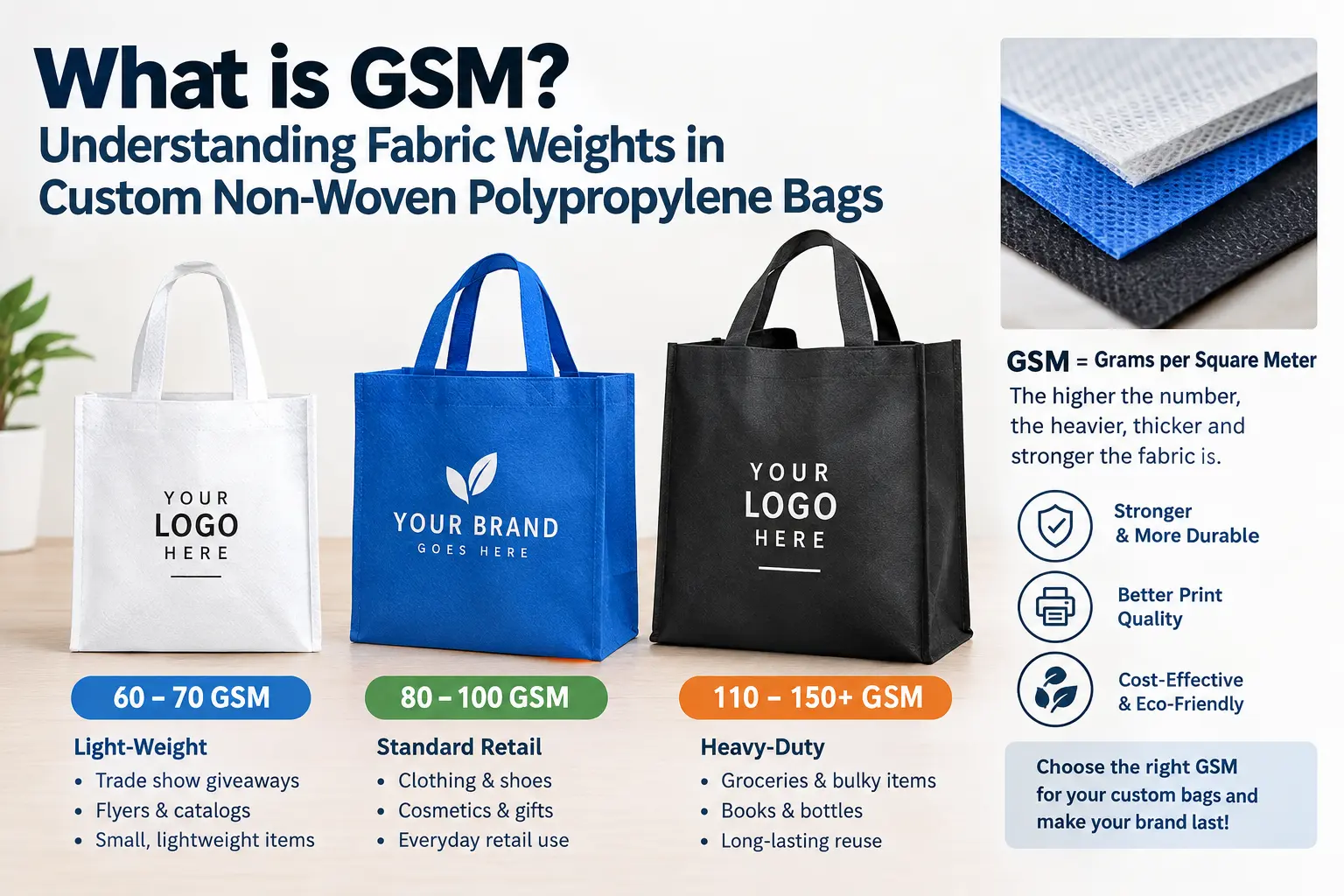
Have you ever wondered why some reusable shopping bags feel super strong and others feel really thin and flimsy? Like, you put a couple of heavy books in one bag and the handle almost rips right off, but another bag can hold heavy milk cartons and juice bottles without even stretching?
It all comes down to one magic science word: GSM.
If you are a business owner buying custom non-woven shopping bags for your shop, or if you are just curious about how bags are made, understanding GSM is super important. Today, we are going to break down what GSM actually means, why it matters for your logo bags, and how to pick the right weight so your customers never drop their stuff on the sidewalk.
What Does GSM Even Stand For?
Let’s start with the big fancy letters. GSM stands for Grams per Square Meter.
That sounds like a math class word, right? But it is actually really easy. Imagine taking a big sheet of the fabric used to make non-woven bags, laying it out flat on a table, and cutting out a giant square that is one meter wide by one meter long. If you put that exact square on a scale, how much does it weigh in grams?
If it weighs 80 grams, the fabric is 80 GSM.
If it weighs 120 grams, the fabric is 120 GSM.
So, a simple rule to remember is: The higher the number, the heavier, thicker, and stronger the fabric is.
When you order custom non-woven bags with your company logo printed on them, the factory will always ask you what GSM you want. If you just say “make me a bag,” they won’t know if you want a super light-weight giveaway bag or a heavy-duty grocery hauling machine.
Breaking Down the Different GSM Numbers
Not all bags are built for the same job. Let’s look at the different weight classes you will usually see when shopping for custom bags:
1. Light-Weight Bags (60 GSM to 70 GSM)
These are the featherweights of the bag world. They are very thin, flexible, and cost almost nothing to make.
What they feel like: Think of a very thin disposable medical gown or a light dust cover.
Best used for: Trade show handouts, lightweight promotional catalogs, single t-shirts, or small jewelry boxes.
The downside: If you try to put heavy or sharp items inside, they can puncture or tear pretty easily. They are meant for quick, light tasks.
2. Standard Retail Bags (80 GSM to 100 GSM)
This is the most popular choice for most stores. If you walk into a clothing boutique, a shoe store, or a gift shop, the non-woven bags they hand you are almost always in this range.
What they feel like: Sturdy, dependable cloth-like paper. It has a nice crisp feel when you open it up.
Best used for: Clothing items, shoe boxes, cosmetic products, and everyday retail purchases.
Why people love it: It hits the sweet spot. It is strong enough to carry a couple of sweaters, but it doesn’t cost a fortune. Plus, your printed logo looks super clear and sharp on it.
3. Heavy-Duty Grocery and Box Bags (110 GSM to 150 GSM+)
These are the heavy hitters. If you need a bag that can handle heavy items day after day without complaining, this is what you want.
What they feel like: Thick canvas or heavy tarp material. You can actually feel the density when you squeeze it.
Best used for: Supermarket grocery shopping, thick books, wine bottles, and structured “box bags” with bottom boards.
Why people love it: Customers reuse these bags hundreds of times. That means your printed business logo stays visible walking down the street for years.
Why Non-Woven Fabric is Different
You might be wondering: what actually is non-woven polypropylene? It sounds like weird science lab stuff.
Regular fabric like your cotton t-shirt is made by taking threads and weaving them back and forth on a loom (over and under, over and under).
Non-woven fabric skips the weaving part! Instead, factories take plastic polypropylene pellets, melt them down, and spin them into long, web-like plastic fibers. Then, they use heat and pressure (or sometimes chemicals) to bond all those fibers together into a solid sheet of fabric.
Because it doesn’t need to be woven on a slow loom, it is super cheap and fast to make. That is why non-woven bags are the absolute kings of eco-friendly, budget-friendly retail packaging. They look and feel like fabric, but they cost way less than cotton or canvas.
How GSM Affects Your Logo and Printing
Choosing the right GSM isn’t just about weight—it also changes how your custom printed logo looks!
When you order custom non-woven bags, you want your brand name to look clean and professional.
On Low GSM (60-70): The fabric is a bit bumpy and thin. If you print a complex logo with tiny text, the thin material might wrinkle, making your words hard to read.
On Mid-to-High GSM (90-120+): The surface is much smoother and tighter. Screen printing and heat transfers sit flat and look amazing. The colors pop out much brighter against a thicker background.
Also, think about the handles! If you use a thin 60 GSM body and glue a heavy handle onto it, the handle might rip right off the side of the bag when someone lifts it. Higher GSM fabrics give the handles a much stronger anchor point, whether they are die-cut loop handles or stitched fabric web handles.
Summary: Which One Should You Buy?
To wrap it all up, picking the right custom non-woven bag weight is all about matching the bag to what your customers are going to put inside it:
Choose 70 GSM if you just need cheap giveaway bags for a trade show event with a lightweight flyer inside.
Choose 90 to 100 GSM if you run a retail store, clothing shop, or boutique and want a reliable everyday bag.
Choose 120 GSM or higher if you are selling heavy items, groceries, or want a premium reusable bag that lasts for years.
So next time you are ordering bags for your business, don’t just guess. check that GSM number. It will save you money, protect your customers’ items, and make sure your brand looks awesome out in the real world.