
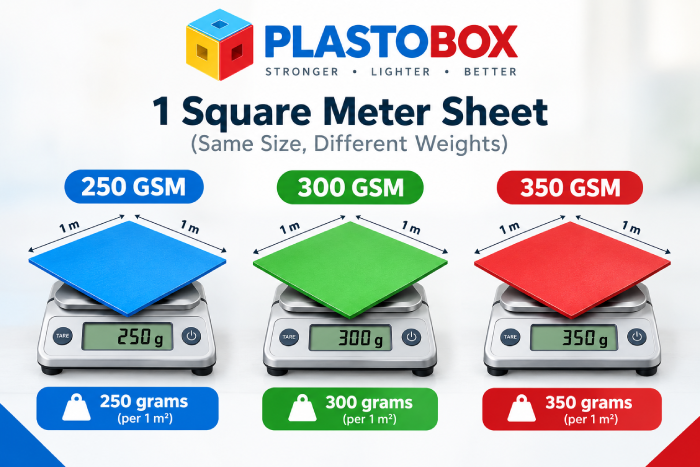
GSM in paper packaging just means grams per square meter, so how much a sheet of board weighs. We get asked about it on pretty much every first call, usually by someone squinting at a quote that says “350 GSM SBS” and wondering if that’s good or bad. Honest answer? Weight. Just weight. Not how thick, not how tough, and yeah, people mix that up constantly so don’t feel bad.
Quick scope note before we go on: this is for paper stuff, meaning cartons, kraft bags, corrugated and rigid boxes. If you’re buying plastic clamshells or foam or molded pulp, GSM isn’t the spec anyone will quote you, so you can skip this one.
What Does GSM Mean, and Which Range Fits Most Boxes?
For most paperboard cartons you’ll land somewhere from 250 up to about 400 GSM, and where exactly depends on what’s going inside.
A lip balm tube doesn’t need what a 16 oz candle jar needs. Most supplier charts you’ll find online say roughly the same thing we do, heavier or fancier products creep toward 400 and light retail items sit happily nearer 250.
So how do they get the number? Somebody in a lab cuts a sample of a known size, weighs it and scales it up to a full square meter. Fun fact, there’s an actual ISO standard for this (536:2019) and it even fusses over whether the sheet was oven-dried first, because a damp warehouse in Houston will make board weigh more than the same board in Denver.
Kitchen scale test: cut 10 x 10 cm, it reads 3 g, you’ve got 300 GSM.
The full wording lives on the ISO 536:2019 page, though we doubt you’ll need it.
Is Higher GSM Always Better? GSM vs Thickness vs Strength
Nope. A 350 GSM board is heavy, sure. Heavy isn’t strong though, and it isn’t thick either, those are three different things and suppliers love to blur them.
Thickness has its own name, caliper, given in microns or in points. Two boards at the exact same GSM can come out at noticeably different calipers if one has denser fibers, and that’s why we’d tell anyone comparing quotes to get both numbers in writing.
Grab a “350” sample from two different mills sometime. One feels fatter. Same weight on paper, but the coating and how tight the fibers are packed change everything you feel in your fingers.
So ask for caliper, we can’t say it enough (a point is a thousandth of an inch, roughly 25.4 microns, if your supplier talks metric). Buying corrugated? Then the number you really want is the edge crush test, ECT, or the burst rating, because that’s what tells you whether a stack of boxes will stay upright in a hot warehouse.
GSM is what you pay for. Not how it performs.
If your supplier quotes in pounds
American printers still love pounds, weirdly. Times 2.7, give or take, and 110 lb cover ends up near 300 GSM.
GSM Chart for Packaging: What Each Box Type Typically Uses
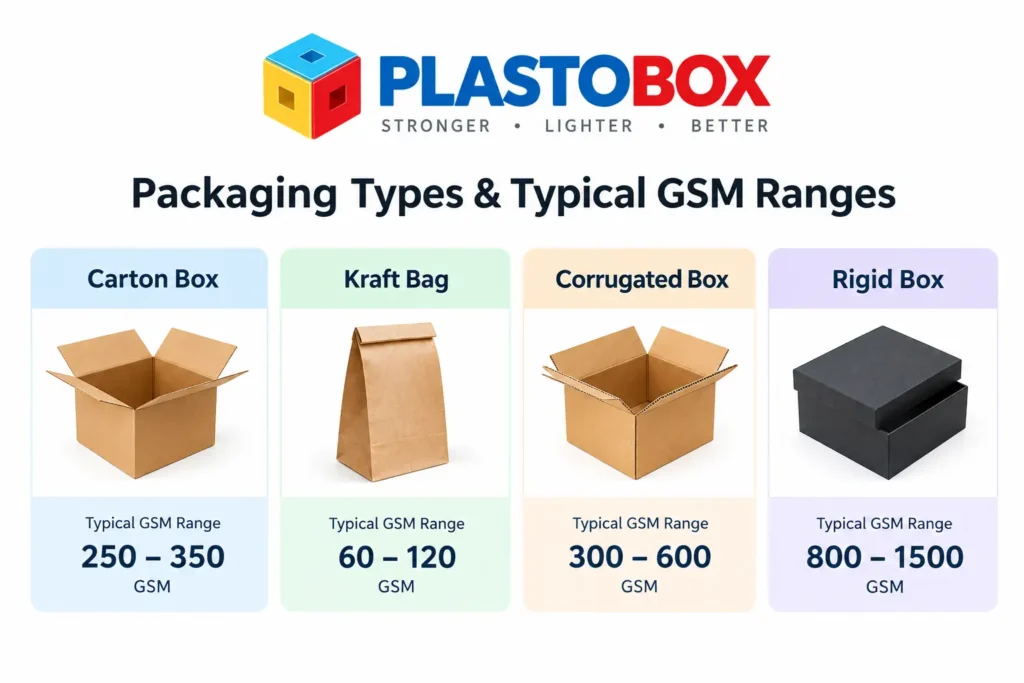
Office-paper charts won’t help you here (nobody’s making a box out of 80 GSM copy paper), so ours is sorted by box type. Ballpark only, since mills grade board their own way and we’ve seen the same “grade” vary a fair bit.
Quick comparison:
| Option | Best For | Key Benefit | Limitation |
|---|---|---|---|
| SBS folding carton board (solid bleached sulphate), 250 to 400 GSM or so | Cosmetic, food and retail cartons | Prints sharp, folds nice and clean | Heavy stuff needs an insert or a thicker sheet |
| Kraft paper and board, anywhere from about 90 up to 400 GSM depending who you ask | Bags, earthy-looking boxes, gift wrap | Tough natural fibers, that brown paper look | Bright colors come out a bit muted on brown |
| Corrugated board (liner sheets plus fluted medium) | Shipping boxes and heavy products | Cushions and stacks well | Bulkier, and GSM on its own says little about strength |
| Rigid box board, 800+ GSM | Luxury electronics, cosmetics, gift sets | Feels expensive, hard to crush | Pricier, and it ships bulky |
People ask about 250 vs 350 all the time. For a box of tea bags or a light snack carton, 250 is fine, folds easily and saves you money. Once there’s a glass jar inside, or you want the box to feel solid when someone picks it up, we’d go 350. It’s stiffness against cost, really.
Corrugated liners are a mess, number-wise. You’ll see one supplier saying 90 to 200 GSM and another saying 125 to 440 and up, and we think the low figures describe one liner sheet while the high ones count heavier liners or several layers together.
Always ask which one the quote means.
Need cartons made for your brand? Our guide to ordering custom packaging boxes in Los Angeles walks through the process.
How Do You Choose the Right GSM for Your Product?
Forget the number for a minute and look at the product. How heavy, how breakable, how far it’s going. GSM is honestly the last thing we’d decide.
The order we’d go in:
- Put the product on a scale, with the insert and the leaflet and whatever else rides along.
- Decide what kind of box (most people already know).
- Check the usual GSM range for that style.
- Get the caliper in microns from your supplier.
- Get a sample and put the real product in it.
First time ordering cosmetic boxes? Start at 300 GSM carton board, drop your actual serum bottle in a sample, shake it a bit, and adjust from there.
You’ll hear people say “just buy the heaviest board you can afford.” For heavy or fragile stuff going coast to coast, okay, fair. For a light retail product it mostly just costs more and fights you when you fold it.
Our take, and plenty of people will disagree: lots of small brands over-spec GSM. Jumping from 300 to 400 bumps the price of every box, when a decent insert or a better box style would protect the product more. And if a supplier keeps saying higher is better but won’t tell you the caliper? That’s a sales line.
Shipping something heavier? Look at custom corrugated boxes, and our page on single, double and triple wall corrugated helps you figure out which wall you need.
Quick Answers and Your Next Move
Q: What’s the best GSM for packaging boxes?
A: Cartons, 250 to 400 mostly. We’d put a granola bar box near the bottom and a perfume or a heavy jar at 300 plus.
Q: How do I convert GSM to pounds?
A: Cover stock pounds times about 2.7 gets you close (110 lb cover is about 300 GSM). Bond and text paper use other factors, so check what you’ve actually got.
Q: Should I choose a higher GSM for safer shipping?
A: Not automatically. A box that fits snug with a decent insert beats a heavier sheet that rattles around, every time.
Q: Why does my 350 GSM sample feel thinner than another 350 GSM sample?
A: Because it probably is thinner. Tighter fibers, different coat, same grams. Check the caliper.
Q: Kraft or white board, which one?
A: Kraft if you want that natural, earthy look on bags or mailers. White board if your artwork has bright colors and you want it crisp on a retail shelf.
Your next move
Before you approve anything, ask for GSM, caliper in microns and the board grade. Then get a sample and put your real product in it. Comparing a few quotes right now? Email those three questions to each supplier today and see who answers properly.
A quick disclaimer, too. We’ve only talked about board weight here, so food-contact rules, coatings and lamination, and real lab strength testing are all outside this piece, and since these are typical ranges rather than standards you should confirm the specs with whoever’s making your boxes.
Planning a premium gift, cosmetic or electronics box? Take a look at custom rigid boxes.
Related reading: The Future of Custom Packaging In USA.
Where to Go Next
Popular options for this topic include corrugated boxes and cosmetic boxes. Related guides: what is gsm? understanding fabric weights in custom non-woven polypropylene bags and what is kraft paper? types, uses, and why it matters for packaging.