
Short answer? Single wall corrugated does the job for most products. We’d bump you up to double wall when the box gets heavy (somewhere past 30 or 40 lbs), or it’s full of dense breakable stuff like glass and ceramics, or it’s going to sit stacked in a warehouse for weeks. Triple wall is for engine parts and export crates. Most small brands never touch it.
The long answer is more of an “it depends”, on weight and stacking and how rough the trip gets. So we’ll show you how each one’s built and what that little round stamp on the bottom flap really means, plus the mistakes that end in either broken product or money you didn’t have to spend.
How Single, Double and Triple Wall Boxes Are Built
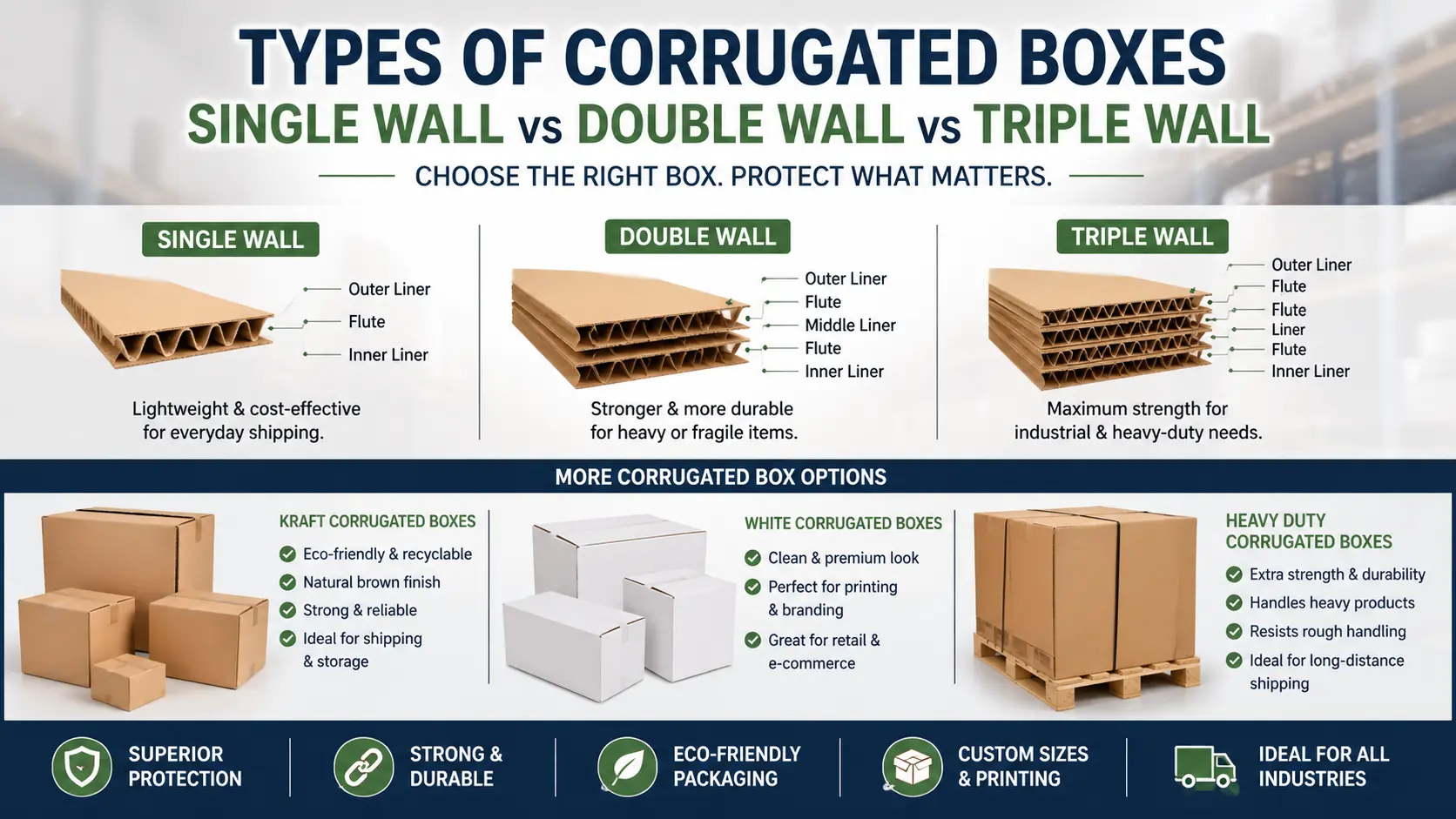
Peel a bit of corrugated apart sometime. Flat paper on the outsides, a wavy sheet glued in the middle (that’s the flute). Single wall has one fluted layer between two liners. Double wall has two fluted layers and three liners. Triple wall has three fluted layers and four liners. That’s the whole difference, but it changes the board’s behaviour a lot, because each extra flute adds a column of arches that resist crushing.
The flute size matters as much as the number of walls. E-flute is thin, about 1/16 inch, and prints nicely, which is why it shows up in retail and mailer boxes. B-flute is about 1/8 inch and handles punctures well. C-flute, a bit thicker again at roughly 5/32 inch, is the common choice for general shipping cartons. Double wall is often a BC combination, so close to 1/4 inch thick. If you want the background on how the board is made, our guide on what corrugated packaging is covers it.
Single Wall vs Double Wall vs Triple Wall at a Glance
Ballpark numbers only. Every mill runs a bit different.
| Type | Typical thickness | Common ECT ratings | Usual contents weight | Good for |
|---|---|---|---|---|
| Single wall | About 1/16 to 3/16 in | 32 to 44 ECT | Up to roughly 40 lbs | Online orders, t-shirts, books |
| Double wall | About 1/4 to 5/16 in | 48 to 61 ECT | Roughly 40 to 100 lbs | Glass, a toaster, tools |
| Triple wall | About 1/2 in | Around 80 ECT and up | 100 lbs and well beyond | Machinery, export, pallet bins |
So what’s ECT? Edge crush test. Basically they stand a strip of board on its edge and push down till it folds, and the number tells you roughly how well your boxes will survive being stacked. A 32 ECT box is the everyday brown carton you get from most online stores. The older burst test (the Mullen number, like 200#) measures puncture resistance instead. You’ll still see both printed in the round stamp on the bottom flap.
When Single Wall Is the Right Call
Most parcels go out in single wall. T-shirts, a jar of face cream, a candle sitting in an insert, a paperback. Product weighs a few pounds and goes from your bench to the carrier to somebody’s porch? Then honestly a 32 ECT single wall carton is plenty (or an E-flute mailer if you want it to look nicer), and you save on weight and shelf space and the price per box too.
It also prints better. Double wall board has a slightly wavy surface (you can sometimes see the flute lines through the ink), so if branding matters, single wall gives you a cleaner face. Our custom shipping boxes are mostly built on single wall for that reason, with the flute picked to suit the product.
Single Wall vs Double Wall: Where the Line Usually Falls
Weight’s the obvious one. Load a single wall box past 30 or 40 lbs and you’ll see the sides start to bulge, and then some guy at the depot grabs it by one end and the bottom flaps let go. Double wall doesn’t do that.
Weight isn’t the only reason, though. Think about these situations too:
- Heavy breakables, wine bottles or tiles say, where every bump goes straight into the product
- Cartons sitting five or six high on a pallet for weeks, worse if the warehouse is humid (damp board gets weak fast)
- Freight and LTL shipments that get forklifted and restacked several times
- Reusable cartons that need to survive several trips
A worked example. A candle maker shipping twelve 10 oz jars to a retailer is sending roughly 20 lbs of glass and wax. A 32 ECT single wall case with a divider insert handles that fine. The same maker shipping 48 jars in one carton is closer to 80 lbs, and that one should be double wall, no question.
Who Actually Needs Triple Wall Corrugated
Triple wall is heavy duty stuff. It’s used for engine parts, industrial equipment, bulk produce bins and export shipments where a wooden crate would otherwise be the choice. It’s stiff enough to stand in for wood in some uses and much lighter to ship.
For a consumer brand it’s nearly always overkill. It’s thick, hard to fold by hand, expensive and heavy, which adds to your shipping bill on every parcel. If you think you need it for a single product box, the real fix is usually a better insert inside a double wall carton.
Mistakes When Choosing Box Strength
Number one, and we see it constantly, is putting everything in double wall just to feel safe. You pay for it on every single order. And it usually doesn’t stop the breakage anyway, because things break when they slide around inside, so a snug fit and a decent insert beat an extra wall nearly every time.
The second is ignoring stacking. A box can survive the trip and still crush at the bottom of a pallet in storage. If cartons sit stacked for a long time, size up the ECT. The third is picking board by thickness alone. A good 44 ECT single wall can outperform a cheap, low-grade double wall. Ask for the rating, not just the wall count. Natural brown kraft corrugated boxes come in all three constructions, so colour doesn’t limit your options either. Not sure corrugated is even the right material? Our cardstock vs corrugated comparison helps with that call.
Corrugated Box Strength FAQs
Is double wall twice as strong as single wall?
Not exactly. It’s usually a lot stronger in stacking and puncture, but the real number depends on the flutes and the paper grade, so compare ECT ratings rather than wall count.
Can double wall boxes be custom printed?
Yes. Print is a little less crisp than on single wall E-flute because the surface is less flat, but logos, text and simple graphics come out well.
Which wall type is cheapest to ship?
Single wall, because it’s lighter and thinner. Over thousands of parcels that weight difference shows up in your carrier bill.
What does 32 ECT mean on a box?
It’s the edge crush rating of the board, meaning it withstood about 32 lbs of force per inch of edge in testing. It’s the standard rating for everyday single wall shipping boxes.
You can browse every style in our corrugated boxes range, or tell us your product weight and how it ships through our contact page, and we’ll suggest the board and flute that fit, with a free dieline and digital proof before anything prints.