

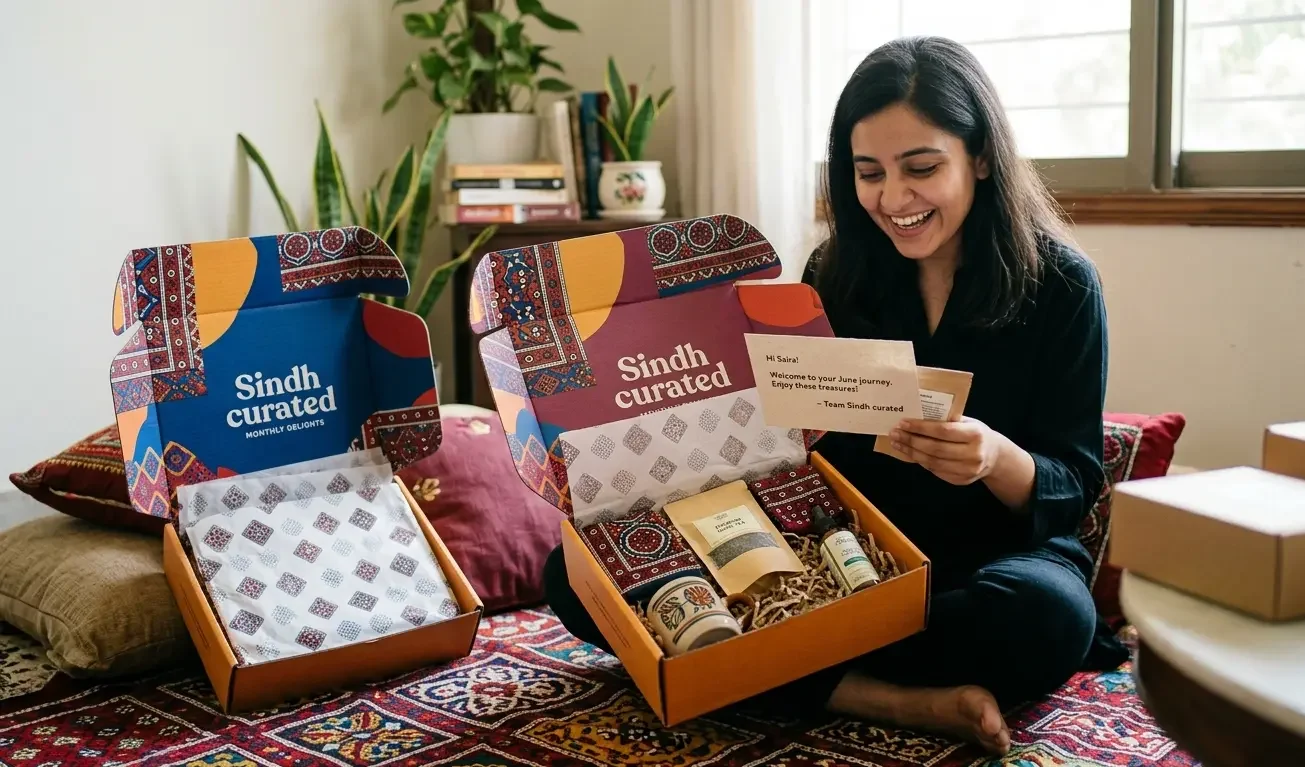
The box you ship in month one has to work in month twelve, with different products inside, at a cost you can live with on every single order. That’s the whole difference between subscription box packaging and ordinary e-commerce packaging. A one-off order? One trip and done. Your subscription box, though, has to put up with twelve months of you changing your mind about what goes in it.
Our short answer goes like this. One outer box, sized for your biggest month. Filler or inserts for the small months. Keep the outside print kind of timeless and let cheap printed bits inside carry the monthly surprise, and we’ll explain why below, with actual numbers.
Why Subscription Box Packaging Is Its Own Problem
Think about what changes from month to month. The products, obviously. Their weight. How fragile they are (a candle in October, a set of socks in November). What doesn’t change, ideally, is the box, because changing box sizes every month means new dielines, new stock to store and new shipping rates to work out.
There’s also repetition. A customer sees your box twelve times a year. The first time, a printed inside lid gets a photo on social media. By the sixth time it needs to still feel cared for, but nobody expects fireworks. We’ve watched brands blow the budget on month one, cut corners by month five, and then wonder about the cancellations. Boring and steady wins here.
Matching the Box Style to Your Price Point
A rough rule we see work: packaging should feel in proportion to what the customer pays. A $20 snack box in a rigid magnetic box feels odd and eats your margin. A $120 skincare box in a plain brown shipper feels cheap.
| Monthly price (roughly) | Box style that usually fits | Notes |
|---|---|---|
| Under $30 | Printed corrugated mailer, one or two colors | Ships as-is, no outer carton needed |
| $30 to $70 | Full-color mailer with printed interior | Inside print gives the reveal without extra parts |
| $70 and up | Mailer with a fitted insert, or a rigid box inside a shipper | Rigid boxes need an outer carton for transit |
For most brands the answer is a roll-end corrugated mailer, the kind with the tuck front and dust flaps. It’s strong enough to ship without an outer box, it opens nicely and the inside can be printed. Our custom printed subscription boxes are built on that style, and you can see related options across the subscription box range.
Sizing for Contents That Change
Size for your fattest month, not your average one. If you can, scribble out the next six months of products on a notepad, then take the biggest month’s stuff and lay it out on the kitchen table the way you’d want a customer to see it, measure how much table it covers and how tall the tallest thing is, and add a little for crinkle paper. There’s your inside dimension.
Then handle the light months with filler or a card insert rather than a smaller box. A common setup: an outer mailer of about 10 x 8 x 4 inches, with a printed card divider that can sit in different positions. If you need ideas on standard footprints, our mailer box dimensions guide lists the common sizes and what usually fits in them.
One mistake that comes up a lot: designing the box around a perfect product photo, and then month four includes a tall bottle that doesn’t fit. Leave yourself an extra half inch of height if your product mix is unpredictable. It’s cheaper than a second box size.
Inserts, Sleeves and the Unboxing Order
Inserts do two jobs. They stop items from sliding around, and they control what the customer sees first. A simple paperboard insert with cutouts is often enough for a fixed lineup (three bottles, say). For changing contents, a fold-in tray or divider is more flexible. Crinkle paper is the cheapest option of all and covers a lot of sins.
We love a sleeve for subscriptions, honestly. Same plain mailer all year, and when December or a special edition rolls around you just slide a printed sleeve over it, so it’s a small run of sleeves and not a whole new box. Same with printed cards, stickers and tissue: they’re where the monthly theme should live.
Think about order too. The welcome card or the item you’re proudest of should sit on top. If the first thing the customer sees is bubble wrap around a spare product, that’s the photo that gets posted.
The Shipping Math Nobody Mentions at Launch
Here’s the bit that bites. Big light boxes get charged by dimensional weight, and on a lot of domestic services that’s length x width x height divided by 139. Grab a calculator. A 12 x 10 x 6 box is 720 cubic inches, divide by 139 and you get about 5.2, so the carrier bills you 6 pounds for a box that weighs two. Trim that to 11 x 9 x 4 and it drops to about 2.9, billed as 3 pounds. On a few hundred boxes a month, that gap is real money.
So every half inch counts. It’s also why a single well-chosen box size beats several: you know your rate, you can buy postage in bulk and your packers aren’t guessing. Our article on how box dimensions affect shipping cost works through more examples. E-flute corrugated is usually the sweet spot for subscription mailers; it’s thin, prints well and is strong enough for most products under a few pounds. Heavier boxes may want B-flute.
How Much Subscription Box Packaging to Order
Order for the subscribers you have, not the ones you’re dreaming about. Got 150? A few hundred boxes covers two months and some new signups. Our minimums are often around 50 boxes depending on the style, and the per-box price drops as you order more, so starting small and going bigger once your numbers calm down is pretty normal.
And leave yourself time! Standard production with us takes 10 to 12 business days once you okay the proof, then free ground shipping to wherever you are in the USA. Shipping on the 1st? You want boxes in the garage a good while before packing day. We can rush it, sure, but planning ahead is cheaper and a lot less stressful.
Subscription Box Packaging FAQs
Should I change my box design every month?
We wouldn’t. Swap the cards or sleeves or inserts each month and leave the box alone, it’s cheaper and your postage stays the same.
Do I need an outer shipping carton?
A corrugated mailer ships fine by itself. Rigid boxes and folding cartons are another story, they’ll want one.
What’s the best material for a subscription mailer?
E-flute for most, it’s thin and takes print nicely. Heavy or breakable stuff inside? Then B-flute, maybe double wall.
Planning a launch, or fed up with your current box? Tell us what goes inside and we’ll figure out a size and style with you, with free design help and a digital proof on every order.