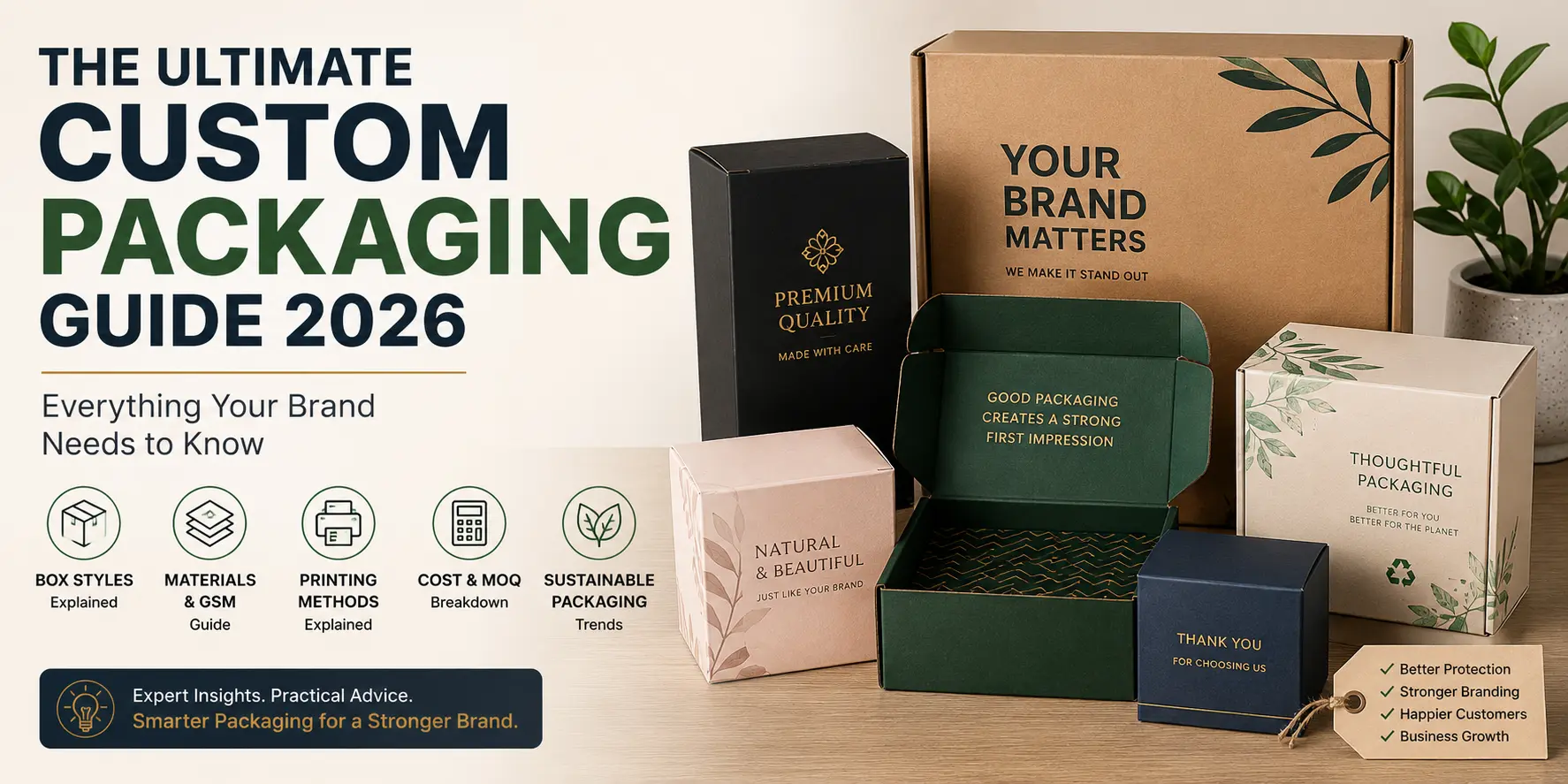
Custom packaging used to just mean a box that kept your stuff from breaking. Now it’s half of how people remember you. Online store, subscription boxes, a lipstick line, hot sauce, a little gift shop brand, doesn’t matter which, because the second somebody picks up your package they’re forming an opinion, and the board and the print and the way the lid comes off all feed into whether they think of you next month or forget your name by Friday. We wrote this guide because we kept explaining the same things on the phone. So here it is, in one place.
Understanding Custom Packaging
So what counts as custom? Basically a box made for your product instead of grabbed off a shelf at a supply store, where you get to pick the size down to an eighth of an inch and then the board, the print, the finish and the style (tuck end, mailer, lid and base, whatever suits). It fits. Nothing rattles.
And people care more than they used to, honestly. We hear it from customers all the time, somebody’s buyer at a boutique turned the box over in their hands, felt the board, looked at whether the print was crisp or a bit fuzzy, and made a call about the product before opening it.
Choosing the Right Packaging Style
We usually start with three dumb-sounding questions on a first call (what is it, who’s buying, where’s it sold), and most of the time the answers just hand us the style. For cosmetics and supplements and most shelf stuff we nearly always end up at a folding carton (light, cheap, prints great), and online brands have pretty much moved to mailer boxes since those ship on their own and open nicely on camera. Jewelry, electronics, fancy gifts? Luxury rigid boxes.
Mismatch is the thing to watch for. We’ve seen a really nice face serum go out in a thin, floppy carton and suddenly it looks like a drugstore knockoff, and the opposite happens too, someone puts a basic phone case in a magnetic rigid box and spends a lot on a feeling nobody was looking for.
Understanding GSM and Packaging Materials
Board choice is where quality starts. You’ll see GSM on every spec sheet we send, which is grams per square meter, so basically how heavy a sheet of the board is, and heavier usually means thicker and stiffer when you squeeze the side panel between two fingers.
Most retail boxes we print land around 250 to 350 GSM. For cosmetic and luxury packaging brands often go thicker, because they want that heavier feel. Rigid boxes are their own thing, thick greyboard wrapped in printed paper, and they don’t fold flat. Ever.
Strength, looks, budget. Pick two and a half, we joke.
Printing Methods and Their Impact
Bad print ruins a good box. Fast.
There’s digital, offset and flexo, and then the fancy add-ons. Our take: offset if you’re printing big runs and the color has to match across all of them, digital if it’s a shorter run or you’ve got six scents with six slightly different boxes (and digital usually skips plate charges, which helps a small brand a lot). For premium we’d honestly just do soft-touch and one small gold foil hit, maybe embossing on the logo if you really want people to feel it, and leave it there.
Weirdly, people run their thumb over a raised logo and decide the product’s better. We’ve watched it happen at trade shows.
Understanding Packaging Costs
“How much?” is the first question on nearly every call. Box size matters, board matters, finishes matter, but quantity matters most, because the press setup costs about the same for 200 boxes as for 5,000, so the price per box keeps sliding down as the order gets bigger.
New brands stare at the first invoice. We get it, cash is tight at launch. Still, once you’re selling steady, a bigger run is usually cheaper over the year. Want a ballpark first? Our cost calculator gives you one.
The Importance of MOQ
MOQ is minimum order quantity. Most shops set one since getting a press ready is the same work whether you print 100 boxes or 10,000.
A low minimum is a big deal when you’re starting out, because the last thing you want is 5,000 boxes in the garage for a product you’ll redesign in six months. Ours are low, often around 50 boxes depending on the style. Test first, then scale.
Knowing your MOQ helps with the dull but important stuff too. Inventory, cash flow, that kind of thing.
Sustainable Packaging Trends
Eco is the biggest shift we’ve seen in years, and a lot of shoppers lean toward brands using eco-friendly packaging now.
On our end it mostly looks like kraft and recyclable board with soy-based or water-based inks on top. Customers flip the box over looking for the recycle note, we’ve noticed (most corrugated and kraft boxes go right in the curbside bin, so that’s an easy line to print).
Not going away. Not in any industry we print for.
Common Packaging Mistakes to Avoid
Most packaging headaches we see come from planning, or the lack of it. Measuring the old box instead of the product is a classic. So is board that’s too thin for a heavy jar, or a logo pulled off a website at screen resolution that prints blurry, or forgetting the thing has to survive a delivery truck, or calling us two weeks before launch.
Every one of those ends in broken products, extra cost or a late launch. A bit of planning up front fixes most of it.
Conclusion
A box isn’t just a box. It rides along with every order whether you planned it or not, and people hold it, so you may as well get the basics right (board, print, style, cost, the eco bit) and stop guessing.
First product or tenth, good custom packaging changes how people see you. That ends up in sales, eventually.
Frequently Asked Questions
What Is Custom Packaging?
A box made to your spec rather than bought off a shelf. Size, board, print, the lot.
Why Is Custom Packaging Important for Businesses?
People spot you faster on a shelf or a doorstep. And a product in a good box looks like it’s worth more, which is half of getting that second order, in our experience.
What Materials Are Commonly Used for Custom Packaging?
SBS paperboard, cardstock, corrugated board, kraft and rigid board, mostly. Heavy product? Lean corrugated. Shelf product? Paperboard is usually plenty.
What Is GSM in Packaging?
Grams per square meter, so how heavy the board is. More GSM usually means stiffer, and that’s why luxury boxes tend to go higher.
What Is the Difference Between Corrugated Boxes and Cardboard Boxes?
Peel the edge of a shipping box and you’ll see the wavy fluted layer in the middle. That’s corrugated, and it’s why it survives a delivery truck. “Cardboard” in everyday talk usually means paperboard, just one solid sheet, which is fine for a retail box nobody’s going to throw.
What Printing Options Are Available for Custom Packaging?
Digital, offset or flexo for the ink itself. After that it’s the extras people love picking from, like foil and embossing, spot UV, and matte or gloss lamination over the whole thing.
How Much Does Custom Packaging Cost?
Size, board, print, finishes and quantity all play in. Order more and each box costs less, often a lot less.
What Is MOQ in Custom Packaging?
The smallest run a maker will print. It shifts with box style and print method, and ours are low, often around 50 boxes depending on the style.
How Long Does It Take to Produce Custom Packaging?
Standard production with us is 10 to 12 business days after you approve the proof, and we can do rush production and shipping if a launch date is breathing down your neck.
Is Eco-Friendly Custom Packaging Available?
Yep. Kraft packaging is the popular one, and we print with soy or water-based inks anyway, so you’re mostly just choosing the board.
How Do I Choose the Right Packaging Style for My Product?
Go back to those three questions from earlier. Shelf stuff tends to end up in a folding carton, online orders in a mailer, the luxury things in rigid, and when you’re stuck between two we’ll just send you a sample of each.
Can Small Businesses Order Custom Packaging?
Of course. Our minimums are low, and the team sets up your dieline and artwork for free, so you don’t need a designer on payroll to get started.
Where to Go Next
Popular options for this topic include custom mailer boxes and product packaging boxes. Related guides: custom packaging for small business: the ultimate guide to unboxing success.