Few boxes are as familiar as the milk carton. Open almost any American fridge and there’s one in the door, every kid has fought with one at a lunch table, and the dairy aisle is basically a wall of them, from the tiny school-size carton to the big family gallon.
Bottling your own milk, juice or plant drink? We print custom milk cartons in pint, quart and half-gallon sizes with your branding on them. There’s more drink packaging over in our food and beverage packaging range.
We’ll admit it, we used to think a milk carton was just a milk carton. Then you trim 3 mm off a side and the thing holds less than the label promises, or it jams in the fridge door, or your pallet pattern loses a row, and the nutrition panel suddenly doesn’t fit. Somebody sweated over those numbers a long time ago.
So whether you run a small dairy, you’re launching an oat milk, or you just wondered why the carton is shaped like a little house, here’s our rundown of standard milk carton dimensions. If you want your own printed, we do custom sizes with low minimums (often around 50 boxes depending on the style) and ship free anywhere in the USA.
A Brief History of Milk Carton Dimensions
Quick bit of history, because it explains a lot.
Milk used to come in glass bottles, which were heavy and broke if you looked at them funny, and cost a lot to truck around. Then a man named John Van Wormer patented a paper milk carton back in 1915 and called it the Pure-Pak, and it had that peaked gable top that still pops into everyone’s head when you say “milk carton”.
Glass bottles hung on for decades, and early plastic jugs joined the fight later. Paper won most of it anyway. Lighter, cheaper, and you could print right on it, which glass never let you do.
Tetra Pak (a Swedish outfit) changed the game again in the 1950s with the aseptic carton. They sterilized the drink and the carton separately and then filled them, and suddenly milk could sit on a shelf for months instead of a couple of weeks in the fridge. Every shelf-stable milk and plant milk carton you see today goes back to that.
A hundred-odd years of fiddling with filling machines, store shelves, fridge doors, cafeteria trays and people’s hands is how we got the standard sizes we have now, and it’s a multi-billion dollar business these days.
The Two Main Milk Carton Structural Styles
Two styles matter, and they measure differently, so let’s sort that out before any numbers.
Gable Top Cartons
This is the house-shaped one most Americans grew up with. Two slanted panels fold up into a little roof, the bottom is flat and square (or close to it), and when we quote height we mean the body plus that roof.
It’s paperboard with a polyethylene coat on both faces so the milk can’t soak into the board. Keep it cold and it lasts maybe two or three weeks, and for fresh milk in US grocery stores it’s still the main format.
Don’t forget the roof when you measure. It adds an inch to an inch and a half above the liquid, and that’s the bit people forget when they’re checking whether it clears a fridge shelf.
Flat Top or Aseptic Cartons
Then the bricks. Everybody calls them Tetra Paks no matter who made them, kind of like Kleenex. Peel one apart (we have, more than once) and you’ll find six layers: paperboard, polyethylene, and a thin skin of aluminum foil that keeps out light and air, which is why the unopened carton can hang out in a pantry for six months or even a year.
Look along the plant milk shelf and it’s almost all bricks. Juice too, and boxed shelf-stable milk, which is a much bigger deal in Europe than here.
No roof, so a flat top is shorter than a gable top holding the same amount, and since it’s a plain brick it packs tighter on pallets and shelves.
Standard Milk Carton Sizes and Dimensions
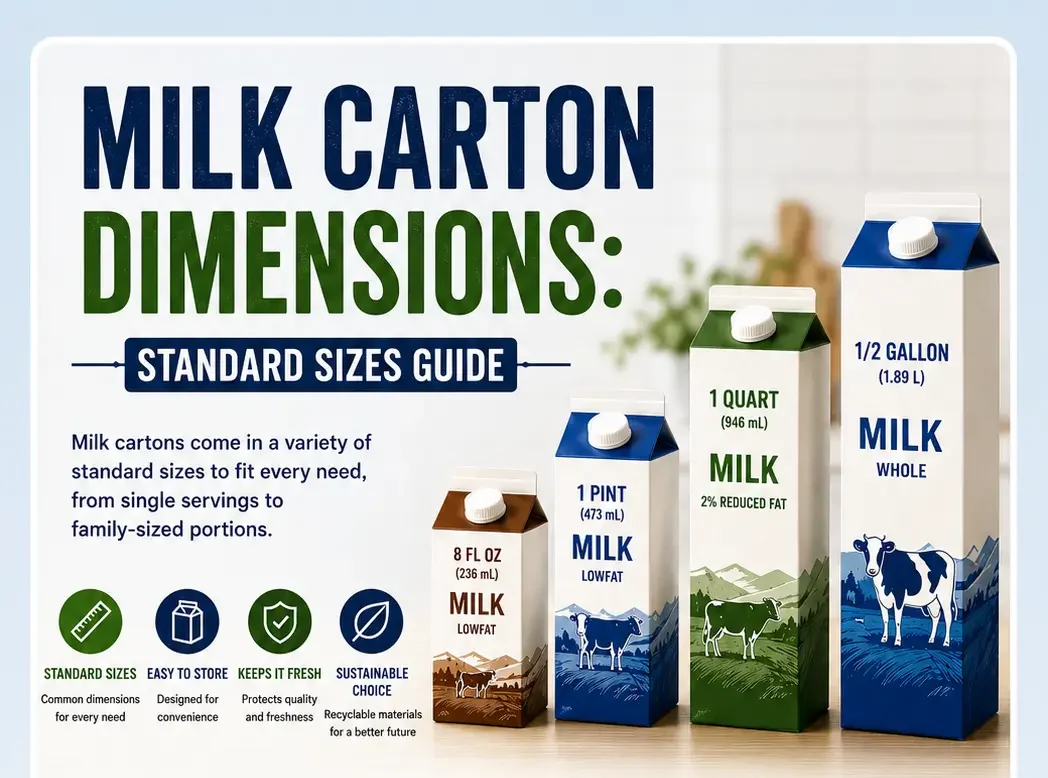
Four main sizes in the US, plus the gallon. Inches and millimeters for each below.
Half Pint (8 oz / 236 ml)
The school lunch carton! Eight ounces is a cup (236 ml), and the whole thing was more or less built around the USDA National School Lunch Program, which pours milk for tens of millions of kids every school day, so it had to be small enough for a first grader to hold and, in theory anyway, open without spraying the table.
Standard half pint gable top dimensions: we’d call it 2.25 x 2.25 x 3.75 inches outside, which in metric is 57 x 57 x 95 mm. If somebody quotes you 2.75 for the height, they’ve measured the body and left the roof off.
Nobody touches that 2.25 inch base. Every filler and every cafeteria cooler in the country is set up for it, and changing it would be a nightmare. Hospitals and airlines use the same carton for portion control, and so do plenty of hotels.
Pint (16 oz / 473 ml)
Pints hold sixteen ounces, or two cups (473 ml if you’re metric). Think of the coffee shop fridge behind the bar, that’s where pints live, along with deli cases and food service kitchens where a half pint runs out too fast.
Standard pint gable top dimensions: 2.75 x 2.75 x 5.75 inches, give or take, which is 70 x 70 x 146 mm.
At the supermarket? Not many plain milk pints, honestly. The grass-fed, cream-on-top crowd loves them though, since a cute little carton of something special can charge more per ounce than you’d believe.
Quart (32 oz / 946 ml)
If you live alone, you probably buy these, because a half gallon turns before you get through it (been there). Thirty-two ounces, 946 ml, and it’s also where heavy cream and half-and-half and chocolate milk tend to land.
Standard quart gable top dimensions: 3.5 x 3.5 at the base and roughly 7.25 inches tall with the roof, so 89 x 89 x 184 mm.
Weirdly consistent, quarts. We’ve lined up cartons from different dairies on the shop counter and you’d need calipers to tell them apart.
Half Gallon (64 oz / 1.89 litres)
Our guess is you bought one of these last week. Most families of two to four drain the 64 ounces (1.89 liters, near enough) in somewhere from a few days to a week, it pours one-handed unless it’s 6am, and the fridge door was built for it.
Standard half-gallon gable top dimensions: right around 3.875 x 3.875 x 9.5 inches, 98.4 x 98.4 x 241 in millimeters.
Makers wander a bit here. We’ve seen 4 x 3.875 x 9.5 and 3.875 x 3.875 x 9.25, but the base hardly moves, staying somewhere between 3.75 and 4 inches square across the big brands, since that’s what the fillers are built for.
Gallon (128 oz / 3.785 litres)
Sixteen cups, about 3.785 liters. The big one for big families.
Funny thing, though, most US gallons aren’t cartons at all. They’re HDPE plastic jugs, because a full gallon is heavy and a paper gable top struggles with the weight and the sloshing. Paper gallons exist. You just don’t see many.
Standard gallon gable top dimensions (where used): around 4.5 x 4.5 x 10.5 inches (114 x 114 x 267 mm). Some sources list 7.5 x 4.5 x 8 inches instead, a squatter shape, which just tells you different makers do different things.
And the plastic jug most people actually buy? Usually about 6.75 x 4.5 x 9.5 inches.
Standard Milk Carton Dimensions Quick Reference Table
| Size | Volume | Gable Top External Dimensions (inches) | Dimensions (mm) | Common Use |
|---|---|---|---|---|
| Half pint | 8 oz / 236 ml | 2.25 x 2.25 x 3.75 | 57 x 57 x 95 | Schools, food service, hospitals |
| Pint | 16 oz / 473 ml | 2.75 x 2.75 x 5.75 | 70 x 70 x 146 | Cafes, specialty products, food service |
| Quart | 32 oz / 946 ml | 3.5 x 3.5 x 7.25 | 89 x 89 x 184 | Small households, tight fridge space |
| Half gallon | 64 oz / 1.89 L | 3.875 x 3.875 x 9.5 | 98 x 98 x 241 | The household favorite |
| Gallon | 128 oz / 3.79 L | 4.5 x 4.5 x 10.5 | 114 x 114 x 267 | Big households, wholesale |
Aseptic and Flat Top Carton Dimensions
Shelf-stable cartons have their own sizing system, nothing to do with the fresh gable tops. Tetra Pak and SIG make most of them, and each has its own set of standard sizes.
Tetra Brik Aseptic (most common format)
You know this one even if you don’t know the name. It’s the brick that your juice box grew up into, holding oat milk, orange juice and boxed milk in stores all over the world.
| Volume | External Dimensions (mm) | Notes |
|---|---|---|
| 200 ml | 95 x 55 x 65 | Single serve, big in Europe and school programs |
| 330 ml | 110 x 60 x 75 | Food service favorite |
| 500 ml | 125 x 65 x 90 | Lots of juice and plant milk |
| 1 litre | 195 x 70 x 95 | The standard retail size internationally |
| 1.5 litre | 225 x 70 x 110 | Bigger retail size |
| 2 litre | 255 x 75 x 125 | Family size in some markets |
Flat top means you can stack bricks right on top of each other with no air in between, while every gable top wastes a little triangle of space above it. Over a whole truckload that adds up.
How to Measure a Milk Carton
Got a sample from a supplier, or a competitor’s carton on your desk? Grab a ruler, it’s easy, but there are a couple of traps.
Three numbers. Height, width, and length (some people say depth).
Height: bottom of the carton to the tippy top of the roof or spout. The only time you’d skip the roof is if you’re working out how tall the liquid part is for fill volume.
Width: across the front, at the base, left to right.
Length: front to back, at the base, square to the width.
On most gable tops width and length come out the same, since the base is square. Not always, though. Some novelty and custom cartons have a rectangle on the bottom.
Wall thickness only matters if you need inside measurements. The board’s usually 18 to 24 point (that’s about 0.45 to 0.61 mm) plus the plastic coats, so the inside and outside of the base end up within a millimeter or two, and for most jobs you can just treat them as the same number.
The two traps we mentioned? People measure width up near the roof, where it narrows, and get a number that’s too small. Or they leave the roof off the height and then wonder why it won’t fit the fridge.
Milk Carton Dimensions by Use Environment
A carton’s size only really makes sense once you picture where it’s going to sit.
Refrigerator Door Shelves
US fridge doors are pretty much designed around milk. A typical door shelf gives you about 4.5 to 5 inches of depth and 10 to 11 inches of height, so a half gallon (3.875 wide, 9.5 tall) slides right in. A gallon at 4.5 inches wide often won’t, which is why it ends up on the main shelf next to the leftovers.
School Cafeteria Requirements
The half pint is the size it is because of cafeterias. Its 2.25 inch base drops into the cup holder on a standard lunch tray, and the 3.75 inch height suits the milk coolers built for it. The National School Lunch Program guidelines have more or less frozen it as the school milk format.
Retail Grocery Shelving
Grocery dairy cases are planned around these footprints too. A 48 inch section fits roughly a dozen half gallons in a row, and the 9.5 inch carton height is why the shelves sit about 10 to 11 inches apart.
Shipping Pallet Configuration
Pallets are where the square base really pays off. On a standard 48 x 40 inch US pallet you can fit about 12 half gallons across and 10 deep, so around 120 per layer, and stack eight layers for roughly 960 cartons per pallet. Tetra Briks at 70 x 95 mm pack even tighter on international pallets. (We get into the freight side more in our guide on how packaging dimensions affect shipping cost.)
Milk Carton Materials and Their Effect on Dimensions
The material changes the specs, mostly how thick the walls are and how small you can realistically make the base.
Standard Fresh Milk Cartons (Gable Top)
Under the print there’s a core of food-grade SBS board, usually 300 to 400 GSM, with low-density polyethylene laid on both sides at roughly 15 to 25 grams per square meter a side. The plastic is what keeps milk out of the board. Put it all together and the wall’s about 0.6 to 0.8 mm thick, which is thin enough that inside versus outside barely matters.
Aseptic Cartons (Tetra Pak and Similar)
The aseptic recipe is six layers of paperboard, polyethylene and aluminum foil stacked in a set order. The foil keeps light and oxygen out, and that’s why no fridge is needed. Overall it’s a touch thicker than a fresh carton, around 0.8 to 1.0 mm.
HDPE Plastic Jugs
HDPE owns the US gallon. It’s food safe, it doesn’t mind milk’s slightly acidic pH, it’s stiff enough at the thickness used, and recyclers take it. Jug walls run about 0.8 to 1.2 mm.
Recyclability Considerations
If you’re a dairy planning to talk up your eco credentials, know that recycling varies a lot by material. Most US curbside programs take paperboard gable tops if they’re flattened. Aseptic cartons are getting accepted in more towns, but it really does depend on where you live. HDPE jugs are about the most widely recycled plastic packaging there is. And the Carton Council of North America says cartons come in lower on greenhouse gas emissions per unit of liquid than glass.
Plant-Based Milk Carton Dimensions
Plant milk brands mostly just borrow dairy’s sizes, whether it’s oat or almond or soy or coconut, though you’ll notice a lot more shelf-stable bricks on their side of the store.
Walk the shelf-stable aisle at any US grocery and you’ll see the 32 oz brick everywhere. It’s about 3.875 x 2.5 x 7.25 inches, a little slimmer than a dairy quart, because a brick just isn’t proportioned like a square-bottomed gable top.
Over in the cold case it’s the 64 oz gable top, the one Oatly and Silk and Califia Farms put their refrigerated stuff in, and it measures about 3.875 x 3.875 x 9.5 inches. Same as cow’s milk, to the eighth of an inch. On purpose! The store slots plant milk right next to dairy, and if it didn’t fit the same shelf it simply wouldn’t get stocked.
Milk Carton Dimensions for Custom and Specialty Products
Off the standard chart, a few specialty uses have their own sizes.
Mini Milk Cartons for Events and Weddings
These are the cute little favor boxes shaped like school milk, often around 2 x 2 x 3.5 inches. No milk goes in them (there’s no liquid barrier at all), just candy or a small gift, and people put them at wedding tables and kids’ birthday parties.
Premium and Artisan Dairy Cartons
Small dairies that want to look different from the store brand next door sometimes change the shape, and one we like is a half gallon at 5 x 3 x 8 inches rather than the usual 3.875 x 3.875 x 9.5, which somehow just looks like the milk that costs a dollar more.
Cream and Half-and-Half Cartons
Since nobody drinks cream by the glass (we hope), heavy cream and half-and-half mostly stick to pints and half pints.
Coffee Creamer Cartons
Diner creamers, those peel-top thimbles, are a whole other category at about 1.5 x 1.25 x 1.25 inches and roughly 0.375 oz (11 ml) each.
Want something standard, or a size nobody else has? We print custom milk cartons pretty much any size, with low minimums and free shipping in the USA, and our team sets up the dieline for free.
Printing and Labelling on Milk Carton Dimensions
Your designer’s going to ask how much room they’ve got, so here’s the answer before they ask.
Take a half gallon gable top. You get four main panels, front, back and two sides, each about 3.875 inches wide and about 8 inches tall from the bottom up to the shoulder where the roof starts.
The roof panels add a strip about 3.875 inches wide and 1.5 to 2 inches tall on each side, which people see from above. Useful, since everyone looks slightly down into a dairy case.
Then the legal stuff. FDA labeling rules mean the carton has to carry the product name and the volume (in fluid ounces and milliliters), a nutrition facts panel, the ingredients and allergens, who processed it and where, and a line saying it’s pasteurized. The nutrition panel has a minimum type size, which in effect sets a minimum panel width, and on a 2.25 inch school carton that gets tight enough that some brands use the simplified small-package nutrition format.
Want a ballpark on printing your own? Our custom packaging cost calculator gives a quick estimate from your carton size, material and print.
Common Mistakes When Specifying Milk Carton Dimensions
Some of these we’ve watched happen more than once, sadly.
Confusing gable height with body height. The roof adds about 1 to 1.5 inches over the body, and if you send the body height when someone wanted the total (or the other way round) the carton won’t fit where you planned.
Not accounting for headspace. Cartons are filled leaving roughly 5 to 8 percent of space at the top, so the milk has room to expand when it warms up and doesn’t squirt out when someone shakes it. Plan a carton with no headspace and you’ll get leaks, or bulgy cartons.
Ignoring regional dimension standards. The US runs on fluid ounces and inch-based fillers, Europe on liters and millimeters. A carton built for an American line might need adjusting before it’ll run on a European one.
Measuring at the wrong point. Width taken up near the roof comes out too small, every time. Measure at the base.
Assuming square base. Most are square, so people stop checking, and then the one custom carton with a rectangular base comes along and throws the whole spec off.
FAQs
What are the dimensions of a standard milk carton? When people say “standard” they usually mean the half gallon, and that one’s roughly 3.875 inches square and 9.5 tall with its roof. For the record, school half pints run about 2.25 x 2.25 x 3.75 and quarts about 3.5 x 3.5 x 7.25.
How tall is a half gallon milk carton? Roughly 9.5 inches to the top of the roof, with about 8 of those inches being the part that actually holds milk.
How tall is a school milk carton? Close to 3.75 inches roof and all, sitting on a base that’s about 2.25 inches square.
What are the dimensions of a quart milk carton? 3.5 by 3.5 at the bottom. Call it 7.25 tall, peak included.
What is the difference between a gable top and a Tetra Pak carton? Gable tops have the little roof, live in the fridge and last two or three weeks. A Tetra Pak is a sealed brick with foil inside, so it can sit in the pantry for six months to a year before you open it.
What are the dimensions of a Tetra Pak one litre carton? In millimeters it’s about 195 tall, 70 deep and 95 wide. Our US customers usually want inches, so that’s roughly 7.67 x 2.75 x 3.74.
Why are most milk cartons square at the base? Because squares pack with no gaps, on the filling line and the store shelf and the pallet, and anything round or oddly shaped leaves dead space you’re paying to ship.
What size carton is used for school milk? In the US it’s the 8 oz half pint gable top, roughly 2.25 x 2.25 x 3.75 inches, the size the National School Lunch Program setup is built around.
How do milk carton dimensions affect shipping costs? Milk’s heavy, so the scale usually sets the freight price rather than dimensional weight. Where size helps is pallet packing, since cartons that tile neatly take fewer pallet spots, and at volume that brings the per-carton cost down.
What are the dimensions of a gallon milk carton? Paper gallons are rare, but when you do spot one it’s somewhere near 4.5 x 4.5 x 10.5 inches. The plastic jug in most fridges is more like 6.75 x 4.5 x 9.5, handle and all.
Related Products and Guides
If you’re working on packaging like this, have a look at custom mailer boxes and product packaging boxes. You might also find these useful: egg carton dimensions: standard & jumbo sizes guide and cigarette carton dimensions guide: standard sizes, types, and everything you need to know.
Want a price? Tell us your size and quantity on our quote page and we will send a free quote and proof.