

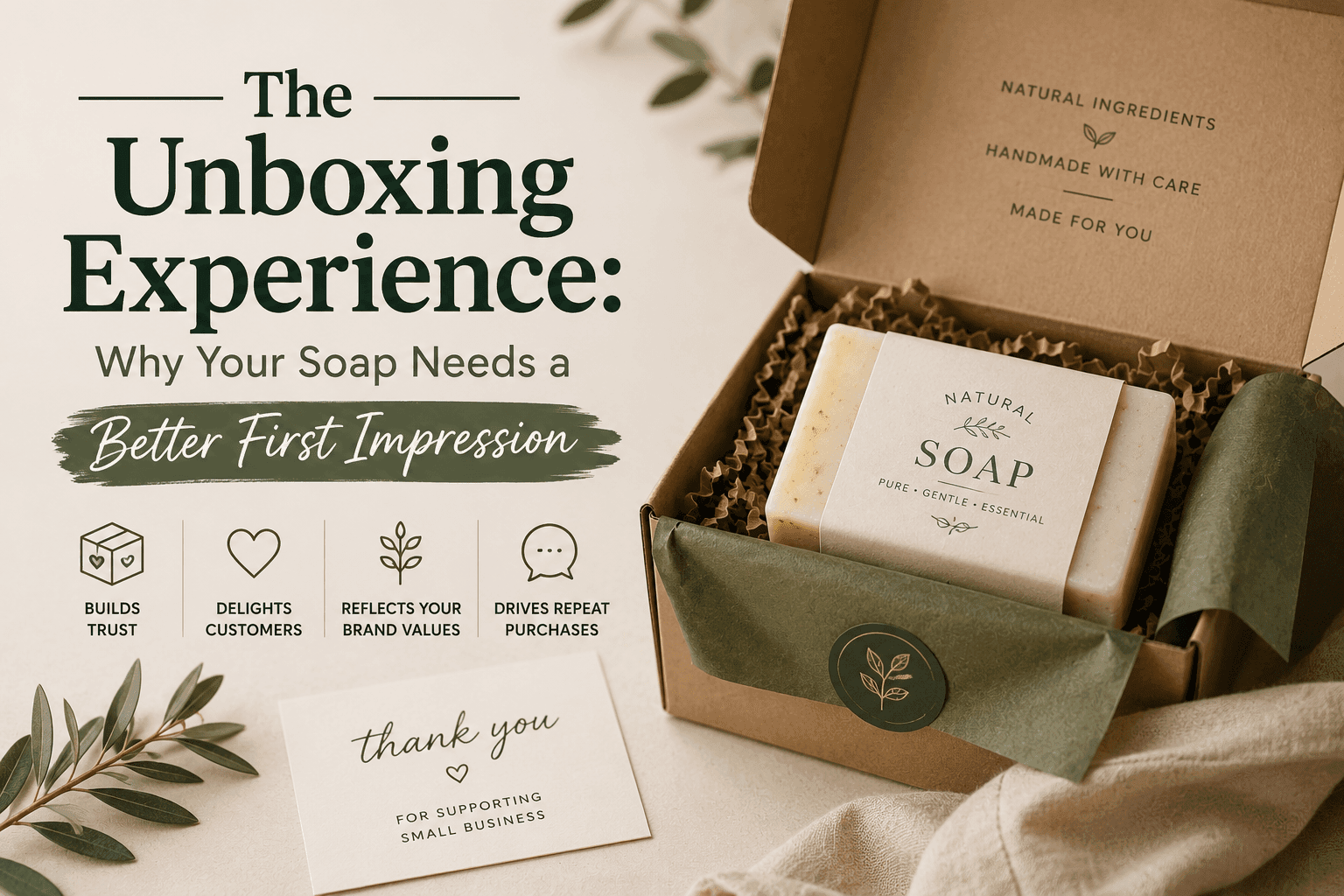
Think about the last time you received something in the mail that genuinely surprised you. Not the product inside, but the packaging itself. The weight of the box, the sound it made when you lifted the flap, the way the tissue paper was folded, the small card sitting on top. That entire sequence before you even touched the product created a feeling. And that feeling shaped everything you thought about the brand that sent it.
This is what the unboxing experience is. And for soap brands, it is more important than most business owners realise.
Soap is a personal product. People use it on their skin every single day. When someone chooses your soap over a mass-market brand, they are not just buying a cleaning product. They are buying into a story, a feeling, a set of values they want to be part of. Your packaging either reinforces that story from the first second or it undermines it before they even get the box open.
Most soap brands spend months perfecting their formulas, sourcing their ingredients, and crafting their scents. Then they ship those carefully made bars in a plain brown box with crinkled tissue paper stuffed in around it. The product experience starts brilliantly the moment the customer uses the soap. But the brand experience started the moment the package arrived, and it told a completely different story.
This guide covers why the unboxing experience matters for soap brands specifically, what the research actually says about packaging and purchasing behaviour, and how to build an unboxing experience that makes customers want to come back, share what they received, and feel good about paying a premium price for your product. If you are ready to upgrade your soap packaging, The Pioneer Packaging offers a full range of custom soap boxes sized to your exact bars, with premium finishes, low minimums, and free USA shipping.
Why the Unboxing Moment Is a Real Marketing Opportunity
The idea of an unboxing experience might feel like something that only matters for luxury goods, electronics, or subscription boxes. But the data suggests otherwise.
Research from Dotcom Distribution found that 40 percent of online shoppers say they would share an image of a purchase on social media if it came in branded packaging. That is effectively free marketing generated by a packaging decision. The same research found that 52 percent of consumers say they are likely to make repeat purchases from an online retailer that delivers premium packaging.
A study on consumer behaviour found that most shoppers decide within 7 seconds whether to pick up a product or move on. For online customers, that decision happens at the moment of delivery rather than at the shelf. The packaging that arrives at their door is the physical embodiment of everything your brand promised when they decided to buy.
For soap specifically, the stakes are particularly high because of how the category works commercially. Soap customers who discover a brand they love tend to be extremely loyal. They buy repeatedly, they order larger quantities over time, and they tell people about it. A strong first impression can convert a first-time buyer into a customer who orders from you for years. A weak first impression, even if the soap itself is excellent, creates doubt that the customer has to overcome before trusting the brand enough to reorder.
The unboxing moment is the first physical interaction a customer has with your brand. Everything before that, the website, the product photos, the reviews, built expectation. The box that arrives is where the brand either lives up to that expectation or falls short of it.
What Customers Actually Notice During Unboxing
Understanding what customers pay attention to during unboxing helps you prioritise which elements of your packaging to invest in. Not everything costs the same, and not everything has the same impact.
The exterior of the package. The first impression starts before the box is even opened. For orders shipped in a mailer box, the printed exterior is the first thing the customer sees and touches. A plain brown generic mailer sends a message about the brand before it is opened. A printed, branded mailer with your logo, brand colours, and perhaps a simple message sends a completely different one.
The moment of opening. How the box opens matters. A box that opens cleanly, with a satisfying resistance and a clear reveal, feels intentional. A box that requires digging into it, that does not stay open on its own, or that collapses when the flap is pulled creates friction at the most important moment.
The first layer. What the customer sees first when the box is open sets the emotional tone for the rest. A branded tissue paper wrap, a logo-printed inner box, or even a simple printed insert on top of the soap all work better than a customer’s first view being plain cardboard void fill.
The feel of the packaging. The texture of the box and any tissue paper communicates quality through touch before the soap is even uncovered. A soft-touch laminated box surface, a matte finish, or even a natural kraft texture each creates a different tactile impression. A thin, flimsy box that bends when held communicates the opposite of quality regardless of what is printed on it.
The soap reveal. When the customer finally unwraps the soap itself, the condition it arrives in matters enormously. Soap that arrives perfectly intact, with sharp edges and an unmarked surface, confirms the quality of the product. Soap with scuffed surfaces, chipped corners, or broken textures creates disappointment even if the damage is only cosmetic.
Small extras. A handwritten thank you note, a product card, a small sample of another product, or a discount code for the next order all extend the positive feeling of the unboxing beyond the moment itself. These additions are often inexpensive but create a disproportionate emotional impact.
The Psychology of Packaging and Perceived Value
There is a well-documented connection between packaging quality and the perceived quality of the product inside. Understanding this connection explains why investing in better soap packaging is not vanity; it is commercial sense.
The principle is called the halo effect. When a customer encounters high-quality packaging, they attribute the quality they perceive in the packaging to the product inside. The logic, which operates largely at an unconscious level, goes like this: a brand that takes this much care over the box probably takes the same care over what is inside it.
The reverse is also true. Research from packaging behaviour studies consistently shows that flimsy, generic, or poorly finished packaging causes consumers to perceive the product inside as lower quality, even when the product itself is objectively excellent. For soap brands, this is a genuine commercial problem because soap quality differences are not immediately obvious to a new customer. The soap needs to be used several times before its quality relative to alternatives becomes clear. The packaging is judged in the first second.
A study cited in the packaging industry found that minimalist, high-quality packaging increases willingness to pay by approximately 27 percent compared to average-quality packaging containing the same product. For a soap bar retailing at $12, that is potentially an additional $3.24 per bar that customers are willing to pay based purely on packaging perception.
For soap brands positioning themselves in the natural, artisan, or premium segment, this psychology is directly relevant. Your customers chose your brand over a $3 supermarket soap, which means they have already signalled that they value quality over price. Your packaging should confirm that the premium they are paying is justified from the very first moment.
The Social Media Effect of Great Soap Packaging
One of the most commercially valuable aspects of excellent unboxing packaging is that it generates social media content without you having to do anything. When a customer receives packaging that genuinely delights them, many of them photograph it and share it.
Instagram, TikTok, and YouTube are full of unboxing content. For small soap brands, appearing in organic unboxing content from real customers is a form of marketing that money cannot reliably buy through paid advertising. It is credible because it comes from a real person sharing a genuine reaction. It reaches new audiences who trust the person sharing it. And it costs you only the investment in the packaging itself.
The characteristics of soap packaging that gets shared on social media are consistent across the category. It must be visually distinctive and photogenic. A box with a striking design, a beautiful colour palette, or an interesting texture photographs well. The arrangement inside the box must be considered, because the photograph is typically taken of the open box rather than after everything has been removed. Tissue paper, ribbon, or decorative elements add visual interest to the open-box photograph. Small unexpected extras, a sample, a note, a small bonus product, create a moment of surprise that people want to share.
For soap brands that have not yet thought about their packaging in terms of its shareability, this is worth serious consideration. A packaging investment that generates 20 customer social media posts per month, each reaching an average of 500 followers, produces 10,000 organic brand impressions from a single packaging decision. That is difficult to value precisely but impossible to dismiss.
Soap Packaging Box Styles and Their Impact on Unboxing
The specific box style you choose for your soap significantly shapes the unboxing experience. Different styles create different experiences and suit different brand positions and price points.
Tuck End Box
The tuck end box is the most widely used soap box construction. It opens and closes through a folding tuck flap. For a good unboxing experience with a tuck end box, the key factors are a precise fit so the soap does not move, quality board weight so the box feels substantial when held, and a printing and finishing treatment that creates a strong visual and tactile impression.
The reverse tuck end is the most common configuration for soap and creates a slightly more secure closure than the straight tuck, which matters for shipping.
Sleeve Box
A soap sleeve wraps around the middle of the bar, leaving the top and bottom of the soap exposed. The sliding motion of removing the soap from the sleeve, revealing the product gradually, creates a small but satisfying moment of reveal. Sleeve boxes use significantly less material than full enclosure boxes, which makes them a strong sustainable choice, and the exposed soap surface allows customers to see and smell the product.
The sleeve works particularly well for soaps with distinctive visual appeal, marbled cold process soaps, brightly coloured layers, or soaps with embedded ingredients that are visible on the surface.
Drawer Box (Slide Out Box)
A drawer box has an outer sleeve and an inner tray that slides out, revealing the soap gradually like a drawer being opened. The deliberate, tactile motion of sliding the inner tray creates a premium opening experience that is significantly more engaging than opening a standard tuck end box.
Drawer boxes are associated with premium and luxury soap positioning. They cost more to produce than tuck end boxes but create an unboxing experience that customers remember and describe when recommending the brand.
Two-Piece Lid and Base Box
A two-piece box has a separate lid and base. The lid lifts off cleanly, creating a clear reveal moment. It is associated with gift packaging and premium products. For soap brands selling gift sets or positioning their product as a luxury item, the two-piece format creates the right expectation from the first moment of opening.
Rigid Box
A rigid box is made from thick chipboard rather than folding paperboard. It does not fold flat, is permanently assembled, and is substantially heavier than a corrugated or paperboard box. The weight of a rigid box in the hand communicates quality before it is opened. When it is opened, the clean, precise interior makes the soap look as though it belongs in a boutique.
Rigid soap boxes are used by premium and luxury soap brands where the box itself is part of the gift experience. They are significantly more expensive than other box styles and are practical for soaps retailing at $20 or above per bar.
Window Box
A window box incorporates a clear panel in the front or top of the box, allowing the soap to be seen through the packaging before it is opened. For visually distinctive soaps, the window creates the opportunity for the soap’s own appearance to sell it. A customer can see the marbling, the colour, and the texture before committing to the purchase.
Window boxes are particularly effective in retail environments where customers cannot open the packaging to inspect the product.
The Elements That Make Soap Packaging Memorable
Beyond the box style itself, several specific elements create the difference between packaging that is adequate and packaging that is genuinely memorable.
Finishing treatments on the box exterior. The surface finish of a soap box creates the first tactile impression. Matte lamination is popular for premium and luxury soap brands because it creates a smooth, sophisticated surface with low reflectivity that photographs beautifully. Soft touch lamination creates a velvety texture that is particularly striking for premium natural soap brands because the sensory experience of the surface aligns with the sensory promise of the soap itself.
Gloss lamination creates a brighter, more vibrant appearance that works well for bold, colourful brand designs. Spot UV coating applies gloss selectively over specific elements, typically a logo or a pattern, creating a contrast against a matte base that draws the eye precisely where the designer wants it.
Foil stamping in gold, silver, rose gold, or copper adds a reflective metallic element that catches light and creates an immediate premium signal. For soap brands using a foil-stamped logo on an otherwise understated box, the effect is particularly striking because the single metallic element reads as confident and deliberate rather than busy.
The fit between the soap and the box. A soap that fits snugly in its box, with minimal movement in any direction, feels considered. The customer can feel when they pick up the box that the soap inside is held securely. This physical sensation communicates care and precision before the box is even opened.
Tissue paper and inner packaging. A soap wrapped in tissue paper inside its box, or placed in a box with a tissue paper liner, adds a layer of tactile discovery between the outer box and the product. The sound of tissue paper rustling, the soft resistance of unwrapping it, and the gradual reveal of the soap beneath create a small but genuine moment of anticipation.
Branded tissue paper, tissue in a colour that complements the brand palette, or tissue with a printed pattern all work more effectively than plain white tissue. The cost difference between plain and branded tissue at typical soap brand quantities is small but the impact on the unboxing experience is significant.
A card or insert. A small card placed on top of the soap inside the box can include a brand story, product ingredients and benefits, care instructions, a personal thank you, a discount code for the next order, or a prompt to share on social media. This card extends the brand interaction beyond the physical opening of the box and creates a tangible second touchpoint inside the package.
Scent. For soap specifically, the box can carry the fragrance of the soap inside even before it is opened. A customer who picks up a well-sealed soap box and catches the scent of the soap before opening it has a multisensory experience that a standard box does not create. This is not something that can be designed, but it is something that a well-fitted, sealed box facilitates naturally.
How Soap Packaging Creates Repeat Customers
The relationship between packaging quality and repeat purchase rates is one of the most commercially important aspects of the unboxing experience for soap brands.
The fundamental mechanism is straightforward. A customer who has a positive emotional experience at the point of unboxing associates that positive emotion with your brand. When they reach the end of the soap bar and consider reordering, that positive emotional memory makes the decision easier. When they see your brand come up in a conversation or on social media, that memory makes them more likely to recommend it.
Research from packaging and consumer behaviour studies consistently shows that customers who receive premium packaging are significantly more likely to repurchase than customers who receive standard packaging, even when the underlying product is identical. For soap brands where the repeat purchase rate is a key driver of business sustainability, this is a compelling commercial argument for packaging investment.
The calculation is straightforward. If premium soap packaging costs an additional $0.75 per unit compared to standard packaging, and it increases your repeat purchase rate from 25 percent to 35 percent, the revenue value of that additional 10 percent repeat purchase rate across your customer base almost certainly exceeds the $0.75 per unit packaging premium many times over. Acquiring a new customer costs more than retaining an existing one, and packaging that improves retention is effectively reducing your customer acquisition cost.
Building an Unboxing Experience for Different Soap Brand Positions
The right unboxing experience for your soap brand depends on where your brand sits in the market and who your customers are. Different positions call for different approaches.
Natural and artisan soap brands typically serve customers who value authenticity, sustainability, and the craft behind the product. The unboxing experience for this position should feel handmade, thoughtful, and genuine rather than corporate or slick. Kraft paperboard boxes with simple printing, natural tissue paper or wax paper wrapping, twine or ribbon details, and a handwritten or hand-stamped card all create the right aesthetic. The packaging should feel like it came from a real person who made the soap, not from a factory.
Premium soap brands serve customers willing to pay more for quality, ingredient sophistication, and a more elevated experience. The unboxing should confirm that premium expectation with every detail. A rigid or high-quality folding carton box with a matte or soft-touch finish, a foil-stamped logo, branded tissue paper in a complementary colour, and a premium card inside all communicate quality before the soap is touched. The soap itself should arrive perfectly presented, with no marks or imperfections.
Gift-oriented soap brands focus on products bought for other people rather than personal use. The unboxing experience for a gift soap set needs to work for the recipient as well as the purchaser. The packaging should feel genuinely gift-worthy without additional gift wrapping. A two-piece lid and base box with a ribbon closure, tissue paper lining, and a high-quality card slot for a personal message creates the kind of packaging that a recipient opens with real anticipation.
E-commerce soap brands shipping direct to consumer face the additional challenge of maintaining the unboxing experience after the packaging has travelled through a courier network. The retail soap box must be protected during shipping, either through a well-fitted corrugated outer box or through sufficiently robust construction to survive the journey. A beautiful box that arrives dented or crushed undermines everything the packaging was designed to achieve.
Common Soap Packaging Mistakes That Hurt the Unboxing Experience
Understanding the most common mistakes soap brands make with their packaging helps avoid them.
The most frequent mistake is an oversized box. A soap bar sitting loose inside a box that is two or three times its size rattles during shipping, requires excessive void fill, arrives surrounded by crumpled tissue paper or packaging peanuts, and creates an immediate impression of disorganisation. The soap looks like an afterthought rather than the centrepiece. Right-sizing the box so the soap fits snugly is the single most important packaging improvement most soap brands can make.
The second most common mistake is using a generic box. A plain white or plain brown box with only a printed label applied to the outside tells the customer nothing about the brand beyond the information on the label. It is also difficult to distinguish from every other plain box that arrives in the post. Printed packaging, even a single colour print on a kraft box, creates a branded experience that a label cannot.
The third mistake is inconsistency between brand presentation online and packaging in reality. A soap brand with a sophisticated, premium website and beautiful product photography that ships in basic packaging creates a dissonance that damages trust. The customer’s expectation, set by the online experience, is not met by the physical experience, and that gap creates disappointment even when the soap itself is excellent.
The fourth mistake is ignoring the inner presentation. Many soap brands invest in a reasonable outer box but give no thought to what the customer sees the moment the box is opened. The first view when the lid comes off or the flap is pulled should be intentional and attractive, not a jumble of void fill with a soap bar somewhere underneath it.
Practical Steps to Improve Your Soap Unboxing Experience
Improving your soap unboxing experience does not require a complete packaging overhaul or a large upfront investment. Here are the most impactful steps in order of their typical return on investment.
First, get the box size right. Measure your soap and order a box that fits it with 5 to 10mm of clearance on each side. This alone eliminates the most common unboxing problem and reduces void fill cost simultaneously.
Second, choose a board weight and finish that feels substantial. A box made from 18 to 24 point paperboard with a matte or soft-touch laminate finish feels noticeably more premium than a thin box with a standard gloss varnish. The cost difference per unit is small. The impression difference is significant.
Third, add branded tissue paper or kraft paper as an inner wrap around the soap. This is typically a very low-cost addition that adds a layer of tactile discovery and keeps the soap surface pristine during shipping.
Fourth, include a card. A small insert card with your brand story, a thank you message, and a reason to come back, whether a discount code or a social media prompt, creates an additional brand touchpoint at almost no cost.
Fifth, consider your outer shipping packaging if you ship direct to consumer. The outer box or mailer is the first physical object the customer interacts with. A printed mailer box with your brand name and perhaps a simple message like “something good inside” creates a positive expectation before the box is even opened.
Soap brands at any stage of growth can explore custom product boxes from The Pioneer Packaging, which offers custom soap packaging in all styles and sizes with full printing customisation, low minimums starting at 50 to 100 units, and free USA shipping that keeps packaging costs predictable.
What Great Soap Packaging Communicates Without Words
One of the most powerful things about great soap packaging is everything it communicates before a single word is read.
A heavy, well-made box says the brand does not cut corners. A precisely fitted soap inside says the packaging was designed for this specific product, not adapted from something generic. A beautiful finish says the brand thinks about aesthetics and quality, which creates the expectation that the soap will too. A small, thoughtful extra inside says the brand thinks about the customer beyond the transaction.
None of these messages are written anywhere on the box. They are felt, physically and emotionally, in the few seconds between the customer picking up the package and pulling out the soap.
For soap brands in a market full of options, where a customer can buy something that cleans their hands from a thousand different sources, those few seconds are some of the most important seconds your brand gets. They are the moment where the experience you have promised is either delivered or not.
Investing in better soap packaging is investing in those seconds. It is investing in the story your brand tells through touch, through texture, through the sound of tissue paper and the weight of a well-made box. And for soap brands whose product works best when a customer uses it every day for months and years, getting those seconds right is one of the most commercially important decisions you make.
To explore the full range of soap packaging options available for your brand, from tuck end kraft boxes for artisan soaps to premium rigid boxes for luxury collections, visit The Pioneer Packaging soap and cosmetic boxes and get a free quote with no minimum order requirement and free USA shipping on every order.
FAQs
Why does the unboxing experience matter for soap brands?
The unboxing moment is the first physical interaction a customer has with your brand. Research shows that 52 percent of customers are more likely to repurchase from a brand that uses premium packaging, and 40 percent would share an image of attractive packaging on social media. For soap brands where repeat purchase rates drive business sustainability, the unboxing experience has a direct effect on revenue.
What is the best soap box style for a premium unboxing experience?
Rigid boxes, two-piece lid and base boxes, and drawer slide boxes create the most premium unboxing experiences for soap. They are associated with luxury and gift positioning. Tuck end boxes with high-quality finishes like soft touch lamination and foil stamping can also create a strong impression at a lower price point.
How does soap packaging affect customer perception of quality?
Through the halo effect, customers attribute the quality they perceive in the packaging to the product inside. High-quality packaging signals that the brand cares about every detail of the product, which increases perceived soap quality even before the customer has used it. Research suggests premium packaging can increase willingness to pay by approximately 27 percent.
What finishing options work best for soap boxes?
Matte lamination and soft touch lamination are the most popular finishes for premium soap brands because they create a sophisticated, tactile surface that photographs well and feels distinctive. Foil stamping adds a metallic element that communicates luxury. Spot UV applies gloss to specific elements, creating visual contrast that draws attention to key design elements.
What should I include inside a soap box for a better unboxing experience?
The most impactful additions are branded tissue paper or kraft paper wrapped around the soap, a small insert card with your brand story or a thank you message, and occasionally a small sample of another product or a discount code for the next order. These additions are low-cost relative to their impact on the unboxing experience.
How important is box size for the soap unboxing experience?
Extremely important. An oversized box where the soap rattles creates an immediate negative impression before the box is fully opened. A snugly fitted box that holds the soap securely communicates care and precision. The box internal dimensions should be 5 to 10mm larger than the soap on each side.
Can small soap brands afford premium unboxing packaging?
Yes. Low minimum order quantities from suppliers like The Pioneer Packaging mean small brands can access custom printed packaging with premium finishes from as few as 50 to 100 units. The per-unit cost of packaging improvements like matte lamination, branded tissue paper, and an insert card is typically less than $1 to $2 per shipment and generates a return through improved repeat purchase rates.
Does soap packaging affect social media sharing?
Yes significantly. Research shows that distinctive, photogenic packaging is one of the strongest predictors of whether a customer will share their purchase on social media. For soap brands, this means packaging that is visually interesting, well-arranged when the box is open, and includes a small surprising element is far more likely to generate organic social media content than standard packaging.