

Here is the question every brand asks when they walk into a retail store for the first time.
Do I put my product on a counter display? Or do I get a floor display?
It sounds like a simple question. But get it wrong, and you waste money, miss sales, and end up with a display stand that nobody looks at.
Get it right, and your product sells itself, day after day, without a single salesperson involved.
In this blog, we break down exactly how both display types work, what the real data says about each one, and how to figure out which one is the right choice for YOUR product and YOUR store.
Let’s get into it.
First – What Is a Countertop Display Stand?
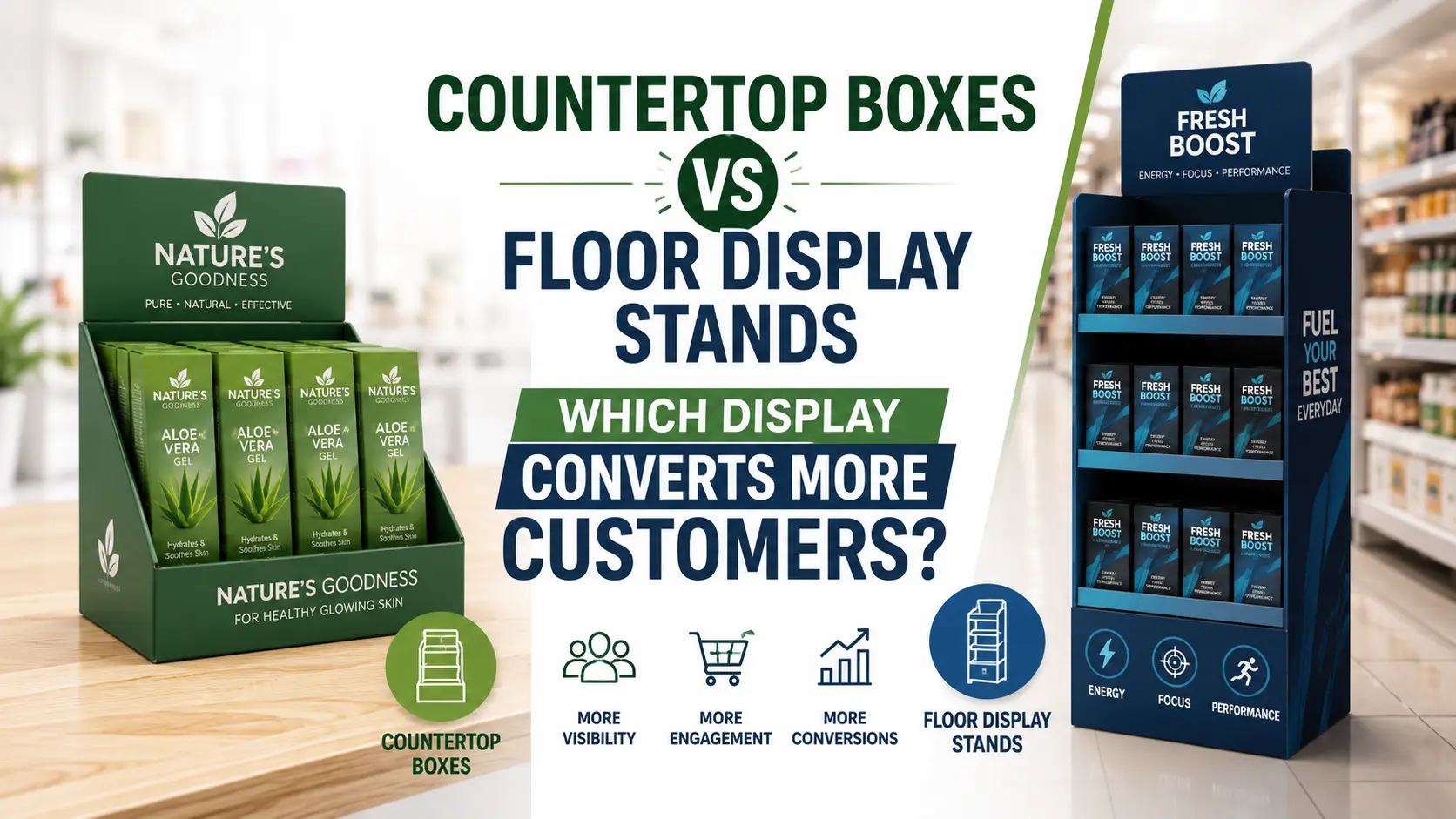
A countertop display stand, also called a counter display unit or CDU, is a small display that sits on top of a checkout counter, service desk, reception desk, or tabletop.
It is compact. It is close to the customer. And it is positioned right where the customer is already standing still at the checkout line.
A countertop display is designed for close-range buyer interaction. It sits close to the customer, so it does not need to be large to grab attention, yet it still performs effectively. It is a smart choice when retail space is limited.
Typical footprint: 6×6 inches to 12×12 inches
Typical height: 8 to 18 inches
Typical product capacity: 12 to 60 small items depending on the product size
Products that work best on counter displays:
- Candy and gum
- Lip balm and lip gloss
- Hand sanitizer
- Energy bars and protein snacks
- Small accessories (keychains, phone cables)
- Travel-size personal care products
- Batteries
- Single-serve supplements and vitamins
And What Is a Floor Display Stand?
A floor display stand, also called a floor standing display unit or FSDU, is a tall, freestanding display that stands directly on the store floor. It holds a lot more product than a counter display and creates a much bigger visual impact from a distance.
Floor displays are freestanding units placed in open areas to capture attention and feature new or promotional items. They are usually at eye level so shoppers are sure to see the product, but they can also be taller and can easily draw shoppers in from a distance.
Typical footprint: 12×12 inches to 24×24 inches
Typical height: 48 to 72 inches
Typical product capacity: 50 to 200+ items depending on shelf count and product size
Products that work best on floor displays:
- Snack packs and food products
- Supplements and vitamins (full-size)
- Cosmetics and skincare sets
- Toys and games
- Books and stationery
- Pet treats and accessories
- Seasonal and holiday products
- New product launches
The Real Question: Which One Converts More Customers?
Here is the honest answer.
Neither one is always better.
The counter display converts more customers per square inch. The floor display converts more customers per visit. They win at different moments, and they work best when you understand exactly what each one does.
Let’s look at both in detail.
How Countertop Display Stands Convert Customers
They Win at the Checkout Line
The checkout line is the single most powerful selling location in any retail store. Every customer in the store walks through it. Every customer is standing still. Every customer has already made the decision to buy something, and their guard is down.
POP displays increase impulse purchases by 20% when placed near the point of sale, capitalizing on the buying moment when customers have already committed to a transaction and show lower resistance to add-on purchases.
That 20% lift is not from a floor display in the middle of the store. That is from a display right at the checkout. Right at the counter. Right where a counter display unit lives.
They Work Because of the “Already Buying” Effect
When a customer reaches the checkout, something interesting happens in their brain. They have already decided to spend money. They are in spending mode. Adding one more small item to their purchase feels easy because they are already buying.
A counter display takes full advantage of this. The product is right there. It is small. It is affordable. It is easy to grab. And the customer is already in the mindset to spend.
This is why candy, gum, batteries, lip balm, and energy bars sell so well from counter displays. The customer was not thinking about buying any of those things when they walked in. But now they are at the checkout, and the counter display puts the product directly in their hand.
They Convert at Close Range
Counter displays placed directly beside the checkout can increase sales by 20 to 35% compared to products kept behind the counter or on a regular shelf.
Close range matters. When a customer is standing 18 inches away from a product, they read the details. They notice the flavor. They read the ingredients. They see the price. And they make a quick decision.
A counter display puts your product at that 18-inch decision range where every customer who pays for something becomes a potential buyer.
How Floor Display Stands Convert Customers
They Win at the Discovery Moment
Most purchases happen because a customer saw something they did not know they wanted and the display made them want it.
That is the floor display’s superpower. It stops customers who were not looking for your product and makes them look.
A floor display works better when the aim is to attract shoppers from a distance and influence their decision before they even reach the product.
A floor display standing at the entrance of a grocery aisle, at the front of a pharmacy, or in the middle of a toy store creates a visibility moment at 10 to 20 feet, far before the customer has passed the product. The customer sees the display, changes direction, and walks toward it. That is the floor display working.
They Win With Bigger Products
Counter displays hold small things. A floor display holds anything.
A 12-pack of energy drinks. A 5-pound bag of dog food. A board game in a big box. A full-size shampoo. These products cannot live on a counter display; they are too big, too heavy, or too tall.
A floor display holds them at the right height, organizes them by variant or size, and puts them in a location where every shopper in the store can see them.
They Win With New Product Launches
Floor displays capture attention and feature new or promotional items placed in open areas to maximize visibility across the store floor.
When a brand launches a new product, they need every customer in the store to see it, not just the customers who happen to walk down that specific aisle. A floor display placed at a store entrance or at the end of a high-traffic aisle puts a new product in front of nearly 100% of the store’s shoppers.
That visibility in the first 2 to 4 weeks of a product launch is what builds awareness, generates trial purchases, and establishes the product on the shelf.
They Hold More Product – Which Means More Sales Per Display
A counter display holds 12 to 60 units. A floor display holds 50 to 200+ units.
More units means more sales capacity per display per day. A floor display that sells 30 units a day generates 3 to 4 times the revenue of a counter display selling 10 units a day even if the counter display has a higher conversion rate per customer interaction.
The Price Point Rule: Which Display Matches Which Product
This is the most practical decision-making tool in the entire blog, and almost no competitor page talks about it.
Products under $10 – Counter Display Wins
Small, affordable products sell best from counter displays. The customer grabs them without overthinking. The low price point makes the decision instant. Counter displays are built for this: close proximity, fast decision, low-risk impulse buy.
Examples: Candy, gum, lip balm, single-serve snacks, travel-size toiletries, small accessories
Products $10 to $20 – Either Can Work
This price range is where counter and floor displays both compete. If the product is small and the store has a busy checkout, a counter display works well. If the product needs space to be understood, flavor varieties, size options, benefit callouts, a floor display gives the brand enough room to tell the story.
Examples: Energy bars, small cosmetics, phone cables, supplements in single-dose format
Products over $20 – Floor Display Wins
Higher-priced products need more selling. A customer spending $30 or more wants to read the label, compare options, and feel confident in the choice. A floor display gives them space to do that. It holds multiple variants side by side. It has a header panel that communicates the brand story. It positions the product as a considered purchase, not a grab-and-go impulse.
Examples: Full-size supplements, skincare sets, toys, books, pet food, seasonal gift sets
Real Store Scenarios: Which Display Works Where
Convenience Store
Counter display wins. Convenience store shoppers are in a hurry. They grab what they need and pay. A counter display at the checkout loaded with candy, gum, energy shots, and single-serve snacks captures every customer at the moment they are already paying. Floor space in a convenience store is tight and already claimed by shelving. Counter displays do not compete for floor space.
Grocery Store
Floor display wins for new products – counter display wins at checkout. Grocery shoppers plan their purchases but also respond strongly to new product discovery. A floor display at the end of an aisle introduces a new product to shoppers who would never walk down that specific aisle. The checkout counter display captures the impulse add-on from every shopper in the store.
Pharmacy (CVS, Walgreens, Rite Aid)
Both – in different locations. A floor display at the front of the store catches customers as they walk in and browse the pharmacy sections. A counter display at the checkout captures the last-minute add-on from every customer paying for their prescription or their main purchase. Counter displays are the final opportunity to connect with a customer before they leave the store.
Boutique or Specialty Retail
Counter display wins. Small boutiques often do not have floor space to spare. A counter display on the sales desk loaded with small accessories, candles, jewelry, or travel-size products captures every single customer who comes to pay, without taking up any of the limited floor real estate.
Big-Box Retail (Walmart, Target, Costco)
Floor display wins. Big-box stores have enormous floor areas and high-traffic promotional zones. A floor display placed at a store entrance, an endcap position, or a seasonal promotional zone in a big-box store reaches thousands of customers per day. Counter displays in these environments are controlled by the retailer and are difficult for individual brands to access.
Head-to-Head: Counter Display vs Floor Display
Visibility Distance
Counter display: 2 to 5 feet – works at close range only
Floor display: 10 to 20 feet – visible from across the store or aisle
Product Capacity
Counter display: 12 to 60 units typically
Floor display: 50 to 200+ units typically
Conversion Trigger
Counter display: Impulse at checkout – customer is already buying
Floor display: Discovery in store – customer was not looking for this product
Best Price Point
Counter display: Under $15 – low-risk impulse buy
Floor display: $15 and above – considered purchase with brand story
Floor Space Needed
Counter display: Zero floor space – sits on existing counter
Floor display: 1 to 4 square feet of dedicated floor space needed
Retailer Approval
Counter display: Easier, often placed without formal buyer approval
Floor display: Often requires buyer or category manager approval for floor placement
Cost Per Unit
Counter display: Lower – less material, smaller structure
Floor display: Higher – more material, taller structure, stronger board needed
Assembly Time
Counter display: 30 to 60 seconds
Floor display: 2 to 5 minutes
Best Retail Environment
Counter display: Convenience stores, boutiques, pharmacies, small specialty retail
Floor display: Grocery, big-box, toy stores, pharmacy floor, mass retail
The Smartest Strategy: Use Both Together
Using a combination of retail display types is the most effective approach. Countertop displays drive small add-on sales, floor displays spotlight seasonal promotions, all working together to guide the customer journey.
Here is what that looks like in practice for a supplement brand entering a pharmacy chain.
Floor display at the store entrance or main aisle: Holds full-size supplement tubs of 30 to 60 servings at $35 to $50 each. The header panel explains the product benefit. The shelf layout shows multiple flavors. Customers who are browsing the health section stop, read, compare, and buy.
Counter display at checkout: Holds single-serve sample packs of the same supplement at $3 to $5 each. Customers who did not stop at the floor display see the sample pack at checkout. They buy the sample to try it. Two weeks later, they come back for the full tub.
The floor display drives the main purchase. The counter display drives the trial. Together, they capture every customer at two different points in the store journey, and they work together to build a repeat customer.
This is exactly how smart brands use both display types together, not as competition, but as a team.
How to Choose: 5 Questions to Ask Yourself
Not sure which one to start with? Ask these five questions.
Question 1 – How much does my product cost?
Under $15, start with a counter display. Over $20, start with a floor display. Between $15 and $20, try both in different store environments and measure which sells more.
Question 2 – How big is my product? Small enough to hold in one hand, counter display. Bigger than a large coffee mug, floor display. Very large or heavy, floor display with a reinforced base and the right board grade.
Question 3 – What retail environment am I in? Tight space, high checkout traffic, counter display. Large floor area, high foot traffic through the main aisles, floor display. Big-box or grocery, floor display or endcap.
Question 4 – Am I launching a new product or selling an established one? New product launch, floor display. You need maximum visibility across the whole store to build awareness fast. Established product with existing shelf presence, counter display for incremental add-on sales.
Question 5 – What is my budget? Counter displays cost less per unit, have lower material cost, smaller structure. If budget is tight, start with counter displays and add a floor display once the product is generating revenue. If budget allows, use both from day one.
What Does Each Display Stand Cost?
Floor display boxes cost more than counter display boxes because they consume more material, have larger dimensions, and require stronger support structures.
Here is an honest cost guide.
Counter Display Units (CDU)
Small quantity (1–50 units): $14 to $48 per unit Medium quantity (51–250 units): $7 to $18 per unit Large quantity (500+ units): $3 to $10 per unit
Floor Standing Display Units (FSDU)
Small quantity (1–50 units): $75 to $190 per unit Medium quantity (51–250 units): $30 to $80 per unit Large quantity (500+ units): $15 to $45 per unit
What drives cost up or down: Size, number of shelves, board thickness, print coverage, finish quality, and quantity. The more you order, the lower the per-unit price – always.
Free shipping makes a real difference. The Pioneer Packaging ships all display stand orders free across every state in the USA, no freight surcharge, no minimum order value. On an order of 100 floor displays, free shipping can save you $500 to $1,500 compared to paying freight separately.
The Verdict
Here is the simple answer to the question this blog set out to answer.
Countertop display stands convert more customers per square inch. They win at the checkout where customers are already buying, already in spending mode, and making fast, low-risk decisions. A counter display placed right at the checkout increases sales by 20 to 35% for the right product at the right price point.
Floor display stands convert more customers per store visit. They win at the discovery moment, stopping shoppers who were not looking for your product and making them walk toward it. A floor display placed in a high-traffic location reaches every shopper in the store, not just the ones who happen to pass the checkout counter.
The smartest brands use both. A floor display builds awareness and drives the main purchase. A counter display captures impulse buys and drives trial. Together, they cover every customer at every stage of the store journey from the moment they walk in to the moment they pay.
Get Your Custom Display Stands From The Pioneer Packaging
The Pioneer Packaging builds custom counter display units and floor standing display stands for brands across the entire USA.
No minimum order. Order any quantity from 5 counter displays for a test run to 5,000 floor displays for a national retail rollout.
Prices 30% lower than most USA competitors.
Free shipping to all 50 states, no hidden freight fees.
10-12 business day turnaround from art approval.
Free design support – send your logo and product dimensions, and we handle the rest.
Visit thepioneerpackaging.com to get your free quote today.
Frequently Asked Questions
Which converts more customers – a counter display or a floor display?
Counter displays convert more customers per square inch because they sit at the checkout where every customer is already in buying mode. Floor displays convert more customers per store visit by stopping shoppers from across the aisle and creating discovery moments for products customers were not specifically looking for. The right answer depends on your product price point, product size, and retail environment.
What products sell best from a counter display stand?
Counter displays work best for products under $15 that customers buy on impulse: candy, gum, lip balm, hand sanitizer, energy bars, single-serve snacks, small accessories, travel-size personal care, and batteries. The product should be small enough to grab with one hand and affordable enough that the customer does not need to think hard before buying.
What products sell best from a floor display stand?
Floor displays work best for products over $20 that need space to tell a story: supplements, cosmetics sets, toys, books, pet food, seasonal products, and new product launches. The floor display gives the brand a header panel, multiple shelves, and enough surface area to communicate product benefits, variants, and brand story before the customer even picks up the product.
Do I need retailer approval to place a floor display stand in a store?
Usually yes; major retailers including Walmart, Target, Costco, Walgreens, and CVS require buyer or category manager approval before a brand can place a floor display on the store floor. This approval is typically part of a merchandising program or promotional agreement. Counter displays at checkout are also often controlled by the retailer, but they are generally easier to negotiate than floor placements.
Can I use both a counter display and a floor display at the same time?
Yes, and this is the most effective strategy for most brands. Use the floor display to drive the main purchase and build product awareness across the store. Use the counter display to drive trial purchases and impulse add-ons at checkout. The two displays work as a team, capturing customers at two different moments in the store journey.
How do I order custom display stands with no minimum order in the USA?
The Pioneer Packaging has no minimum order quantity on all counter display units and floor standing display units. You can order any quantity from a single prototype to a full national retail rollout. Every order gets the same full-color custom printing, structural engineering, food-grade materials where applicable, and free shipping across all 50 states.