
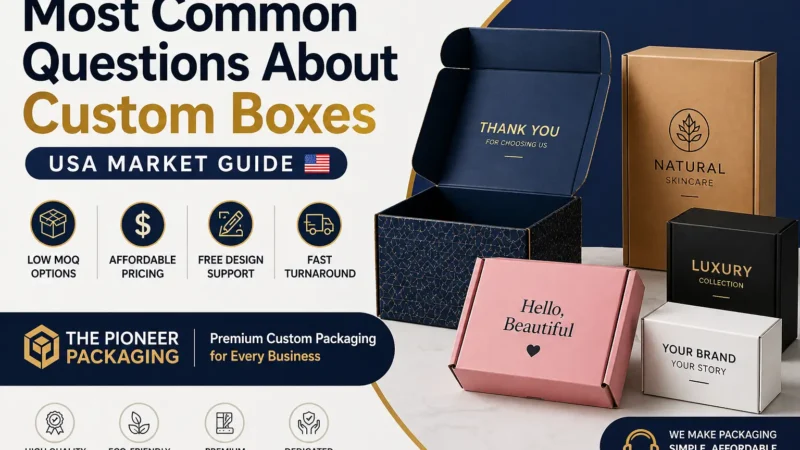
Most Common Questions About Custom Boxes
Custom-packaging-in-usa Packaging Boxes

Most Common Questions About Custom Boxes (USA Market)

Most Common Questions About Custom Boxes (USA Market) Custom boxes have become an essential part of modern branding, especially for e-commerce stores, retail businesses, and subscription-based brands in the USA. As competition continues to grow, businesses are not just focused on product quality; they are also investing in packaging that creates a strong first impression. This is why questions about custom boxes, pricing, materials, and ordering processes are among the most searched topics online. Many startups and small businesses often struggle to understand how custom packaging works, especially when it comes to minimum order quantities, design options, and overall cost. Since packaging directly impacts both branding and shipping expenses, making the right decision becomes very important. Even a small mistake in box selection can increase costs or affect customer experience. To help clear this confusion, we’ve compiled the most common questions people ask about custom boxes in the USA market. These answers will help you make smarter decisions, whether you are just starting your business or looking to improve your existing packaging strategy. 1. What are custom boxes and how are they used? Custom boxes are packaging solutions designed specifically for a product, brand, or business. They can be printed with logos, colors, and designs to match branding. Businesses use them for shipping, retail packaging, subscription boxes, and product presentation. They help improve customer experience and create a professional brand image. 2. How much do custom boxes cost in the USA? The cost of custom boxes in the USA depends on size, material, printing type, and order quantity. On average, simple mailer boxes can start from $0.50–$2 per unit, while premium rigid boxes can cost $3–$10 or more. Bulk orders usually reduce the per-unit cost significantly. 3. What is MOQ (Minimum Order Quantity) for custom boxes? MOQ refers to the minimum number of boxes a supplier requires per order. In the USA, many manufacturers set MOQs between 250–1000 units. However, some suppliers now offer low MOQ options starting from 50–100 boxes for small businesses and startups. 4. Can I order custom boxes with no minimum quantity? Yes, some packaging companies offer no MOQ or very low MOQ services. These are ideal for startups, small businesses, or product testing. However, per-unit cost is usually higher compared to bulk orders. 5. How long does it take to get custom packaging made and delivered? Production time typically ranges from 7 to 20 business days depending on design complexity and quantity. Shipping may take an additional 3 to 7 days within the USA. Rush production is sometimes available for urgent orders. 6. What types of custom boxes are best for small businesses? Small businesses usually prefer affordable and practical packaging such as: 7. Can I design my own custom packaging boxes? Yes, most packaging suppliers allow you to upload your own artwork or logo. Many also provide free design support or 3D mockups to help you visualize the final product before printing. 8. What is the difference between mailer boxes and shipping boxes? Mailer boxes are self-locking, lightweight, and often used for branding and ecommerce deliveries. Shipping boxes (corrugated boxes) are stronger and designed for protection during transit. Mailer boxes focus more on presentation, while shipping boxes focus on durability. 9. Are custom boxes worth it for branding and small businesses? Yes, custom boxes are highly effective for branding. They improve customer unboxing experience, increase brand recognition, and help businesses stand out in a competitive market. Even small investments in packaging can lead to higher perceived product value. 10. Where can I order custom boxes with low MOQ in the USA? You can order custom boxes from packaging manufacturers and suppliers that specialize in low MOQ production. Many companies now offer flexible ordering, free design support, and fast shipping for startups and e-commerce brands across the USA. Final Thoughts Custom packaging is no longer just a protective layer; it is a powerful branding tool that directly influences how customers perceive your business. From cost and design to MOQ and delivery time, understanding these key factors helps you make smarter decisions and avoid unnecessary expenses. Whether you are a startup or an established brand, choosing the right packaging strategy can significantly improve your product presentation and customer experience. If you are looking for reliable and affordable custom packaging solutions in the USA, The Pioneer Packaging is here to help. We specialize in high-quality custom boxes with low MOQ, free design support, and fast turnaround times, perfect for startups, ecommerce brands, and growing businesses. Our goal is to make premium packaging accessible without the burden of high minimum order requirements. 👉 Partner with The Pioneer Packaging today and elevate your brand with packaging that truly stands out.
No Comments Read More
how to measure a box length width height - complete guide
Packaging Boxes Client Questions Expert Answers Custom-packaging-in-usa

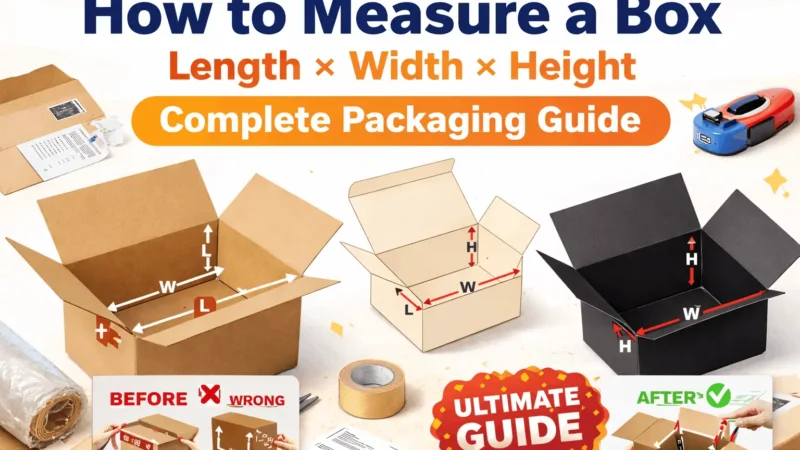
How to Measure a Box (Length × Width × Height) – Complete Packaging Guide

How to Measure a Box (Length × Width × Height) – Complete Packaging Guide Getting the box dimensions right is more important than most people think. Whether you’re shipping products, designing custom packaging, or calculating shipping costs, accurate measurements help you avoid wasted space, product damage, and unnecessary expenses. Many people get confused between length, width, and height. Others measure the outside instead of the inside. Even small mistakes can lead to higher shipping fees or poorly fitting packaging. That’s why understanding how to measure a box correctly is essential for businesses, e-commerce sellers, and anyone working with packaging. In this complete guide, you’ll learn how to measure a box step-by-step, understand the correct order of dimensions, calculate volume, and avoid common mistakes. By the end, you’ll know exactly how to measure any box accurately and choose the right packaging every time.Note: Must read the full article, then you will never make mistakes, and you will never face losses. It is important to read the complete guide. Why Box Measurements Matter in Packaging and Shipping Accurate box measurements are the foundation of effective packaging. A few inches too large can increase shipping costs. A few inches too small can damage your product. Getting the dimensions right helps you avoid both problems. For businesses, correct measurements improve product protection and reduce material waste. A properly sized box keeps items secure during transit and prevents unnecessary movement inside the package. Box dimensions also directly impact shipping costs. Most carriers calculate pricing based on box size, not just weight. Larger boxes often mean higher dimensional weight and increased expenses. Accurate measurements also improve branding and presentation. Custom-fit packaging creates a professional look and enhances the unboxing experience for customers. Whether you’re shipping products, designing custom boxes, or ordering packaging, knowing the exact dimensions helps you make smarter decisions. Next, let’s break down the three key dimensions every box has: length, width, and height. Understanding Length, Width, and Height of a Box Every box has three basic dimensions: length, width, and height. Understanding these is the first step to measuring a box correctly. Many packaging mistakes happen simply because these dimensions are misunderstood. Length is the longest side of the box when looking at the top opening. It usually runs from left to right. This is always measured first. Width is the shorter side of the box, measured from front to back. Some people also call this depth. Width is always measured after length. Height is the vertical distance from the bottom to the top of the box. This shows how tall the box is when standing upright. These three measurements form a 3D dimension. Unlike 2D measurements that only include length and width, boxes require all three dimensions to define their size properly. It’s also important to understand that length is always the longest side. Width is the shorter side. Height is always vertical. Keeping this rule in mind helps avoid confusion when measuring. Step-by-Step Guide to Measuring a Box Correctly Measuring a box is simple when you follow the right steps. Using a consistent method ensures accurate dimensions every time. Step 1: Gather the Right ToolsUse a measuring tape, ruler, or scale. A measuring tape works best for most boxes. Make sure the box is fully assembled before measuring. Step 2: Measure the LengthPlace the box in front of you with the opening facing up. Measure the longest side from left to right. This is the length. Always measure this first. Step 3: Measure the WidthNow measure the shorter side from front to back. This is the width. It is always measured after length. Step 4: Measure the HeightMeasure from the bottom of the box to the top. This vertical measurement is the height. Step 5: Write Dimensions in the Correct FormatAlways write measurements in this order:Length × Width × Height (L × W × H) For example:10″ × 8″ × 4″ Following these steps ensures accuracy and consistency. But there’s one more important factor to consider — whether to measure inside or outside the box. That’s what we’ll cover next. Once you understand these three dimensions, measuring a box becomes simple. In the next section, you’ll learn the step-by-step method to measure a box accurately. Internal vs External Box Dimensions One of the most common mistakes is measuring the outside of a box instead of the inside. This small error can lead to poor product fit and higher shipping costs. Internal dimensions refer to the space inside the box. These measurements determine whether your product will fit properly. Packaging manufacturers and suppliers usually ask for internal dimensions. External dimensions measure the outer size of the box. These are useful for shipping, storage, and logistics. Shipping carriers often use external dimensions to calculate rates. Box thickness also affects measurements. Cardboard, corrugated material, and rigid boxes all have different wall thicknesses. This reduces the available space inside the box. For custom packaging, internal dimensions are usually more important. They ensure your product fits securely and stays protected during shipping. Understanding the difference helps you avoid costly mistakes. Next, let’s look at the correct order of box dimensions and why it matters. Correct Order of Box Dimensions (L × W × H) Using the correct order of box dimensions is just as important as measuring accurately. The standard format used in packaging is Length × Width × Height (L × W × H). This format is widely accepted by manufacturers, shipping companies, and packaging suppliers. Length is always written first. It represents the longest side of the box.Width comes second. It is the shorter side of the box.Height is written last. It shows how tall the box is from bottom to top. For example:12″ × 9″ × 4″Here, 12″ is length, 9″ is width, and 4″ is height. Some people confuse height with depth. In many cases, height and depth are interchangeable. What matters most is staying consistent and clearly identifying each dimension. Writing dimensions in the wrong order can lead to incorrect

No Comments Read More

Sign In

Register

Reset Password

Please enter your username or email address, you will receive a link to create a new password via email.