
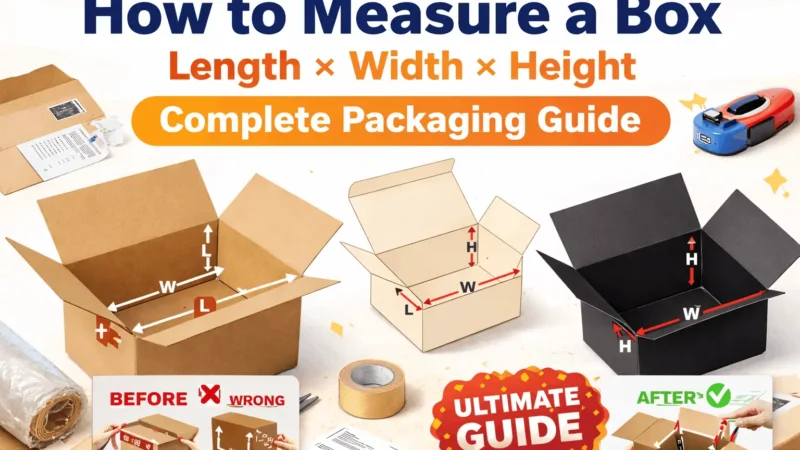
How to Measure a Box (Length × Width × Height) – Complete Packaging Guide
How to Measure a Box (Length × Width × Height) – Complete Packaging Guide Getting the box dimensions right is more important than most people think. Whether you’re shipping products, designing custom packaging, or calculating shipping costs, accurate measurements help you avoid wasted space, product damage, and unnecessary expenses. Many people get confused between length, width, and height. Others measure the outside instead of the inside. Even small mistakes can lead to higher shipping fees or poorly fitting packaging. That’s why understanding how to measure a box correctly is essential for businesses, e-commerce sellers, and anyone working with packaging. In this complete guide, you’ll learn how to measure a box step-by-step, understand the correct order of dimensions, calculate volume, and avoid common mistakes. By the end, you’ll know exactly how to measure any box accurately and choose the right packaging every time.Note: Must read the full article, then you will never make mistakes, and you will never face losses. It is important to read the complete guide. Why Box Measurements Matter in Packaging and Shipping Accurate box measurements are the foundation of effective packaging. A few inches too large can increase shipping costs. A few inches too small can damage your product. Getting the dimensions right helps you avoid both problems. For businesses, correct measurements improve product protection and reduce material waste. A properly sized box keeps items secure during transit and prevents unnecessary movement inside the package. Box dimensions also directly impact shipping costs. Most carriers calculate pricing based on box size, not just weight. Larger boxes often mean higher dimensional weight and increased expenses. Accurate measurements also improve branding and presentation. Custom-fit packaging creates a professional look and enhances the unboxing experience for customers. Whether you’re shipping products, designing custom boxes, or ordering packaging, knowing the exact dimensions helps you make smarter decisions. Next, let’s break down the three key dimensions every box has: length, width, and height. Understanding Length, Width, and Height of a Box Every box has three basic dimensions: length, width, and height. Understanding these is the first step to measuring a box correctly. Many packaging mistakes happen simply because these dimensions are misunderstood. Length is the longest side of the box when looking at the top opening. It usually runs from left to right. This is always measured first. Width is the shorter side of the box, measured from front to back. Some people also call this depth. Width is always measured after length. Height is the vertical distance from the bottom to the top of the box. This shows how tall the box is when standing upright. These three measurements form a 3D dimension. Unlike 2D measurements that only include length and width, boxes require all three dimensions to define their size properly. It’s also important to understand that length is always the longest side. Width is the shorter side. Height is always vertical. Keeping this rule in mind helps avoid confusion when measuring. Step-by-Step Guide to Measuring a Box Correctly Measuring a box is simple when you follow the right steps. Using a consistent method ensures accurate dimensions every time. Step 1: Gather the Right ToolsUse a measuring tape, ruler, or scale. A measuring tape works best for most boxes. Make sure the box is fully assembled before measuring. Step 2: Measure the LengthPlace the box in front of you with the opening facing up. Measure the longest side from left to right. This is the length. Always measure this first. Step 3: Measure the WidthNow measure the shorter side from front to back. This is the width. It is always measured after length. Step 4: Measure the HeightMeasure from the bottom of the box to the top. This vertical measurement is the height. Step 5: Write Dimensions in the Correct FormatAlways write measurements in this order:Length × Width × Height (L × W × H) For example:10″ × 8″ × 4″ Following these steps ensures accuracy and consistency. But there’s one more important factor to consider — whether to measure inside or outside the box. That’s what we’ll cover next. Once you understand these three dimensions, measuring a box becomes simple. In the next section, you’ll learn the step-by-step method to measure a box accurately. Internal vs External Box Dimensions One of the most common mistakes is measuring the outside of a box instead of the inside. This small error can lead to poor product fit and higher shipping costs. Internal dimensions refer to the space inside the box. These measurements determine whether your product will fit properly. Packaging manufacturers and suppliers usually ask for internal dimensions. External dimensions measure the outer size of the box. These are useful for shipping, storage, and logistics. Shipping carriers often use external dimensions to calculate rates. Box thickness also affects measurements. Cardboard, corrugated material, and rigid boxes all have different wall thicknesses. This reduces the available space inside the box. For custom packaging, internal dimensions are usually more important. They ensure your product fits securely and stays protected during shipping. Understanding the difference helps you avoid costly mistakes. Next, let’s look at the correct order of box dimensions and why it matters. Correct Order of Box Dimensions (L × W × H) Using the correct order of box dimensions is just as important as measuring accurately. The standard format used in packaging is Length × Width × Height (L × W × H). This format is widely accepted by manufacturers, shipping companies, and packaging suppliers. Length is always written first. It represents the longest side of the box.Width comes second. It is the shorter side of the box.Height is written last. It shows how tall the box is from bottom to top. For example:12″ × 9″ × 4″Here, 12″ is length, 9″ is width, and 4″ is height. Some people confuse height with depth. In many cases, height and depth are interchangeable. What matters most is staying consistent and clearly identifying each dimension. Writing dimensions in the wrong order can lead to incorrect