

Walk down any grocery store cereal aisle and you will notice something immediately. The boxes vary enormously. A single-serve box of oatmeal sits next to a family-size box of corn flakes that towers over it by a factor of four. A boutique granola brand uses a narrow, tall box that looks nothing like the wide, shallow box next to it. A store-brand cereal comes in a box that is almost identical in shape and size to its name-brand competitor on the adjacent shelf.
This variation is not random. Cereal box dimensions are the result of deliberate decisions made by food manufacturers, packaging engineers, and marketing teams that balance shelf presence, cost efficiency, material use, production line requirements, retail category management standards, and consumer psychology. Every centimetre of a cereal box is justified by some combination of these factors.
For packaging buyers, food manufacturers, private label brands entering the cereal category, and retailers planning category layouts, understanding cereal box dimensions is genuinely important practical knowledge. This guide covers standard cereal box dimensions across every common size, explains the reasoning behind those dimensions, covers box construction and materials, and provides the practical reference information needed to make informed decisions about cereal packaging at any scale.
Why Cereal Box Dimensions Are Not Arbitrary
Before getting into specific measurements, it is worth understanding the forces that shape cereal box dimensions, because this context makes the specific numbers much more meaningful.
Shelf fit and category management is the primary constraint. Retail grocery shelves have standard depths, typically 12 to 18 inches for the cereal category, and standard heights between shelves. Cereal boxes must fit within these constraints while maximising the visual impact of the front panel. A box that is deeper than the shelf cannot be fully pushed back, leaving the box protruding into the aisle. A box that is taller than the shelf opening cannot be shelved at all. Most cereal box dimensions are engineered to fit standard supermarket shelving configurations.
Serving size communication and consumer psychology drive the vertical dimension of many cereal boxes more than the physical volume of the cereal inside. Research consistently shows that taller packaging is perceived as containing more product than shorter packaging of equal volume. This is why many cereal boxes are notably tall relative to their depth, and why box heights have tended to increase over time even as the actual weight of cereal inside remained the same or decreased.
Production line efficiency at cereal manufacturing facilities creates a strong preference for standardised box dimensions within a brand’s range. Filling lines, sealing equipment, and carton-erecting machinery are configured for specific box dimensions. Introducing a new box size that requires retooling machinery carries significant cost, which is why cereal brands tend to use a small number of standardised box sizes across their product range.
Shipping and logistics efficiency drives the depth and width dimensions of cereal boxes. Boxes must tessellate efficiently on pallet layers to minimise wasted space during transport. A box dimension that does not fit efficiently on a standard 48 × 40 inch pallet creates logistical cost that compounds across millions of units.
Material cost is directly proportional to the surface area of the box. A taller box with a smaller footprint uses more paperboard than a shorter box with a larger footprint containing the same volume of cereal. The ongoing trend toward packaging right-sizing, driven by sustainability goals and material cost management, is creating gradual changes in standard cereal box proportions.
Standard Cereal Box Sizes
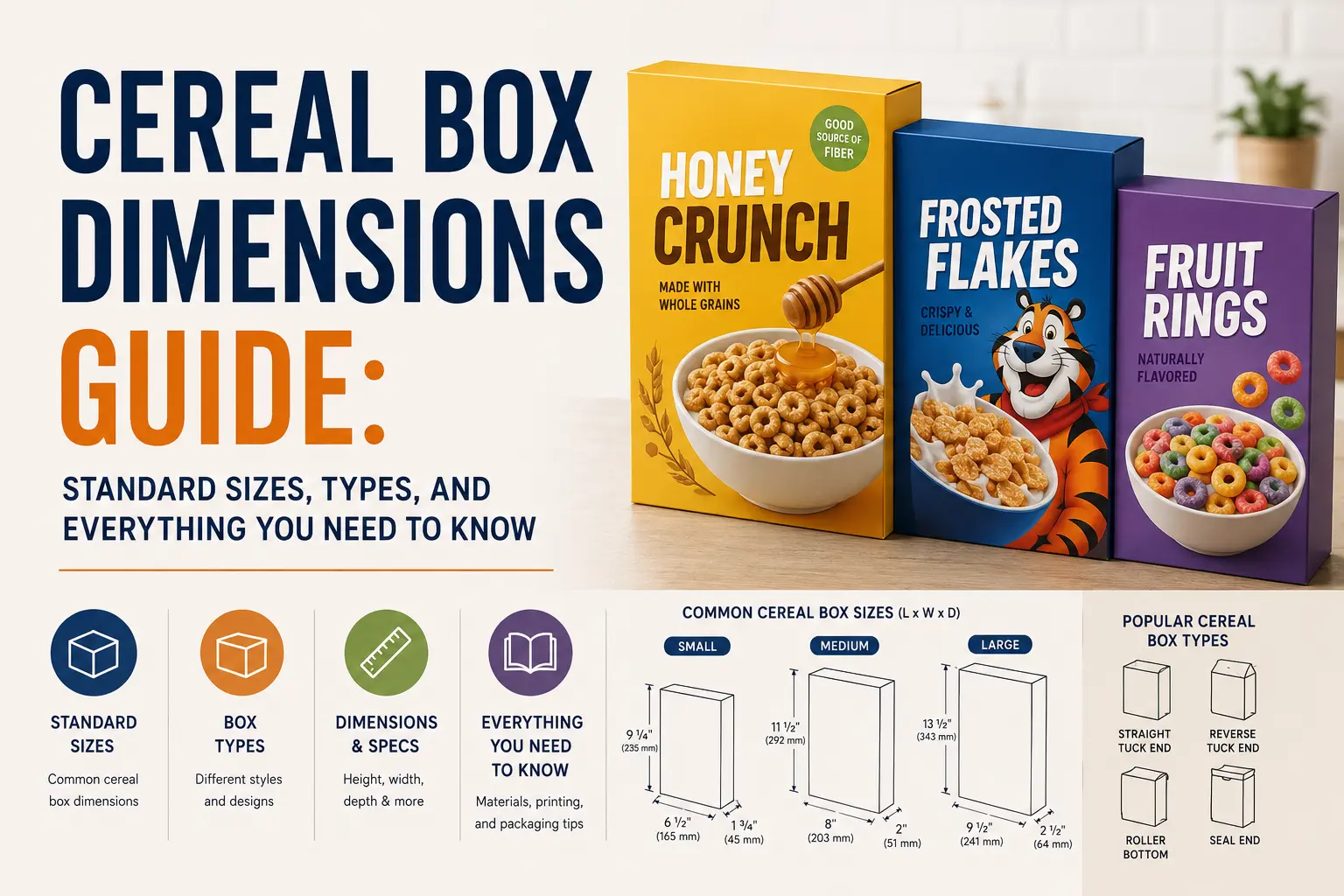
Cereal boxes do not follow a single universal dimensional standard the way, for example, ISO paper sizes do. However, the industry has converged on a set of common size ranges that cover the majority of cereal products sold in major markets. These size ranges are described below with typical dimensions in both inches and millimetres.
All dimensions are given as width × depth × height, where width is the dimension of the front panel face, depth is the dimension from front to back of the box, and height is the vertical dimension when the box stands upright on a shelf.
Single Serve Box
Typical dimensions: 2.5 × 1.5 × 4.5 inches (63.5 × 38.1 × 114.3 mm)
The single serve cereal box is the smallest standard format in the cereal category. It contains a single portion of cereal, typically 1 to 1.5 ounces, and is designed for individual consumption in one sitting. Single serve boxes are found in hotel breakfast offerings, airline catering, hospital food service, variety pack multipacks, and convenience retail formats.
The very small footprint of single serve boxes creates specific packaging engineering challenges. The box must be rigid enough to protect its contents despite its small dimensions, and the front panel must communicate the brand and product information in a very compressed space. Many single serve boxes use the same front panel design as their full-size equivalents, scaled down.
Single serve boxes are also used as the individual components within variety packs, where multiple different cereal types are grouped together in an outer multipack box. In this format, the individual boxes are sized to create an outer multipack with efficient proportions.
Small or Individual Size Box
Typical dimensions: 5.5 × 2.25 × 7.75 inches (139.7 × 57.15 × 196.85 mm)
The small individual size box contains approximately 8 to 12 ounces of cereal and is positioned for single-person households, trial purchases, and consumers who prefer to buy smaller quantities to maintain freshness. This size is particularly common for premium, artisan, and specialty cereal brands where consumers are less likely to buy in large quantities due to the higher price per ounce.
The small box format is also used for cereals with inherently lower serving frequencies, such as granola and muesli products that are used as toppings or occasional breakfast alternatives rather than daily staples.
Regular or Medium Size Box
Typical dimensions: 7.75 × 2.4 × 11 inches (196.85 × 60.96 × 279.4 mm)
The regular or medium size box is the most widely used cereal box format in the American market and in many other markets globally. It contains approximately 12 to 18 ounces of cereal and is designed for households of one to three people. This size represents the balance point between price per serving, freshness maintenance after opening, and physical manageability.
The regular size box is the format around which most cereal category management and retail shelf systems are designed. When cereal brands develop their packaging systems, the regular size is typically the reference format from which other sizes are proportionally derived.
The front panel dimensions of the regular size box, approximately 7.75 inches wide by 11 inches tall, provide adequate space for brand identity, product imagery, nutritional communication, health claims, and promotional messaging. This front panel size has become the industry’s reference canvas for cereal brand design.
Large Size Box
Typical dimensions: 8.7 × 2.75 × 12 inches (220.98 × 69.85 × 304.8 mm)
The large size box contains approximately 18 to 24 ounces of cereal and is positioned for households of three to four people and for consumers who buy in larger quantities to reduce per-serving cost. The large box is one of the most commonly purchased sizes in the cereal category for families, combining reasonable per-serving value with manageable physical handling.
The additional width and height of the large box compared to the regular size gives brand designers more panel space to work with, which some brands use for expanded recipe suggestions, promotional content, or more detailed nutritional information.
At 12 inches tall, the large box begins to approach the upper height limit for standard supermarket cereal shelving. Shelf openings in the cereal category are typically 12 to 15 inches, and a 12-inch box fits comfortably with adequate clearance.
Family Size Box
Typical dimensions: 9.75 × 3 × 13.25 inches (247.65 × 76.2 × 336.55 mm)
The family size box contains approximately 24 to 32 ounces of cereal and is the primary value format for larger households and for consumers who are highly regular cereal eaters. The family size represents the best cost per serving of the standard cereal formats and is the format most aggressively promoted through price promotions and loyalty programs by major cereal brands.
The family size box is notably taller and wider than the regular size, creating a dominant shelf presence that is visible from further away in the aisle. This visual dominance is a deliberate marketing consideration, as brands that occupy more vertical and horizontal shelf space tend to attract more consumer attention.
At 13 to 13.5 inches tall, the family size box is at or near the maximum height for standard supermarket cereal shelving. Some retailers use taller shelving in their cereal aisles specifically to accommodate family size boxes from major brands.
The greater depth of the family size box, typically 3 inches compared to 2.4 to 2.75 inches for smaller formats, means the box extends further back on the shelf. Shelf depths of 15 to 18 inches in the cereal category comfortably accommodate this depth.
Club or Warehouse Size Box
Typical dimensions: 11.5 × 3.5 × 14.5 inches (292.1 × 88.9 × 368.3 mm)
The club or warehouse size box is the largest standard cereal format and contains approximately 36 to 48 ounces or more of cereal. It is sold primarily through warehouse club retailers like Costco, Sam’s Club, and BJ’s Wholesale Club, which operate on a fundamentally different retail model from standard supermarkets.
The warehouse size box does not need to conform to standard supermarket shelving dimensions because warehouse clubs use different shelving systems, typically pallet displays and heavy-duty warehouse racking rather than standard gondola shelving. This gives manufacturers more flexibility in the dimensions of club-size packaging.
The very large front panel of the club size box, approximately 11.5 inches wide by 14.5 inches tall, provides substantially more brand canvas than any other format. Some brands use this additional space for extended content such as detailed recipes, promotional games, or loyalty program information.
The significant weight of a full club size box, potentially 3 to 4 pounds, means that box construction must be robust enough to maintain structural integrity under the weight of the cereal and the physical demands of handling by consumers, retail staff, and logistics operations.
Cereal Box Dimensions by Product Type
Beyond the standard size categories above, cereal box dimensions vary by product type in ways that reflect the physical characteristics of different cereal formats.
Flaked Cereals
Flaked cereals like corn flakes, bran flakes, and similar products have a relatively low bulk density. A given volume of flaked cereal weighs less than the same volume of denser cereal formats. This means flaked cereal boxes appear large relative to the weight of their contents, which can create a perception of value at the shelf even at a competitive price point. Flaked cereal boxes tend to use the full height of standard shelf formats to maximise this visual volume effect.
Puffed and Extruded Cereals
Puffed and extruded cereals such as corn puffs, rice crisps, and similar formats have even lower bulk density than flaked cereals. The same weight of puffed cereal occupies significantly more volume than flaked cereal. This creates proportionally larger boxes for a given weight of product. A 10-ounce box of puffed corn cereal may be nearly as tall as a 20-ounce box of dense granola.
Granola and Muesli
Granola and muesli are among the densest cereal formats, meaning a given weight of product occupies relatively little volume. Granola and muesli boxes tend to be proportionally shorter and wider than flaked or puffed cereal boxes of equivalent weight. Many premium granola brands use a short, wide box format that is distinctive on the shelf and different from the tall, narrow boxes of mainstream breakfast cereals.
Oatmeal and Hot Cereal
Rolled oats and other hot cereal products are sometimes packaged in round cylindrical containers rather than rectangular boxes, particularly the traditional Quaker Oats format. Where rectangular boxes are used for oatmeal, they tend to be shorter and wider than equivalent cold cereal boxes because of oatmeal’s relatively high density.
Children’s Cereals
Cereals marketed primarily to children typically use standard regular or large size box dimensions but with packaging design that maximises visual appeal and engagement on the front panel. Some children’s cereal brands use slightly wider boxes to create a more prominent shelf presence and larger surface area for character imagery and interactive content.
Cereal Box Construction
Understanding how cereal boxes are constructed helps explain their dimensional characteristics and their performance in manufacturing, logistics, and retail environments.
Folding Carton Construction
Virtually all cereal boxes are constructed from folding paperboard cartons. A folding carton is cut and scored from a flat sheet of paperboard, then folded and glued into its three-dimensional box form. Cereal boxes use a specific folding carton style called a straight tuck end or a reverse tuck end, where the top and bottom of the box are closed by folding flaps that tuck into the box interior.
The tuck end construction allows cereal boxes to be manufactured and shipped flat, which significantly reduces the storage space required at the manufacturing facility before boxes are filled. Flat boxes are erected on the filling line, filled with cereal, and then sealed at the top by tucking the top flap closed.
The top of the cereal box is typically not glued shut, relying instead on the pressure fit of the tuck flap to stay closed. This allows consumers to reclose the box after each use to maintain cereal freshness. The bottom of the box is typically glued shut during manufacturing to prevent the bottom from opening under the weight of the cereal.
Board Weight and Specification
Cereal boxes are made from solid bleached sulphate (SBS) board or similar high-quality paperboard. SBS board provides an excellent bright white surface for high-quality printing on the outer faces while maintaining the food contact safety required for the inner surface in contact with the cereal or the inner bag.
Board weight for cereal boxes is typically in the range of 16 to 24 points (approximately 0.016 to 0.024 inches) of paperboard thickness. Heavier board provides better structural rigidity but adds to material cost and weight. The board weight is selected to balance structural performance against material efficiency.
Inner Bag or Liner
Almost all cereal boxes contain an inner liner bag made from polyethylene film or a laminate material. This inner bag is the primary barrier protecting the cereal from moisture, oxygen, and contamination. The cereal is sealed inside the bag, which sits inside the outer paperboard box. The box provides structural protection and is the primary brand communication surface, while the inner bag provides the functional barrier needed to maintain cereal quality.
The inner bag dimensions must match the internal dimensions of the box precisely. A bag that is too large relative to the box creates wrinkles and folds that can interfere with the box closure and create air pockets that reduce effective barrier performance. A bag that is too small creates tension that may cause the bag to tear during filling.
Cereal Box Printing and Design
The front panel of a cereal box is one of the most competitive brand design canvases in the consumer packaged goods industry. Cereal brands spend enormous amounts on packaging design research, consumer testing, and print quality to maximise the impact of their front panel.
Printing Process
Cereal boxes are printed using offset lithographic printing, which produces photographic quality colour reproduction at high print speeds. The smooth, white surface of SBS board is ideal for offset printing, supporting sharp detail, accurate colour matching, and consistent results across very large print runs.
Most cereal boxes are printed in four-colour process printing (CMYK) with the addition of one or more Pantone spot colours for precise brand colour matching. Brand colours like the specific red of Kellogg’s or the blue of Quaker Oats must be exactly consistent across every box produced in every print run, which requires the colour control that spot colour printing provides.
Surface Finishes
Cereal boxes commonly receive a surface finish applied over the printed board. Gloss varnish is the most common finish, providing a sheen that enhances colour vibrancy and provides a degree of scuff resistance. Some premium cereal brands use matte varnish for a more sophisticated appearance. Spot UV gloss applied selectively over specific design elements such as a brand logo or product imagery creates a tactile contrast that draws the eye to key elements.
Panel Layout
The front panel is the primary brand and product communication surface, featuring the brand logo, product name, a product image typically showing a bowl of the cereal with serving suggestions, key health or nutritional claims, and any current promotional messaging. The back panel is commonly used for extended content such as nutritional information, ingredient lists, suggested recipes, games, or promotional instructions. The side panels carry legal requirements including the full nutritional facts panel, ingredient list, allergen information, manufacturer details, and barcode.
Nutritional and Regulatory Information
The Nutrition Facts panel required by FDA regulations in the United States has specific minimum size requirements for the type used within it. These size requirements effectively set a minimum panel size for the side of the box where the Nutrition Facts panel must appear. For small format cereal boxes, this minimum size requirement can be a constraining factor in box dimension decisions.
How Cereal Box Dimensions Affect Shipping and Logistics
For manufacturers and retailers, the dimensional efficiency of cereal boxes has significant implications for supply chain cost.
Pallet Configuration
Standard US pallets measure 48 × 40 inches. Cereal boxes must be configured on pallets in arrangements that use the pallet footprint as efficiently as possible while maintaining stable stacking. Common regular-size cereal boxes measuring approximately 7.75 × 2.4 inches can be arranged on a pallet in configurations that tessellate efficiently within the 48 × 40 inch footprint.
The depth dimension of cereal boxes, which is typically the smallest dimension at 2 to 3.5 inches, is particularly important for pallet configuration because it determines how many boxes can be arranged across the pallet depth. A depth that divides evenly into 40 inches is more efficient than one that leaves significant gaps.
Case Pack Configuration
Individual cereal boxes are packed into corrugated outer shipping cases for pallet distribution. The case pack configuration, meaning how many individual boxes are packed into each shipping case, is designed to produce a case with dimensions that fit efficiently on pallet layers. A case containing 12 regular-size boxes arranged in a 3 × 4 configuration produces case dimensions of approximately 23 × 10 × 12 inches, which tessellates reasonably well on a standard pallet.
Fill Rate and Dimensional Weight
Cereal boxes have a notoriously poor fill rate, meaning the ratio of product weight to package volume is low. The low bulk density of most cereal products means the box is mostly air when full. For shipping purposes, this means the dimensional weight of cereal cases almost always exceeds the actual weight, and shipping cost is based on dimensional weight. This is one of the reasons cereal manufacturers are incentivised to right-size their packaging, reducing box volume while maintaining or increasing the weight of product inside.
E-commerce Shipping Considerations
As cereal increasingly sells through e-commerce channels, the dimensional efficiency of individual boxes has become more important. A regular-size cereal box shipped individually in an outer mailer box creates a large, light package that is billed at a high dimensional weight by carriers. Some cereal brands have developed compact packaging formats specifically for e-commerce fulfillment that reduce box volume without reducing cereal quantity, improving the economics of direct-to-consumer shipping.
Cereal Box Dimensions Across Major Brands
While specific proprietary dimensions vary and brands adjust dimensions periodically, the general size conventions used by major cereal brands provide useful reference context.
Kellogg’s, one of the world’s largest cereal manufacturers, uses a consistent size range across its product portfolio that roughly corresponds to the regular, large, and family size dimensions described in this guide. Their Corn Flakes, Frosted Flakes, and Special K lines use box formats that fit standard supermarket shelving while maximising front panel visibility.
General Mills uses similar size conventions across its portfolio of Cheerios, Lucky Charms, Cinnamon Toast Crunch, and other brands. General Mills has been particularly active in right-sizing initiatives, having reduced the depth dimension of several of its boxes in recent years to reduce material use while maintaining the same front panel dimensions and therefore the same shelf presence.
Post Holdings follows comparable conventions for its Honey Bunches of Oats, Grape-Nuts, and Raisin Bran lines. Post has also experimented with resealable top closures on some products, which affects the top panel construction without significantly changing the overall box dimensions.
Private label cereal brands at retailers including Walmart, Target, Kroger, and Aldi typically match the dimensions of the leading national brand equivalent very closely. This is a deliberate strategy that allows private label products to be shelved directly adjacent to national brands at the same shelf positions, simplifying category management and creating direct visual comparison.
Cereal Box Sustainability and Right-Sizing
The cereal category has been at the centre of packaging sustainability discussions for decades, largely because cereal boxes have long been associated with the practice of selling air, where the box is designed to appear larger than its contents justify.
The right-sizing movement in cereal packaging involves reducing box dimensions to more accurately reflect the volume of cereal inside while maintaining or improving structural performance and shelf presence. Several major brands have implemented right-sizing programs that reduced box dimensions by 10 to 20% while maintaining the same net weight of cereal and therefore the same serving count.
These right-sizing initiatives reduce paperboard material use proportionally to the reduction in box surface area, reduce logistics cost through improved pallet fill rates, reduce energy use in manufacturing and transport, and often improve consumer perception by reducing the feeling of being misled by oversized packaging.
Recycled content in cereal box paperboard has become a standard specification rather than a premium option for most major brands. SBS board with 35% to 100% recycled content is widely available and used across the cereal category. FSC certification is increasingly specified as a baseline requirement by major retailers, which has accelerated the adoption of certified sustainable board in cereal packaging.
The inner liner bag remains the most significant sustainability challenge in cereal packaging. The polyethylene film used in most inner bags is difficult to recycle through standard curbside recycling programs, though it is accepted at store drop-off recycling points for plastic film in many locations. Some brands have introduced paper-based inner bags that are more readily recyclable but require careful engineering to maintain adequate moisture barrier performance.
Cereal Box Size and Consumer Perception
Research in consumer behaviour and packaging psychology has produced several consistent findings about how cereal box dimensions influence purchase decisions and consumer perceptions.
Taller boxes are perceived as containing more product than shorter boxes of identical volume. This well-documented phenomenon, related to the Delboeuf illusion and similar visual perception effects, is why cereal manufacturers have historically preferred tall, narrow box proportions over short, wide ones even when both contain identical volumes of cereal.
Front panel width influences purchase rate when products are viewed from a normal shopping distance. Wider boxes occupy more horizontal shelf space and are more likely to capture peripheral visual attention as a shopper moves down the aisle. This is why family size boxes, which are both taller and wider than regular size, command disproportionate visual attention in the cereal aisle.
Pack size influences perceived value independent of price per serving. Many consumers use the size of the package as a proxy for value, particularly when they are not closely comparing price per ounce. A family size box priced at a modest premium over a regular size box is often perceived as better value even when the actual per-serving cost is similar.
The reduction of box size without a corresponding price reduction, a practice sometimes called shrinkflation, is well-documented in the cereal category and tends to generate negative consumer response when noticed, though many consumers do not notice gradual dimensional reductions over time.
FAQs
What are the standard dimensions of a cereal box?
Standard cereal box dimensions vary by size format. A regular or medium size cereal box typically measures approximately 7.75 × 2.4 × 11 inches. A family size box is typically 9.75 × 3 × 13.25 inches. A large size box is typically 8.7 × 2.75 × 12 inches. Single serve boxes are much smaller at approximately 2.5 × 1.5 × 4.5 inches.
How tall is a standard cereal box?
A regular size cereal box is typically about 11 inches tall. A large size box is approximately 12 inches tall. A family size box is typically 13 to 13.5 inches tall. Single serve boxes are approximately 4 to 5 inches tall.
How wide is a cereal box?
A regular size cereal box is typically about 7.75 inches wide. A large size is approximately 8.7 inches wide. A family size box is approximately 9.75 inches wide. Single serve boxes are typically about 2.5 inches wide.
How deep is a cereal box?
Cereal box depth, the front-to-back dimension, ranges from approximately 1.5 inches for single serve boxes to 3.5 inches for club or warehouse size boxes. Regular size boxes are typically about 2.4 inches deep. Family size boxes are typically about 3 inches deep.
What size paper is a cereal box made from?
When a cereal box is unfolded into a flat blank, the total paperboard area required for a regular size cereal box is approximately 200 to 250 square inches. The exact flat blank dimensions depend on the specific box dimensions and the amount of panel overlap in the glued seams.
Can cereal boxes be recycled?
The outer paperboard cereal box is recyclable through standard curbside recycling programs in most municipalities. The inner plastic liner bag is generally not accepted in curbside recycling but can be recycled at store drop-off points for plastic film. The box and liner should be separated before recycling.
Why are cereal boxes so large compared to the amount of cereal inside?
Cereal boxes appear larger than their contents for several reasons. Cereal, particularly puffed and flaked varieties, has a low bulk density, meaning a given weight occupies a large volume. Additionally, the inner liner bag is not filled to the very top to allow the bag to seal properly and to provide room for settling during transport. Finally, taller boxes have historically been preferred by brands because they are perceived as containing more product.
What is the surface area of a standard cereal box?
The surface area of a standard regular size cereal box measuring approximately 7.75 × 2.4 × 11 inches is calculated by adding the areas of all six faces: two front and back panels (7.75 × 11 inches each), two side panels (2.4 × 11 inches each), and two top and bottom panels (7.75 × 2.4 inches each). This produces a total surface area of approximately 267 square inches or 1,722 square centimetres.
What is the volume of a standard cereal box?
The internal volume of a regular size cereal box measuring approximately 7.75 × 2.4 × 11 inches is approximately 204.6 cubic inches or 3.35 litres. This is the total internal volume of the box, not the volume of cereal it contains, since the inner bag is not completely filled.
Quick Reference: Standard Cereal Box Dimensions
| Size Format | Typical Width | Typical Depth | Typical Height | Typical Net Weight |
|---|---|---|---|---|
| Single serve | 2.5 in (63.5 mm) | 1.5 in (38.1 mm) | 4.5 in (114.3 mm) | 1 to 1.5 oz |
| Small / individual | 5.5 in (139.7 mm) | 2.25 in (57.15 mm) | 7.75 in (196.85 mm) | 8 to 12 oz |
| Regular / medium | 7.75 in (196.85 mm) | 2.4 in (60.96 mm) | 11 in (279.4 mm) | 12 to 18 oz |
| Large | 8.7 in (220.98 mm) | 2.75 in (69.85 mm) | 12 in (304.8 mm) | 18 to 24 oz |
| Family size | 9.75 in (247.65 mm) | 3 in (76.2 mm) | 13.25 in (336.55 mm) | 24 to 32 oz |
| Club / warehouse | 11.5 in (292.1 mm) | 3.5 in (88.9 mm) | 14.5 in (368.3 mm) | 36 oz and above |