

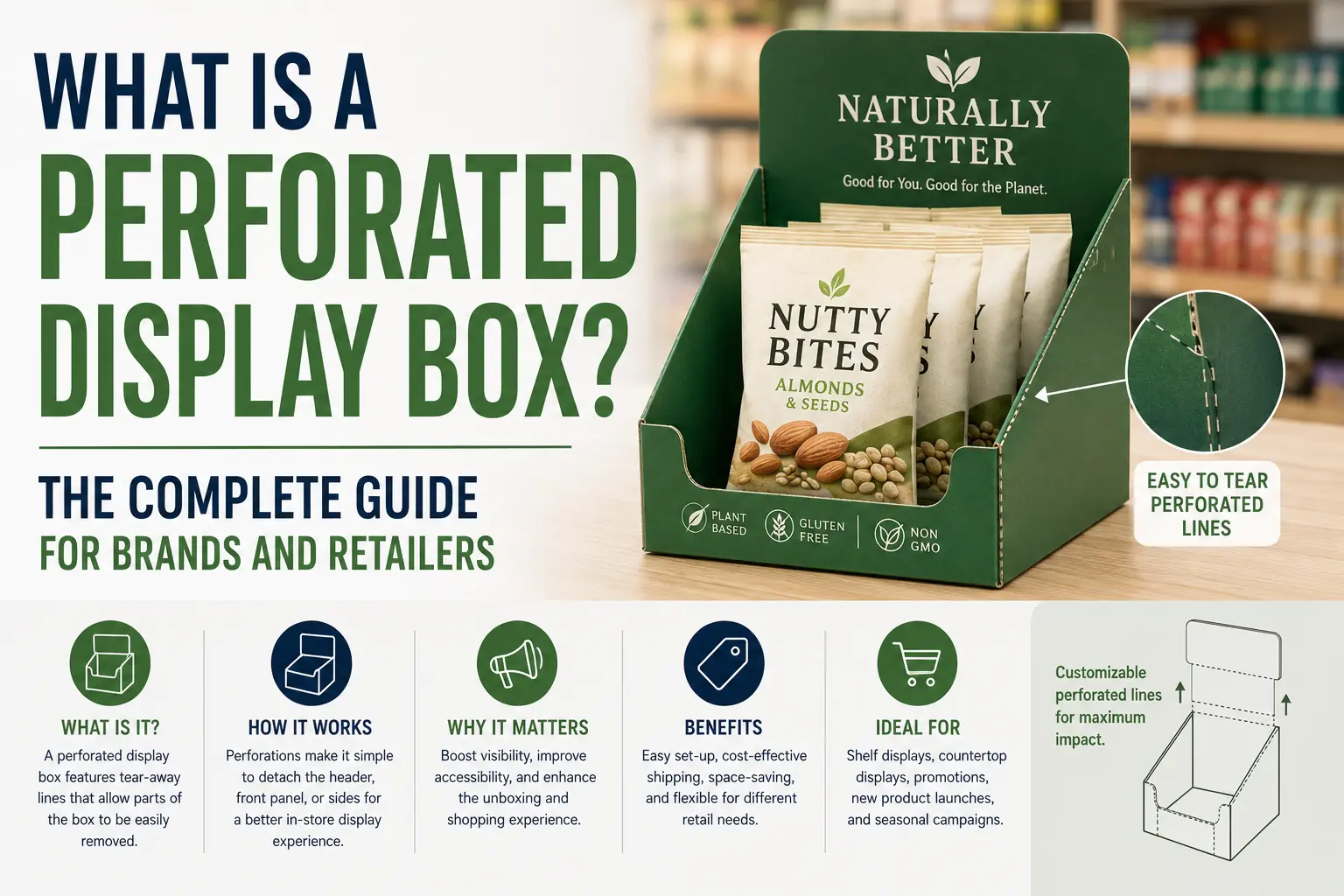
Walk into any convenience store, pharmacy, grocery aisle, or big-box retailer, and you will encounter perforated display boxes without necessarily knowing their name. The countertop box of energy bars where you grab one from an opening at the front. The cardboard shipper on the shelf with its front panel torn away to reveal rows of snack bags. The tissue box with its oval slot at the top. The cosmetic display on the beauty counter where lipsticks stand upright in a box with a section torn off. All of these are perforated display boxes.
They are one of the most commercially effective packaging formats in retail, combining two functions that are normally handled by two separate packaging units: the protective shipping and storage container and the retail display unit. When that combination works well, it eliminates a step in the retail supply chain, reduces packaging waste, and creates a product presentation that is both professional and immediately accessible to shoppers.
For brands looking for a closely related format, tear away display boxes offer a similar shipping-to-display conversion with a slightly different opening mechanism suited to specific retail environments.
Despite their prevalence, perforated display boxes are poorly understood by many of the brand owners and product managers who would benefit most from using them. This guide covers everything you need to know, from how they are constructed and how the perforation mechanism actually works, to the different types available, the industries that use them, the materials and printing options, and how to choose the right configuration for a given product and retail environment.
What Is a Perforated Display Box?
A perforated display box is a packaging structure that incorporates one or more pre-cut perforation lines into its design, allowing a section of the box to be cleanly torn away to transform the box from a closed shipping or storage container into an open retail display unit.
The perforation itself is a series of small, precisely spaced cuts made through the packaging material in a defined pattern. These cuts create a line of structural weakness that allows the material to tear cleanly and predictably along the intended path when moderate force is applied. The cuts are spaced and sized so that the material holds together completely during shipping and handling but tears easily and cleanly when the perforation is deliberately opened.
The key distinction between a perforated display box and other packaging types is the dual-purpose function the perforation enables. The box ships as a fully enclosed, structurally sound container protecting its contents during transit. When it reaches the retail environment, a store associate tears along the perforation line to open a section of the box, converting it into a display unit that presents the products inside in a facing arrangement visible and accessible to shoppers. The remaining box structure holds the products upright, organised, and branded, functioning as a shelf-ready display without any additional setup.
This dual-purpose design means one packaging unit replaces two: the distribution carton and the retail display unit. For high-volume consumer goods moving through fast-moving retail channels, this represents a meaningful reduction in packaging material, handling labour, and operational complexity at the retail level.
How the Perforation Mechanism Works
Understanding the mechanics of perforation helps explain why it is such a reliable and versatile packaging technology and why it behaves differently from a simple scored fold or a standard tear strip.
A perforation is created by a die-cutting tool, specifically a steel rule die or a rotary die-cut machine, that cuts through the packaging material in a repeating pattern of cuts and uncut bridges. Each cut removes a small section of material, and the uncut bridge between cuts holds the material together. When the perforation is complete, the line consists of alternating cut sections and intact material bridges.
The ratio of cut length to bridge length determines how the perforation behaves. A perforation with longer cuts and shorter bridges tears very easily but holds less securely during handling. A perforation with shorter cuts and longer bridges requires more force to tear but provides better structural integrity during transit. Packaging engineers select the cut-to-bridge ratio based on the specific requirements of the application: how much force the perforation needs to withstand during shipping and how cleanly and easily it needs to tear when opened.
For a typical display box perforation, the cut-to-bridge ratio is engineered so that:
During transit, the box can be stacked, jostled, compressed, and handled without the perforation opening accidentally. The force required to open the perforation should be significantly greater than any incidental force it will encounter in normal distribution.
At the retail end, a store associate can open the perforation cleanly with a single deliberate pull, without needing any tools, without damaging the products inside, and without leaving a ragged or untidy tear line that would detract from the display presentation.
The perforation line is usually positioned so that when it is torn, the remaining box structure forms a useful display tray or backdrop. A front-opening perforation creates a tray with three walls and an open front, which holds the products upright and facing outward. A top-and-front opening creates a gravity-feed style display where products slide forward as each one is removed. A side-panel perforation can create a display with a large branded surface visible from multiple angles.
Types of Perforated Display Boxes
Perforated display boxes are not a single format but a family of related configurations, each suited to specific products, display environments, and retail strategies. Understanding the different types is essential for choosing the right one.
Shelf-Ready Perforated Display Box
Also called retail-ready packaging or RRP, the shelf-ready perforated display box is designed to move directly from the distribution pallet onto the retail shelf without any repacking by store staff. The box ships fully loaded with products, and the store associate tears the perforation to open the front or top panel, places the entire unit on the shelf, and walks away. The products are immediately displayed and accessible to shoppers without any individual stacking or arrangement.
Shelf-ready boxes are particularly valued by large retailers including Walmart, Target, Costco, and major supermarket chains because they reduce the time store staff spend handling individual products. Many major retailers now mandate shelf-ready packaging from their suppliers as a condition of ranging.
A typical shelf-ready perforated display box has a front panel perforation positioned approximately one-third to halfway up the box height, leaving a tray of adequate depth to contain the products upright, and a top perforation or flap that tears away to expose the top of the products. The printed side panels of the remaining tray serve as the brand display surface.
Countertop Perforated Display Box
Countertop display boxes are designed for placement on retail counter surfaces, checkout counters, pharmacy counters, and point-of-purchase locations where impulse buying is the primary purchase driver. They are typically smaller than shelf-ready boxes and are positioned to hold products at a height and angle that is immediately visible and accessible to a customer standing at the counter.
The perforation on a countertop display box typically opens the front of the box to create an open-front tray, sometimes with an angled or stepped design that tilts the products toward the customer. Many countertop perforated display boxes also include a hang tab at the back panel, allowing them to be hung on a pegboard display rail as an alternative to countertop placement.
Countertop perforated display boxes are extremely common in convenience stores for confectionery, chewing gum, and mints; in pharmacies for over-the-counter products, lip care, and bandages; in beauty supply stores for cosmetic accessories; and in electronics retail for cables, earphones, and accessories.
Gravity-Feed Perforated Display Box
A gravity-feed display box is engineered so that products inside feed forward under gravity as each item is removed from the front. The box is typically inclined slightly, either by design or by the shelf it sits on, so that as a product is taken from the front of the display, the remaining products slide forward to fill the gap.
The perforation on a gravity-feed display box typically removes the front panel entirely, or a large section of it, creating a wide, unobstructed opening through which products can slide forward freely. The top panel may be perforated and removed as well to make the display more open.
Gravity-feed configurations are widely used for confectionery bars, battery packs, energy drinks, and small snack items where rapid product turnover requires automatic product advancement to maintain a consistently full-looking display without staff intervention.
Side-Panel Perforated Display Box
Some perforated display box configurations retain a solid front panel and instead use side panel perforations to create a different visual presentation. Opening the side perforation allows the box to be folded outward to create a three-dimensional display with a printed backdrop and a product-holding tray visible from the front.
This configuration is used for premium and gift-oriented products where the three-dimensional display presentation is more impactful than a simple open-front tray. It is common in confectionery seasonal displays, wine and spirits retail, and premium personal care.
Dispenser Perforated Box
A perforated dispenser box is specifically designed for single-item dispensing rather than bulk display. The perforation creates a controlled opening through which one item at a time can be extracted. The box retains its structural integrity after the perforation is opened, and the remaining products inside are dispensed in sequence as each is removed.
Tissue boxes are the most familiar example of dispenser perforation, where the top opening allows one tissue to be extracted at a time. The same principle applies to boxes of individually wrapped confectionery, boxed wet wipes, boxed straws, and single-dose pharmaceutical packaging.
The perforation on a dispenser box is typically smaller and more precisely engineered than display box perforations because the size and shape of the opening controls the dispensing behaviour. Too large an opening allows multiple items to be extracted simultaneously or causes the internal stack to collapse. Too small an opening requires excessive force to extract each item.
Shipping-to-Display Conversion Box
The shipping-to-display conversion box is perhaps the most commercially significant type of perforated display box. It is a standard corrugated distribution box that incorporates strategically placed perforations allowing it to be converted into a branded retail display unit without any additional packaging material.
The concept is straightforward: a brand ships products to retail in a corrugated outer case that is not just a functional shipping container but also a designed retail display. When the case arrives at the retail location, the store associate tears the perforation to remove sections of the outer corrugated walls, revealing a display tray with printed branding, product facing, and sometimes a header card or backdrop displaying the brand name.
This format is particularly prevalent in the fast-moving consumer goods category for products including soft drinks, snack foods, personal care products, household cleaning products, and seasonal items. It eliminates the need to unpack a corrugated shipper and then set up a separate display unit, saving significant time at the retail end and reducing the total amount of packaging material consumed per unit sold.
Materials Used in Perforated Display Boxes
The material choice for a perforated display box affects its structural performance, the quality of the perforation, its printability, its sustainability profile, and its cost. Different materials suit different applications.
Corrugated Cardboard
Corrugated cardboard is the dominant material for shipping-to-display conversion boxes and for larger shelf-ready display units. Its layered construction, with a fluted medium between two flat liners, provides excellent structural strength, stack resistance, and protection during transit. Corrugated perforated display boxes are available in single wall and double wall configurations, with single wall B or C flute being most common for retail display applications.
The perforation on corrugated board must cut through the entire thickness of the board, including all three layers. This requires a heavier die-cutting force than solid paperboard, and the cut-to-bridge ratio must be calibrated for corrugated’s tendency to tear less cleanly than solid board. Well-designed corrugated perforations tear cleanly along the line when the ratio is correct.
Corrugated display boxes can be printed directly on the outer liner using flexographic printing, or the outer liner can be pre-printed with lithographic quality printing before lamination to the corrugated structure.
Solid Bleached Sulphate Paperboard
SBS paperboard is the standard material for countertop display boxes, dispenser boxes, and premium retail display applications where a smooth, bright print surface and precise perforation performance are required. It is made from virgin wood fibre and provides an excellent white surface for high-quality printing.
SBS board perforates very cleanly due to its solid, uniform structure. The perforation tears predictably and leaves a clean edge. This clean tear is particularly important for countertop display boxes where the visual quality of the opened display reflects on the brand.
SBS is available in a range of thicknesses, typically 16 to 24 point, and is food-contact safe, making it suitable for food product display boxes.
Kraft Paperboard and Kraft Corrugated
Kraft board and kraft-faced corrugated are used for perforated display boxes targeting natural, artisan, sustainable, and eco-conscious brand positioning. The natural brown colour of kraft board is a recognised aesthetic shorthand for sustainability and artisan quality.
Kraft board perforates similarly to SBS board but the unbleached surface has different printing characteristics, requiring inks formulated for natural paper backgrounds. Designs typically use fewer colours and simpler graphics that work with rather than against the natural brown surface.
Many organic food brands, natural personal care brands, and sustainable consumer goods brands use kraft perforated display boxes as an intentional brand signal.
Recycled Content Board
Coated recycled board uses recycled fibre in the inner plies with a coated white surface on the outer face. It is less expensive than virgin SBS board and carries a strong sustainability credential. Performance for perforated display applications is comparable to SBS for most applications, though very high-precision perforation designs may perform marginally better on virgin board.
Many major retailers now specify minimum recycled content percentages for supplier packaging, and coated recycled board meets these requirements while providing adequate print quality for brand graphics.
Perforation Techniques and How They Are Made
The way perforations are created affects their precision, consistency, and the range of shapes and patterns achievable.
Flatbed Die-Cutting uses a flat steel rule die pressed down onto the material to create cuts in a single press stroke. The steel rule die is a custom-made tool with sharp blades bent and arranged in the exact pattern of the desired perforation. Flatbed die-cutting is used for most folding carton and smaller corrugated packaging applications. It produces precise, consistent perforations and can create complex perforation patterns in a single operation.
Rotary Die-Cutting uses cylindrical dies that rotate continuously as the material passes through, cutting the perforations in a continuous process. Rotary die-cutting is faster than flatbed for high-volume production and is used for large corrugated display boxes produced in high quantities. It provides consistent results and is compatible with fully automated production lines.
Laser Perforation uses a focused laser beam to ablate the material along the perforation line rather than cutting with a mechanical blade. Laser perforation is used for very fine or complex perforation patterns, for materials that are difficult to cut mechanically, and for applications requiring micro-perforations for ventilation. It is slower and more expensive than mechanical die-cutting but provides unmatched precision for specialist applications.
Web Press Perforation is used for high-volume flexible packaging and labels, applying perforations to a continuous web of material as it moves through a press. This technique is used for roll-fed packaging and labelling applications rather than for rigid boxes.
Industries That Use Perforated Display Boxes
Perforated display boxes are used across a remarkably wide range of industries, which reflects the versatility of the format and the universality of the retail display challenge it solves.
Food and Snack Industry
The food and snack industry is the largest single user of perforated display boxes. Individually wrapped confectionery bars, snack bags, cereal bars, protein bars, chewing gum, mints, and candy packs are all routinely shipped in corrugated display boxes with front and top perforations. The shelf-ready design is particularly valued by grocery chains and convenience stores, where high product velocity and limited staff time make manual replenishment a significant operational cost.
Checkout counter perforated display boxes for impulse-purchase confectionery are one of the most commercially productive uses of the format. Research consistently shows that checkout display placement significantly increases impulse purchase rates for confectionery, and a well-presented perforated display box increases conversion further by making the product immediately accessible without the barrier of a fully enclosed box.
Bakery items, fresh produce trays, and refrigerated food items also use perforated packaging, though in these applications the ventilation function of the perforations is as important as the display function.
Pharmaceutical and Healthcare
Over-the-counter medicines, vitamins and supplements, personal care products, and medical accessories are widely packaged in perforated display boxes for pharmacy and health retailer distribution. The format allows products to be displayed accessibly on pharmacy countertops and shelves without requiring a pharmacist or assistant to retrieve them from behind the counter.
Blister-packed medications use individual perforation between doses, allowing a single dose card to be detached cleanly from the pack. This is a specific application of perforation technology distinct from display box perforation but equally important in the healthcare packaging context.
Cosmetics and Personal Care
Cosmetic display boxes for lipsticks, lip balms, nail products, travel-size toiletries, hair accessories, and cosmetic samples are almost always perforated display formats. The countertop display box is particularly prevalent in this category, where product sampling and impulse purchase are important purchase drivers.
Premium cosmetic brands use perforated display boxes in high-quality SBS board with sophisticated print finishes, spot UV, and foil stamping to create retail displays that reflect the brand’s premium positioning while maintaining the operational convenience of the shelf-ready format.
Electronics Accessories
USB cables, charging cables, earphones, headphone adapters, screen protectors, phone cases, and other small electronics accessories are commonly displayed in perforated boxes in electronics retail, convenience stores, airports, and general merchandise stores. The format allows the product to be visible and accessible to shoppers who want to examine it before purchase without a store associate needing to retrieve it.
Stationery and Office Products
Pens, markers, correction fluid, adhesive products, sticky notes, and other stationery items use perforated display boxes extensively in stationery retail, office supply stores, and the stationery sections of general merchandise retailers.
Tobacco and Related Products
Perforated display boxes are used extensively in tobacco retail for products including rolling papers, filters, pipe tobacco, and nicotine replacement products. The countertop and behind-counter display formats are standard in this category.
Household and Cleaning Products
Batteries, light bulbs, cleaning wipes, sponges, air fresheners, and other household consumables use perforated shelf-ready display boxes in supermarkets and home improvement retailers. The high product velocity of household consumables makes shelf-ready packaging particularly valuable in this category.
Key Benefits of Perforated Display Boxes
The commercial case for perforated display boxes is well-established across multiple retail categories, and the benefits operate at several levels simultaneously.
Elimination of Separate Display Units
The most significant economic benefit of perforated display boxes is the elimination of the separate retail display unit. A brand that ships products in standard corrugated outers and sets up separate countertop display units is paying for two packaging formats, two sets of tooling and print plates, two inventory management challenges, and the labour cost of setting up displays at the retail location. A perforated display box collapses these into a single packaging format, which reduces cost and operational complexity across the entire supply chain.
Retail Labour Reduction
Major retailers have made explicit statements about the value they place on packaging that reduces their in-store labour requirements. Shelf-ready perforated display packaging reduces the time required to put a product onto the shelf from minutes to seconds. At scale, across thousands of product lines and hundreds of store locations, this labour reduction is a commercially significant cost saving that retailers pass back as pressure on their suppliers to adopt shelf-ready formats.
Reduced Product Damage and Spoilage
Because the products inside a perforated display box are not individually handled during the retail setup process, they are exposed to fewer touchpoints and therefore less risk of damage. A case of individually wrapped confectionery bars that is simply opened along a perforation and placed on shelf encounters far fewer handling events than the same products unpacked from a standard shipper and individually stacked on a display tray.
Improved Shelf Presence and Visibility
A well-designed perforated display box creates a more professional, branded retail presentation than individually stacked products or products transferred to a generic retailer display. The brand graphics on the display tray remain visible throughout the product’s time on shelf, providing continuous brand communication to every shopper who passes.
Impulse Purchase Stimulation
Accessibility is one of the strongest drivers of impulse purchase. A product that is immediately within reach, clearly presented, and easy to pick up without effort converts casual interest into purchase far more effectively than the same product behind glass, in a sealed box, or in a location that requires any additional effort to access. Perforated display boxes, particularly countertop formats at checkout, are specifically engineered for this accessibility advantage.
Waste Reduction
Using a single packaging unit for both distribution and display reduces the total amount of packaging material consumed per unit sold. This is a genuine environmental benefit and is increasingly cited by brands in their sustainability communications. Several major FMCG brands have quantified the material savings from switching to shelf-ready perforated display packaging as part of their packaging sustainability reporting.
Faster Retail Setup and Restocking
Store associates report that shelf-ready perforated display packaging can reduce the time required to put a product on shelf by 50 to 80 percent compared to conventional packaging. This is primarily because the shelf-ready format eliminates the need to unpack individual products, dispose of the shipping outer, and arrange products manually on the shelf.
Design Considerations for Perforated Display Boxes
Effective perforated display box design involves several considerations that go beyond basic dimensions and material specification.
Perforation Placement and Path
The position of the perforation line determines the shape and size of the display opening after tearing. The perforation must be positioned to leave a tray of adequate depth to hold the products upright without them falling forward, and the opening must be large enough to make the products fully visible and easily accessible. For a typical countertop snack display, the front perforation is usually positioned 30 to 50 percent of the way up the box height, leaving a tray deep enough to contain the products while exposing at least their upper half to shopper view.
Tear Direction and Sequence
On boxes with perforations on multiple panels, the sequence and direction of tearing affects how cleanly and easily the box opens. Well-designed multi-panel perforations include a corner perforation or a starting tab that indicates where to begin tearing and guides the tear along the correct path. Without this guidance, store associates may start tearing in the wrong location, producing an irregular or damaged opening.
Print Design Integration
The graphic design on the box must account for the perforation line from the start of the design process. Design elements that are intended to be part of the display should be positioned below the perforation line on the display tray. Elements above the perforation line will be torn away and discarded. A common mistake in perforated display box design is placing key brand elements in the zone that will be removed, which destroys the brand communication on the finished display.
Structural Integrity After Opening
The remaining display tray after the perforation is opened must be structurally sound. If the perforation weakens the box excessively, the tray may sag, buckle, or collapse under the weight of the products. The box designer must ensure that the remaining panels after perforation are adequately supported and that the tray retains sufficient rigidity for its expected display duration.
Header Card and Backdrop Integration
Many perforated display box designs incorporate a header card, which is a raised panel above the product display area that carries brand name, product imagery, and promotional messaging visible above the product line. When the front perforation is opened, the header card rises above the display tray to create a three-dimensional display with both product presentation and brand communication. The header card may be a separate insert or an integral part of the box construction created by the shape of the remaining structure after tearing.
How Perforated Display Boxes Differ from Similar Packaging Formats
Understanding how perforated display boxes relate to adjacent packaging formats helps clarify when each is the right choice.
| Feature | Perforated Display Box | Standard Corrugated Shipper | Separate Display Unit | Blister Pack |
|---|---|---|---|---|
| Primary function | Shipping and display combined | Shipping only | Display only | Individual product protection |
| Setup required at retail | Tear perforation only | Unpack and dispose | Assemble display | None |
| Brand visibility on shelf | High, via display tray | None | High | Moderate |
| Labour at retail | Very low | High | Medium | None |
| Cost per unit | Low to medium | Low | Medium to high | Medium |
| Best for | FMCG, snacks, cosmetics, pharma | Bulk distribution | Seasonal, premium display | Single-item pharma, small goods |
| Sustainability | Good, single packaging unit | Good for shipping only | Additional material required | Variable |
Printing and Customisation Options
The printable surfaces of a perforated display box are the primary brand communication medium at the retail point of sale, and the quality of printing and finishing directly affects how the brand is perceived by shoppers.
Flexographic Printing is the standard printing method for corrugated perforated display boxes. It is fast, cost-effective at high volumes, and produces consistent brand colour reproduction. Modern flexographic presses achieve significantly higher print quality than older generations of the technology, making flexo appropriate for most FMCG display box applications.
Litho-Lamination applies a separately lithographically printed paper sheet to the outer surface of the corrugated box, producing print quality that rivals folding carton packaging. Litho-lam corrugated perforated display boxes are used for premium brands where print quality is a brand priority. The trade-off is higher cost and slightly reduced recyclability due to the adhesive used in the lamination.
Digital Printing on corrugated is increasingly viable for short runs and allows high levels of customisation including personalised displays, seasonal variations, and market test designs without the cost of new print plates.
Surface Finishes including gloss varnish, matte varnish, spot UV, and foil stamping are all available on perforated display boxes, subject to the material and printing method used. Premium finishes on display box trays create a more impactful retail presence.
Sustainability of Perforated Display Boxes
The sustainability profile of perforated display boxes is genuinely strong relative to the alternatives they replace, though with some nuances worth understanding.
The primary sustainability advantage is material reduction. A single packaging unit serving both shipping and display functions uses less total material than separate shipping and display packaging. This material reduction reduces the carbon footprint of the packaging per unit sold.
Corrugated cardboard perforated display boxes are widely recyclable. The box is already open at the retail end, making it easy for store staff to flatten and recycle the display tray after the products sell through. Recycling rates for corrugated packaging at the retail level are high because retail locations typically have robust cardboard recycling programs.
Paperboard perforated display boxes are similarly recyclable through standard cardboard recycling streams. Boxes without lamination, foil coating, or wax coating are fully recyclable.
The challenge comes from surface treatments. Gloss plastic lamination, wax coatings, and metallic foil reduce recyclability and should be avoided by brands with strong sustainability commitments. Water-based varnishes and paper-based finishes maintain full recyclability.
FSC and PEFC certification of the board used in perforated display boxes is increasingly specified by retailers and brands as a baseline sustainability requirement. These certifications verify responsible forest management and are a meaningful differentiator for brands communicating sustainability credentials.
FAQs
What is a perforated display box?
A perforated display box is a packaging structure with one or more pre-cut perforation lines that allow a section of the box to be torn away cleanly, converting the box from a closed shipping container into an open retail display unit. It combines shipping and display functions in a single packaging format.
How does the perforation on a display box work?
The perforation is a series of small, precisely spaced cuts made through the packaging material using die-cutting equipment. The cuts create a line of structural weakness that holds together during transit but tears cleanly when deliberate force is applied, allowing a clean opening without tools.
What is the difference between a perforated display box and shelf-ready packaging?
Shelf-ready packaging is a broader term for any packaging designed to move directly from the distribution pallet to the retail shelf without repacking. Perforated display boxes are the most common format of shelf-ready packaging, using perforation to open the display facing. All perforated display boxes designed for shelf placement are shelf-ready, but shelf-ready packaging also includes other formats such as trays with removable lids.
What materials are used in perforated display boxes?
The most common materials are single wall corrugated cardboard for larger shelf-ready boxes, and SBS or coated recycled paperboard for countertop display boxes and smaller formats. Kraft board is used for sustainable and artisan positioning. The choice depends on the product weight, the required print quality, and the environmental specification.
What industries use perforated display boxes?
Perforated display boxes are used across food and snack, pharmaceutical and healthcare, cosmetics and personal care, electronics accessories, stationery, tobacco, and household products categories, among others.
Can perforated display boxes be recycled?
Yes. Corrugated and paperboard perforated display boxes without plastic lamination, wax coating, or metallic foil are recyclable through standard cardboard recycling streams. Surface treatments that include plastic or wax reduce recyclability.
What is the difference between a perforated display box and a dispenser box?
A display box uses perforation to open a large section of the box for batch product display. A dispenser box uses perforation to create a controlled opening for single-item sequential dispensing. Both use perforation technology but for different purposes.
How are perforations created in packaging?
Perforations are created using flatbed die-cutting, rotary die-cutting, or laser perforation. The method chosen depends on the material, the complexity of the perforation pattern, and the production volume required.
What is the minimum order quantity for custom perforated display boxes?
This varies by supplier and printing method. Digital printing allows short runs from approximately 100 units. Flexographic printing for corrugated typically requires 500 to 1,000 units or more to amortise tooling and plate costs economically.
How do I design a perforated display box so the perforation is in the right place?
Work with your packaging designer or supplier to create a dieline that marks the perforation position precisely. Ensure all key brand graphics intended to be part of the retail display are positioned below the perforation line. The perforation should be positioned to leave a display tray deep enough to hold your products securely while exposing enough of the product face to be visible and accessible to shoppers.
Quick Comparison: Perforated Display Box Types
| Type | Best For | Opening Style | Typical Material | Primary Location |
|---|---|---|---|---|
| Shelf-ready display box | FMCG, snacks, household goods | Front and top perforation | Corrugated single wall | Supermarket shelf, endcap |
| Countertop display box | Impulse items, cosmetics, pharma | Front perforation or fold-down | SBS or recycled paperboard | Checkout, pharmacy counter |
| Gravity-feed display box | High-velocity confectionery, batteries | Full front panel removal | Corrugated or SBS | Checkout counter, shelf |
| Side-panel display box | Premium, seasonal, gift products | Side panel tear-out | SBS with premium finish | Specialty retail, endcap |
| Dispenser box | Tissues, wipes, single-serve items | Controlled top or front opening | SBS paperboard | Counter, shelf |
| Shipping-to-display conversion box | CPG brands reducing packaging count | Multi-panel perforation | Corrugated, litho-lam option | All retail environments |