

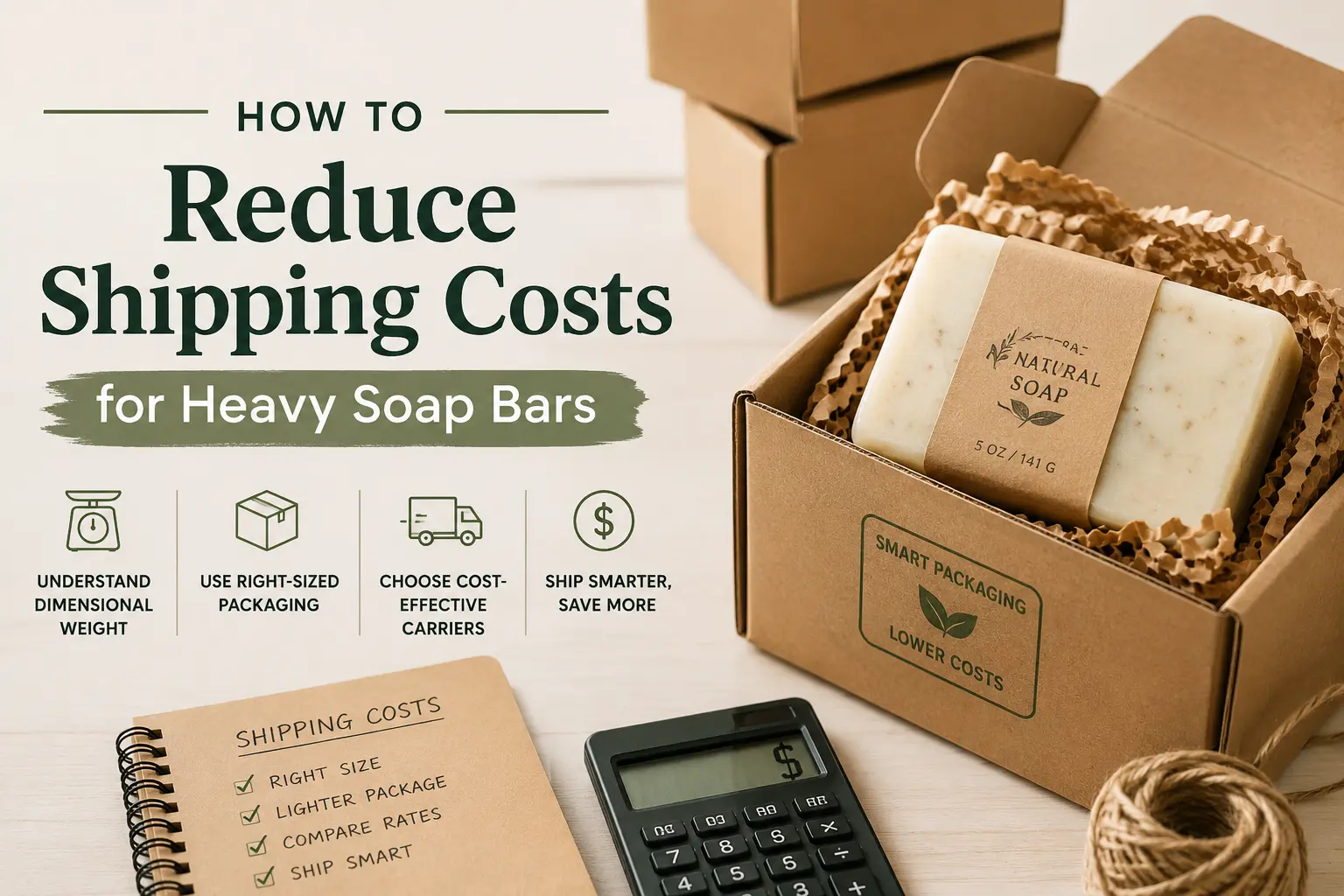
Shipping soap sounds easy. A solid little brick, can’t spill, can’t shatter, no hazmat forms. Then you’ve been selling online for three or four months, you look at what Pirate Ship took off your card last week, and it hits you. Soap is heavy. Heavy is expensive.
Your average cold process bar is 4 to 6 ounces, give or take how generous you are with the cutter. Three of those and the box, you’re past a pound. Six and you’re flirting with 2.5 pounds. Now, most shipping advice online is about dimensional weight (the carrier charging for the size of a light, puffy box), but soap’s the opposite problem, since the carrier bills whichever is bigger and with dense bars it’s nearly always the scale weight that wins.
That means a chunk of every order goes to the post office, every time. The good news? There are practical ways to bring it down without your bars arriving chipped or your unboxing looking cheap.
Below is everything we know that actually works, from picking the carrier and service to cutting the box down to size. And if you want luxury soap boxes cut to your bar’s exact size so you’re not mailing extra board, we make custom soap packaging with low minimums (often around 50 boxes, depending on the style) and free shipping anywhere in the USA.
Understand Why Soap Ships Expensively
Quick bit of why first, then the fixes.
Soap is dense. A 5-ounce bar takes up hardly any room but weighs a lot more per cubic inch than, say, a T-shirt or a tube of lip balm, so for soap the weight on the scale, not the size of the box, is usually what the carrier prices you on.
Soap orders are also rarely one bar. People buy three, four, six at a time (which is honestly part of why soap is such a nice product to sell direct), and that weight piles up fast. Four bars at 5 ounces each, plus around 8 ounces of box and filler, and you’re at 1.75 pounds. Six bars and you’re past 2.5.
Then the packaging adds its own ounces. Tissue, crinkle paper, the carton, the mailer boxes around it. On something this heavy per unit, every extra bit of board or filler is money you hand straight to the carrier.
Use USPS Priority Mail Cubic for Dense, Heavy Soap Orders
If you only take one thing from this guide, take this one. It’s the trick most soap makers we talk to either haven’t heard of or aren’t using.
USPS Priority Mail Cubic prices your parcel by its size instead of its weight, as long as it’s 20 pounds or under. And since soap is heavy for its size, that flips the usual math in your favor in a big way.
The mechanics are kind of nerdy but stick with us. USPS sorts Cubic parcels into tiers by how much space they take up, starting at 0.1 cubic feet and going up in tenths to 0.5, and inside each tier the price is the same whether the box is feather-light or packed with twelve bars of oatmeal goat milk.
Take a 6 × 4 × 3 inch box. That’s 72 cubic inches, or about 0.042 cubic feet, so it lands in the 0.1 tier. Whether there’s 8 ounces of soap in there or a few pounds, the label costs the same.
So a four-bar order in a small corrugated mailer that size, weighing maybe 1.5 pounds, can come in noticeably cheaper on Cubic than on regular weight-based Priority Mail, especially to far-away zones. A dollar or two a parcel doesn’t sound like much. Over a few hundred orders a month it really is.
The catch, if you can call it that, is the box has to be small. Smaller box, lower tier, lower price. That’s the opposite of a lot of shipping advice and it gives you a real reason to cut your soap packaging as tight as you safely can.
You won’t find Cubic pricing at the post office counter. You get it through shipping platforms like Pirate Ship, Shippo or ShipStation, which have commercial access. Pirate Ship is popular with small soap businesses since there’s no monthly fee. Rates shift every January or so. Check yours.
Right-Size Your Soap Packaging
Box size and postage are tied together tightly for soap. Every extra half inch pushes up either the dimensional weight on services that use DIM pricing, or your tier on Cubic. Either way you pay.
The goal is simple enough. Find the smallest box that holds the bars snug so they can’t slide around, because loose bars in transit chip at the corners and scuff on the faces, and chipped soap means an email from an unhappy customer and a free replacement out of your pocket.
A well-fitted soap box leaves roughly 5 to 10 mm of room on each side. Enough for a thin tissue or kraft wrap. Not enough for the bar to rattle. (Our soap box dimensions guide has typical sizes if you want a starting point.)
For multi-bar orders, use a box made for that bar count rather than one generic box for everything. Two bars rattling around in a four-bar box means wasted space, more filler, more weight, and a higher tier.
What we’d suggest is a small family of box sizes built around your most common orders. If most orders are one, two or four bars, three box sizes that fit each exactly will save more over a month than one big box that fits everything badly.
And measure the actual bars, not the mold. Cold process shrinks a little as it cures, hand-cut bars wander a few millimeters either way, and a stamped logo adds nothing but a beveled edge can. We’ve had soap makers send us mold dimensions and then find their cured bars swimming in the box. Grab a ruler and three random bars from the curing rack, take the biggest numbers, and size from those.
Compare Carriers for Every Weight Bracket
No carrier wins every time. The cheapest option depends on the weight, the box size and where it’s going, so if you’re using one carrier for everything without checking, you’re almost certainly overpaying on some orders.
For most US soap orders under 2 pounds, USPS tends to come out cheapest, whether that’s Priority Mail Cubic or USPS Ground Advantage when the customer isn’t in a hurry.
Between 2 and 5 pounds it gets more mixed. USPS Flat Rate boxes can be good value for longer distances, Cubic still works if the box is small, and it’s worth checking Ground Advantage too.
Once you’re over 5 pounds (wholesale orders, big gift sets) we’d start checking UPS and FedEx properly, because USPS gets steep on the far zones and UPS Ground in particular can surprise you on a heavy box.
Easiest way to not think about any of this? A multi-carrier platform. Pirate Ship, Shippo, Easyship, whatever you like, they put USPS and UPS and FedEx side by side on the screen before you print, and you click the cheap one. Five seconds.
Use USPS Flat Rate Boxes Strategically
If it fits, it ships, as the old USPS ads used to say. Flat Rate boxes cost one price regardless of weight (up to 70 pounds, which no soap order is getting near), and for a dense parcel that’s a pretty good deal.
Soap brands mostly use the Small, Medium and Large Flat Rate boxes. Prices go up a bit most years and commercial rates through a shipping platform are lower than retail, so look up today’s rates rather than trusting an old blog post (including this one).
Flat Rate makes the most sense for heavy orders going a long way. A 3-pound soap order from California to New York is Zone 8, which is pricey on weight-based rates, but Flat Rate doesn’t care about distance.
It’s not always cheapest though. Lighter or shorter trips often come out cheaper on Cubic or Ground Advantage. Compare before you assume.
One more thing. USPS gives Flat Rate boxes away free at the post office or by delivery from usps.com, so you skip buying boxes altogether. The trade-off is branding. You can’t print your logo on a Flat Rate box, and if your unboxing is part of the brand, that’s a real loss.
Reduce Packaging Weight Without Reducing Protection
Weigh an empty packed box sometime. Just the packaging, no soap. People are usually a bit shocked, and every ounce of that is something you’re paying to mail over and over.
The usual culprits, in our experience: an outer box two sizes too big plus the filler to pad it out, a heavy rigid box doing a job a light corrugated one would do fine, and a fistful of crinkle paper in a gap that shouldn’t exist.
One wrap of tissue or kraft per bar. That’s honestly enough, soap isn’t a wine glass.
And for the shipper itself, corrugated beats rigid chipboard on both counts, lighter and better at taking a hit on a sorting belt (rigid boxes look gorgeous on a shelf, that’s what they’re for). If the retail box matters to your brand, put a light fitted soap box inside a corrugated shipper instead of using a heavy rigid box as both.
If you’re ordering custom product boxes from us, tell us how heavy your bars are and how you ship. We’ll suggest the lightest board that still does the job, whether that’s paperboard for retail shelves or corrugated for direct shipping.
Encourage Multi-Bar Orders to Improve Shipping Efficiency
The more bars in one parcel, the less you pay in shipping per bar. Simple math. If one bar costs about the same to ship as four, the four-bar order costs you roughly a quarter as much per bar.
So it pays to nudge people toward bigger orders, and the soap brands we work with tend to use three moves for that. A free shipping threshold gets people adding a bar to qualify. A small discount on three or more bars makes the bundle math obvious. And themed gift sets of three or four bars in one kraft soap box make buying several feel natural instead of like a decision.
The free shipping threshold works best set just above what one or two bars cost, so someone buying two adds a third. Weirdly, plenty of shoppers would rather spend a dollar more with free shipping than see a postage line at checkout. People are funny like that.
Choose Packaging Materials That Protect Without Excess Weight
Fillers aren’t equal. Some protect a lot per ounce and some mostly just look nice.
Crinkle paper is a soap-brand favorite because it looks pretty and natural. It’s also fairly heavy for the space it fills. A handful of crinkle weighs several times what an air pillow does in the same gap.
Air pillows are the lightest filler going. They weigh almost nothing and cushion well. Not as pretty, sure, but if cutting postage is the priority they make a real difference.
Cornstarch packing peanuts land somewhere in between on weight, and kids love that they melt in the sink, so there’s that.
Between bars in a multi-bar order, a thin sheet of kraft paper stops them rubbing and adds next to nothing. Way lighter than bubble wrap for the same job.
Negotiate Carrier Rates Based on Volume
Carriers do haggle. Not with everyone, and not loudly, but if you ship steadily it’s worth a call once you’ve got some history.
UPS and FedEx both run negotiated rate programs, and you don’t have to be enormous to get a rep on the phone, though how much they knock off depends on your volume and which services you use.
USPS is a different animal. You don’t negotiate at all, you just get commercial pricing automatically through something like Pirate Ship, and it’s already well under the counter price, which is why nearly every small soap maker we know starts on USPS and stays there for a good while.
When you do call UPS or FedEx, bring receipts. Six to twelve months of parcel counts, average weights and box sizes, and where your stuff goes by zone. Reps take you a lot more seriously with a spreadsheet.
Consider Using Poly Mailers for Single Soap Bar Orders
Get a lot of one-bar orders? Then poly mailers are worth a look. A poly mailer weighs a fraction of an ounce and adds basically no size, compared with a corrugated box that weighs several ounces.
One bar in a retail tuck end box, wrapped in tissue, slipped into a poly mailer with a stiff card for support, weighs close to what the soap itself weighs. The same bar in a corrugated mailer box might carry another 6 to 8 ounces of packaging.
Protection’s the trade. A poly bag won’t stop a corner getting dinged if it’s squashed against a metal edge at a sorting hub, and soap corners do chip.
So if you try it, don’t drop a naked bar in a bag. Keep it in its retail box, give the box one wrap of bubble, then the mailer. Still light, and it gets through the mail fine most of the time.
Build Shipping Cost Into Your Pricing Strategy
Amazon trained everyone to expect free shipping, for better or worse. So the cleanest fix is often just baking postage into your bar price from the start.
A surprise shipping charge at checkout is one of the classic reasons people abandon carts. Plenty of shoppers would rather see a slightly higher price and “free shipping” than a lower price plus a postage line, even when they end up paying a bit more overall.
For a soap brand the math is straightforward. Work out what your average order costs to ship, divide it across the bars in that order, and add that amount to each bar’s price. Then advertise free shipping. Lots of customers prefer that, even if the total is a touch higher.
Not keen on raising prices across the board? Set a free shipping minimum instead, at two or three times your single-bar price. People add bars to qualify, your average order goes up, and your shipping cost per bar drops at the same time.
Audit Your Shipping Invoices Regularly
Carriers make billing mistakes more often than you’d think. Address correction fees, the wrong zone, duplicate charges, surcharges that shouldn’t apply. They sit on invoices and most small businesses never notice.
If you ship decent volume with UPS or FedEx, check your invoices every month against what you expected to pay. Carriers will credit confirmed errors if you report them inside their claim window, so don’t wait too long.
There are also audit services that go through your carrier invoices for you and take a cut of whatever they recover. Once you’re shipping a few hundred parcels a month, they can easily pay for themselves.
USPS errors are less common, but they happen, often around dimensional weight or a surcharge. If your shipping platform quoted one price and you got billed another, look into it.
A tiny habit that helps a lot here: weigh every parcel on a cheap postal scale before you print the label instead of guessing from last week. Guess low and you get an adjustment charge later, guess high and you just overpaid. Either way the scale pays for itself in about a month.
Offer Local Pickup for Nearby Customers
Doing Saturday markets, or have a little storefront? Turn on local pickup. Zero postage on those orders.
Add a pickup option at checkout so customers near you can collect instead of paying postage. Zero shipping cost for you, zero shipping charge for them. Everybody’s happy, and pickup customers tend to grab an extra bar while they’re there, which never hurts.
Even a small share of orders switching to pickup adds up. Say one order in twenty gets picked up instead of shipped, and you do a couple hundred orders a month. That’s ten labels a month you never buy, and over a year it’s real money, without changing anything else in how you run the business.
FAQs
What is the cheapest way to ship soap bars? For most soap orders under 20 pounds, USPS Priority Mail Cubic through a discount platform like Pirate Ship is usually cheapest, since it charges by box size instead of weight. For heavier multi-bar orders going far, USPS Flat Rate boxes can also be a good deal.
How much does it cost to ship a bar of soap? Annoying answer, it depends (carrier, zone, box, the year). One bar in a little corrugated mailer on USPS Ground Advantage is about as cheap as it gets. Punch your real numbers into your shipping app and you’ll know in ten seconds.
Does soap count as a heavy item for shipping? It’s denser than most products its size, so multi-bar orders get heavy fast. Six bars can top 2.5 pounds. Small boxes, heavy contents, so it’s the scale number that you pay on, almost never the box size.
Is USPS or UPS cheaper for shipping soap? Under 2 pounds, USPS nearly every time. Past 3 to 5 pounds UPS Ground starts winning some, mostly on shorter trips. Just compare on each label, the software does it for you.
What box size is best for shipping soap to reduce costs? The smallest one that holds the soap snugly. For one bar, roughly 4.5 × 3.5 × 1.5 inches inside works well. For three bars, around 5.5 × 3.5 × 1.5 inches. Six bars can go in a long row at about 9 × 3.5 × 1.5 or two rows of three at around 6 × 5 × 1.5, and we’d usually pick the two rows because it’s sturdier. Smaller boxes land in lower Cubic tiers.
Should I offer free shipping on my soap orders? If your margins allow, yes. Build the cost into your prices, or set a free shipping minimum, which is especially good for soap because it nudges people toward multi-bar orders that cost you less per bar to ship.
How do I access USPS Priority Mail Cubic pricing? Not at the post office counter. You get it through shipping platforms with commercial USPS access, like Pirate Ship (popular with small soap makers), Shippo or ShipStation, usually well below counter prices.
What packaging reduces shipping weight for soap? Light paperboard or corrugated instead of heavy rigid chipboard, air pillows instead of crinkle paper, and a box cut to size so you don’t need much filler at all. A fitted soap box with a thin tissue wrap is about as light as you can get while still protecting the bar.
The Bottom Line
Lye prices you can’t control. Postage, a lot more than you’d think. If we had to pick the big four, it’d be Cubic through a discount platform, boxes cut tight for each order size, a rate comparison on every single label, and pricing that quietly pushes people from one bar to three.
And the box is sitting right in the middle of most of that. A soap box that fits properly gets rid of filler, shrinks the parcel and makes the product look good, all at once. If you’re ready to trim your packaging and improve the unboxing at the same time, take a look at our custom boxes for skincare and soap brands. We make them to your bars’ exact size, print them however you like, keep minimums low, and ship them free across the USA so your packaging costs stay predictable. You can get a rough number first with our packaging cost calculator.
Related reading: How to Design a Custom Shipping Box for Free.
Where to Go Next
Popular options for this topic include custom printed soap boxes and product packaging boxes. Related guides: how to reduce packaging costs for a candle business and how to reduce packaging costs in ecommerce without hurting brand quality.