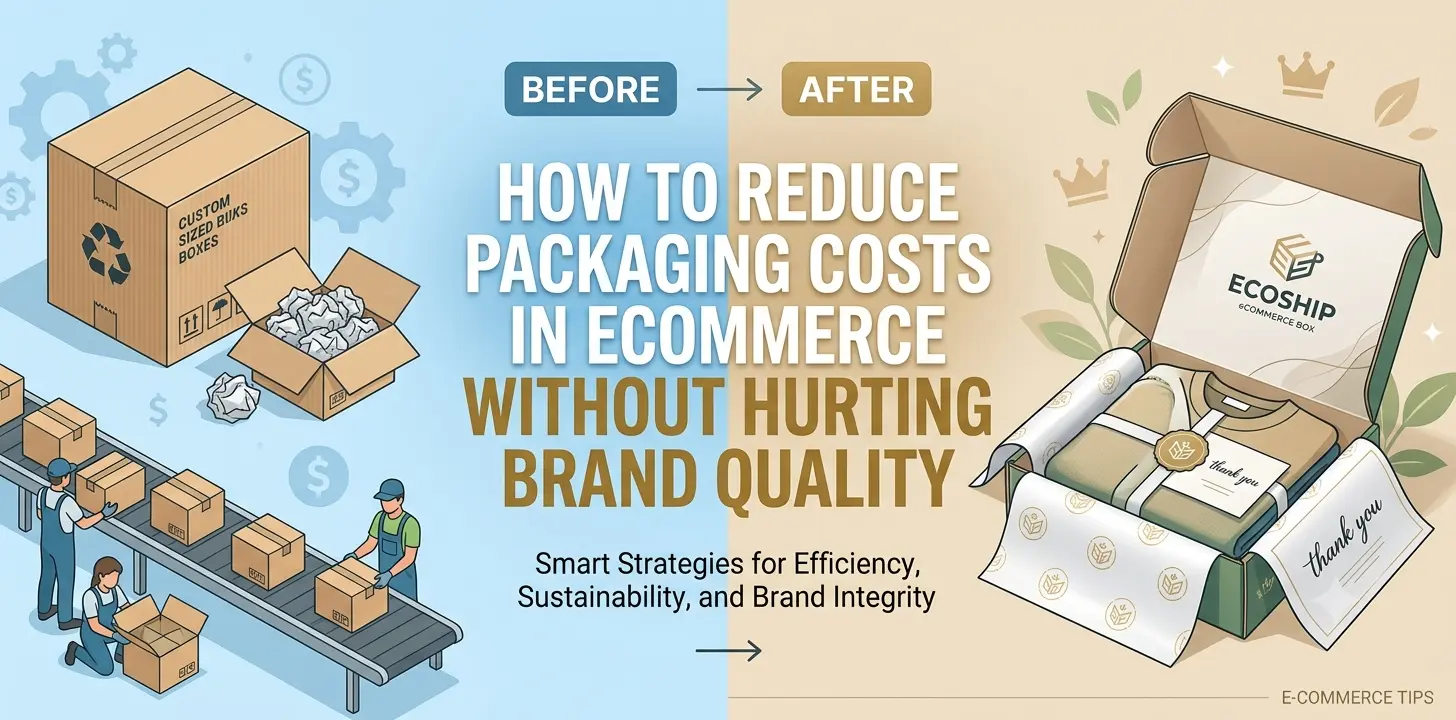
Want to reduce packaging costs in ecommerce without the box looking cheap? Shrink it first. Before you touch print or board or anything else, get the box down to the size of the thing inside, because right-sizing almost always saves more on shipping than any discount we could ever give you on the box itself, and then you can go after the smaller stuff (print nobody sees, board that’s heavier than it needs to be, too many sizes on the shelf).
The part you shouldn’t cut? What the customer sees and touches first. Below is how we tell the two apart, with some real numbers.
Where Your Packaging Money Actually Goes
Most people price packaging as the figure on the box quote. Half the story, maybe less. When we sit down with a brand and add it all up per order, it pretty much always lands in these buckets:
- The box itself, which comes down to size, board, how much ink and how many you buy.
- Inserts and fill, and honestly that’s just empty space you’re paying to plug.
- Shipping. Dimensional weight, mostly.
- Damage and returns, usually from stuff sliding around or board that’s too weak.
- Storage, where flat boxes beat assembled ones by a mile.
- Packing labor, so how long it takes someone to fold and fill one.
See it laid out like that and it’s kind of obvious why chasing the cheapest box price backfires, because you save a few cents on board, a mug cracks, you pay for the mug plus a second shipment plus a slightly annoyed customer, and the savings from months of orders are gone in a week.
Right-Size First: The DIM Weight Math
UPS and FedEx bill on whichever is bigger, actual weight or dimensional weight. You pay for air, basically.
How do they get the number? Length times width times height in inches, divided by a divisor (139 is common on retail accounts), then rounded up to the next pound. Say you sell a 1.5 pound skincare kit and drop it in a 14 x 10 x 6 inch stock box, that’s 840 over 139, roughly 6.04, and they bill you 7 pounds for it. Put the same kit in a 10 x 8 x 4 custom box? 320 over 139 is about 2.3. Three pounds billed. Same product, less than half the billable weight, and less void fill to buy on top. We go deeper into the carrier rules in how packaging dimensions affect shipping cost.
Use the Lightest Board That Survives the Trip
A lot of brands over-spec. We see double wall for a t-shirt all the time, and rigid board for something that hits the bin a minute after it’s opened.
Match board to risk. For soft goods and light items under a couple of pounds, an E-flute corrugated mailer is usually plenty (it’s thin, it prints nicely and it stacks small), B-flute is where we’d go for heavier or more fragile things, and double wall we really save for dense, heavy or pricey items going a long way. Not sure where the jumps are? Our comparison of single, double and triple wall corrugated boxes walks through it.
Kraft is the other easy win. Plain kraft corrugated boxes with a one-color logo look like you meant it, and you skip flooding every panel with ink.
Spend Print Budget Where the Customer Looks
People look at the lid. Then the inside of the lid. The bottom and the side panels get about half a second, if that, so we’d print that way, and to be fair a kraft mailer with one color outside and full color under the lid often feels more special than full coverage outside, plus the inside print never gets scuffed on a conveyor belt.
Finishes are the same story. Foil and embossing and soft-touch on every single product add up quickly, so keep them for a hero product or the holiday gift set and run the everyday line in simple print on standard custom mailer boxes. Nobody judges you by the underside.
Cut the Number of Box Sizes
Each extra size is its own setup and its own shelf. And its own small, pricey reorder.
So group your products. Could three box sizes, with a couple of different inserts, cover twelve products? Usually, yes, and since inserts are cheap to vary while boxes aren’t, that’s where we’d put the variety. Packing gets faster too, which matters if you pay someone by the hour, because nobody’s hunting for the right carton anymore and you stop seeing a little candle swimming in a box two sizes too big.
Buying in Bulk Without Drowning in Boxes
Price per box drops as quantity goes up, since the setup work gets spread over more units. Good argument for big orders.
The argument against? Cash sitting in cardboard, a garage full of flats, and the chance you change the design or the product size halfway through the pile. What we usually suggest is something like three to six months of your best-selling size in one run, with the slower sizes on shorter runs. Flat-shipping styles like mailers and custom ecommerce boxes make bulk a lot easier on storage than assembled rigid boxes do. Play with a few quantities in our packaging cost calculator and you’ll see where the unit price starts to flatten out.
Returns: The Hidden Packaging Cost
One broken item costs you the product, a second shipment, a return label and quite often the customer too. That’s where slightly-too-cheap packaging gets expensive.
Start with your damage claims. Is there a pattern, crushed corners, a pump top snapping off every tenth order? Then fix that one thing, a better insert or stronger board in that one box, not across the whole range. And if you get a lot of size or color returns, we’d put a second adhesive strip on the mailer so the customer can reseal it and send it back in the same box (no return packaging to buy at all).
Reducing Packaging Costs FAQs
What is the fastest way to reduce packaging costs?
Right-size your boxes. You cut dimensional weight charges and filler in one go, and honestly it tends to beat haggling over box price.
Do bulk packaging orders always save money?
Per box, yes, the price falls as you order more. Just don’t buy more than you’ll use before the design or product changes, since shelf space and tied-up cash cost you too.
Will cheaper packaging make my brand look worse?
Not if you cut in the right spots. Keep the outside simple and the lid and inside nice, that’s the bit people actually notice.
Want a second opinion on the boxes you use now? Send us your sizes and what you ship, and the Pioneer Packaging team will point out where you could trim and quote it for free, with free ground shipping anywhere in the USA. Ask for a packaging cost review.
Related reading: How Custom Boxes Decrease eCommerce Return Rates.
Related reading: Custom Pharmaceutical Packaging Boxes.