Stroll down a cereal aisle and look, really look, at the boxes for a minute. A single-serve oatmeal box sits beside a family-size corn flakes box about four times its size, a small-batch granola comes in a tall skinny box that looks nothing like the wide flat one next to it, and the store brand is a near twin of the name brand on the next shelf over. None of that’s an accident.
Launching a granola or cereal brand? We print custom cereal boxes and mini cereal boxes in pretty much any size you need.
Every one of those boxes is the result of a long argument, really, between the people who make the cereal and the engineers who design the box and the marketing team who want it bigger and the store that only has so much shelf, and the size you see is just where they all stopped arguing.
We print a lot of these for granola and cereal startups, so below we’ve laid out the standard cereal box dimensions for every common size, why they ended up that way, how the boxes get built and printed, and the numbers you’ll want handy when it’s time to order.
Why Cereal Box Dimensions Are Not Arbitrary
Before the numbers, here’s what’s pushing and pulling on the size of a cereal box. The measurements make a lot more sense once you know this.
Shelf fit and category management comes first. The cereal aisle shelves we’ve measured are usually 12 to 18 inches deep. Too deep a box and carts clip the corner sticking out, too tall and it just won’t go in. The shelf sets the limits before a designer draws a single line.
Serving size and shopper psychology often decide the height more than the actual amount of cereal does. Tall packages tend to look like they hold more than short ones of the same volume, people have studied this a lot, and it’s a big reason cereal boxes are tall and thin, and why heights crept up over the years even when the weight inside stayed the same or dropped a little.
Production line efficiency is the sneaky one. Filling lines get set up for a box size and then left alone, more or less, because changing over means new parts and a lost shift, so the big brands squeeze nearly every flavor into the same three or four boxes.
Shipping and logistics push on the width and depth. Boxes need to fit together neatly on pallet layers with as little wasted space as possible, and a size that doesn’t pack well on a standard 48 x 40 inch pallet costs a little extra on every load, which adds up fast across millions of boxes.
Material cost follows the surface area of the box. A tall box with a small footprint uses more paperboard than a shorter, wider box holding the same cereal, and the push toward right-sizing (to save board and look greener) is slowly changing the classic cereal box shape.
Standard Cereal Box Sizes
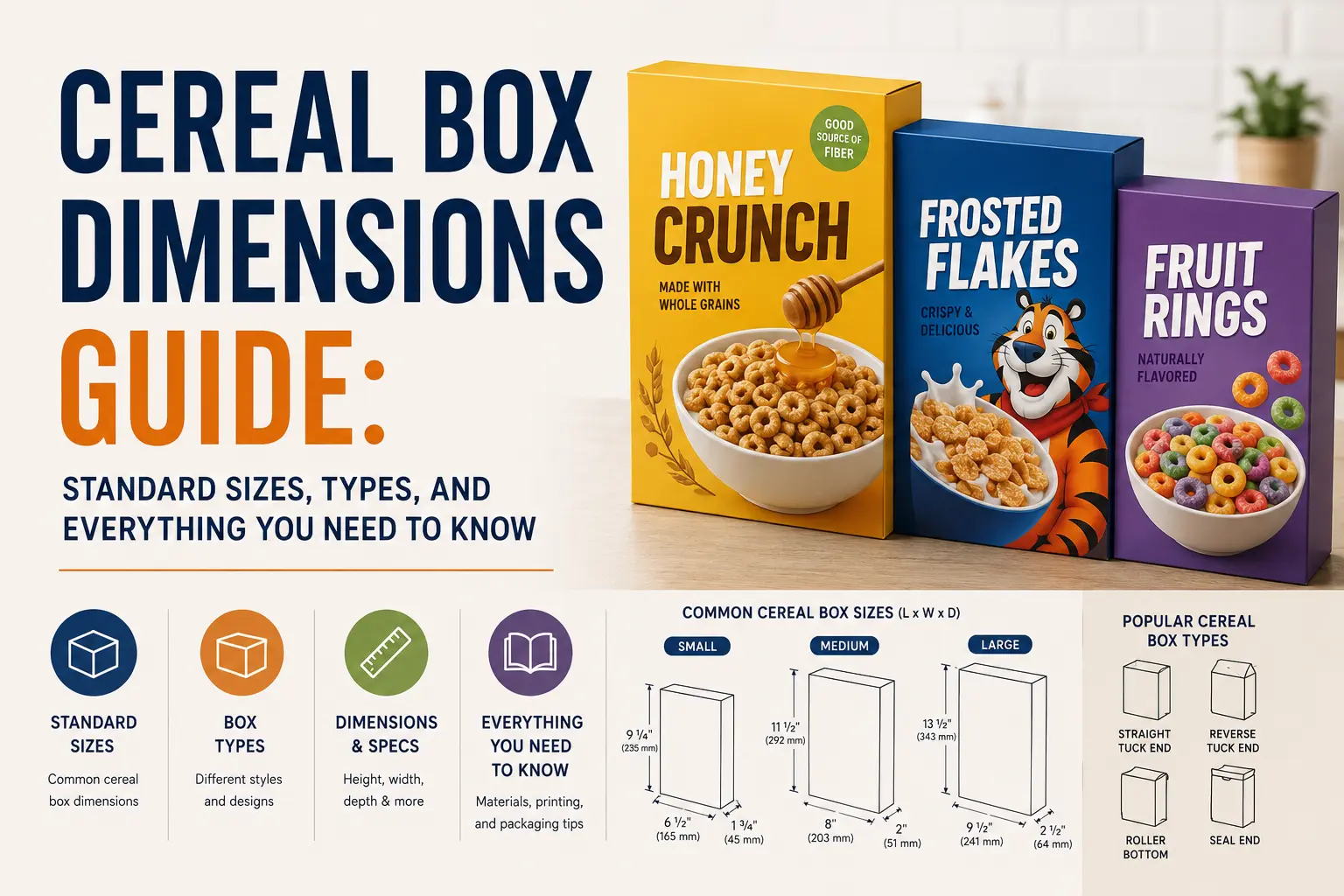
There’s no single official standard for cereal boxes, nothing like the ISO paper sizes. Over the years, though, the industry has settled on a set of common size ranges that cover most of what’s sold in big markets, and they’re below in inches and millimeters.
All sizes are width x depth x height. Width is the front panel, depth is front to back, and height is how tall it stands on the shelf.
One tip before the list, from the brands we’ve worked with: if you’re launching a new cereal or granola, don’t invent a size from scratch. Start from the closest standard box below, check your fill weight in it with a real bag of product (pour it, shake it down, see where it settles), and only then tweak an inch here or there. Stores like familiar sizes, and you’ll have a much easier time getting your box onto a shelf that was set up for the regular one.
Single Serve Box
Typical dimensions: 2.5 x 1.5 x 4.5 inches (63.5 x 38.1 x 114.3 mm)
The baby of the family, an ounce or so of cereal. You’ve met it at a hotel buffet or on a plane, and probably in the variety pack your parents bought for a camping trip.
These little ones are fiddly to get right. The board has to be stiff enough to survive a lunchbox, and all the required info has to squeeze onto a panel about the size of a playing card, so brands mostly shrink their big-box artwork and we end up nudging the font sizes on the proof until it’s readable again.
They’re also the building blocks of variety packs, where several different cereals sit together in one outer box, and the little boxes get sized so the outer pack comes out in a sensible shape.
Small or Individual Size Box
Typical dimensions: 5.5 x 2.25 x 7.75 inches (139.7 x 57.15 x 196.85 mm)
Eight to 12 ounces or so, bought by people living on their own and by people trying a brand for the first time, plus anyone who can’t stand stale cereal. It’s also where a lot of the pricey small-batch cereals live, since at $9 a box nobody’s stocking up.
Lots of granola lands here too, since most folks sprinkle it on yogurt a few times a week rather than eating a full bowl every morning, and a smaller box means the last handful isn’t stale by the time they reach it.
Regular or Medium Size Box
Typical dimensions: 7.75 x 2.4 x 11 inches (196.85 x 60.96 x 279.4 mm)
The workhorse. Picture “a box of cereal” and this is what shows up, 12 to 18 ounces, about a week of breakfasts for a couple.
Grocery planners lay out the whole aisle with this box in mind, and brands designing a full range almost always draw this one first and then stretch or shrink it for the others. That 7.75 by 11 inch front panel is pretty much the standard canvas for cereal designers, big enough for the logo and the bowl shot and a health claim, with a little room left for a promo sticker.
Large Size Box
Typical dimensions: 8.7 x 2.75 x 12 inches (220.98 x 69.85 x 304.8 mm)
Roughly 18 to 24 ounces, the family-of-four box, and a popular one because the price per bowl is decent without the box getting so heavy a seven-year-old can’t pour from it. Designers get a bit more panel to play with, which usually ends up as a recipe or a contest on the back.
Twelve inches tall is getting up there. Most cereal shelf gaps are 12 to 15 inches, so it fits, just.
Family Size Box
Typical dimensions: 9.75 x 3 x 13.25 inches (247.65 x 76.2 x 336.55 mm)
Got teenagers? This is your box, somewhere between 24 and 32 ounces, and since it’s usually the cheapest per serving it’s the one plastered with “2 for $7” tags most weeks.
It’s noticeably taller and wider than the regular box, so it owns more of the shelf and you can spot it from further down the aisle. That’s on purpose. Brands that take up more shelf space tend to get noticed more.
At 13 to 13.5 inches tall it’s at or near the top limit for standard cereal shelving, and some stores actually set their cereal shelves taller just to fit the big brands’ family boxes.
The depth goes up too, usually to about 3 inches compared with 2.4 to 2.75 on the smaller sizes, so the box sits further back. Shelves 15 to 18 inches deep handle that fine.
Club or Warehouse Size Box
Typical dimensions: 11.5 x 3.5 x 14.5 inches (292.1 x 88.9 x 368.3 mm)
The giant. Anywhere from 36 to 48 ounces, sometimes more, and it’s mostly a Costco, Sam’s Club or BJ’s thing, often shrink-wrapped two at a time so you leave with a small mountain of cereal.
Clubs sell straight off pallets and big racking, so nobody has to worry about a supermarket shelf, and the box can get as big as the brand likes. That front panel is huge, about 11.5 by 14.5 inches, and it’s where you’ll find the recipes and the loyalty program stuff.
Full, one of these can weigh 3 or 4 pounds. The board has to be up to that, because the box gets tossed into a flatbed cart and then a car trunk and then dragged out by one corner.
Cereal Box Dimensions by Product Type
Here’s the thing nobody tells you when you start a cereal brand: the box size depends less on how many ounces you’re selling and more on how fluffy your cereal is.
Flaked Cereals
Corn flakes and bran flakes are mostly air with a bit of corn holding it together, so a 12 ounce bag of flakes fills a box that’d hold a lot more of something heavier, and brands quite like that because a big box for the money reads as a good deal from the aisle. They tend to run the box right up to full shelf height.
Puffed and Extruded Cereals
Puffs are even airier. We’ve seen a 10 ounce box of puffed corn stand nearly as tall as a 20 ounce box of granola, which looks odd side by side but makes total sense once you pour them.
Granola and Muesli
Granola goes the other way, it’s heavy and packs down, so a pound doesn’t need much room. That’s why so many craft granola brands end up in a short, chunky box, and to be fair it also helps them look different from the tall mainstream stuff, which we think is half the point.
Oatmeal and Hot Cereal
Oats are dense too. You know the round Quaker tube, and when oats do go in a rectangular box it’s usually squatter than a cold cereal box holding the same weight.
Children’s Cereals
Kids’ cereals mostly stick with regular or large sizes and let the cartoon on the front do the work, although a few go a touch wider to grab more shelf and leave room for a maze on the back.
Cereal Box Construction
Quick tour of how a cereal box is actually put together, since it explains a lot of the sizing.
Folding Carton Construction
It’s a folding carton, nearly always, which means a flat printed sheet of paperboard that gets die-cut, creased, folded and glued, usually as a straight tuck or reverse tuck end with flaps closing the top and bottom. They arrive at the cereal plant flat in bundles (thousands fit on one pallet), get popped open on the line, the bag of cereal drops in, and the top gets closed.
Ever wonder why you can close the top again but the bottom never opens? The bottom flaps are glued at the factory so the weight can’t push them out, and the top just tucks, so you can shut it after every bowl.
Board Weight and Specification
SBS, mostly. That stands for solid bleached sulfate, the bright white board that makes a bowl of strawberries on the front look good enough to eat, and the inside is fine for food packaging. Thickness? Somewhere around 16 to 24 point, which is 0.016 to 0.024 of an inch, and we’ll be honest, every brand we’ve worked with wanted the thinnest board that wouldn’t feel cheap when you squeeze it.
Inner Bag or Liner
The bag is doing the real freshness work. It’s usually polyethylene film or a laminate, and it keeps damp air off the cereal so it stays crunchy, while the box is basically a printed billboard with some structure to it.
Getting the bag size right is fussier than you’d think. A bag that’s too roomy creases up, pokes into the top flap and leaves air pockets, and one that’s too snug gets yanked tight on the filler and splits, which makes a mess on the line nobody enjoys cleaning up.
Cereal Box Printing and Design
The front of a cereal box might be the most fought-over few square inches in a grocery store, and the big brands spend serious money testing every version of it.
Printing Process
The giants print offset, millions of boxes at a time, and on top of the usual four process colors they’ll add a Pantone or two so their famous red never drifts toward orange from one batch to the next, because shoppers really do notice when a row of boxes doesn’t match. Newer brands doing a few thousand boxes often start on digital printing instead, which honestly looks great now and skips the plate costs.
Surface Finishes
Most of them get a gloss varnish on top so the colors pop and the corners don’t scuff in the shipping case. The fancier granola people often go matte instead, and if you want one trick we like, put spot UV on just the bowl of cereal so the milk looks wet under the store lights.
Panel Layout
Logo, name, the big bowl photo and maybe a “good source of fiber” badge go on the front. Mazes and recipes go on the back, if you remember those from breakfast as a kid. The sides get stuck with all the legal bits, Nutrition Facts and ingredients and allergens and the barcode.
Nutritional and Regulatory Information
One thing that catches startups out: US Nutrition Facts labels have minimum type sizes under FDA rules. That quietly puts a floor on how narrow the side panel can be, and on really small boxes it’s sometimes the thing that stops a brand from shrinking the box any further.
How Cereal Box Dimensions Affect Shipping and Logistics
Box size quietly drives freight costs for cereal makers, a lot more than most people outside the industry realize. If you want the bigger picture, our guide on how packaging dimensions affect shipping cost goes into it.
Pallet Configuration
Standard US pallets are 48 x 40 inches. Cereal boxes have to be arranged on them as efficiently as possible while still stacking stably, and regular boxes at about 7.75 x 2.4 inches can be laid out in patterns that fill that footprint well.
Depth is the number planners obsess over here, since a box that’s 2.5 inches deep goes into 40 sixteen times flat and one that’s 2.7 leaves an awkward gap you pay to ship empty.
Case Pack Configuration
Individual boxes get packed into corrugated shipping cases for pallet shipping. The case pack, meaning how many boxes go in each case, is planned so the case itself fits well on pallet layers. Twelve regular boxes in a 3 x 4 layout make a case of about 23 x 10 x 12 inches, which fits a standard pallet reasonably well.
Fill Rate and Dimensional Weight
Cereal boxes are famously mostly air, because most cereal is so light for its volume. For shipping that means the dimensional weight of a cereal case nearly always beats its real weight, and carriers charge on dimensional weight. That’s one of the big reasons cereal makers want to right-size their boxes, shrinking the box while keeping the same amount of cereal or more.
E-commerce Shipping Considerations
Now that more cereal sells online, the size of each box matters more. A regular cereal box shipped alone in a mailer makes a big, light parcel that carriers bill at a high dimensional weight. Some brands have come up with more compact boxes just for ecommerce that hold the same amount of cereal in less space, which makes direct-to-consumer shipping a lot cheaper. If you’re picking an outer mailer for that, our mailer box dimensions guide is a good starting point.
Cereal Box Dimensions Across Major Brands
Exact sizes are each brand’s own business and they get tweaked now and then, but the general size habits of the big brands are still useful for reference.
Kellogg’s, one of the biggest cereal makers in the world, uses a consistent set of sizes across its range that roughly lines up with the regular, large and family sizes in this guide. Corn Flakes, Frosted Flakes and Special K all use boxes that fit standard shelving while showing as much front panel as they can.
General Mills uses similar sizes across Cheerios, Lucky Charms, Cinnamon Toast Crunch and the rest. Like several big brands, it has talked publicly about right-sizing, and one common approach in the industry is making the box shallower to save board while keeping the front panel the same size, so the shelf presence doesn’t change.
Post follows similar conventions for Honey Bunches of Oats, Grape-Nuts and Raisin Bran, and has tried resealable tops on some products, which changes the top of the box without really changing its overall size.
And have you noticed the store brand at Kroger or Walmart or Aldi is nearly the same size as the famous one next to it? On purpose, of course, so it slots into the same shelf space and you can’t help comparing the price.
Cereal Box Sustainability and Right-Sizing
Cereal has been at the center of packaging sustainability arguments for decades, mostly because cereal boxes have a reputation for “selling air,” with boxes that look bigger than what’s inside.
Right-sizing is the fix, shrinking the box to fit the cereal better without making it flimsy or invisible on the shelf, and a few big names have done it publicly while keeping the same ounces inside.
That saves paperboard in proportion to the smaller surface area, packs more onto each pallet, uses less energy in making and moving the boxes, and often makes shoppers feel less like they’ve been tricked by a giant box.
Recycled content in cereal board is now pretty standard for big brands rather than a premium extra, and board with a good share of recycled fiber is widely available across the category. Many big retailers also ask for responsibly sourced board, which has pushed more brands toward documented sourcing.
The inner bag is still the hardest part to make sustainable. Most polyethylene bags can’t go in the curbside bin, though many stores take them at plastic film drop-off points, and some brands have tried paper-based inner bags that recycle more easily but need careful engineering to keep moisture out.
Cereal Box Size and Consumer Perception
This bit’s fun.
Put two boxes holding exactly the same amount side by side, one tall and one short, and most people will tell you the tall one has more in it. It’s a well-known visual effect, linked to things like the Delboeuf illusion, and it’s why cereal makers have always preferred tall, narrow boxes over short, wide ones even when the volume is identical.
Front panel width affects how often people pick a box up when they see it from normal shopping distance. Wider boxes take up more of the shelf and are more likely to catch someone’s eye as they walk down the aisle, which is why family boxes, taller and wider, get so much attention.
Size reads as value too. Most of us don’t check the little price-per-ounce label (be honest), so a family box that’s a dollar more than the regular one feels like a bargain even when the math comes out about even.
And making the box smaller without lowering the price, which people call shrinkflation, is well known in cereal. Shoppers react badly when they notice it, though lots of people don’t notice small size changes made gradually over time.
FAQs
What are the standard dimensions of a cereal box?
Most people asking this mean the regular box from a normal grocery run, and that one’s about 7.75 by 2.4 by 11 inches. The other sizes are in the table further down so we won’t repeat them all here.
How tall is a standard cereal box?
Grab a ruler and a regular box and you’ll get about 11. Family boxes go a little past 13, which is roughly as tall as most shelves allow.
How wide is a cereal box?
A bit under 8 inches across the front on a regular box. Family boxes are closer to 10.
How deep is a cereal box?
Thinner than you’d guess. A regular box is only about 2.4 inches front to back, family boxes are around 3, and even the giant warehouse club ones only reach about 3.5, which is why they tip over so easily on a half-empty shelf.
What size paper is a cereal box made from?
Cut one open and flatten it on a table and you’ve got roughly 200 to 250 square inches of board for a regular box, a bit more or less depending on how wide the glue flap is.
Can cereal boxes be recycled?
The box can go straight in your curbside bin. That plastic bag inside is another story, since most curbside programs won’t take it, but plenty of grocery stores have a film drop-off bin near the entrance where it can go instead.
Why are cereal boxes so large compared to the amount of cereal inside?
Three reasons, really. Flakes and puffs are bulky for their weight, the bag has to leave some headroom to seal and the cereal settles on the truck, and then (let’s be honest) a taller box just looks like more cereal, which the brands have known for decades.
What is the surface area of a standard cereal box?
For a regular box it works out around 267 square inches (about 1,722 square centimeters) once you add up all six faces, and the front and back are most of that.
What is the volume of a standard cereal box?
Roughly 205 cubic inches, so a bit over 3.3 liters, for a regular box. Not all of that’s cereal, mind you, since the bag never goes right to the top.
Quick Reference: Standard Cereal Box Dimensions
Here’s everything above in one table. Ordering your own? Browse our cereal packaging boxes, and our team will set up the dieline for your exact size at no extra cost.
| Size Format | Typical Width | Typical Depth | Typical Height | Typical Net Weight |
|---|---|---|---|---|
| Single serve | 2.5 in (63.5 mm) | 1.5 in (38.1 mm) | 4.5 in (114.3 mm) | 1 to 1.5 oz |
| Small / individual | 5.5 in (139.7 mm) | 2.25 in (57.15 mm) | 7.75 in (196.85 mm) | 8 to 12 oz |
| Regular / medium | 7.75 in (196.85 mm) | 2.4 in (60.96 mm) | 11 in (279.4 mm) | 12 to 18 oz |
| Large | 8.7 in (220.98 mm) | 2.75 in (69.85 mm) | 12 in (304.8 mm) | 18 to 24 oz |
| Family size | 9.75 in (247.65 mm) | 3 in (76.2 mm) | 13.25 in (336.55 mm) | 24 to 32 oz |
| Club / warehouse | 11.5 in (292.1 mm) | 3.5 in (88.9 mm) | 14.5 in (368.3 mm) | 36 oz and above |
Where to Go Next
Popular options for this topic include custom mailer boxes and product packaging boxes. Related guides: beer box dimensions: 6, 12 & 24 pack sizes explained and jewelry box dimensions: standard sizes for every piece type.
Want a price? Tell us your size and quantity on our quote page and we will send a free quote and proof.