

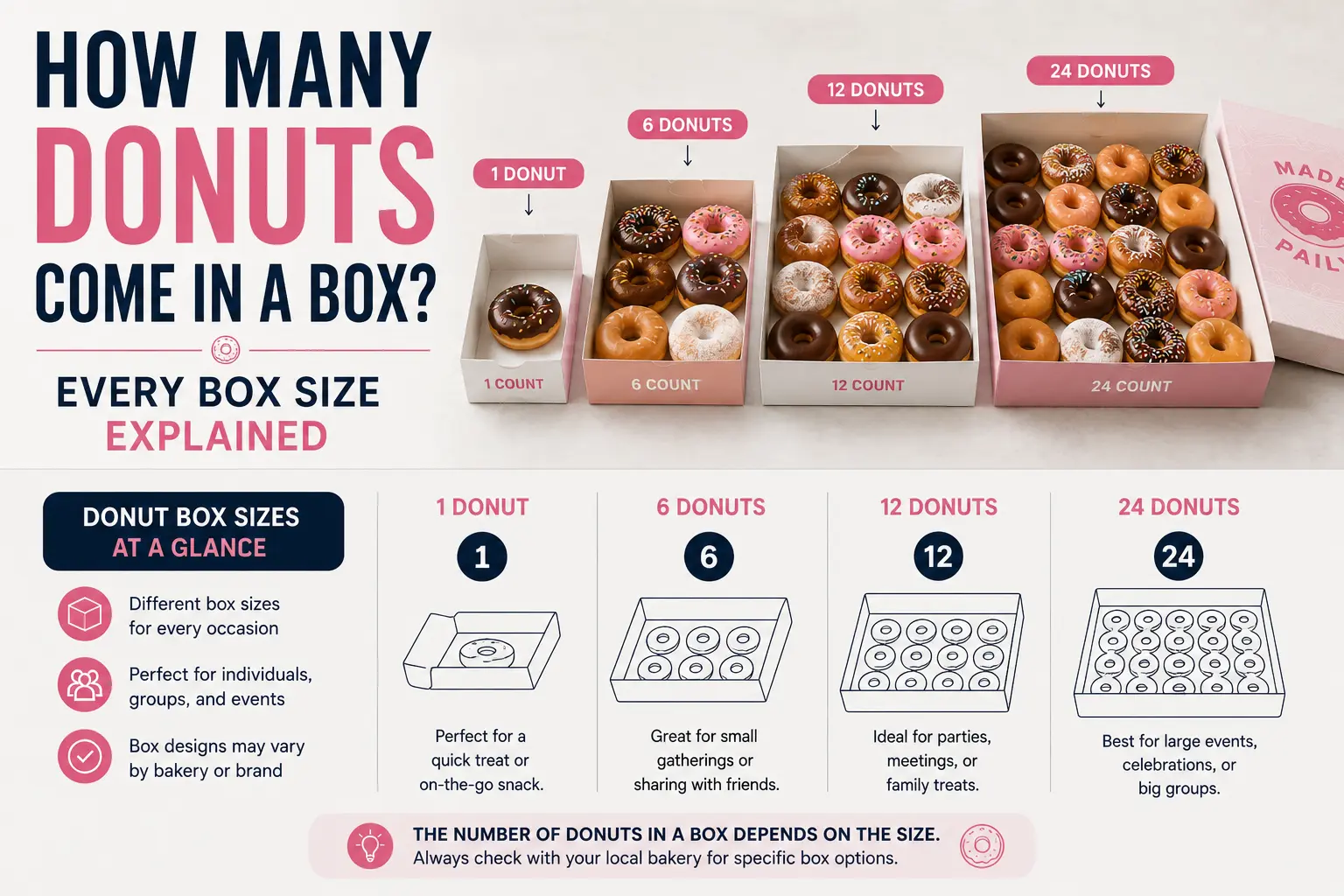
Most donut boxes hold 6, 12, or 24 donuts, but the right quantity depends on the donut size, box dimensions, arrangement, and how much space you need between each donut.
For bakeries, cafes, donut shops, and food brands, choosing the right box is more than picking a number. The box should protect the donuts, keep them looking fresh, and give your brand enough space for a professional presentation.
This guide explains common donut box quantities, typical box sizes, how to arrange donuts, and how to choose custom donut boxes for your bakery.
How Many Donuts Usually Come in a Box?
There is no single standard donut box size. Bakeries use different box sizes based on their products and customers.
Common quantities include:
| Donut Quantity | Common Use |
|---|---|
| 1–2 donuts | Individual orders or small treats |
| 4 donuts | Small gift or snack box |
| 6 donuts | Half-dozen orders |
| 12 donuts | Standard dozen box |
| 18 donuts | Large orders |
| 24 donuts | Party or catering orders |
| 48+ donuts | Large catering orders |
The 6- and 12-donut boxes are especially common because they work well for everyday bakery orders.
However, a dozen box for standard ring donuts may need different dimensions from a box designed for large filled donuts, specialty donuts, or donuts with toppings.
How Many Donuts Are in a Dozen?
A dozen contains 12 donuts.
A bakery may arrange 12 donuts in several ways depending on the box design. A common arrangement is:
- 3 rows of 4
- 4 rows of 3
- 2 rows of 6
The best arrangement depends on the donut diameter and the internal dimensions of the box.
For custom packaging, it is better to measure the actual donut and design the box around those measurements rather than assume that every dozen donuts needs the same box.
Standard Donut Boxes Dimensions
Understanding donut box dimensions is useful for bakeries choosing packaging, for customers who need to know if boxes will fit in a car or refrigerator, and for anyone planning to transport donuts to an event.
Donut box dimensions vary by the number of donuts the box holds and the size of the donuts themselves. Standard ring donuts for most major chains are approximately 3 to 3.5 inches in diameter. Mini donuts are typically 1.5 to 2 inches in diameter.
Here are the typical external dimensions for standard donut boxes:
Single donut box: Typical dimensions: approximately 4 x 4 x 2.5 inches. Small square or rectangular box just large enough for one standard donut.
Half dozen box (6 donuts): Typical dimensions: approximately 10 x 7 x 2.5 inches or 9 x 6 x 2.5 inches depending on the brand and how donuts are arranged inside.
Dozen box (12 donuts): Typical dimensions: approximately 14.375 x 10.875 x 2.25 inches for a standard industry box. This is the most widely produced donut box size and most donut box manufacturers produce a box close to these dimensions. Some brands use slightly different measurements such as 16 x 12 x 2.25 inches for a slightly roomier dozen box.
Two-dozen box (24 donuts): Typical dimensions: approximately 19 x 14 x 2.5 inches or larger. Two-dozen boxes are significantly wider and longer than dozen boxes to accommodate the additional donuts in a single layer.
5-dozen catering box (60 donuts): Typical dimensions: approximately 16 x 12 x 2.5 inches per tray, with multiple trays stacked or arranged for large catering orders.
The height of most donut boxes is 2 to 2.5 inches because this is the right amount of clearance for a standard frosted or glazed donut without pressing on the toppings. Filled donuts and donuts with tall decorations may need slightly taller boxes to prevent the toppings from being smashed against the lid.
What Size Is a Donut Box?
There is no universal donut box size because donuts come in different diameters and heights.
A typical standard donut may be around 3 to 4 inches across, but specialty donuts can be larger.
Your box size should consider:
- Donut diameter
- Donut height
- Number of donuts
- Toppings
- Frosting
- Fillings
- Arrangement
- Required clearance
- Box material
- Shipping or handling requirements
For example, a box for six plain ring donuts may be much shallower than a box for six tall specialty donuts with thick toppings.
How to Measure Donuts for Custom Boxes
Before ordering custom donut packaging, measure the actual product.
Measure:
Diameter
Measure across the widest part of the donut.
Height
Measure from the bottom to the highest point of the donut.
Toppings
Check whether frosting, sprinkles, chocolate, fruit, or other toppings add extra height.
Product arrangement
Place the donuts in the arrangement you want inside the finished box and measure the total footprint.
These measurements help your packaging supplier create a box that fits the product properly.
Why Donut Box Dimensions Matter
A box that is too small can damage the donuts.
A box that is too large can allow the donuts to move around during transportation.
The goal is to create enough space for safe placement without wasting unnecessary packaging space.
Proper dimensions can help:
- Protect frosting
- Reduce product movement
- Improve presentation
- Make stacking easier
- Reduce wasted space
- Support efficient shipping
- Create a better customer experience
For bakeries selling premium donuts, packaging dimensions can be especially important because customers often judge the product before opening the box.
Donut Box Materials and Construction
Most donut boxes are made from SBS paperboard, which is a solid bleached sulphate board that provides a clean white surface for printing, adequate rigidity to protect the donuts, and food contact safety. The board is typically 18 to 24 point in thickness for donut boxes, which gives it enough stiffness to support the weight of a full dozen donuts without sagging. Custom bakery packaging boxes are made from food-grade SBS paperboard with grease-resistant treatment, designed to keep your donuts fresh and presentable from shop to customer.
Donut boxes typically use a simple one-piece lock corner construction where the four walls of the box are folded up and locked together at the corners. This style is quick to assemble and sturdy enough for bakery use. The lid is usually a separate piece of the same material that sits on top of the base tray, or in some designs the box is a single piece that folds into a tray and lid together.
The inside of a donut box is typically uncoated white board. The outside is often printed with a simple brand design, the shop’s logo, or left plain white for independent bakeries that stamp or label their boxes individually.
Many donut boxes include a wax coating or grease-resistant treatment on the inside to prevent oil and glaze from soaking through the board. This is particularly important for glazed donuts and jelly-filled donuts that can release moisture over time.
Donut Boxes Styles
The donut box has become an important brand communication surface, especially as premium and artisan donut shops have grown in popularity. Here are some trends worth knowing about.
Window boxes are donut boxes with a clear plastic or cellophane window cut into the lid so customers can see the donuts inside without opening the box. These are popular in bakeries where the visual appeal of the donuts is a selling point. Window packaging boxes are a popular choice for premium donut shops, letting customers see the donuts inside without opening the box, and are particularly effective for decorated or colourful donuts where the presentation matters.
Custom printed boxes are widely used by chain donut shops and increasingly by independent bakeries. Full colour printing on the box exterior with brand logos, seasonal designs, and promotional messaging creates a more professional and memorable presentation. Custom boxes also work as marketing when customers carry them out of the shop or take photos of them for social media. Brands looking to stand out can explore custom food and beverage packaging options that combine high-quality printing with food-safe materials.
Eco-friendly donut boxes using recycled content board, compostable materials, and water-based inks are growing in popularity, driven by consumer preference and sustainability commitments from larger chains. For bakeries committed to sustainability, eco-friendly boxes made from recycled content board are a practical and increasingly popular choice.
Stackable designs allow multiple donut boxes to be stacked securely without the top box sliding off or crushing the donuts in the box below. This is important for customers carrying multiple dozen boxes or for delivery drivers transporting large orders. For high-volume donut display and retail settings, display packaging options can help bakeries present their products in a clean, professional, and brand-consistent way.
How to Choose the Right Donut Box
Before ordering, answer these questions:
How many donuts will the box hold?
Choose the quantity you sell most often.
What is the average donut size?
Measure your actual products instead of relying on a standard size.
Do your donuts have tall toppings?
If yes, allow enough vertical clearance.
Will the box be delivered?
Delivery requires more attention to strength and product movement.
Do you need a window?
A window can help customers see the product in retail or bakery settings.
Do you need custom printing?
Consider your logo, colors, product information, and other brand elements.
Will you sell gift boxes?
Premium structures and finishes may make sense for special collections.
Frequently Asked Questions
How many donuts come in a box?
Common quantities include 6, 12, and 24 donuts, although bakeries can use boxes for smaller or larger quantities.
How many donuts are in a dozen?
A dozen contains 12 donuts.
What size box do I need for 12 donuts?
The required size depends on the donut diameter, height, toppings, and arrangement. Measure the actual donuts and choose dimensions that provide enough clearance without excessive empty space.
What is the best material for donut boxes?
Paperboard works well for many bakery boxes. Kraft can provide a natural appearance, while corrugated board can provide additional strength for larger orders and delivery.
Can I get custom donut boxes with my logo?
Yes. Custom donut boxes can be printed with your logo, colors, artwork, product information, and other brand details.
Can donut boxes have windows?
Yes. A clear window can be added to suitable box structures so customers can see the donuts without opening the package.
Can I order boxes for 6 or 12 donuts?
Yes. Custom packaging can be designed for six, twelve, twenty-four, or other quantities based on your product and sales needs.
How do I choose the right donut box size?
Measure the donut diameter and height, then consider the number of donuts, toppings, arrangement, and delivery method. Your packaging supplier can use these measurements to develop the final box dimensions.
Are custom donut boxes suitable for delivery?
Yes. The box structure and material can be selected based on your delivery method. Larger orders may require stronger board or additional outer shipping protection.
How much do custom donut boxes cost?
The price depends on the box dimensions, material, quantity, printing, structure, finishes, windows, and shipping requirements.
Final Thoughts
The right donut box should do more than hold donuts. It should fit the product, protect toppings and decorations, support safe handling, and present your bakery professionally.
For most bakeries, 6-, 12-, and 24-count boxes are useful starting points. But the best packaging depends on your actual donut dimensions and how customers receive the product.
If you need packaging made specifically for your bakery, The Pioneer Packaging can create custom donut boxes with your preferred size, structure, printing, window, and finish.
Request a custom quote and create donut packaging designed around your products and brand.