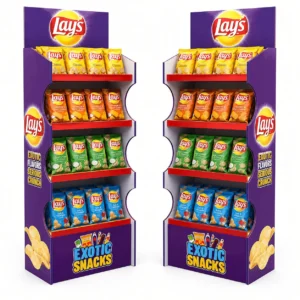
Picture a gas station counter. Twenty little things fighting for a glance while someone pays. Custom cardstock dispenser boxes are the ones that win that spot because they hold the stock and sell it at the same time. Pop the front and the carton is now a neat little tray people grab from.
Cardstock is just paperboard, really, lighter than corrugated and nicer to print on, so we’d use it when the stuff inside is small and doesn’t weigh much, think gum packs and lip balms and tea sachets, hand warmers in winter, a single candy bar, sample packets, that sort of thing. Heavy stuff? Different story.
How Custom Cardstock Dispenser Boxes Work
Nearly all of them leave us as a closed carton, so they ship and sit in a stockroom like any other box and the product stays clean. Then the clerk rips along the perforation (or pops the tuck front), the top folds back and becomes a header card with your logo on it, and the front lip sits low enough for a hand. Done.
Bottom feed is the other option. There’s a slot at the base, someone takes one, the next drops down, and it’s great for sachets and flat packs. Tea bags and wipes behave nicely this way. Round or loose items don’t, so for those we stick with the open tray.
Perforation strength is worth a word. Too weak, and the box tears open in transit. Too strong, and the clerk ends up ripping the front panel off in ragged pieces. We’ve tuned these over plenty of runs, and we can send a sample if you want to test the tear yourself.
Why Cardstock Instead of Corrugated
For small, light products, cardstock prints sharper and costs less. SBS paperboard has a bright white surface, so photos and fine type look clean. Kraft cardstock gives a natural brown look. If your units are heavier, like jars or bottles, or the display will travel in bulk without an outer carton, corrugated is the safer call. Our cardboard dispenser boxes cover that end. There’s also a quick comparison in cardstock vs corrugated if you’re on the fence.
Counter Dispenser Box Printing and Finishes
Because these sit at arm’s length from the customer, finishes are actually noticed. Gloss makes the colors pop and wipes clean when the counter gets sprayed down, matte or soft-touch is quieter and feels pricier, and for the logo we can do spot UV, foil or an emboss (we’d pick one, not stack them all). Print the inside of the tray too, since that panel shows once the product starts selling down.
Our team sets up the dieline for free, lays out your artwork and checks your files for print problems. You’ll approve a digital proof before anything runs, and a physical sample is available on request.
How Big, and How to Order
Just send one unit’s measurements and a count per box. Most folks land on 12, 24 or 36, and we’ll work out the tray depth and header height from there. Minimums are low, often around 50 boxes depending on the style, and the price per box drops as quantity rises. Standard production takes 10 to 12 business days after proof approval, rush is available on request, and ground shipping is free anywhere in the USA.
Browse other formats in our dispenser packaging range, or check countertop display boxes if you’d rather go open-top from day one.
Custom Cardstock Dispenser Boxes FAQs
How many items should a dispenser box hold?
Twelve to thirty-six units is typical for counter space. More than that and the box gets too wide for most checkout counters.
Can the box ship closed and open at the store?
Yes. Most of our cardstock dispensers ship as closed cartons and open along a perforated front into a display tray.
Is cardstock strong enough for heavy items?
Not really. For jars, bottles or anything over a few ounces each, we’d point you to a corrugated dispenser instead.
You May Also Need
Building a full product line? Take a look at custom cardboard dispenser boxes and custom CBD dispenser boxes. Everything in this range is listed under dispenser packaging.