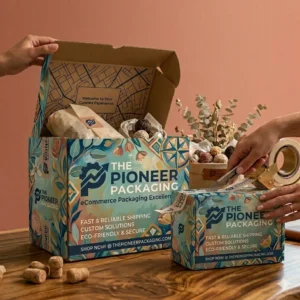
Fold, tuck, done. Cardboard mailer boxes are the roll end, tuck front style you’ve probably opened a hundred times from online orders. Lid hinged at the back, little dust flaps at the sides, and then the front tucks down into the base and holds without any glue at all (most shippers still slap a strip of tape on it anyway, and to be fair we would too).
Who buys them? Small online shops mostly, plus subscription kits, T-shirt brands, a few booksellers and quite a lot of cosmetics people sending stuff straight to a customer’s door. People switch to them because the box takes a beating like a shipping carton and then, when it’s opened on the kitchen table, it kind of feels like a gift.
Cardboard Mailer Boxes and Flute Choice
Our default is E-flute. It’s thin (about 1/16 inch) but stiff enough for a paperback or a skincare set and it takes print well, and when the stuff inside gets heavier or the courier route is rough we’d bump you up to B-flute, which is closer to 1/8 inch. Ceramic plates? Ask us about double wall. Subscription boxes carrying a mix of glass jars and paper goods usually do best in B-flute.
A rule of thumb from the packing table: if you can dent the packed box with your thumb, go up a flute size. Our mailer box dimensions guide covers common sizes for each flute.
Sizing to Cut Postage and Void Fill
Carriers bill on dimensional weight. Every spare inch, every parcel. A mailer cut close to the product needs less crinkle paper too, and our usual advice is to measure the thing, give it roughly a quarter inch each side so it slides in without a fight, then go a bit bigger if you wrap in tissue or plan an insert.
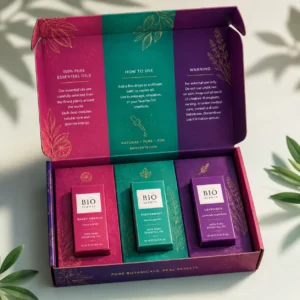
Inserts help a lot with multi item kits. A die-cut card insert holds three jars of candles or skincare apart so they don’t clink together. Without one, everything slides to one end the first time the box gets tipped on a conveyor.
If you sell several products, it’s tempting to order one mailer size for everything. That works for a while. But a small item in a big box needs a pile of filler, and you pay postage on the empty space every time. Two or three sizes cover most catalogs nicely, and our guide on cutting ecommerce packaging costs shows where else the savings hide.
Printing Mailers Inside and Out
Kraft mailers with one color printing look clean and keep costs down. White mailers take full color printing better, and inside printing (a pattern or a thank you message under the lid) is a lovely surprise when someone opens it. It costs a little more than outside only printing, but for subscription brands it’s often the part customers photograph. Matte lamination looks smart, but gloss resists scuffs in transit a little better.
See our kraft corrugated boxes for a plain brown option, or our custom mailer boxes for more color and finish choices. The whole corrugated shipping boxes range is there too. We set up the dieline and your artwork free, then send a digital proof.
Cardboard Mailer Box FAQs
Do cardboard mailer boxes need tape?
The tuck front locks on its own, but most sellers add tape or a sticker seal so the box can’t pop open in a mail sack.
Are these mailers recyclable?
Usually, yes, plain corrugated goes in the recycling bin and our inks are soy-based or water-based. A thick laminate on top can be a problem for some local programs though, so we’d skip it if that matters to you.
How many do I have to order, and how long does it take?
Not many, often around 50 boxes depending on the style. After you approve the proof it’s 10 to 12 business days, and if you’re in a hurry just request rush timing when you get in touch.
More From This Range
Similar options include mailer cartons, mailer shipping boxes, tuck top mailer boxes and bux board boxes. Browse all of them in corrugated shipping boxes. For measurements, see mailer box dimensions.