
A box isn’t just there to keep a product from getting dinged in a truck. On a store shelf it’s also the thing that gets noticed (or doesn’t), and it decides how long some poor stock clerk spends unloading it.
So more brands are asking us about display-ready boxes, tear away ones mostly.
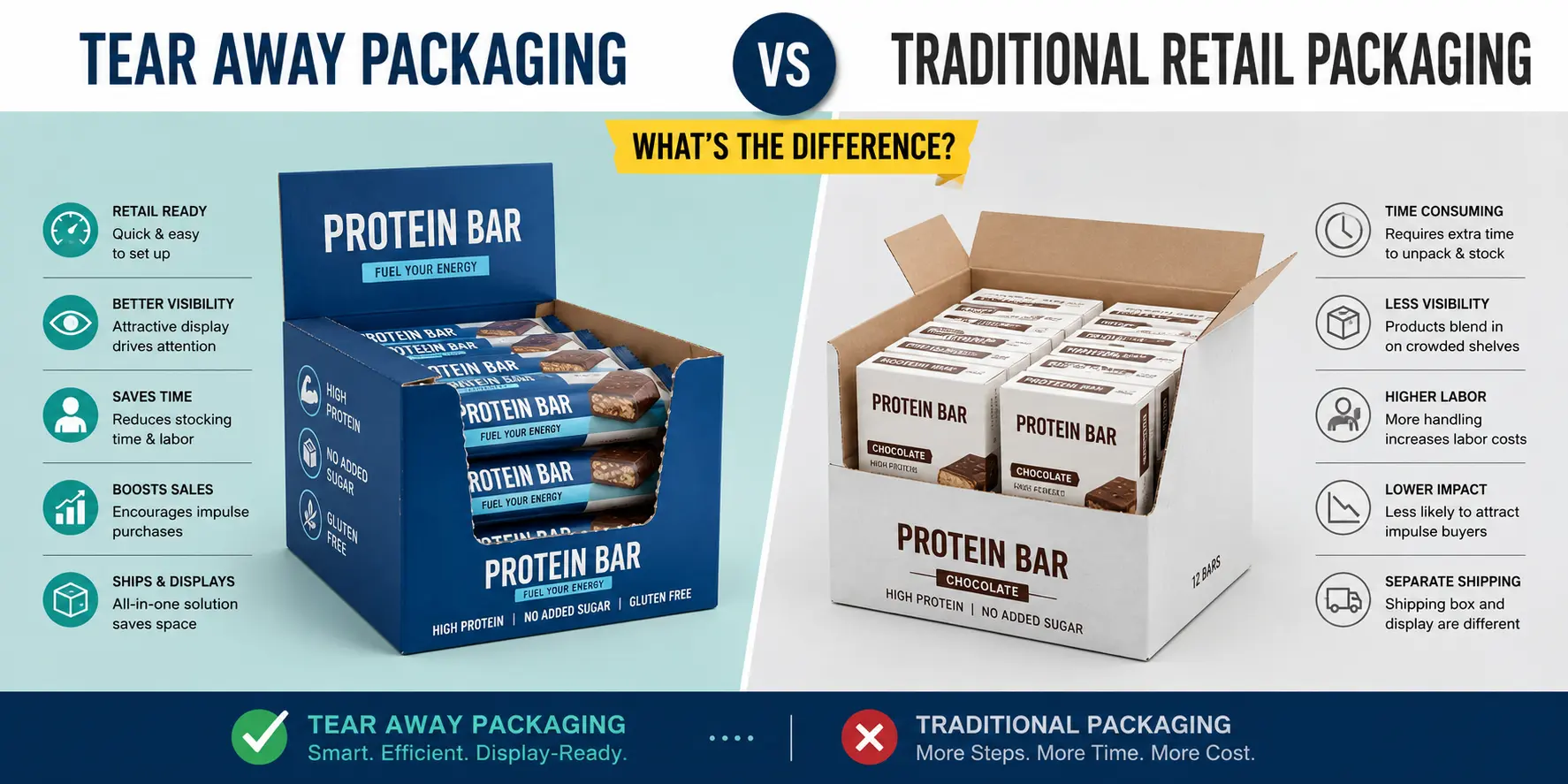
So how does tear away packaging actually stack up against traditional retail packaging? And which one gives you and the store more for the money?
We’ll walk through it below, section by section, and you can decide which fits the way you sell.
What Is Tear Away Packaging?
It’s a shipping box that turns into a display. Simple as that.
It ships closed like any carton, then at the store someone tears a perforated panel off and there’s your open tray. If you want the nuts and bolts of how those perforations work, we wrote a whole piece on what a perforated display box is.
Brands go for custom tear away display boxes mostly because stores like them. Less fiddling for staff, product facing out.
What Is Traditional Retail Packaging?
This is the usual setup. Each item has its own package, and those get packed into a bigger master carton for shipping, and when the carton arrives somebody has to open it and stock everything by hand.
Think of things like:
- folding cartons and plain paperboard packs
- product boxes in all their sizes
- blister packaging, the clear plastic on a card
- single retail cartons of the cardboard kind
Staff pull each unit out of the shipper and line it up on the shelf. One at a time.
It’s still everywhere, and it works, but it eats more labor than people expect.
Key Differences Between Tear Away Packaging and Traditional Retail Packaging
1. Shelf Stocking Efficiency
Time on the shelf is the first big gap.
With traditional packs, a clerk opens the shipper, pulls the products out, sets them up one by one in neat rows and then breaks down and hauls away the empty carton, which is a lot of steps for a box of lip balm.
Tear away cuts most of that. Rip the panel, set the tray down, done in maybe thirty seconds.
Winner: Tear Away Packaging
2. Product Visibility
Can shoppers spot you? That’s half of retail.
One little carton on a crowded shelf? Gone, basically. A tray with a header card reads from an aisle away.
What you gain, roughly:
- bigger graphics with room for your logo and a headline
- a shelf spot that looks like yours, not the store’s
Winner: Tear Away Packaging
3. Labor Costs
Store wages keep going up. Every minute spent unpacking costs somebody.
Old-style packs get handled unit by unit, while with a tray the restock is pull empty, drop full, walk away, and store managers do remember who made their Tuesday easier.
Winner: Tear Away Packaging
4. Branding Opportunities
With a traditional pack you get the box itself to print on. That’s it.
Tear away gives you two surfaces, the product’s own pack and the whole display around it, and the display is where you can go big. Things we often see printed on them:
- your logo, large
- a QR code (we’ve seen recipe links do well)
- a seasonal promo, like a holiday flavor
- a short line on what the product does
- a price callout space for the retailer
More space means more chances to say something useful at the moment someone’s deciding.
Winner: Tear Away Packaging
5. Shipping Protection
Honestly? Both can protect well if they’re built right.
Traditional packs lean on the master carton for the trip. Tear away does it in one piece, so the board matters a lot, and we’d go with corrugated (E-flute or B-flute depending on weight) so it handles stacking on a pallet and the odd drop off a dock.
Winner: Tie
6. Retail Presentation
How it looks on the shelf counts. A lot.
Traditional packaging is mostly about protecting and branding one unit. The tear away style is about the group, an open tray where a shopper can grab one without knocking the rest over, and that open front tends to pull hands toward it.
Winner: Tear Away Packaging
Comparison Table
| Feature | Tear Away Packaging | Traditional Retail Packaging |
|---|---|---|
| Shelf Stocking Speed | Excellent | Moderate |
| Product Visibility | High | Standard |
| Branding Opportunities | Extensive | Limited |
| Retail Presentation | Premium | Basic |
| Labor Efficiency | High | Moderate |
| Impulse Purchase Potential | High | Lower |
| Shipping Protection | Excellent | Excellent |
| Merchandising Efficiency | Excellent | Standard |
When Traditional Retail Packaging Makes Sense
Plenty of products are better off in their own box. No shame in it.
We’d stick with traditional packs for luxury items where unboxing is half the fun, pricey electronics, bulky stuff that won’t fit a tray, and anything shipped straight from an online store. Those need a good box, not a display.
When Tear Away Packaging Is the Better Choice
If being seen fast and restocking fast matter more than anything else, go with tear away. Here’s who uses it most:
Food and Snacks
- protein bars and granola bites
- candy, chips, the checkout lane stuff
Supplements and Wellness
- vitamin packs and gummies
- single-serve nutrition sachets
Cosmetics
- lip balm, the classic counter item
- small makeup and skincare minis
Pet Products
- treat pouches and little toys by the register
Electronics Accessories
- chargers, earbuds, USB cables
Pretty much all of these sell on impulse. Someone’s standing in line, sees it, grabs it.
How Tear Away Packaging Supports Retail Growth
Stores want help in the stockroom and on the shelf, and tear away does a bit of both. Faster restocks, tidier rows, your brand as one solid block. For small brands that often means a buyer who’s happier to reorder.
Final Thoughts
Neither one is wrong. Your product and your stores decide it.
Sell one at a time, or mostly online? Traditional retail packaging is fine, keep it.
Chasing shelf presence and grab-and-go sales in physical stores, though, we’d lean tear away nine times out of ten. Comparing them with other options? Our guide to shelf ready packaging vs tear away display boxes goes through that one too.
Want to try a run? We do the dieline and artwork setup for free, and minimums are low, often around 50 boxes depending on the style.
Related Products and Guides
If you’re working on packaging like this, have a look at custom mailer boxes and product packaging boxes. You might also find these useful: how display packaging helps increase retail sales and 10 industries that use tear away display boxes for product merchandising.