You’ve seen hundreds of these without knowing the name. The box of energy bars by the register where you grab one through a hole in the front. The cardboard case on a grocery shelf with its front ripped off so the chip bags show. A tissue box with that oval slot on top. The little lipstick stand at the beauty counter where half the box has been torn away. Every one of those is a perforated display box, and if you sell anything small through stores, it’s worth knowing how they work.
The trick is that one box does two jobs. Normally you’d need a shipping carton to get product to the store and then some kind of display boxes or stand to show it off, but a perforated box ships closed and then turns into the display with one tear, which cuts out a step, cuts out some cardboard, and gets the product in front of shoppers looking tidy.
If you’re weighing up close cousins of this format, tear away display boxes do almost the same shipping-to-display trick, just with a slightly different opening that suits certain stores better.
Lots of brand owners and product managers who’d really benefit from these boxes don’t know much about them, honestly. So this guide goes through it all: how they’re built, how the perforation actually works, the main types, who uses them, materials and printing, and how we’d pick the right setup for your product and the store it’s going into.
What Is a Perforated Display Box?
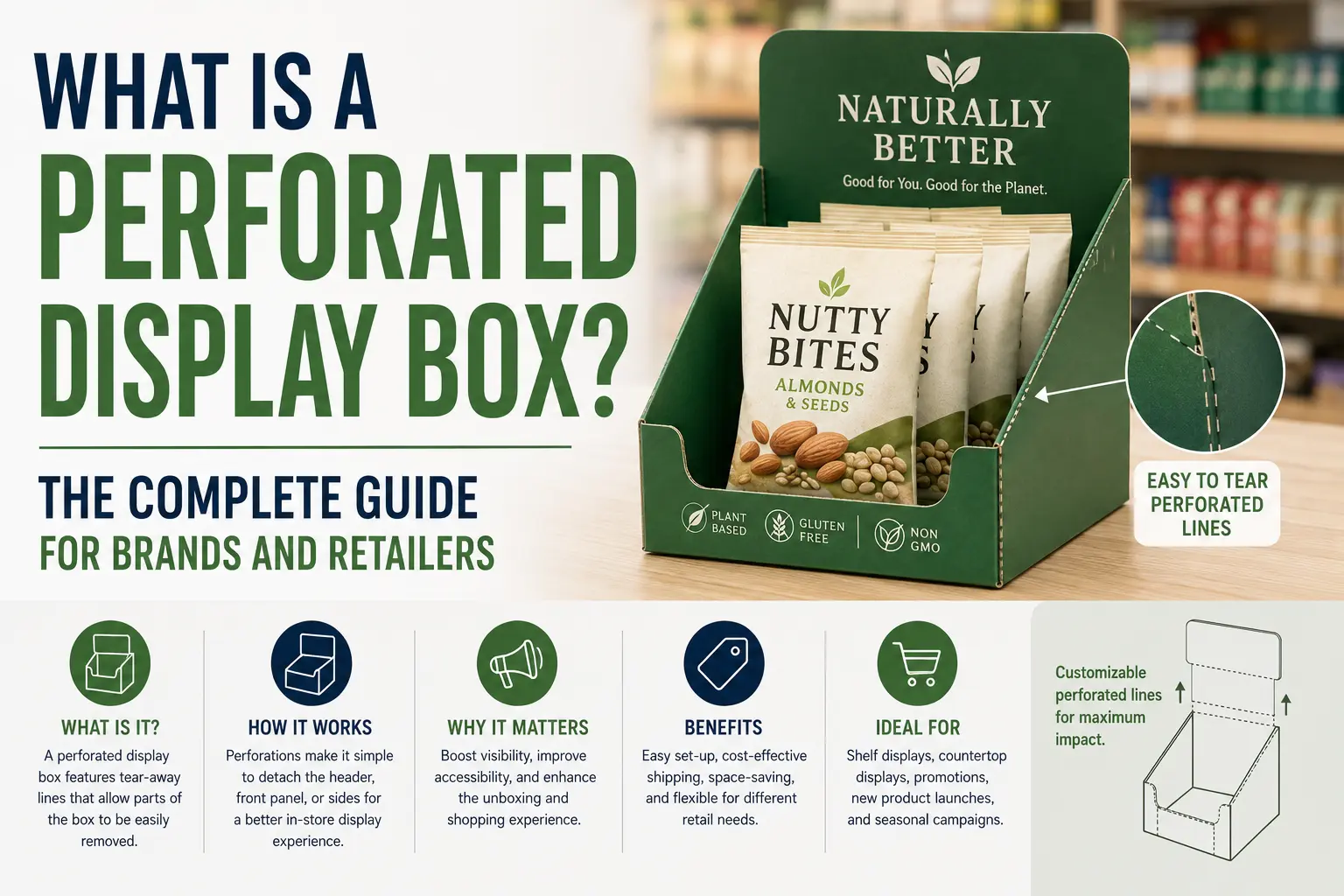
A perforated display box is a box with one or more lines of pre-cut perforations, so that a section can be torn off cleanly and the closed carton becomes an open retail display.
The perforation itself? A row of tiny cuts through the board, spaced evenly, nothing fancy. We like to describe it as a weak spot you put there on purpose, strong enough to ride out a bumpy week in a truck and weak enough that a stock clerk with one free hand can rip it open in a second.
That double life is the whole point. Closed, it’s a normal sturdy case. Torn, it’s a little branded tray with your product standing up and facing the aisle, and nobody had to build anything or find a spare display stand in the back room.
So one unit replaces two, the shipping carton and the display. For products that move fast through busy stores, that’s real savings on board, on handling time and on general hassle at the store end.
How the Perforation Mechanism Works
Quick detour into the mechanics. It’s more interesting than it sounds, promise, and it explains why a perforation behaves nothing like a fold line or a pull-strip.
The perforation gets made by a die, either a flat steel rule die or a rotary die on a machine, that cuts the board in a repeating pattern of cuts and small uncut “bridges.” The cut parts go right through. The bridges in between hold everything together. So the finished line is cut, bridge, cut, bridge, all the way along.
How it behaves comes down to the ratio of cut length to bridge length. Long cuts with short bridges tear really easily but can pop open too soon in transit. Short cuts with long bridges take more force to tear but hold up better on the road. Whoever engineers the box picks that ratio based on how much abuse it’ll take in shipping and how cleanly it needs to open at the store.
For a typical display box, the goal is roughly this.
On the way to the store, the box can be stacked, bumped, squeezed and thrown around a bit without the perforation giving way. The force needed to open it should be well above anything it’ll run into on a normal delivery route.
Then at the store, one firm pull should do it. No box cutter near your product, and no fuzzy, chewed-up edge either, because a ragged tear makes the whole display look a bit sad.
Placement changes everything else. Put the perforation on the front and you get a three-sided tray with an open front, holding the products upright and facing out. Open the top and front together and you’ve got a gravity-feed style display where products slide forward as people take them. A side panel perforation can give you a display with a big branded surface you can see from a few angles.
Types of Perforated Display Boxes
There isn’t just one perforated display box. It’s more of a family, each type suited to certain products, certain spots in a store and certain ways of selling. Knowing the main ones makes the choice a lot easier.
Shelf-Ready Perforated Display Box
Retail people call it RRP, retail-ready packaging. Pallet to shelf, nobody repacks a thing: the clerk rips the front or top, slides the case into its slot and moves on to the next one, and your product is out and grabbable before they’ve even reached the end of the aisle.
Why do Walmart, Target, Costco and the big grocers love it so much? Labor. Every minute a worker isn’t stacking single items is money saved, multiplied by thousands of stores, which is why some of them push suppliers toward shelf-ready packaging before they’ll list a new product.
On most of the ones we see, the front perforation sits a third to halfway up the box. Lower than that and products tip forward. Higher and shoppers can’t see much. There’s usually a top flap that tears away too, and the printed sides of what’s left become your mini billboard.
Countertop Perforated Display Box
Countertop display boxes live next to the register, the pharmacy window, anywhere people grab something while they wait. Smaller than shelf cases, usually, and tilted so the person in line is basically staring at your product.
Tear the front and you’ve got an open tray (some are stepped or angled so things lean toward the customer). We’d almost always add a hang tab on the back too. Counter space runs out fast in a busy store, and a tab lets them hang your box on a pegboard instead of sticking it in a drawer.
Where do you see them? Everywhere, really. Candy, gum and mints at gas stations. Lip balm, bandages and cold medicine at pharmacies. Hair clips and makeup bits in beauty supply shops, and cables and earbuds in electronics stores.
Gravity-Feed Perforated Display Box
A gravity-feed box is set up so products move forward on their own as each one is taken. The box tilts a little, either by design or because of the shelf it’s on, and when someone grabs the front item the rest slide down to fill the gap.
Here the perforation usually takes away the whole front panel, or most of it, so there’s a wide clear opening for things to slide through. The top can be perforated and removed as well to open it up more.
You’ll find gravity-feed boxes holding candy bars, batteries, energy drinks and small snacks, the stuff that sells so fast the display would look half empty all day if it didn’t refill itself.
Side-Panel Perforated Display Box
Some designs keep the front solid and put the perforations on the sides. Open those and the box folds outward into a three-dimensional display, with a printed backdrop behind and a product tray in front.
Brands use this for premium and gift products, where a 3D display makes more of a splash than a plain open tray. Seasonal candy, wine and spirits, higher-end personal care, that kind of thing.
Dispenser Perforated Box
Different goal here. A dispenser box isn’t trying to show off twenty items at once, it wants to let them out one at a time through a small opening, while the rest of the box stays stiff and keeps the stack lined up behind it.
You’ve used a hundred of these. Tissue boxes, obviously, and also the cartons for wet wipes, straws, individually wrapped mints and single-dose pharmaceutical packaging.
The opening is the fussy part. A few millimeters too wide and you get three wipes in your hand, or the stack slumps over inside; a few too narrow and every pull is a fight, so it’s worth mocking up a sample with your actual product and pulling items out of it a dozen times before anything goes to print.
Shipping-to-Display Conversion Box
If we had to pick the type that matters most for brands selling into big retail, it’d be this one. Picture an ordinary brown corrugated case, the kind that shows up on a pallet, except somebody planned where the perforations go so it turns into a proper branded display.
At the store, the clerk tears away chunks of the outer wall. Inside there’s a printed tray with your product lined up facing forward. Sometimes a header card pops up behind it with the brand name on it, and that’s it, display done, no second box needed.
Soda, chips, shampoo, dish soap, Halloween candy in October. Pretty much any consumer product that moves fast ends up in one of these sooner or later, since the store skips a whole unpack-then-build-a-display step and less cardboard gets used for every item that’s sold.
Materials Used in Perforated Display Boxes
Pick the board and you’ve basically picked how strong the box is and how clean it tears, plus how the print looks, how green it is and what it’ll cost. Nothing wins on every count. A case of soda and a counter box of lip balm want very different stuff.
Corrugated Cardboard
This is the workhorse for shipping-to-display boxes and the bigger shelf-ready cases. You’ve got a wavy flute glued between two flat liners, and that sandwich is what lets a case of thirty-six snack bags survive being stacked five high on a pallet. Most retail displays we see run on single wall, B or C flute, with double wall saved for heavy stuff like bottled drinks.
Perforating corrugated is a bit harder than perforating solid board. The cut has to go through all three layers, so the die needs more pressure, and since corrugated likes to tear a little rougher, the cut-to-bridge ratio needs more care. Get it right and it tears clean. Get it wrong and you get that furry edge with bits of flute sticking out.
For printing, you can print straight onto the outer liner with flexo, or print a nicer litho sheet first and laminate it onto the corrugated (more on that further down).
Solid Bleached Sulphate Paperboard
SBS is what most countertop boxes, dispenser boxes and fancier display pieces are made of. It’s virgin fiber, bright white and smooth, so your colors pop and fine detail stays sharp.
And it tears like a dream. Solid, even board means the rip follows the line exactly, which you’ll appreciate on a counter display where that torn edge sits a few inches from your logo at eye level.
Most of what we run is somewhere in the 16 to 24 point range. It’s used for food packaging all the time, so candy and snack displays are fine on it.
Kraft Paperboard and Kraft Corrugated
Natural, handmade, eco brands? Kraft board or kraft-faced corrugated, nine times out of ten, because people read brown as “earthy” before they’ve read a single word.
Tearing is about the same as SBS. Printing isn’t. Ink soaks into unbleached paper differently and colors go darker and duller, so we’d keep the art simple with fewer colors that play nice with the brown (white ink plus one dark color is a combo we like a lot).
Plenty of organic food brands and natural personal care lines pick kraft display boxes on purpose, as a signal of what they’re about.
Recycled Content Board
Coated recycled board is recycled fiber inside with a white coated face on top. Cheaper than SBS, nicer green story. On a normal display it tears and prints close enough to virgin board that most shoppers would never notice, and only on really intricate perforation patterns would we nudge you back to SBS.
Worth knowing: a few big retailers set minimum recycled content for supplier packaging now. Coated recycled usually gets you over that line without making your graphics look washed out.
Perforation Techniques and How They Are Made
You don’t need to know this to order a box. It does help when a supplier starts throwing terms at you, though.
Most box jobs run on flatbed die-cutting. Someone bends sharp steel rule into the exact shape of your cut and crease lines, mounts it on a board, and the press stamps it down onto each sheet. Folding cartons and smaller corrugated packaging almost always go this way, and the nice part is that a fancy perforation pattern costs about the same to cut as a boring straight one once the die exists.
Huge corrugated orders are different. There you’ll hear about rotary die-cutting, where the pattern wraps around a cylinder that spins as board feeds through, and on a run of fifty thousand cases it’s simply quicker.
Then laser perforation. Lasers burn the line instead of cutting it! Way too much for a candy display. Brilliant for micro-holes that let fresh food breathe, or a pattern so fiddly no die could hold it, and you pay extra for the privilege.
And web press perforation you’ll mostly meet on labels and flexible film, where a continuous roll gets perforated as it runs through the press. Not something used on rigid boxes or display cartons.
Industries That Use Perforated Display Boxes
The list of industries using these is long, which kind of tells you how universal the “get it on the shelf and get it noticed” problem is.
Food and snack industry. Food and snacks use more perforated display boxes than anyone. Walk any gas station and count: candy bars, chip bags, protein bars, gum, mints, and almost all of it came in a corrugated case with a front and top that tore off. With product moving that fast, no convenience store clerk has time to restock one bar at a time.
The checkout counter is where this format really earns its keep. Impulse candy sells well by the register, everyone in retail knows that, and an open perforated box makes it even easier because there’s nothing between the shopper’s hand and the product.
You’ll spot perforations on bakery and produce packs too, though there they’re half about airflow, since a sealed tray of strawberries sweats.
Pharmaceutical and healthcare. Pharmacy counters are covered in these, cough drops and vitamins and bandages and those little travel toothpastes, all in torn-open boxes so you can grab one without asking anybody.
Blister packs use perforation in a different way, between doses, so you can snap off one dose card cleanly. Not a display box thing, but it’s the same basic idea and it matters a lot in healthcare packaging.
Cosmetics and personal care. Beauty might be the category that loves these most, lip balm and nail polish and those tiny travel shampoos and hair clips almost always sit in some kind of perforated display. Countertop boxes are especially common here, since trying things and buying on a whim drive a lot of beauty sales.
The pricier beauty brands go a step further, SBS board with spot UV or a strip of foil on the display, and it still sets up in seconds for the store staff.
Electronics accessories. Forgot your charger on a trip? The cable you grabbed at the airport newsstand probably came out of a perforated box, and the earbuds next to it too, because people want to pick those up and read the little specs on the back without waiting for someone with a key.
Stationery and office products. Pens, markers, glue sticks, sticky notes, and come back-to-school season the office supply aisle is basically a wall of torn-open display boxes.
Tobacco and related products. Rolling papers, filters, pipe tobacco and nicotine replacement products are commonly sold from perforated display boxes. Countertop and behind-the-counter display formats are pretty much standard in that category.
Household and cleaning products. How many packs of AA batteries does a supermarket sell in a week? Loads. Same with sponges and wipes and air fresheners, which is why shelf-ready perforated cases pretty much took over that aisle.
Key Benefits of Perforated Display Boxes
Retail has been using these for decades, so the case for them isn’t really up for debate anymore. What surprises people is how many different places the savings turn up.
No separate display unit. Here’s where the real money is. Say you ship in plain brown cases and then mail each store a countertop stand on top of that. Now you’re buying two kinds of packaging and paying for two sets of dies and print, and you’re storing both, and on top of that some poor store clerk has to put the stand together. Roll all of it into one perforated box and a whole layer of cost just disappears.
Less store labor. Store managers are always short on staff. A torn-open case goes up in seconds instead of minutes, and across a whole chain that adds up to a mountain of hours, so you can see why buyers keep nudging suppliers toward shelf-ready.
Less damage. Fewer hands, fewer dents. A case of candy bars that gets torn open and slid onto the shelf barely gets touched, while the same bars unpacked from a plain shipper and hand-stacked onto a tray get picked up, dropped, squished in somebody’s fist.
Better shelf presence. Loose product on a shelf looks like a garage sale, honestly. Put the same product in a printed tray and it looks like a brand, and your graphics stay right there for weeks, working on every person who walks past.
More impulse buys. People buy what’s easy to reach. That’s really all impulse buying is. If the gum is right there at hand height in an open box, it sells, and if it’s behind glass or sealed in a carton, a lot of those “eh, why not” purchases never happen. Countertop boxes at checkout are built around that one simple fact.
Less waste. One box instead of two. Less cardboard per item sold, and a nice line for your sustainability page.
Faster setup and restocking. Store teams get product out a lot quicker this way. No unwrapping single items, no breaking down a shipper, no lining things up by hand one at a time.
Design Considerations for Perforated Display Boxes
This is the part where good and bad displays split apart. Dimensions and board grade are the easy bit. Here’s what else we’d think about.
Where the perforation goes. Tear too low and products topple out the front. Tear too high and shoppers see a wall of cardboard with a few caps poking over it. For a typical countertop snack display we’d usually start the front perforation 30 to 50 percent of the way up, so the bottom of each product is held and the top half is on show.
Tear direction and order. With tear lines on two or three panels, the clerk needs to know where to start, so we’d add a thumb tab or a little corner perforation, otherwise somebody in a hurry jams a finger in the wrong spot and the tear wanders right through your logo.
Artwork and the tear line. Whatever’s printed above the perforation gets thrown away, and you’d be amazed how often a logo ends up sitting right in that zone on the first proof. Catch it then. If it slips through, your finished display has no name on it.
Strength after opening. Once you’ve ripped half the front off, what’s left still has to hold up a few pounds of product for weeks. Too many cuts in the wrong spot and the tray starts to bow by day three, so we’d always load a sample with real product and leave it on a shelf for a while before signing off.
Header cards and backdrops. Want the display to look taller than it is? Add a header card, the raised panel at the back with your name or a photo or this month’s deal, which stands up once the front comes off (built into the box or tucked in as a separate insert, either works). Not sure how big the whole thing should be? Our guide on what size display box you need helps with that.
How Perforated Display Boxes Differ from Similar Packaging Formats
Lining it up next to the alternatives makes the choice clearer.
| Feature | Perforated Display Box | Standard Corrugated Shipper | Separate Display Unit | Blister Pack |
|---|---|---|---|---|
| Primary function | Shipping and display combined | Shipping only | Display only | Individual product protection |
| Setup required at retail | Tear perforation only | Unpack and dispose | Assemble display | None |
| Brand visibility on shelf | High, via display tray | None | High | Moderate |
| Labour at retail | Very low | High | Medium | None |
| Cost per unit | Low to medium | Low | Medium to high | Medium |
| Best for | FMCG, snacks, cosmetics, pharma | Bulk distribution | Seasonal, premium display | Single-item pharma, small goods |
| Sustainability | Good, single packaging unit | Good for shipping only | Additional material required | Variable |
Printing and Customisation Options
On a shelf, the print is your salesperson. So it’s worth knowing the options.
Flexographic printing is what most corrugated displays get. It’s quick and cheap once you’re printing thousands, and today’s flexo looks far better than the blotchy stuff from twenty years ago, so for a snack or battery display it’s usually all you need.
Litho-lamination is the fancy route. A sheet gets printed on a litho press, the same kind used for folding cartons, then glued onto the corrugated, and the print comes out crisp enough for a premium brand. It costs more, though, and that glue layer makes the box a bit harder to recycle.
Digital printing is great for short runs. No plates, so a holiday version or a test design for twelve stores doesn’t cost a fortune, and it’s a big part of why our minimums can stay low (often around 50 boxes depending on the style).
Surface finishes such as gloss or matte varnish, spot UV and foil stamping all work on display boxes, depending on the board and the press. A bit of foil on the header card goes a long way on a crowded shelf.
Sustainability of Perforated Display Boxes
Short answer: pretty good, with a couple of catches.
The obvious win is that you’re using one box where you’d otherwise use two. Less board in, less board out, smaller footprint for every item sold.
Then there’s what happens after. By the time the last candy bar is gone the box is already open, so whoever’s closing the store flattens the tray and throws it on the cardboard bale out back, and most stores recycle cardboard pretty reliably.
Paperboard counter boxes go into the same stream. As long as there’s no plastic film, foil or wax on them, they recycle fine.
The catches are all about coatings. Plastic film, wax, metallic foil, all of them make the recycler’s life harder. If you’re shouting about being green on the box, go with water-based varnish or a paper finish.
One more thing buyers sometimes ask for is FSC or PEFC chain-of-custody board, which traces where the fiber came from. If your retailer wants it, bring it up when you ask for the quote.
FAQs
What is a perforated display box?
It’s a shipping case with tear lines cut into it. Pull along the line, a panel comes off, and the case becomes a display. One box, two jobs.
How does the perforation on a display box work?
Tiny cuts in a row, with little uncut bits between them, so the line holds through shipping and rips cleanly when you actually pull on it. No knife needed.
What is the difference between a perforated display box and shelf-ready packaging?
Think of shelf-ready as the family name. Anything that goes pallet to shelf without repacking belongs, and perforated boxes are just the most common member, next to cousins like trays with lift-off lids.
What materials are used in perforated display boxes?
Heavy stuff on a supermarket shelf? Single wall corrugated. Small counter box, SBS or coated recycled board, and kraft when you’re after that natural look.
What industries use perforated display boxes?
Honestly, most of retail. If it’s small and sells fast, someone’s put it in one.
Can perforated display boxes be recycled?
If you leave off the plastic film, the wax and the foil, yep, it goes in with the rest of the cardboard.
What is the difference between a perforated display box and a dispenser box?
Display boxes open wide and show off the whole batch, and a dispenser lets things out one by one through a small hole, like your tissue box at home does.
How are perforations created in packaging?
Dies, mostly, flat or rotary, and once in a while a laser for the really fiddly patterns.
What is the minimum order quantity for custom perforated display boxes?
Depends who you ask and how it’s printed. Digital keeps short runs affordable, and our minimums are often around 50 boxes depending on the style, while flexo only pays off on bigger runs where the plate cost gets spread thin.
How do I design a perforated display box so the perforation is in the right place?
Get a dieline with the tear line drawn on it (our team does that for free), keep your logo below the line, and then fill a physical sample with real product and leave it on a shelf for a few days. If it still looks good on day four, you’re there.
Quick Comparison: Perforated Display Box Types
| Type | Best For | Opening Style | Typical Material | Primary Location |
|---|---|---|---|---|
| Shelf-ready display box | FMCG, snacks, household goods | Front and top perforation | Corrugated single wall | Supermarket shelf, endcap |
| Countertop display box | Impulse items, cosmetics, pharma | Front perforation or fold-down | SBS or recycled paperboard | Checkout, pharmacy counter |
| Gravity-feed display box | High-velocity confectionery, batteries | Full front panel removal | Corrugated or SBS | Checkout counter, shelf |
| Side-panel display box | Premium, seasonal, gift products | Side panel tear-out | SBS with premium finish | Specialty retail, endcap |
| Dispenser box | Tissues, wipes, single-serve items | Controlled top or front opening | SBS paperboard | Counter, shelf |
| Shipping-to-display conversion box | CPG brands reducing packaging count | Multi-panel perforation | Corrugated, litho-lam option | All retail environments |
Still stuck between corrugated and paperboard? Our corrugated vs cardboard display boxes comparison goes through it. Or just send us your product size and we’ll suggest a setup.
Where to Go Next
Popular options for this topic include custom mailer boxes and product packaging boxes. Related guides: countertop display boxes vs floor display boxes: which one is better? and how to choose the right custom display stand.