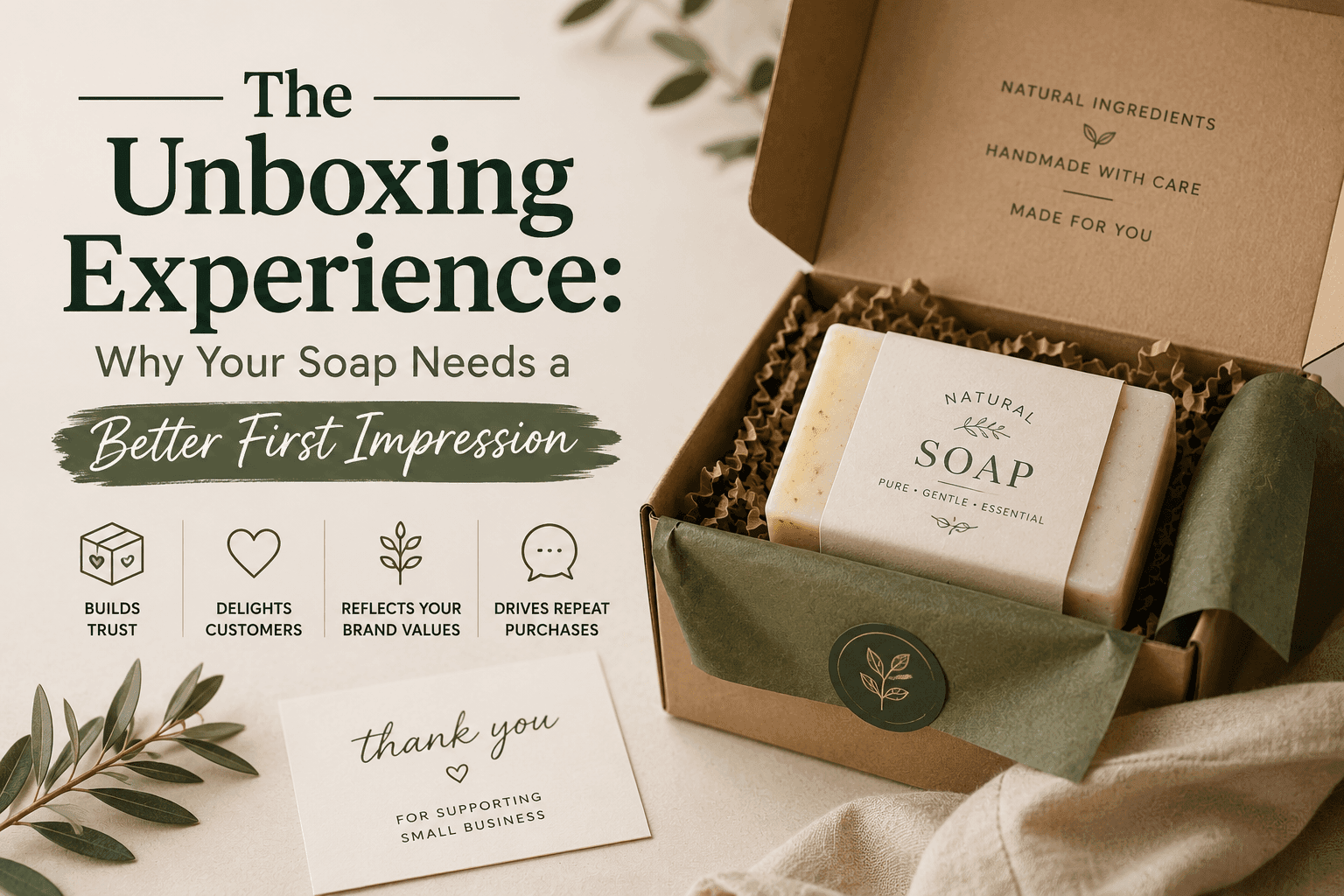
Think about the last parcel that actually made you go “oh, nice.” Not because of what was in it, but the box itself. How heavy it felt when you picked it up, that little scrape as the flap came loose, tissue folded just so, a small card sitting on top. You hadn’t touched the product yet and you’d already decided how you felt about the brand. Funny how that works.
That’s the unboxing experience. And for soap brands it matters more than most owners give it credit for.
Soap’s personal, isn’t it? You rub it on your face. Nobody pays $11 for a bar of cold process lavender because they need to get clean, they pay because they like the person who made it and the little story on the label, and the box either agrees with that story or kind of contradicts it.
Picture a maker who spent half a year on a goat milk and oat recipe. Six-week cure on every batch, bars cut by hand with a wire cutter in the garage. Then off they go in a plain brown box with tissue stuffed in the gaps. Lovely soap. Sad box. Guess which one the customer meets first.
So this guide is about why the unboxing experience matters for soap in particular, what the research people quote actually says, and how to put together an unboxing that gets customers reordering, posting about it and feeling fine about paying a bit more. If you’re ready to sort your packaging out now, we make custom soap boxes sized to your exact bars, with premium finishes, low minimums and free ground shipping in the USA.
Why the Unboxing Moment Is a Real Marketing Opportunity
A lot of people assume unboxing only matters for luxury handbags, phones or subscription boxes. We’d push back on that.
There’s an old Dotcom Distribution survey that half the packaging industry quotes (we’re guilty too). Roughly four in ten online shoppers said they’d post a photo of an order if it came in branded packaging, and about half said nicer packaging made them likelier to buy from that shop again. Is it gospel? Nah, it’s a survey. Does it match what we see when customers send us screenshots of their boxes on Instagram? Pretty much.
Shoppers in a store give a product maybe a few seconds before walking on, and with online orders that same snap verdict happens on the doormat instead, box in one hand, keys in the other.
Soap buyers are loyal, too, which raises the stakes. Once somebody finds the bar that doesn’t dry out their hands, they’ll reorder for years, go from one bar to a bundle of four, gift it at Christmas. Blow the first impression and even a great bar has to climb out of a hole.
Your site and photos made a promise. The cardboard keeps it. Or doesn’t.
And if you sell at markets or in a local gift shop too, the box is doing double duty. On a shelf next to fifteen other handmade soaps, it’s the only thing a stranger has to judge you by, since they can’t exactly lather up in the aisle (well, some try, there’s always a tester bar for a reason).
What Customers Actually Notice During Unboxing
Worth knowing before you spend anything, because some upgrades cost a lot and nobody notices, while a 4 cent sticker gets a “cute!!” in the reviews.
The outside of the package. Before anything gets opened there’s the mailer, and a plain brown one with a shipping label says “warehouse” whereas a printed one in your colors, maybe with “hello, it’s us” on the flap, says “someone thought about me.”
The moment it opens. Ever wrestled a box that won’t stay open, or one where the lid flops back down while you’re trying to get stuff out? Annoying. A good mailer opens with a tiny bit of resistance and then just sits there, open, showing off.
The first layer. Whatever’s on top sets the mood. Branded tissue or a card beats a face full of kraft crinkle every time.
How it feels. Fingers get there before eyes do, honestly. Soft-touch is a bit like suede, raw kraft has that papery honesty to it, and then there’s the thin carton that caves in when you pinch it, which, sorry, feels cheap however nice the artwork is.
The soap itself. Then the bar. Sharp corners and a clean face and they relax. A chipped edge, a scuff from rubbing against the box wall for three days on a truck, and there’s a little sigh even though it’ll wash exactly the same.
Little extras. A handwritten thank-you takes ten seconds. A sample sliver of your new scent costs pennies. People remember both far longer than they should.
Notice what’s missing from that list? Expensive stuff. Most of what customers react to is fit, feel and a bit of thoughtfulness, so you really don’t need a rigid box with magnets to make a good impression. A well-sized kraft carton with one nice detail beats a fancy box that rattles.
The Psychology of Packaging and Perceived Value
So here’s the slightly uncomfortable truth we tell every soap maker who asks: the box changes how good people think the soap is, and once you’ve accepted that, a few extra cents on the box starts to look less like vanity and more like the cheapest marketing you’ll ever buy.
Marketing people call it the halo effect. Lovely box, so people assume lovely soap, because if you fussed this much over cardboard you surely fussed over the oils.
Works backwards too, unfortunately. A flimsy box makes good soap seem ordinary, and with soap that’s a real problem, because nobody can tell your bar is better until they’ve used it maybe five or six times, whereas the box gets judged in about one second flat.
You’ll find a stack of studies claiming shoppers pay more for identical stuff in nicer boxes. We’d rather not wave a made-up percentage around. Here’s a simpler test with your own numbers, though: if a good box means you can ask $13 instead of $12 and nobody complains, that one dollar covers the soft-touch upgrade several times over.
Artisan and natural brands, this one’s aimed at you. Someone who walked past the $3 grocery bar to buy yours has already voted with their wallet, and the box is your chance to tell them they voted well.
The Social Media Effect of Great Soap Packaging
Here’s the bit owners love. A box that really delights people gets photographed, without you asking.
Scroll TikTok for five minutes and you’ll hit an unboxing. For a tiny soap brand, landing in a real customer’s video is advertising you can’t reliably buy, since it’s a real person with a real reaction showing it to friends who trust them, and the only bill was your packaging.
What gets shared? From what lands in our inbox, it’s boxes that pop on a phone screen, a strong color or a pattern or some texture the camera can pick up. Insides that look arranged, since people film the open box before they unpack it. A sticker or ribbon or a sprig of dried lavender gives that shot something to focus on. And a surprise of some kind, like a mini bar they didn’t order, is often the thing that tips someone into posting.
One practical tip from the print side: put something worth photographing on the inside of the lid. A short line, a pattern, your logo big and bold. Inside printing costs a bit more but it’s exactly what ends up in the open-box photo.
Ever looked at your own box and asked “would I post this?” Worth doing. Napkin math: 20 posts a month at 500 followers each is 10,000 sets of eyes, from cardboard.
Soap Packaging Box Styles and Their Impact on Unboxing
Box style changes the whole ritual, and each one suits a different price and personality.
Tuck End Box
The tuck end is the workhorse soap box style, a carton with a flap that tucks in. To make one feel special, get it sized so the bar can’t slide, use board stiff enough that it doesn’t dent when squeezed, and spend a little on the finish.
Most soap makers go reverse tuck, which locks a touch more firmly than a straight tuck, handy once it’s bouncing around in a mail van.
Quick note on board: white SBS gives you the brightest print, kraft gives you that natural look, and for a standard 4 to 5 oz bar either one is plenty stiff. If your bars are a chunky 6 oz or you’re stacking them three high in a shipper, we’d go a bit thicker.
Sleeve Box
Sleeves wrap the bar’s middle and leave both ends bare, so you slide the soap out like a little reveal. Sleeve boxes use way less board than a full carton (nice if you’re cutting waste) and people can sniff the soap right there on the shelf.
Got swirly cold process bars, rainbow layers, or oats and poppy seeds showing on top? A sleeve lets them do the talking. Just remember a bare bar can pick up scuffs, so for shipping we’d still tuck sleeved soaps into a mailer with a bit of tissue.
Drawer Box (Slide Out Box)
Outer sleeve, inner tray, slide it open like a matchbox. Opening one just feels nicer than flipping a flap.
Drawer boxes sit at the posh end. They cost more than tuck end boxes, though people describe opening them to friends, which is sort of the point.
Two-Piece Lid and Base Box
Lid up, soap revealed. That’s it, and that’s why gift sets love it. If your bars are pitched as a small luxury or a present, this format tells people so before they’ve even looked inside.
Rigid Box
Rigid means thick chipboard wrapped in printed paper, already assembled, no folding. Heavy in the hand. Inside it’s crisp and neat and your soap suddenly looks like it belongs in a hotel gift shop.
Rigid soap boxes make sense when the box is part of the gift, and since they cost noticeably more, we’d usually only suggest them for bars selling around $20 and up.
Window Box
Window boxes have a cutout on the front or lid so the bar’s visible without opening anything, and if your soap is the pretty one in the room, that’s free advertising.
Window boxes shine in shops, where nobody’s allowed to open the carton. Trying to ditch plastic? Ask about an open die-cut window with no film.
The Elements That Make Soap Packaging Memorable
Box style’s only half of it. The small stuff is what people talk about.
The finish on the outside. Fingers notice the surface of a soap box first. Ask us what soap people order most and it’s matte, no contest. Quiet. Easy to photograph. Soft-touch is the other favorite, it’s got that peachy almost-fuzzy feel, and on a creamy shea butter bar we reckon the box kind of hints at what’s inside.
Loud, colorful brand? Gloss is fine. Spot UV is the sneaky one, a shiny logo on a dull matte box that you only really notice when you tilt it toward the kitchen window.
Then foil. Gold, copper, silver, it glints from across the room. We’d keep it to the logo. Foil on everything starts to look like a cheap party favor, and it costs more anyway.
The fit. Pick up the box and nothing slides. You can feel it, and it says somebody measured.
Inserts, if you sell sets. Put three bars loose in one box and they’ll spend the whole trip knocking corners off each other. A die-cut card insert with three little wells? Problem solved, and the open box suddenly looks like a curated set instead of a pile of soap.
Tissue and inner wrap. Tissue adds a step between box and bar, that rustle and the slow peel back before the soap appears, and we’ve watched grown adults slow down for it.
Plain white tissue is fine. Tissue in your brand color, or printed with your logo, is better, and at most soap brands’ quantities the jump in cost is small compared to how much nicer the unboxing feels.
A card or insert. We’re big fans of the humble card. Write a few lines about why you started making soap, add one care tip (a draining dish stops the bar going mushy, most people don’t know that), and put a code for next time on the back. That card often ends up stuck on someone’s fridge.
Scent. Only soap gets this one, and it’s kind of magic. Lift a snug box of grapefruit and cedar bars and you smell it before you’ve seen anything. You can’t print that. A tight-fitting box just lets it build up in there.
How Soap Packaging Creates Repeat Customers
This is the money part, honestly.
Here’s how it plays out. Someone smiles opening your box, and that little smile gets filed under your brand name in their head, so when the bar’s down to a soggy sliver three weeks later, hitting reorder takes no thought at all. A friend asks “what soap is that?” and the same memory does your selling for you.
Most of the studies people quote agree that nicer packaging nudges repeat buying even with identical product inside. For soap brands, who live and die by reorders, that’s reason enough.
Running a soap of the month club? Double it. The same box turning up twelve times a year gets stale by about March, so we’d swap a sticker or a sleeve with the seasons (snowflakes in December, something citrusy for summer) and give people a reason to actually look forward to it.
Okay, calculator time. Suppose the nicer box adds 75 cents a unit. If that nudges your repeat buyers from a quarter of your list up to about a third, the extra reorders are worth way more than 75 cents a bar, and that’s before you count the friends they tell. Ads to find a brand-new customer cost real money, so anything that keeps the ones you’ve got is basically a discount on growth.
Building an Unboxing Experience for Different Soap Brand Positions
“Good packaging” means something different depending on who you’re selling to, so let’s go through the usual four.
Natural and artisan brands. Your buyer wants to feel the hands behind the bar, so we’d steer you away from anything glossy and toward kraft soap boxes printed in a single ink, maybe wax paper inside and a loop of twine, plus a rubber-stamped card. It should look like it came from the kitchen where the soap was made (which, let’s be honest, it often did).
Premium brands. If someone’s paying $16 for a bar with sea buckthorn and French clay in it, a flimsy carton is going to feel like an insult. Rigid or a thick carton, soft-touch, a small foil logo, tissue that matches your color. And quality control on the bars themselves, because a nick on a $16 soap gets noticed.
Gift brands. You’re really selling to two people, whoever pays and whoever opens it on their birthday. Nobody wants to wrap a gift box, so make it ready to hand over as is. Our usual suggestion is a two-piece box with a ribbon and a slot for a note.
Online-only brands have the courier problem. Your pretty retail carton needs either a snug corrugated mailer around it or a build tough enough to survive solo, because a crushed corner ruins all the work. Sizing both layers? Our soap box dimensions guide covers it.
Common Soap Packaging Mistakes That Hurt the Unboxing Experience
We see these four constantly.
Box too big. Number one, by a mile. A 4 oz bar in a box built for three of them just thumps around all the way from your garage to Tucson, and then the customer has to dig through a fistful of filler to find it. Sizing it snug fixes most other problems by itself.
Then the generic box, plain white or brown with a sticker on top. It tells customers nothing and blends into every other parcel on the doormat, while even one-color print on kraft says “this is us.”
Third, a gorgeous website and a sad box. Moody lighting, stylish photos, then a bare carton arrives. People notice the mismatch and trust dips a little, which isn’t fair to great soap, but there it is.
And fourth, forgetting the inside. Good outer box, then lift the lid and it’s a pile of crinkle with a bar lost somewhere in the middle. What they see first should look planned.
A quick way to catch all four: pack one order exactly like a customer would get it, mail it to yourself or a friend, and open it on camera. Watching the video back is humbling, and you’ll spot things you never notice when you’re packing fifty orders on a Sunday night.
Practical Steps to Improve Your Soap Unboxing Experience
No need to start from scratch. Here’s the order we’d tackle it in, best value first.
Size first. Measure the bar with calipers if you’ve got them (a ruler’s fine), add 5 to 10mm each side, and that’s your inside size. Measure a few bars, too, since hand-cut soap is never perfectly uniform and you’ll want the box to fit the chunky ones.
Board and finish next. Something around 18 to 24 point paperboard with matte or soft-touch feels miles better than thin board with a cheap gloss, for not much more per box.
Then wrap the bar in branded tissue or kraft paper. Cheap. Keeps the surface clean too, and if your bars sweat a bit in humid weather (glycerin-heavy ones do), a paper wrap soaks that up before it marks the box.
Add a card. Story, thank-you, a reason to come back. Pennies. A round sticker to seal the tissue shut is another tiny touch people love tearing.
Get a proof and a sample. We send a digital proof before anything prints, and you can ask for a physical sample to drop your real bar into before the bulk run, which is where you find out the box is 3mm too tight for the chunky bars. Standard production after that is 10 to 12 business days from proof approval.
Last, if you ship direct, sort the outer mailer, because that’s the first thing they touch, and a printed one with “something good inside” on the flap warms people up before they’ve opened it.
Whenever you’re ready, take a look at custom product boxes from The Pioneer Packaging. We make soap packaging in every common style and size, fully printed, with low minimums (often around 50 boxes depending on the style) and free ground shipping in the USA, so your packaging costs don’t wobble.
What Great Soap Packaging Communicates Without Words
Good soap packaging says a lot without a single word.
A heavy box says you don’t cut corners. A perfect fit says this box was made for this bar. A beautiful finish makes people expect the soap to be just as nice, and a small extra inside says you were thinking about them, not just the sale.
None of that’s printed anywhere. It gets felt in those few seconds between lifting the parcel and pulling out the soap.
It’s easy to assume nobody notices the box. Upgrade it, though, and don’t be surprised when customers start mentioning it in reviews. Packaging is invisible when it’s average and weirdly visible once it’s good.
People can buy hand soap in a thousand places, from the gas station to a fancy spa shop. Those few seconds at the kitchen counter are where you stop being one of the thousand and become the one they go looking for again.
So better soap packaging really just buys you those seconds, the rustle of tissue, the weight of the box, the smell when the lid comes up. For something people reach for every morning for months, that’s worth getting right.
Want to see options, from tuck end kraft boxes for artisan bars to rigid boxes for luxury sets? Browse our soap range and our guide to cosmetic boxes for skincare brands, then grab a free quote. Low minimums, free design help and free ground shipping on every US order.
FAQs
Why does the unboxing experience matter for soap brands?
It’s the first time anyone physically meets your brand. That Dotcom Distribution survey suggests a good share of shoppers reorder more after nice packaging and plenty would post a pretty box, and since soap lives on repeat orders, you feel that in sales.
What is the best soap box style for a premium unboxing experience?
Rigid, two-piece and drawer boxes feel the most luxe and say “gift.” On a tighter budget, a tuck end with soft-touch and a foil logo still punches well above its price.
How does soap packaging affect customer perception of quality?
Halo effect, basically. Nice box, so people assume nice soap, and a slightly higher price feels fair before they’ve even lathered up.
What finishing options work best for soap boxes?
We’d start with matte or soft-touch, since both feel lovely and photograph well. Add foil if you want a touch of luxury, or spot UV to make just the logo shine.
What should I include inside a soap box for a better unboxing experience?
Tissue or kraft paper around the bar and a small card, plus once in a while a sample or a discount code. Cheap stuff, big payoff.
How important is box size for the soap unboxing experience?
Huge. A rattling bar makes a bad impression before the lid’s even off. Aim for an inside size roughly 5 to 10mm bigger than the bar on each side.
Can small soap brands afford premium unboxing packaging?
Yep. With minimums often around 50 boxes depending on the style, small makers can get printed boxes with nice finishes without buying thousands, and things like matte lamination or branded tissue usually add a modest amount per order that better reorders tend to cover.
Does soap packaging affect social media sharing?
Quite a lot, in our experience. A box that looks great in a photo, is neatly arranged when it’s opened and hides a little surprise is much more likely to end up in someone’s story than a plain one.
Related reading: Custom Candle Boxes vs Stock Packaging.
Related Products and Guides
If you’re working on packaging like this, have a look at cosmetic boxes, custom mailer boxes and product packaging boxes. You might also find these useful: avoid these 5 common mistakes when designing custom soap boxes and how to reduce shipping costs for heavy soap bars.