

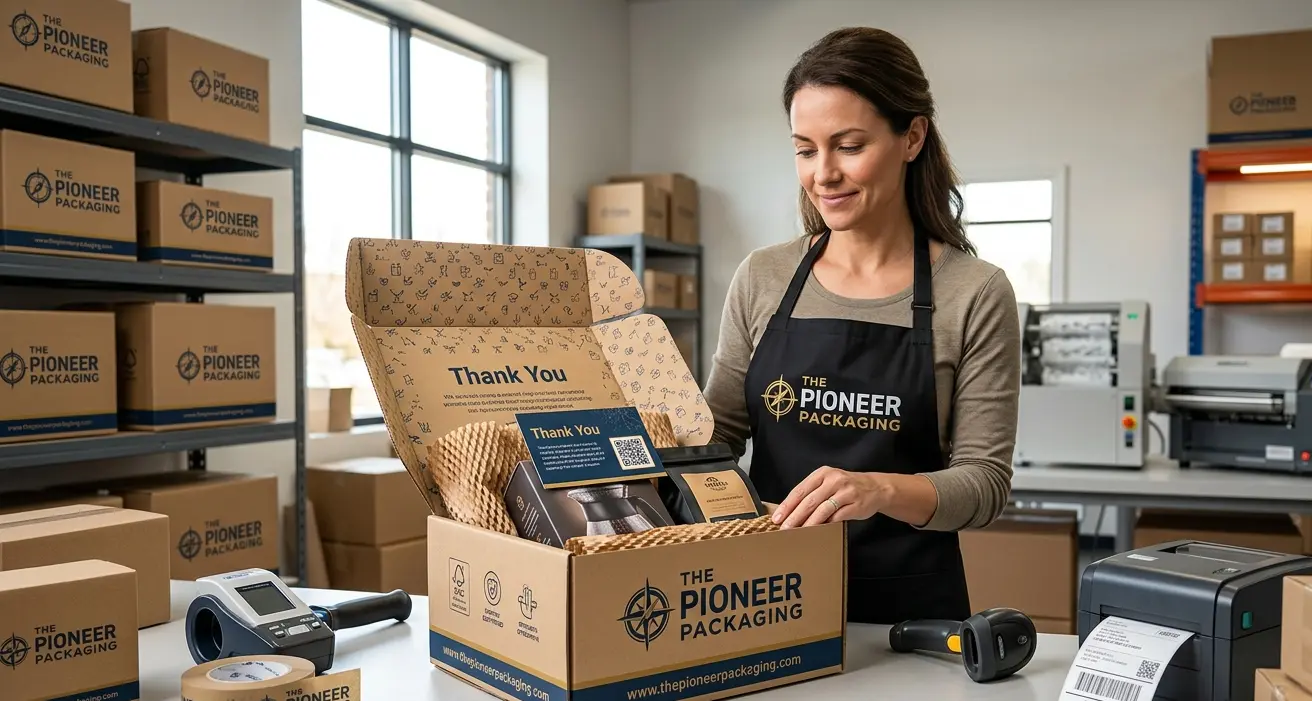
Most Shopify sellers obsess over ads, product pages, and checkout flows and completely forget about the one thing that actually lands in their customer’s hands: the box.
Wrong packaging choice? You’re bleeding money on shipping fees, watching return rates climb, and silently losing repeat customers who never forget a damaged delivery or a forgettable unboxing.
The right corrugated packaging box strategy, on the other hand, protects your products, slashes your logistics costs, and turns every delivery into a branded moment that drives loyalty.
This guide breaks down everything from flute types to fulfillment automation so you can make packaging decisions that directly impact your bottom line.
What Is Corrugated Packaging & Why Shopify Stores Rely on It
What Makes Corrugated Boxes Different from Regular Cardboard?
Most people use “cardboard” and “corrugated” interchangeably. They’re not the same thing and that confusion costs eCommerce sellers every day.
Regular cardboard is a single flat sheet. Think cereal boxes, shoe boxes, product packaging at retail. It’s lightweight, cheap, and fine for display but terrible for transit.
Corrugated packaging is a three-layer system: two flat linerboards sandwiching a wavy inner layer called the “flute.” That fluted middle layer is the secret. It acts like a shock absorber, distributing impact, resisting crushing, and providing structural rigidity that flat cardboard simply can’t match.
For shipping products across warehouses, delivery vans, and doorsteps, corrugated boxes are not a luxury. They’re the professional standard.
Understanding Flute Types (A, B, C, E) and When to Use Each
Not all corrugated boxes are built the same. The flute profile that inner wave pattern determines how the box performs under pressure, and choosing the wrong one is a mistake many sellers don’t even know they’re making.
- A-Flute: The thickest and most cushioning. Ideal for fragile items like glassware, ceramics, or electronics. Offers excellent stacking strength but uses more material.
- B-Flute: Thinner and denser. Great for canned goods, displays, and items that need puncture resistance over cushioning. A popular choice for retail-ready packaging.
- C-Flute: The most widely used flute in eCommerce. A balance of cushioning, stacking strength, and cost-efficiency. If you sell general merchandise, C-Flute is your workhorse.
- E-Flute: Very thin, smooth surface, printable. Perfect for smaller products where presentation matters cosmetics, gift items, subscription boxes.
Pro Tip: For most Shopify stores shipping mixed product types, C-Flute offers the best cost-to-protection ratio. Reserve A-Flute for your most delicate SKUs.
Single-Wall vs Double-Wall: Which Is Right for Your Products?
Single-wall corrugated boxes have one fluted layer. They handle most standard eCommerce shipments perfectly products under 20–25 lbs, non-fragile, average transit time.
Double-wall boxes stack two fluted layers for dramatically increased strength. Use them for:
- Heavy products (machinery parts, tools, bulk goods)
- Long-distance or international shipments
- Fragile items requiring extra buffer
- Products that will be stacked in storage or transit
Double-wall costs more. But when you compare that cost to a single damaged shipment and the refund, replacement, and lost customer that follows it’s almost always worth it.
Why eCommerce Businesses Prefer Corrugated Packaging
Corrugated packaging dominates eCommerce for one reason: it’s engineered for punishment.
Your box will be tossed on conveyor belts, stacked in delivery trucks, dropped on doorsteps in rain, and manhandled by multiple people before it reaches your customer. Corrugated survives all of that better than any alternative at a comparable price point.
Beyond durability, corrugated is:
- Lightweight keeping dimensional weight (and carrier fees) down
- Customizable printable, dieable, foldable into any shape
- Recyclable meeting modern sustainability expectations
- Available at scale from single units to millions of boxes
How to Choose the Right Corrugated Packaging for Your Shopify Products
How to Match Box Strength with Product Weight
Box strength is measured by two standards you’ll encounter from suppliers:
Bursting Strength (Mullen Test): Measures how much pressure the box wall can withstand before rupturing. Ideal metric for boxes handling rough handling or heavy contents.
Edge Crush Test (ECT): Measures stacking strength. More relevant for products stored in stacks or shipped on pallets.
A simple rule of thumb:
- Under 10 lbs → Standard single-wall, 32 ECT
- 10–25 lbs → Single-wall, 44 ECT or higher
- 25–50 lbs → Double-wall
- 50+ lbs → Heavy-duty double or triple-wall
Always factor in the product’s fragility separately from its weight. A 5 lb ceramic vase needs far more protection than a 5 lb bag of coffee.
Packaging for Fragile vs Durable Items
Fragile products demand a layered protection strategy the corrugated box is just the outer shell.
For fragile items, pair your corrugated box with:
- Foam inserts or molded pulp
- Air pillows or bubble wrap lining
- Dividers or partitions for multi-unit orders
- Double-boxing for extremely delicate items (box inside a box)
Durable items apparel, books, non-breakable accessories can ship in snug-fit boxes with minimal internal packing. The goal is zero movement, zero excess.
Common Mistakes Shopify Sellers Make When Choosing Boxes
These are the packaging errors that silently drain profit margins:
- Using boxes that are too big. Dead air space means higher dimensional weight fees and items shifting during transit.
- Skimping on box grade for heavy products. A weak box under a heavy product is a return waiting to happen.
- Ignoring moisture. Corrugated loses significant strength when wet. For certain climates or seasons, moisture-resistant coatings matter.
- One-size-fits-all mindset. Different products need different packaging. Standardizing too aggressively leads to poor fits and damage.
- Not testing before scaling. Always ship test orders before committing to bulk packaging for new products.
How Wrong Packaging Increases Return Rates
Damaged goods are the #1 cause of avoidable eCommerce returns. But the damage often starts with the wrong box, not rough handling.
When a product arrives damaged, you don’t just lose the revenue you pay return shipping, process a refund or replacement, potentially lose a review, and almost certainly lose the customer’s long-term loyalty. Studies consistently show that customers who experience a poor delivery are significantly less likely to reorder, regardless of how smoothly the rest of their experience went.
The packaging decision made before shipment determines whether that customer comes back.
Ready to stop guessing and start protecting your products and profits? Get a free packaging consultation and supplier shortlist tailored to your Shopify store’s product mix. →
Custom vs Standard Corrugated Boxes Which Is Better for Shopify Stores?
When Standard Boxes Are Enough
Standard corrugated boxes the plain brown, off-the-shelf variety are perfectly adequate in many situations. If you’re in early-stage growth, testing a new product, or operating on razor-thin margins, standard boxes make complete financial sense.
Use standard boxes when:
- You’re shipping fewer than 200–300 orders per month
- Your product category doesn’t rely heavily on brand experience (e.g., B2B supplies, replacement parts)
- You’re still validating your product-market fit
- Budget constraints make custom tooling impractical short-term
There’s no shame in starting here. Getting efficient operations running on standard boxes is smarter than spending on custom packaging before you’ve proven demand.
When Custom Packaging Becomes Essential
Once your store starts scaling and especially once you’re competing in markets where customer experience differentiates brands custom packaging stops being optional.
Custom corrugated packaging becomes essential when:
- Your brand is built around premium perception (beauty, lifestyle, gift products)
- You run a subscription box model
- Your unboxing experience is part of your product story
- You want to reduce reliance on discounts and compete on value instead
- You’re selling through influencers or targeting social media sharing
Custom boxes communicate professionalism instantly. Before a customer even opens the package, they’ve already formed an impression of your brand.
Cost Comparison: Custom vs Bulk Standard Boxes
Here’s a realistic breakdown for a mid-size Shopify seller:
| Factor | Standard Boxes | Custom Printed Boxes |
|---|---|---|
| Unit cost (500 units) | $0.50–$1.20 | $1.80–$3.50 |
| Minimum order | 10–50 units | 100–500 units |
| Lead time | Same day | 2–4 weeks |
| Brand impact | None | High |
| Return on experience | Neutral | Significant |
The math changes fast at scale. At 1,000+ units per month, custom boxes often cost only marginally more per unit than standard while delivering exponentially more brand value.
ROI of Branded Packaging for Small Stores
The ROI of custom packaging isn’t measured only in direct revenue it shows up in:
- Repeat purchase rates: Customers who remember the experience come back
- Organic social sharing: Unboxing content drives free reach
- Reduced discount dependency: Perceived premium value reduces price sensitivity
- Word-of-mouth: Remarkable packaging gets talked about
A well-documented case study from the eCommerce world: Dollar Shave Club built cult-level loyalty partly through memorable, witty box copy. They weren’t selling a premium product at a premium price they were selling a premium experience.
Your corrugated box is real estate. Use it.
Want to explore custom packaging without the guesswork? Request a custom corrugated packaging quote and see what’s possible at your volume. →
How Corrugated Packaging Impacts Shipping Costs & Profit Margins
How Box Size Affects Shipping Fees
This is where packaging decisions get expensive fast.
Carriers like UPS, FedEx, and USPS don’t just charge by weight anymore. They charge by dimensional weight, which means your box size directly determines your shipping bill even if the product inside is light.
A product weighing 1 lb shipped in an unnecessarily large box can cost as much to ship as a 5 lb product in a correctly sized box.
The fix? Right-size your packaging. Match your box dimensions as closely as possible to your product dimensions, with just enough room for protective fill.
Dimensional Weight Explained Simply
Dimensional weight (DIM weight) is calculated like this:
DIM Weight = (Length × Width × Height) ÷ DIM Factor
The DIM factor varies by carrier (typically 139 for domestic US shipments with major carriers). If your DIM weight exceeds actual weight, you’re billed for DIM weight.
Example:
- A box measuring 18 × 14 × 12 inches = 3,024 cubic inches
- Divided by 139 = 21.7 lb DIM weight
- If your product weighs 6 lbs, you’re paying for 21.7 lbs
That difference, multiplied across thousands of shipments, is a profit margin disaster hiding in plain sight.
Reducing Packaging Waste to Save Money
Right-sizing isn’t just about cost it’s about eliminating waste that doesn’t serve your product or customer.
Actionable steps:
- Audit your top 10 SKUs are boxes accurately sized?
- Eliminate void fill wherever products can be secured with properly fitted inserts
- Consolidate SKUs into fewer box sizes to simplify operations without over-boxing
- Explore custom-fit packaging for your highest-volume products
Even a $0.30 reduction in materials cost per order adds up to $3,000 per month at 10,000 orders.
Hidden Packaging Costs Shopify Sellers Ignore
Beyond the box itself, sellers routinely overlook:
- Storage costs for large packaging inventory
- Labor time wasted assembling complex or oversized packaging
- Void fill materials tape, bubble wrap, tissue that add up fast
- Returns processing driven by inadequate protection
- Reordering inefficiency from poor supplier terms
Track your all-in packaging cost per order, not just the box unit cost. That’s the number that tells the real story.
Using Corrugated Packaging to Create a High-Converting Unboxing Experience
Why Unboxing Matters for Customer Retention
The unboxing moment is the only physical touchpoint you have with your customer after the sale. Everything before it ads, product pages, checkout happens on a screen. The box is real.
Research from Dotcom Distribution found that a significant majority of consumers are more likely to make repeat purchases from brands with premium packaging. And nearly half have shared unboxing content on social media.
That’s free marketing, driven entirely by your packaging decision.
A forgettable brown box says: “We shipped you a thing.” A thoughtfully designed unboxing experience says: “We care about you receiving this.”
That emotional difference drives retention.
How to Design Branded Corrugated Boxes
You don’t need a massive budget to create a memorable branded box. Start with:
- Exterior print: Your logo and brand color on the outside immediately signals professionalism. Even a single-color exterior print makes a dramatic difference.
- Interior print: A branded interior a color wash, a pattern, a message creates a genuine “reveal” moment when the customer opens the box.
- Box copy: Brand voice on the outside of the box (“Handle With Obsessive Care”) creates personality before it’s even opened.
- Custom sizing: A box that fits your product perfectly looks intentional, not accidental.
Work with a packaging designer or use your corrugated supplier’s dieline templates if you’re starting from scratch.
Adding Inserts, Thank-You Cards, and Upsells
The inside of the box is conversion territory. Use it strategically:
- Thank-you cards: Handwritten-style or personalized printed cards create emotional connection and invite reviews
- Discount inserts: A next-purchase discount card, tucked inside, drives repeat purchases at a fraction of your ad retargeting cost
- Product samples: Introducing a new SKU? Include a sample in existing orders to test interest at near-zero cost
- QR codes: Link to tutorial videos, loyalty programs, or referral offers
- Upsell inserts: “Complete the look” or “Pairs perfectly with…” printed cards with a QR code to a product bundle
Every insert should have one clear purpose and one clear call to action. Don’t clutter the experience.
Real Examples of Shopify Brands Winning with Packaging
Glossier built a reputation for their iconic pink bubble wrap pouches and minimalist outer packaging turning shipping materials into collectible brand touchpoints.
Allbirds uses unbleached, recycled corrugated boxes with their sustainability story printed directly on the packaging reinforcing their brand values at the exact moment customers are most engaged.
Smaller Shopify brands regularly go viral on TikTok and Instagram with thoughtful packaging that costs less than $2 extra per order generating thousands of dollars in organic reach.
You don’t need Glossier’s budget. You need intentionality.
Download our free Unboxing Experience Branding Checklist the exact framework used by high-converting Shopify brands to turn packaging into a retention engine. →
Recyclable vs Biodegradable Packaging
These terms are often used interchangeably, but they mean very different things and your customers are increasingly sophisticated enough to know the difference.
Recyclable packaging can be processed and reused in recycling systems. Most corrugated cardboard is recyclable, making it one of the most environmentally responsible packaging materials available. The recycling rate for corrugated cardboard in the US exceeds 90%.
Biodegradable packaging breaks down naturally over time without leaving toxic residue. Not all recyclable materials are biodegradable, and not all biodegradable materials are recyclable.
For most Shopify stores, high-recycled-content corrugated boxes clearly labeled as recyclable are the most practical and credible eco-friendly move you can make today.
How Sustainability Influences Buying Decisions
This is no longer a niche concern. Sustainability is now a mainstream purchasing factor, particularly among younger demographics.
Multiple surveys confirm that a growing majority of consumers particularly Millennials and Gen Z consider environmental impact when making purchase decisions. And a meaningful segment actively avoids brands they perceive as environmentally irresponsible.
For Shopify sellers competing in crowded markets, a credible sustainability story isn’t just feel-good marketing. It’s a competitive differentiator that justifies price premiums and builds long-term loyalty.
Certifications and Eco-Labels That Build Trust
Don’t just claim sustainability prove it. Look for packaging with:
- FSC Certification (Forest Stewardship Council): Confirms paper/board sourced from responsibly managed forests
- SFI Certification (Sustainable Forestry Initiative): Similar to FSC, widely recognized in North America
- PCW Content Labels: Indicates percentage of post-consumer waste recycled content
- How2Recycle Label: Gives consumers clear, standardized recycling instructions
These certifications cost nothing to display on your packaging if your supplier already uses certified materials and they communicate genuine environmental responsibility at a glance.
Balancing Eco-Friendliness with Cost
The good news: sustainable corrugated packaging has never been more affordable. As demand has scaled, prices have normalized.
Practical balance strategies:
- Choose boxes with high recycled content (often same price as virgin board)
- Replace plastic void fill with recycled paper fill or honeycomb kraft paper
- Eliminate plastic tape in favor of kraft paper tape (recyclable with the box)
- Right-size your boxes to reduce total material use
The goal isn’t perfection overnight it’s demonstrable, honest progress that you can communicate to customers with confidence.
Where to Source Corrugated Packaging for Your Shopify Store
Local vs International Suppliers: Pros & Cons
Local/Domestic Suppliers:
- Faster lead times (critical for custom packaging)
- Easier quality control and communication
- Lower minimum order quantities typical
- Simpler logistics, no import complexity
- Generally higher unit cost
International Suppliers (especially China-based):
- Significantly lower unit costs at volume
- Higher MOQs (minimum order quantities)
- Longer lead times (4–8 weeks typical)
- Quality control requires diligence
- Suitable for established, high-volume stores
Recommendation: Start local to validate your packaging spec and establish quality standards. Shift internationally (or negotiate hybrid supply) once you’re ordering consistently at scale.
Minimum Order Quantities Explained
MOQs exist because packaging manufacturing has fixed setup costs especially for custom printing. A supplier printing a custom box design sets up plates, inks, and machinery. That cost gets amortized across the order quantity.
Typical MOQs:
- Plain/standard boxes: 10–50 units (most suppliers)
- Custom single-color print: 100–250 units minimum
- Full-color custom print: 500–1,000 units minimum
- Premium finishes (foil, embossing): 500–2,000 units
If you can’t meet MOQs for custom packaging yet, look for suppliers offering digital print runs at lower quantities unit cost is higher, but entry barrier is lower.
How to Negotiate Better Pricing
Packaging suppliers have more flexibility than they initially show. Leverage:
- Volume commitments: Agree to a quarterly or annual volume in exchange for better unit pricing
- Simplified designs: Fewer print colors and finishes dramatically reduce production cost
- Standardized sizes: Ordering fewer distinct box sizes in higher quantities per size beats ordering many sizes in small quantities
- Payment terms: Upfront payment or shorter terms often unlock price reductions
- Competitive quotes: Always get 3+ quotes and let suppliers know you’re comparing
Red Flags When Choosing Packaging Vendors
Protect your supply chain by watching for:
- No physical address or verifiable business registration
- Samples that don’t match quoted specifications
- Unusually low prices without clear explanation
- Inability to provide references or case studies
- Vague lead time commitments
- No quality control process for custom orders
- Communication delays before you’ve even placed an order
A bad packaging vendor doesn’t just cost you money they cost you inventory, lead time, and customer trust during fulfillment delays.
Packaging Optimization Strategies for Scaling Shopify Stores
When to Switch to Bulk Packaging
The trigger for bulk packaging is consistency. Once you can confidently predict monthly order volume within a reasonable range and your product mix has stabilized bulk purchasing unlocks significant cost advantages.
General thresholds:
- 500+ orders/month: Start evaluating bulk pricing tiers
- 1,000+ orders/month: Bulk purchasing is almost certainly more cost-effective
- 2,500+ orders/month: Consider warehousing your own packaging inventory
Track your packaging spend as a percentage of revenue. Above 3–5% for most eCommerce categories warrants a serious optimization review.
Automating Packaging in Fulfillment Centers
As volume scales, manual packaging becomes a bottleneck. Automation options include:
- Box-on-demand systems: Machines that cut and fold boxes to custom sizes per order, eliminating void fill and reducing material waste by up to 30%
- 3PL partnerships: Third-party logistics providers with integrated packaging automation worth evaluating once you exceed 500–1,000 daily orders
- Packing station standardization: Even pre-automation, standardized packing stations with pre-assembled box inserts dramatically reduce labor time per order
Automation investments pay back fast at scale. Even simple station standardization can cut per-order packing time by 20–40%.
Packaging Standardization for Faster Shipping
Standardization is the underrated efficiency lever. Fewer box sizes means:
- Faster picker decisions (“which box does this need?”)
- Simpler training for warehouse staff
- Better bulk pricing from suppliers
- Easier forecasting and reordering
Audit your SKUs and identify the minimum number of box sizes that cover 90%+ of your orders with acceptable fit. Most stores can consolidate to 3–5 box sizes without meaningful compromise.
Scaling Without Increasing Packaging Costs
The goal of scaling operations is to grow revenue without growing costs proportionally. For packaging, that means:
- Negotiate volume pricing annually your volume is leverage, use it
- Eliminate premium materials where they don’t add measurable customer value
- Track packaging cost per order monthly as a KPI
- Audit returns data if damage-related returns are rising, repackaging investment pays back through reduced refund costs
- Invest in automation early the cost per order reduction often funds the investment within 12–18 months
Conclusion: Your Packaging Is a Business Decision, Not an Afterthought
Every box you ship is a touchpoint, a cost driver, a brand moment, and a customer experience all at once for Shopify stores.
The Shopify sellers who win long-term aren’t just the ones with the best products. They’re the ones who understand that packaging is part of the product. It protects revenue, communicates brand values, and turns one-time buyers into loyal customers who tell their friends.
Start by auditing what you’re currently using. Are your boxes the right size, strength, and grade for your products? Are you losing money on dimensional weight? Are you leaving retention opportunities on the table with a forgettable unboxing experience?
Then systematically upgrade starting with the changes that have the most direct impact on your costs and customer experience.
Get a custom quote today and discover packaging solutions designed to reduce costs, protect your products, and elevate your Shopify brand.
Frequently Asked Questions
1. What type of corrugated box is best for Shopify shipping?
For most Shopify sellers, C-Flute single-wall corrugated boxes offer the ideal balance of protection, weight, and cost. For heavier or fragile products, upgrade to double-wall. Match your flute type to your product’s specific protection needs.
2. How do I reduce shipping costs with better packaging?
Right-size your boxes to minimize dimensional weight charges. Eliminate unnecessary void fill. Consolidate to fewer box sizes to negotiate better bulk pricing. Even a modest reduction in box dimensions can meaningfully cut per-shipment carrier fees across high order volumes.
3. Is custom packaging worth it for small Shopify stores?
At fewer than 200–300 monthly orders, standard boxes are usually more practical. But once you’re growing consistently and brand experience is part of your competitive strategy, custom packaging delivers measurable ROI through improved retention, social sharing, and reduced discount dependency.
4. What is the cheapest packaging option for eCommerce?
Plain, standard corrugated boxes in bulk from domestic suppliers typically offer the lowest entry cost. Poly mailers are cheaper for non-fragile soft goods. The cheapest option per unit isn’t always the cheapest per order when you factor in damage rates and returns.
5. How can I prevent product damage during shipping?
Use the correct corrugated grade for your product weight, pair with appropriate interior protection (foam, air pillows, paper fill), right-size your box to eliminate movement, and test shipments before scaling new products or packaging changes.
6. Are corrugated boxes eco-friendly?
Yes corrugated cardboard has one of the highest recycling rates of any packaging material, exceeding 90% in the US. Choosing boxes with FSC certification and recycled content further strengthens your sustainability credentials.
7. What size box should I use for my products?
Your box should accommodate your product plus any necessary protective fill with minimal excess space. As a rule, no more than 2 inches of clearance on each side for standard products. Use your most common product dimensions as the basis for your core box size selection.
8. How do I find reliable packaging suppliers?
Request physical samples before committing. Verify business credentials. Get at least three competitive quotes. Check references from other eCommerce sellers. Start with a small test order before placing bulk commitments. Domestic suppliers are generally safer for initial sourcing.
9. Does packaging really affect customer retention?
Significantly. Research consistently shows that packaging quality influences repeat purchase decisions and social sharing behavior. The unboxing experience is your last physical impression and often determines whether a customer becomes a loyal repeat buyer or a one-time purchaser.
10. Can packaging increase sales in Shopify stores?
Yes through multiple mechanisms. Great packaging increases repeat purchase rates, drives organic social sharing (free acquisition), enables premium pricing, and reduces returns (protecting revenue). The ROI is measurable, even if it’s not immediate.