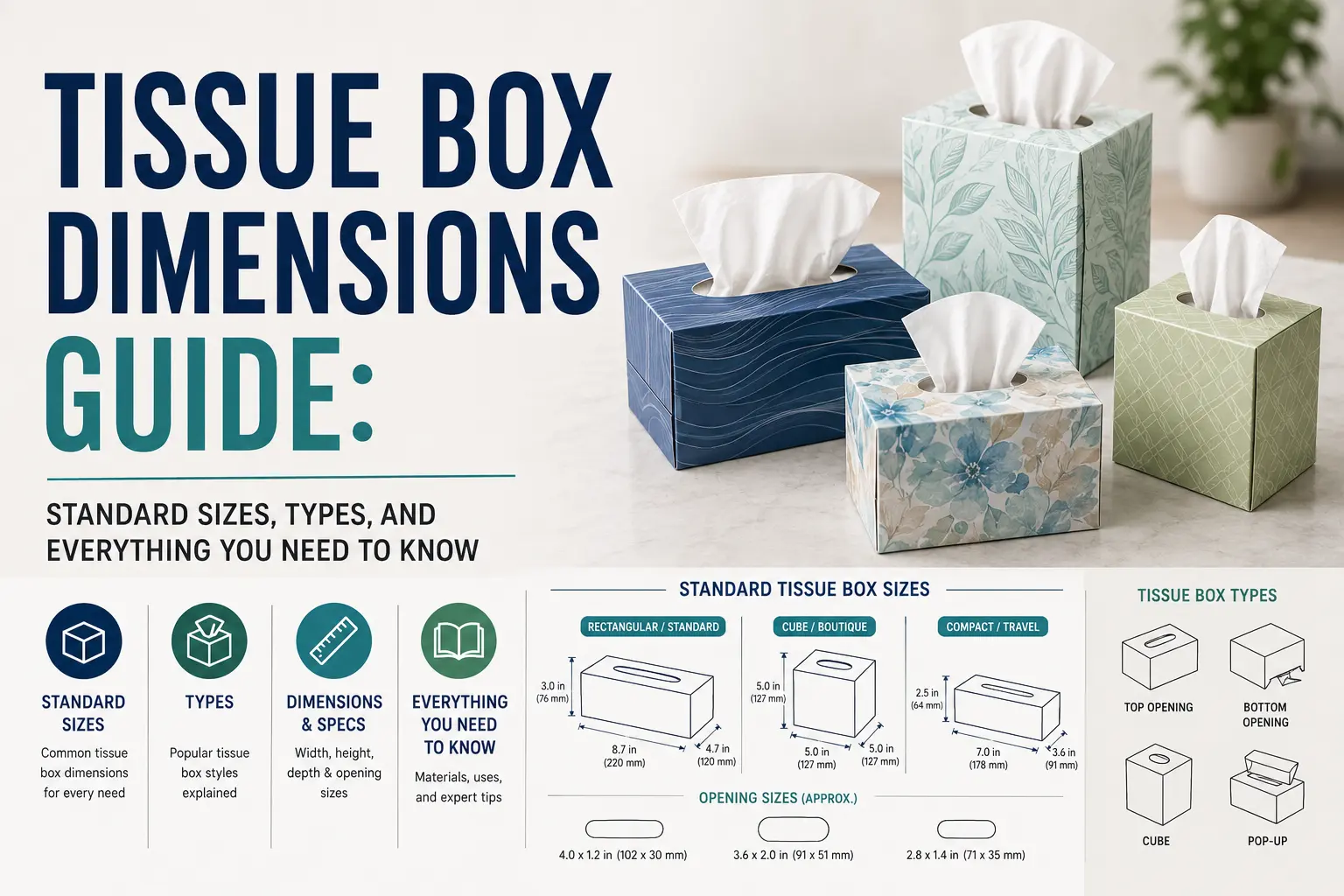
You could probably draw a tissue box from memory, couldn’t you? There’s one on pretty much every desk and nightstand in America, and the shape’s so well known that people sell knitted covers for it and the odd architect has borrowed it for a building. Here are the tissue box dimensions that matter.
Here’s the funny part though. Those sizes weren’t picked because they looked nice. We print a fair few of these and the number of things a tissue box has to get right surprises most clients, from the tissue count and the fold to the shelf it lives on in Target, the pallet it ships on, and that slot on top which has to hand you one tissue at a time without ripping it.
So if you’re a private label brand, a tissue maker, a retail buyer or someone who just wants tissue boxes with a logo on for a hotel, it’s worth knowing the sizes before you ring a supplier. Below we’ve gone through every standard tissue box size and format, why the numbers are what they are, the different box types and where each one gets used, plus a quick reference table at the end.
Why Tissue Box Dimensions Are More Engineered Than They Appear
A tissue box gets squeezed from several directions at once, which is why the industry sizes aren’t neat round numbers. They’re the numbers that happen to solve all the problems together.
Start with the tissue. They go in folded and interleaved (each one’s tucked halfway into the next one, which is the clever bit that makes the next tissue pop up when you pull). However big that folded stack ends up is how big the inside of the box has to be.
Then there’s the opening on top. Too big and the whole stack sags into it, too small and the tissue rips on the way out. It has to be wide enough for fingers, but still hold the last few tissues up when there’s hardly any weight left in the box, so that slot ends up shaping the whole top panel.
Stores are the outside limit. Supermarket and pharmacy shelves in the tissue aisle have set depths and heights, so a box that’s too tall or too deep just doesn’t get shelved well. Go much smaller than the space, though, and you’re wasting shelf space that brands pay good money for.
Then freight. Nobody wants to pay to ship gaps on a pallet, so sizes that stack neatly on a standard 48 by 40 pallet are the ones that survived.
That’s why you keep seeing the same handful of numbers.
Standard Tissue Box Sizes and Dimensions
There are maybe six or seven formats that matter. We’ve put each one below in inches and millimeters as length × width × height (length being the long side as it sits on the table, height being how tall it stands), because mixing those up is the most common mistake we see on quote requests.
These are outside measurements, and they’re typical, not gospel. Kleenex, Puffs and Scotties (and their cousins overseas) all sit roughly here, but every brand’s off by a hair and private label boxes can wander a bit further.
Cube or Square Tissue Box
Size: 4.75 × 4.75 × 5.25 inches, give or take (120.65 × 120.65 × 133.35 mm).
The cube is probably the one you’re picturing. It’s nearly square, so it doesn’t have a “front”, and you can drop it on a desk corner or the edge of a bathroom counter or a coffee table and it looks fine whichever way it faces.
Most cubes hold somewhere around 60 to 80 tissues, depending on the brand and how thick the tissue is. It’s small, which is exactly why people pick it for a desk or a personal space where a long flat box would hog the surface.
Almost every decorative tissue box cover you can buy is made for the cube, by the way, since square covers are much easier to design than long ones.
Ever noticed it’s a bit taller than it is wide? At about 5.25 inches tall against 4.75 on the other sides, that extra half inch is room for the tissue stack and the opening up top.
You’ll see cubes on office desks, bathroom counters and in hotel rooms, basically anywhere someone wants something smaller and a bit nicer looking than a big flat box.
Flat or Rectangle Tissue Box (Standard)
You’ll usually find it at 9.25 × 4.75 × 3.25 inches, or in metric 234.95 × 120.65 × 82.55 mm.
This is the original, and still the best seller pretty much everywhere. Long and low, and when people say “tissue box” this is usually what they mean. It holds roughly 100 to 200 tissues depending on brand, thickness and count, which is the most tissues for its height of any standard box.
Being low, it suits places where you don’t want something tall in the way, a dining table, a conference room credenza, a side table in the living room. And at around 9 to 9.5 inches long, you can reach a tissue from pretty much any side.
Stores love it, mostly because two of them stack on a normal supermarket shelf.
The slot on top is something like 7 × 1.75 inches and runs the long way, same as the tissue stack under it, so you pull along the box rather than across it.
At home it tends to land in the kitchen or living room, where a cold going round the house empties a cube in a day and a half.
Flat or Rectangle Tissue Box (Large Family Size)
A bit bigger all round, so 9.5 × 5 × 3.75 inches or thereabouts (241.3 × 127 × 95.25 mm).
Same idea as the standard flat box, just a bit bigger, more tissues and a better price per tissue. Usually 150 to 230 tissues depending on brand. The little bit of extra height and width takes the extra tissues without the box getting much bigger on the table.
You’ll find these a lot at warehouse clubs, sold in multipacks, and in homes that go through tissues quickly and care about cost per tissue. They still fit anywhere a standard flat box does.
Rectangular Upright or Tall Tissue Box
Same footprint as a cube but 9 inches tall, so 4.75 × 4.75 × 9 (or 120.65 × 120.65 × 228.6 mm).
Take a cube and nearly double the height. Same square footprint, a lot more tissues, so it’s handy wherever counter space is tight but you don’t want to swap boxes all the time.
Bathrooms are where it shines. Sinks and vanities never have enough space, and a tall narrow box squeezes between the soap dispenser and the toothbrush cup, or into a corner, where a flat box would be too wide.
It usually holds 100 to 150 tissues. More than a cube, fewer than a standard flat box, so kind of a middle option.
The opening sits on top, about the same size as a cube’s.
Pocket or Travel Size Tissue Pack
Normally about 4.5 × 3.25 × 0.75 inches, so 114.3 × 82.55 × 19.05 mm.
Strictly speaking these aren’t boxes. They’re soft packets wrapped in plastic film or paper, not paperboard cartons. Still, they’re a standard tissue format and worth having the numbers for.
A pocket pack holds about 8 to 15 tissues and is made to fit a jacket pocket, a handbag or a little side pocket on a backpack. You can buy them one at a time or in multipacks.
At around 0.75 inches thick they actually fit in most pockets, which is the whole point. They’re the go-to for tissues on the move, and you’ll see them at airport shops, checkout counters and convenience stores.
Oval Top Tissue Box
Size wise it’s the standard flat box again, 9.25 × 4.75 × 3.25 inches (234.95 × 120.65 × 82.55 mm). What changes is the hole, which is oval rather than a straight slot, and on some boxes the whole top panel gets rounded off as well.
It’s more of a look than a different format. The tissue comes out a touch differently, but mostly brands use it to stand apart on the shelf, or for product lines where the packaging style matters a lot.
Boutique or Designer Tissue Box
Expect something like 4.5 × 4.5 × 5.5 inches (114.3 × 114.3 × 139.7 mm).
Think of it as the cube’s slightly posher sibling, a touch narrower and often a little taller. It tends to go with nicer tissue aimed at upscale shops and gifting.
Luxury tissue brands use it a lot, and so do hotels for their bathroom amenities. Because it’s meant to look premium, it usually gets fancier artwork, specialty printing and better board than a regular supermarket box. If that’s the look you’re after, our cube gift boxes are built along similar lines.
Tissue Box Dispenser Opening Dimensions
Get the hole wrong and the whole box is useless, so it gets just as much fuss as the box itself.
You want to grab a tissue one-handed while sneezing, basically, no digging around. At the same time the opening has to hold the last few tissues up when the stack’s nearly gone and there’s almost no weight pushing on them.
It also has to match the folded tissue, or the interleaving trick doesn’t work. Pull one out and the next one should come up just far enough to see and grab, not so far that it flops out by itself.
Flat boxes usually get a slot of about 6.5 to 7.5 inches by 1.5 to 1.75 inches, running the long way since the stack underneath runs the long way too.
Cubes have a smaller one, usually around 4 to 4.25 inches long and 1.5 to 1.75 inches wide, matching the smaller inside.
Tall boxes have the same footprint as a cube, so their opening is about the same size.
Most openings have a thin plastic film or a folded paperboard frame around them, which keeps the shape as tissues come out and stops the board from tearing. A few greener brands have dropped the plastic and switched to a paperboard frame so the whole box goes straight in the recycling. (If you’re working on any kind of pull-through box, our dispenser packaging range uses the same idea.)
Tissue Sheet Dimensions and How They Relate to Box Dimensions
This bit trips people up the most when they spec their own box.
Unfold a normal facial tissue and you’ve got something close to 8.2 × 8.4 inches (208 × 213 mm). That’s the two-ply size for standard facial tissue from the big brands. Single-ply sheets are often cut a bit larger, since thinner tissue feels like less in your hand.
Before it goes in the box, each tissue gets folded down to roughly a quarter of its open size, so you end up with a folded packet of about 4.1 × 4.2 inches. The tissues are then interleaved, each one’s edge tucked into the fold of the next, and that stack goes into the box.
The inside of the box has to match that stack pretty closely. Too much room and the stack slides around and the tissues jam at the opening or stop feeding. Too little and the tissues get squashed, which makes them feel worse and come out badly.
That’s why a flat box is usually about 8 to 8.5 inches long and 4 to 4.25 inches wide on the inside, almost the same as the folded packet. The inside height then depends on how many tissues you’re putting in, which is why a higher-count flat box is taller than a lower-count one even when the length and width don’t change at all.
Tissue Box Construction and Materials
Tissue boxes are folding paperboard cartons, usually built a lot like a reverse tuck end or a tray and sleeve. Exactly how depends on the maker and the format.
Paperboard Specification
The usual board is SBS (solid bleached sulfate) at around 16 to 20 point thickness. That’s stiff enough to keep the box in shape the whole time it’s used, even near the end when the remaining tissues aren’t pushing out on the walls anymore. We print a lot of cardstock dispenser boxes on similar board.
The inside surface needs to be clean, since the tissues go on people’s faces and shouldn’t pick up anything from the packaging. SBS handles that fine without any extra treatment.
Printing and Coating
Most tissue boxes are printed offset, with full color artwork, patterns and messaging wrapped around all four sides and the top. The bottom usually stays plain, or just carries a barcode and the required product info.
Finishes depend on where the brand sits. Ordinary supermarket boxes get a gloss varnish so the colors pop and the box doesn’t scuff. Premium ones might get gloss or soft-touch lamination for a nicer feel in the hand, and some go with a matte varnish because it looks a bit more grown up.
Honestly these are some of the more fun jobs we get. A tissue box sits out where guests see it (the dish soap lives under the sink, nobody cares what that looks like), which is why you get holiday prints and limited runs on cubes every year.
Recycled Content and Sustainability
Quick one, this.
Most of the big brands use a lot of recycled board in their boxes now, and the carton can go in the curbside bin once you’ve yanked out that little plastic film around the hole.
The tissue inside is its own topic. Where the fiber comes from is something shoppers and retailers ask about more and more, so you’ll see recycled fiber on a lot of packs.
Tissue Box Sizes for Commercial and Institutional Use
Commercial and institutional tissue packaging is a bit different from what you’d buy at the supermarket, in size, style and spec.
Facial Tissue for Offices and Commercial Environments
Office tissue boxes are usually the normal flat or cube format, the same or close to what’s in stores. The main change is often the count, with higher counts so someone isn’t replacing boxes all day in a busy office.
Some places skip the paperboard box altogether and use a refillable plastic dispenser with a compressed refill pack, which has completely different dimensions from a normal retail box.
Facial Tissue for Hotel and Hospitality
Hotels tend to use smaller boxes than retail, usually boutique or cube, since a guest only needs so many for one stay and the room is supposed to feel a bit special. The board, the printing and the tissue are often nicer than a standard store box.
They also have to fit hotel bathroom vanities and counters, which are usually smaller and more uniform than the ones in people’s homes.
Cube Box for Institutional Desk Use
In an open-plan office, you usually see one tissue box per desk. Nearly everyone goes with the cube for that, because the footprint is small and it doesn’t eat into working space.
Tissue Box Dimensions and Retail Category Management
If you plan shelves for a store, tissue box sizes are one of the main things you’re juggling.
Supermarket gondola shelving in the tissue and paper aisle usually has shelves 12 to 18 inches deep with 12 to 15 inches between them. That works nicely for flat boxes, since at 3.25 inches tall you can stack two on a 12-inch shelf or three on a 15-inch one.
Cubes stand about 5.25 inches tall, so unless the shelves get moved they’re usually one layer only. A lot of stores give cubes their own shelf because they don’t sit well next to flat boxes in the same row.
The flat box’s 9.25-inch length matters a lot for shelf space. On a standard 48-inch gondola section you can fit five flat boxes end to end in one facing, or turn them so the long side runs back into the shelf if it’s deep enough to take 9.25 inches.
Planograms in this aisle have to deal with the size differences between formats and with how fast tissues sell. Popular lines need enough depth on the shelf to hold plenty of stock so staff aren’t refilling every hour.
For a private label brand this is where we’d push back if a designer wants a quirky size. A box that’s half an inch taller than the cube next to it might look great in the mockup, but if it doesn’t fit the shelf gap the store just won’t stock it, or they’ll lay it on its side, which is worse.
Tissue Box Dimensions for Custom and Promotional Packaging
A custom tissue box is one of the few promo items people don’t throw straight in a drawer.
Corporate gifts, weddings, conferences, holiday promos, we’ve seen them all. Nearly every one sticks to a standard size, mainly because the tissue packs you buy from mills are cut to fit standard boxes and nobody wants to pay for odd tooling.
Cubes get customized the most by a mile. Four tall sides plus the top is more room than people expect, enough for a logo and the event details and still some pattern left over.
Print a cube with the couple’s names and the wedding date and guests really do take them home, which you can’t say for most favors. Companies doing a desk giveaway lean toward flat boxes instead.
Minimums vary by supplier and print method. Digital printing is what makes short runs possible, and with us minimums are low, often around 50 boxes depending on the style. Offset’s more for the 500-plus crowd, where it starts to make sense on price. Want a ballpark? Our packaging cost calculator gives you one in a minute, or send us your size and quantity and we’ll do it properly.
Common Applications and Where Each Tissue Box Size Is Used
Quick cheat sheet, by where the box ends up.
Desk, small bathroom, hotel vanity, a little meeting room? Cube, nine times out of ten.
If it’s the family room or a dining table, somewhere tissues disappear fast and a low box looks tidier, we’d go flat. Same for conference tables, and for shelves where a store wants the most tissues per foot.
The tall one is for that awkward gap between the soap and the toothbrushes, where you’ve only got a cube’s worth of floor but want more tissues in it.
Boutique boxes suit nice home bathrooms, hotel rooms, spas and gifting, where the box itself is supposed to say quality.
Pocket packs are for bags, pockets, trips, outdoor events, the car glove box, and anywhere you need tissues and there’s no box around.
Measuring your own box or tissue pack? Our guide on how to measure a box explains how suppliers read length, width and height. We did the same kind of rundown for cereal, too, in the cereal box dimensions guide.
FAQs
What are the standard dimensions of a tissue box?
There isn’t just one, annoyingly. Most of the time people mean the cube or the long flat box, and the numbers for those two (plus the tall and family sizes) are in the table at the bottom, so we won’t repeat them all here.
How big is a Kleenex tissue box?
Pretty much the standard cube and flat sizes above. It does shift a little between their product lines though, so if you’re making a cover to fit one, we’d measure the actual box on your counter rather than trust a number off the internet (ours included).
What size is a standard cube tissue box?
Roughly 4.75 by 4.75 wide and 5.25 tall, on the outside, and you’ll get maybe 60 to 80 tissues in one depending on how plush they are.
How many tissues fit in a standard flat tissue box?
Depends what you bought, but the everyday one’s normally 100 to 120 tissues and the big family size at a warehouse club can run 150 to 230.
What is the size of the opening on a tissue box?
On the flat box we usually see something between 6.5 and 7.5 inches long and an inch and a half or so wide. The cube’s slot is shorter, more like 4 inches and a bit.
What size tissue box fits in a standard tissue box cover?
Nearly all of them are made for the cube (4.75 × 4.75 × 5.25). Flat box covers exist, sized for 9.25 × 4.75 × 3.25, they’re just harder to find.
What are the dimensions of a travel size tissue pack?
Small enough to live in your jeans pocket for a week without you noticing, at about 4.5 × 3.25 × 0.75 inches, and there’s usually 8 to 15 in there.
Can tissue boxes be recycled?
The cardboard part, yep, most towns take it curbside. Just tear the plastic film out of the hole first because the paper mill really doesn’t want it.
What is the surface area of a standard cube tissue box?
Close to 145 square inches, which we only know because people designing all-over prints ask us. You get there by adding the top and bottom (4.75 × 4.75 each) to the four sides (4.75 × 5.25 each), which is handy to know if you’re working out print area for a custom design.
How deep is a tissue box shelf space at retail?
Usually 12 to 18 inches deep in a supermarket or drugstore, so with a flat box being 4.75 inches wide you’d get two, maybe three, lined up front to back on a 12-inch shelf.
Quick Reference: Standard Tissue Box Dimensions
And here’s everything in one place, if you just want the numbers to send to your designer or printer. We’d still measure your actual tissue stack before ordering, since a few millimeters either way matters more than you’d think on a box this small, and honestly the tissue count column is the one that varies most, because two brands with the same box can stuff very different numbers of sheets in depending on how thick the ply is.
| Format | Length | Width | Height | Typical Tissue Count |
|---|---|---|---|---|
| Cube | 4.75 in (120.65 mm) | 4.75 in (120.65 mm) | 5.25 in (133.35 mm) | 60 to 80 |
| Standard flat | 9.25 in (234.95 mm) | 4.75 in (120.65 mm) | 3.25 in (82.55 mm) | 100 to 160 |
| Large family flat | 9.5 in (241.3 mm) | 5 in (127 mm) | 3.75 in (95.25 mm) | 150 to 230 |
| Tall upright | 4.75 in (120.65 mm) | 4.75 in (120.65 mm) | 9 in (228.6 mm) | 100 to 150 |
| Boutique | 4.5 in (114.3 mm) | 4.5 in (114.3 mm) | 5.5 in (139.7 mm) | 50 to 75 |
| Travel pack | 4.5 in (114.3 mm) | 3.25 in (82.55 mm) | 0.75 in (19.05 mm) | 8 to 15 |
Keep Reading
Ready to order? Start with custom mailer boxes and product packaging boxes. For more background, read beer box dimensions: 6, 12 & 24 pack sizes explained and jewelry box dimensions: standard sizes for every piece type.