

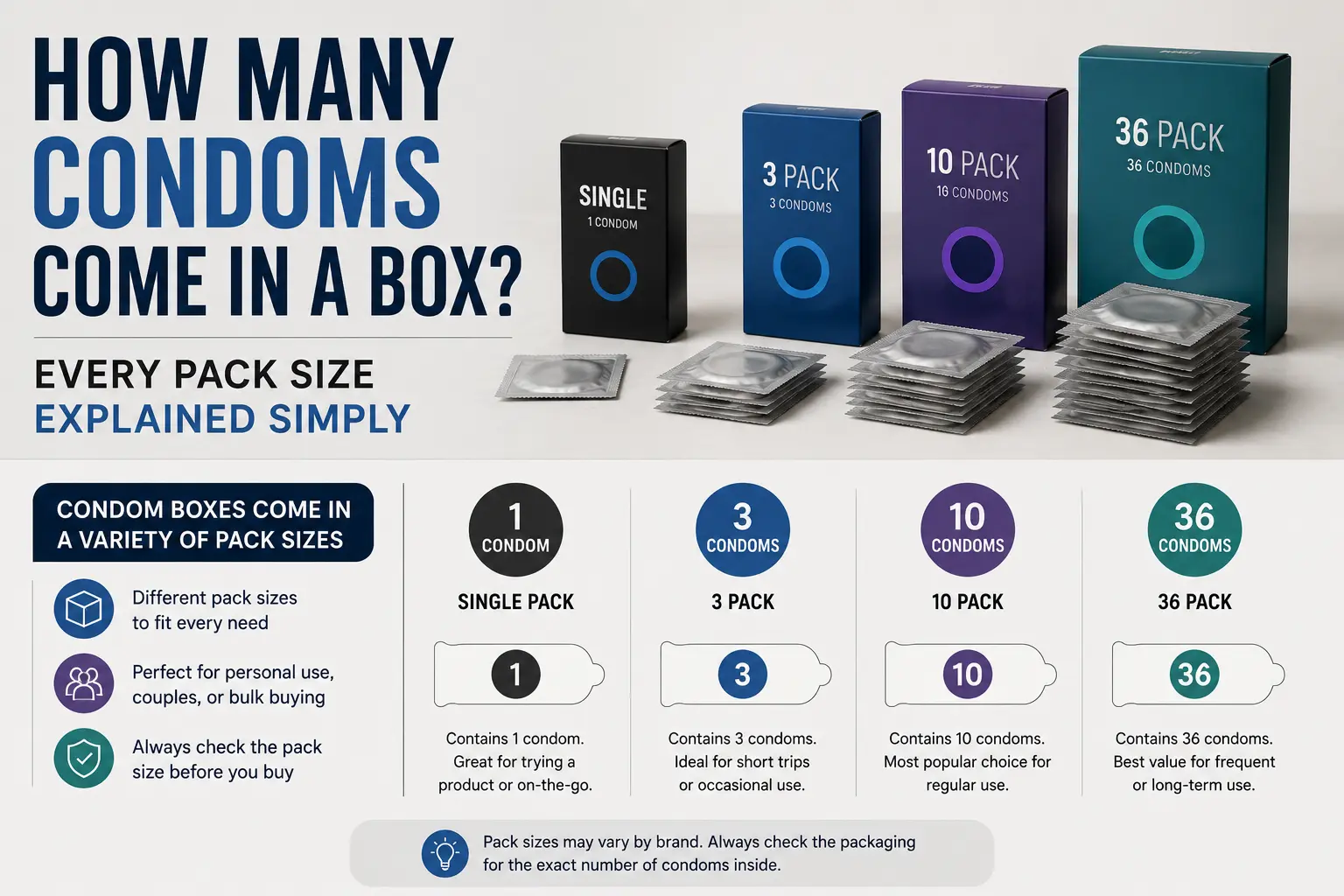
How Many Condoms Come in a Box? Every Pack Size Explained Simply

Condom pack sizes explained simply

If you have ever walked down the pharmacy aisle looking for condoms, you already know how many choices there are. Small boxes. Big boxes. Value packs. Bulk packs. Different brands, different numbers on the front. It can feel confusing when all you want is a simple answer.

So here it is: most custom condom boxes contain 3, 10, 12, or 24 condoms. These are the sizes you will find most often on pharmacy and grocery store shelves in the United States. Beyond that, larger sizes of 36, 50, 100, and even 1,000 are available online and at warehouse clubs.

But the full picture is more interesting than just a list of numbers. This guide explains every pack size, what each one is actually for, how much each costs per condom, how major brands like Trojan, Durex, and Magnum package their products, and how to figure out which size is right for you.

The Four Main Condom Pack Categories

Before getting into specific numbers and brands, it helps to know that condom boxes generally fall into four broad categories. Once you understand these, the rest makes a lot more sense.

Trial or travel packs contain 1 to 6 condoms. These are for people trying a brand for the first time, people who need just a few for a trip, or people who buy condoms occasionally. They cost more per condom than larger packs but have the lowest total price on the shelf.

Standard retail packs contain 10 to 12 condoms. This is the most popular size at pharmacies and grocery stores. It is the size that most regular users buy. The price is reasonable and the quantity lasts long enough to be convenient without being an overwhelming commitment.

Value packs contain 24 to 36 condoms. These are for people who use condoms regularly and want to save money over time. Buying a 24-pack instead of two 12-packs usually saves you a noticeable amount per condom.

Bulk packs contain 50 to 1,000 or more condoms. These are for very frequent users, couples using condoms as their main contraceptive method, clinics, universities, and health organisations that distribute condoms to others. The cost per condom drops significantly at this level.

Every Pack Size Explained

Here is a breakdown of every common box size you will encounter, what it contains, and who it is best for.

1-pack or single condom

Single condoms are sold individually, usually near pharmacy checkout counters, in vending machines, at convenience stores, and in some hotel amenity kits. They are the most expensive per condom by a wide margin but are genuinely useful when you need just one in a hurry. Some brands package them in stylish metal tins or card wallet formats for discretion.

3-pack

The 3-pack is the smallest standard box. It is everywhere: pharmacies, grocery stores, petrol stations, convenience stores, and even some supermarket self-checkout areas. It is designed for trying a new brand or type before buying more, for travel, and for people who use condoms occasionally. The 3-pack is typically the most expensive option per condom but has the lowest shelf price overall, usually between $3 and $8 depending on the brand.

6-pack

The 6-pack is slightly larger than the 3-pack and is a step up for people who want a bit more on hand without committing to a bigger box. It is widely available and popular for people who use condoms occasionally but more than just a few times a month.

10-pack

Some brands use 10 as their standard pack size rather than 12. Durex commonly uses 10-packs in some markets and product lines. The difference between a 10 and a 12-pack is small in terms of cost and value, but it is worth checking the number on the front of the box rather than assuming it is 12.

12-pack

The 12-pack is the single most popular condom box size in the United States. It is the default standard size for most brands across most product lines. When someone says they are buying a box of condoms, they are most often talking about a 12-pack. It typically costs between $10 and $18 at retail pharmacies depending on the brand and type.

24-pack

The 24-pack is the first real value size. Buying a 24-pack instead of two 12-packs almost always saves money. It is widely available at pharmacies, online, and at some warehouse clubs. People who use condoms regularly every week typically find the 24-pack to be the sweet spot between cost savings and not overbuying.

36-pack

The 36-pack is a popular bulk option available from most major brands. Trojan in particular offers many of its popular product lines in 36-packs. This size is most commonly available online and at warehouse retailers like Costco. The cost per condom drops noticeably compared to smaller packs.

40-pack

Some brands offer 40-packs as a slightly unusual bulk size, typically sold online. The value per condom is similar to the 36-pack.

48-pack

The 48-pack is available from some brands online. Like the 40-pack, it sits between the standard 36-pack and the larger 100-pack.

50-pack

Some brands offer 50-packs as a round-number bulk option, typically available through online retailers and health organisations.

100-pack

The 100-pack is the standard large bulk size for individual consumers. Major brands including Trojan, Durex, and Lifestyles offer 100-packs through online retailers and warehouse clubs. The cost per condom at this level is typically the lowest available to regular consumers, often 40 to 70 cents per condom for mainstream brands.

144-pack

Some brands offer 144-packs, which is the equivalent of a gross (a traditional wholesale unit of 12 dozen). Durex offers a 144-pack called the Adventure Pack in some markets. These are usually only practical for very heavy users or organisations.

1,000-pack and larger

For clinics, sexual health organisations, universities, and government health departments, condoms are available in cases of 1,000 or more directly from manufacturers and medical supply distributors. These are not sold at regular retail locations. The cost per condom at this volume can be as low as 10 to 25 cents.

Pack Size Comparison Table

Pack SizeBest ForTypical Retail Price (USD)Approx. Cost Per Condom
1 (single)Emergency, travel, vending$1 to $3Very high
3-packTrying a new brand, occasional use$3 to $8High ($1.00 to $2.50)
6-packOccasional use, slightly better value$6 to $12High ($1.00 to $2.00)
10-packStandard retail, some brands$8 to $14Medium ($0.80 to $1.40)
12-packMost popular standard size$10 to $18Medium ($0.83 to $1.50)
24-packRegular users, value buying$15 to $28Medium-low ($0.60 to $1.15)
36-packFrequent users, good bulk value$20 to $35Low ($0.55 to $0.97)
100-packHeavy users, best retail value$40 to $70Very low ($0.40 to $0.70)
144-packVery heavy users, some brands online$45 to $80Very low ($0.31 to $0.55)
1,000-packClinics, organisations, wholesale$100 to $400Lowest ($0.10 to $0.40)

Prices vary by brand, retailer, and whether you are buying in store or online. Online prices are usually lower than in-store for the same product.

How Many Condoms Come in a Box by Brand

Different brands package their condoms in different quantities. Here is a clear breakdown of the most widely sold brands in the United States.

Trojan

Trojan is the best-selling condom brand in the United States with around 70 percent market share. It offers the widest range of pack sizes of any brand. Depending on the specific product line, Trojan condoms are available in 3-packs, 6-packs, 10-packs, 12-packs, 24-packs, 36-packs, and 100-packs. Their most popular products like Trojan ENZ, Trojan Bareskin, and Trojan Ultra Thin are available in most of these sizes. Newer or more specialised lines may only come in smaller sizes initially.

For Magnum condoms, which are Trojan’s larger size range, the packaging follows the same size options as regular Trojan condoms. Magnum boxes come in 3-packs, 12-packs, and 24-packs at most retail locations, with larger sizes available online. Some Magnum bulk options go up to 1,000 units for wholesale buyers.

Durex

Durex is the top-selling condom brand globally and is particularly dominant in Europe, Australia, and many Asian markets. In the United States, Durex commonly comes in 3-packs, 10-packs, 12-packs, and 24-packs at retail. Online, Durex offers larger sizes including 36-packs and their 144-pack Adventure Pack which is one of their most popular bulk options.

Durex electronically tests every single condom it produces, which is a quality assurance point the brand highlights in its marketing.

Lifestyles and SKYN

Lifestyles is a widely distributed US brand available at most pharmacies. Standard retail sizes are 3-packs, 12-packs, and 24-packs. Their SKYN line, which uses polyisoprene instead of latex and is suitable for people with latex allergies, comes in 3-packs, 12-packs, and 24-packs at most retailers. Because polyisoprene is more expensive to manufacture than latex, SKYN products are generally not available in the very large bulk sizes that latex condoms come in.

Magnum (by Trojan)

Magnum deserves its own mention because it is frequently searched for separately. Magnum condoms are Trojan’s larger-diameter condom line and the packaging sizes are the same as standard Trojan sizes: 3-packs, 12-packs, and 24-packs at retail, with larger bulk sizes available online. The box is slightly larger physically than a standard Trojan box to accommodate the larger condom dimensions, but the count per box is the same.

ONE Condoms

ONE Condoms is known for fun, colourful designs and a wide variety of styles. They commonly sell in 3-packs, 12-packs, and 24-packs, with some styles available in larger sizes online.

Crown Skinless Skin

Crown is a popular choice among users looking for an ultra-thin condom. They are available primarily through online retailers in 12-packs, 36-packs, and 144-packs.

Female Condoms (Internal Condoms)

Female condoms, also called internal condoms, are a different product from male external condoms and come in smaller quantities. The FC2 Female Condom, which is the primary brand available in the United States, is typically sold in 3-packs or 12-packs. Female condoms are less widely available at retail than male condoms and are more commonly obtained through health clinics and online.

Store Brand and Generic Condoms

Pharmacy chains including CVS, Walgreens, and Rite Aid all sell their own store-brand condoms, typically positioned as a lower-cost alternative to national brands. Store brand condoms are regulated to the same FDA standards as name brand condoms. They are usually available in 12-packs and 24-packs.

Brand Pack Size Summary Table

BrandSmallest PackMost Common Retail PackLargest Widely Available Pack
Trojan312100 (online)
Durex312144 (online)
Magnum (Trojan)312100 (online)
SKYN (Lifestyles)31224
Lifestyles31236
ONE Condoms31224
Crown1212144
FC2 Female Condom31212
Store brands (CVS, Walgreens)31224

Variety Packs: Trying Multiple Types in One Box

One option that many people do not know about is the variety pack. A variety pack contains a mix of different condom types from the same brand in a single box. Instead of getting 12 of the same condom, you might get 3 each of 4 different styles, giving you a chance to try different textures, sensitivities, and features without buying a full box of each.

Trojan and Durex both offer popular variety packs. Common configurations include:

A 12-count variety pack with 3 or 4 condoms of each of 3 or 4 different styles. A 24-count variety pack with 6 condoms of each of 4 different styles. A 36-count variety pack with multiple styles in larger quantities.

Variety packs are a genuinely useful option if you are not sure what type of condom you prefer, if you and your partner like different styles at different times, or if you simply enjoy having variety. They are widely available at pharmacies and online.

Specialty Condom Pack Sizes

Not all condom types come in the same range of pack sizes. Specialty condoms are often only available in smaller packs because they sell in lower volumes than standard condoms.

Ultra-thin condoms are usually available in 3-packs, 10-packs, and 12-packs. Occasionally in 24-packs.

Textured and ribbed condoms follow similar availability to ultra-thin, with 3-packs and 12-packs being the most common.

Flavoured condoms are typically sold in 3-packs or small variety packs of 5 to 12. Large bulk flavoured condom packs are unusual.

Glow-in-the-dark condoms are typically a novelty product sold in very small packs of 3.

Extra-large condoms follow similar pack size availability to standard condoms but may have fewer bulk options available depending on the brand.

Non-latex condoms including polyisoprene (SKYN) and polyurethane varieties are generally available in smaller pack sizes because the higher manufacturing cost makes large bulk packs less economically practical for most consumers.

Condom Subscription Services

Something none of the other guides covering this topic mention is the growing availability of condom subscription services. Several online retailers and brands now offer subscriptions where condoms are delivered to your door on a regular schedule, typically monthly or quarterly.

Subscription services typically offer:

A discount of 10 to 20 percent compared to one-time purchase prices. The convenience of never running out. Delivery in discreet plain packaging. Flexibility to change pack sizes, frequency, or product type between deliveries.

Popular subscription options include services through Amazon Subscribe and Save, direct subscriptions from brands like Trojan and Durex through their own websites, and sexual health focused subscription services. If you use condoms regularly and have identified a brand and type you are happy with, a subscription is worth considering as a convenient and cost-effective option.

Are Condoms FSA and HSA Eligible?

This is a practical detail that many people in the United States do not know. Condoms are eligible for purchase with Flexible Spending Account (FSA) and Health Savings Account (HSA) funds. This means if you have an FSA or HSA through your employer or health insurance, you can use those pre-tax dollars to buy condoms, which effectively reduces the cost by your marginal tax rate.

Most major online retailers including Amazon and pharmacy chain websites allow you to filter for FSA-eligible products. Condoms from all major brands qualify.

Using FSA funds to buy a large bulk pack of condoms at the beginning of the year is a practical way to reduce cost and make sure your FSA dollars are spent before any year-end use-it-or-lose-it deadline applies.

How Condom Box Size Affects Cost Per Condom

The price difference between small and large packs is significant. Here is a concrete example using Trojan ENZ as a reference, which is one of the most widely sold condom products in the US.

A 3-pack of Trojan ENZ typically costs around $5 to $7 at a pharmacy, which works out to approximately $1.67 to $2.33 per condom.

A 12-pack of Trojan ENZ typically costs around $12 to $15, which works out to approximately $1.00 to $1.25 per condom.

A 36-pack of Trojan ENZ typically costs around $20 to $28 online, which works out to approximately $0.55 to $0.78 per condom.

A 100-pack of Trojan ENZ typically costs around $45 to $60 online, which works out to approximately $0.45 to $0.60 per condom.

Compared to the 3-pack price, buying a 100-pack saves roughly 65 to 75 percent per condom. Over a year of regular use, this can amount to a real saving of $100 or more depending on how frequently you use condoms.

The catch, as always, is the expiry date. Buying more than you will realistically use before the condoms expire is not a saving. It is waste.

Condom Shelf Life and How It Affects Pack Size Choice

Every condom box has an expiry date printed on it, and every individual foil wrapper has an expiry date stamped on it as well. Using a condom after its expiry date is not recommended because the material can degrade, which reduces its reliability.

Here are the standard shelf life guidelines:

Latex condoms without spermicide typically last 5 years from the date of manufacture. Latex condoms with spermicide typically last 3 years from the date of manufacture. Polyisoprene condoms (such as SKYN) typically last 3 years from manufacture. Polyurethane condoms typically last 5 years from manufacture.

When you buy a box of condoms in store, the expiry date is usually 2 to 4 years away depending on how long the product has been sitting in the supply chain. When you buy online, freshness can vary more, so it is worth checking the expiry date if you are buying in bulk.

A practical guideline: buy only what you expect to use within one to two years to be safe, and check the expiry date on the box at the time of purchase if you are buying a large quantity.

Proper Condom Storage

This matters because storing condoms incorrectly can damage them even before the expiry date, making them less reliable even if they technically have not expired.

Store condoms at room temperature in a dry location away from direct sunlight. A bedside drawer, bathroom cabinet with good ventilation, or a closet shelf all work fine.

Do not store condoms in your wallet for more than a few days. The heat from your body and the friction of sitting on the wallet can damage the condom and the foil wrapper.

Do not store condoms in your car’s glove compartment. Cars can get very hot, and heat degrades latex rapidly.

Do not store condoms near sharp objects, perfume, sunscreen, or other chemicals that could puncture the wrapper or degrade the material.

Where to Buy Each Pack Size

The pack sizes available to you depend on where you are shopping.

Convenience stores and petrol stations almost exclusively carry 3-packs. Occasionally you will find a 6-pack, but the selection is very limited. Prices at convenience stores are typically the highest of any channel.

Pharmacies and drugstores such as CVS, Walgreens, and Rite Aid carry the widest in-store selection. You will typically find 3-packs, 12-packs, and 24-packs of major brands, with some stores also stocking 36-packs of popular products.

Grocery stores and supermarkets typically carry 3-packs and 12-packs with some 24-packs. Selection is usually smaller than a dedicated pharmacy.

Warehouse clubs such as Costco and Sam’s Club carry large bulk packs, typically 36-packs, 40-packs, or multi-pack bundles of 12-packs. Costco in particular offers competitive prices on bulk condom packs from major brands.

Online retailers such as Amazon offer the widest range of pack sizes including sizes not available in physical stores. Prices are generally lower than in-store for the same product, and delivery is in plain, discreet packaging.

Health clinics, sexual health centres, and Planned Parenthood provide free condoms in individual sachets or small packs as part of their sexual health services. These are free of charge regardless of income or insurance status.

University health centres frequently provide free condoms to students. Many universities also sell condoms at reduced prices through campus health services or vending machines.

Condom Box Dimensions and Packaging

For those who are interested in the physical size of condom boxes, standard retail boxes are compact and discreet. A typical 12-pack condom box measures approximately 3.5 to 4 inches long, 2.5 to 3 inches wide, and 0.75 to 1 inch deep. The exact dimensions vary slightly by brand and product.

Individual condoms inside the box are each wrapped in a small square or rectangular foil packet, typically around 2.5 by 2.5 inches. These foil wrappers provide a hermetic seal that protects the condom from air, moisture, and light, all of which can degrade the material over time.

Larger bulk boxes are proportionally bigger, and 100-packs are typically around the size of a medium paperback book.

Most brands deliver online orders in plain brown boxes or padded envelopes with no branding visible on the outside, which is a privacy consideration many buyers appreciate.

FAQs

How many condoms come in a standard box?
The most common standard box size is 12 condoms. However this varies by brand, with 3, 10, and 24 also being widely sold sizes.

How many condoms are in a Trojan box?
Trojan boxes come in 3, 6, 10, 12, 24, 36, and 100 count depending on the product line. The 12-pack is the most common Trojan box size at retail.

How many condoms come in a Durex box?
Durex boxes typically contain 3, 10, 12, or 24 condoms at retail. Online you can find Durex in larger box sizes including 36 and 144 count.

How many condoms come in a Magnum box?
Magnum boxes by Trojan come in 3, 12, and 24 count at most retail stores. Larger Magnum box sizes are available online.

What is the biggest condom box you can buy?
For individual consumers the largest commonly available box is 100 count. Some brands like Durex sell 144-count boxes online. Wholesale boxes of 1,000 exist for clinics and organisations.

What is the smallest condom box available?
The smallest standard box is a 3-pack, widely available at pharmacies, convenience stores, and petrol stations. Some brands also sell single condoms individually.

Do all brands use the same box sizes?
No. Box sizes vary by brand. Trojan offers the widest range of box sizes. SKYN and specialty brands typically only offer smaller box sizes due to higher manufacturing costs.

Why do some condom boxes have 10 and others have 12?
There is no universal standard. Each brand chooses its own box count. Some brands use 10 as their standard box size while others use 12. Always check the number on the front of the box rather than assuming.

Are variety pack boxes available?
Yes. Trojan and Durex both offer variety pack boxes containing multiple condom types in one box, typically in 12, 24, or 36 count configurations.