

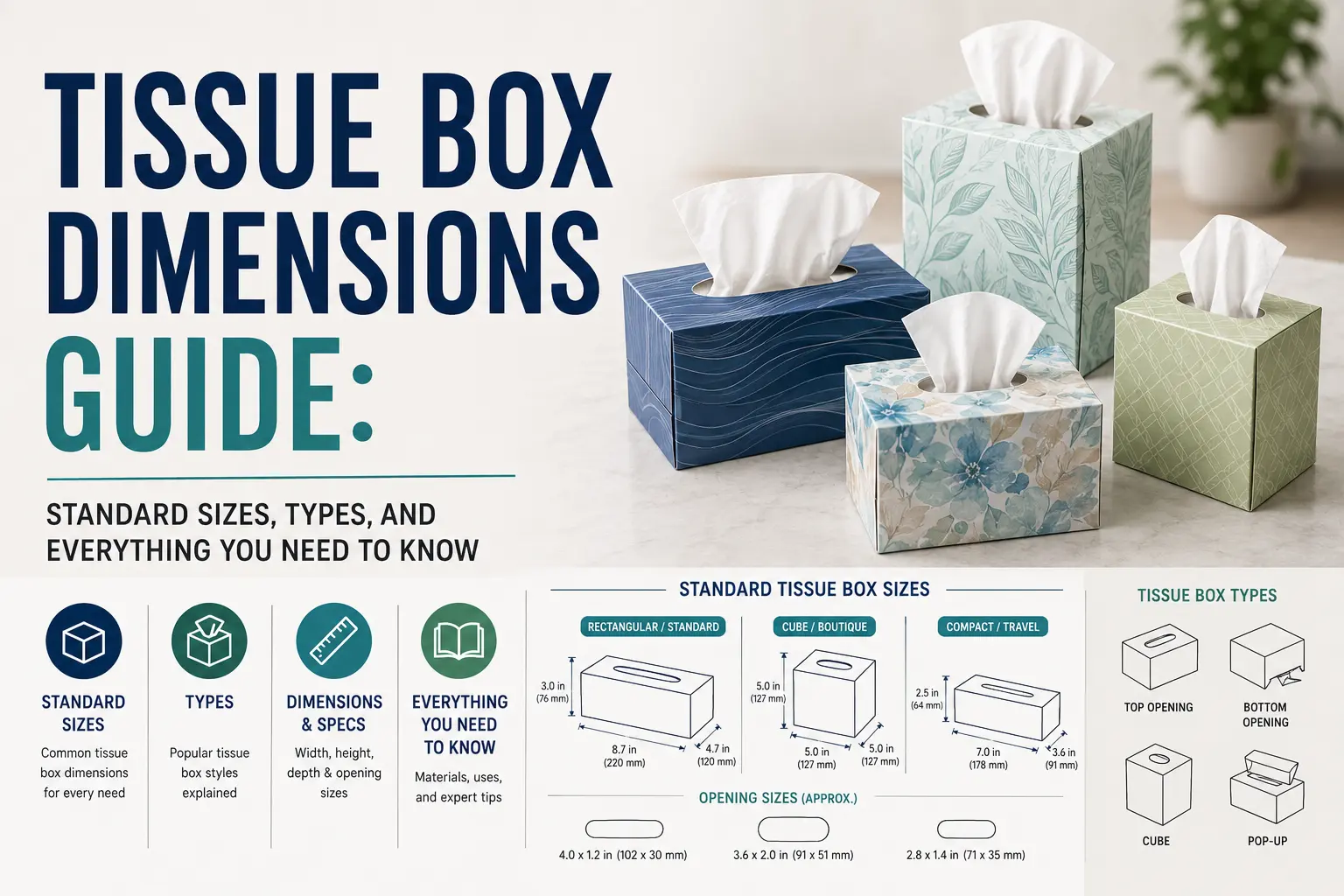
Few household products are as immediately recognisable as the tissue box. It sits on desks, nightstands, kitchen counters, bathroom vanities, and coffee tables in homes and offices around the world. Its shape is so familiar that it has become a design object in its own right, inspiring decorative covers, architectural references, and product design homages across multiple creative industries.
But beneath that familiar shape lies a more complex reality than most people expect. Tissue box dimensions are not arbitrary. They are the result of carefully considered decisions by packaging engineers and product designers that balance the number of tissues the box holds, the physical dimensions of each tissue sheet, how the tissues fold and stack inside the box, how the box fits into retail shelf allocations, how efficiently it ships and stores, and how a dispenser opening of specific dimensions allows tissues to be extracted one at a time without tearing or jamming.
For packaging buyers, private label brands, tissue manufacturers, retail category managers, and anyone sourcing custom tissue boxes, understanding these dimensions in detail is genuinely important practical knowledge. This guide covers every standard tissue box size and format, explains the engineering reasoning behind the dimensions, addresses different box types and their applications, and provides comprehensive reference information for practical use.
Why Tissue Box Dimensions Are More Engineered Than They Appear
The dimensions of a tissue box are constrained from multiple directions simultaneously, which is why the sizes that have emerged as industry standards are not arbitrary round numbers but specific measurements that solve a set of intersecting requirements.
The tissue sheet itself is the primary constraint. A standard facial tissue sheet is folded and interleaved in a specific way before being placed in the box. Interleaved tissues are folded so that each tissue is partially nested inside the next, allowing one tissue to pull up as the previous one is extracted. The dimensions of the folded sheet stack determine the internal dimensions the box must accommodate.
The dispenser opening at the top of the box is engineered to a specific size that allows single tissue extraction without the entire stack collapsing into the opening or the tissue tearing during extraction. The opening must be large enough for a hand to access the tissue but small enough to support the remaining tissues from falling through. This functional engineering constraint directly influences the top panel dimensions of the box.
Shelf allocation in retail environments is the external constraint. Standard supermarket and pharmacy shelving for the tissue category uses specific shelf depths and heights within which tissue boxes must fit. Boxes that exceed these allocations cannot be efficiently shelved. Boxes that are significantly smaller than shelf allocations waste premium retail real estate that brands pay dearly to occupy.
Shipping efficiency drives the depth and width proportions of tissue boxes. Boxes must tessellate efficiently on standard pallets, and the dimensions that produce efficient pallet coverage without wasted space have influenced the standard sizes that the industry has converged on over decades.
All of these constraints interact, which is why tissue box dimensions cluster around specific values rather than being spread evenly across a range.
Standard Tissue Box Sizes and Dimensions
The tissue box industry has converged on several standard formats, each serving a distinct use case and target consumer need. These formats are described below with typical dimensions in both inches and millimetres. Dimensions are given as length × width × height, where length is the longest horizontal dimension, width is the shorter horizontal dimension, and height is the vertical dimension of the standing box.
It is important to note that these are typical external dimensions reflecting industry convention. Actual dimensions vary between brands and manufacturers by small amounts, and private label or custom tissue boxes may deviate from these standards. The dimensions below represent the ranges used by major tissue brands including Kleenex, Puffs, Scotties, and equivalent international brands.
Cube or Square Tissue Box
Typical dimensions: 4.75 × 4.75 × 5.25 inches (120.65 × 120.65 × 133.35 mm)
The cube tissue box is one of the most immediately recognisable packaging formats in the consumer goods category. Its near-square proportions make it visually distinctive on any surface and allow it to be oriented in any direction without appearing out of place. It fits equally well on a desk corner, a bathroom counter edge, or a coffee table without the directionality that rectangular boxes impose.
The cube box typically holds approximately 60 to 80 tissues depending on the brand and tissue thickness. Its compact dimensions make it the preferred format for personal and workspace use where a full-size flat box would take up too much surface area.
The cube format is also the most popular format for decorative tissue box covers, because its square proportions are easier to design covers for than rectangular formats. The wide range of decorative tissue box covers available for purchase is largely sized and shaped for the cube format.
The slight height advantage over its width and length, at approximately 5.25 inches tall versus 4.75 inches in the other two dimensions, reflects the internal stacking of the tissues and the space required for the dispenser opening at the top.
Cube boxes are popular for office desk use, bathroom counters, hotel rooms, and any setting where a smaller, more decorative tissue box is preferred over a full-size flat box.
Flat or Rectangle Tissue Box (Standard)
Typical dimensions: 9.25 × 4.75 × 3.25 inches (234.95 × 120.65 × 82.55 mm)
The flat rectangular tissue box is the original and most widely sold tissue box format globally. Its elongated, low-profile shape is what most people picture when they think of a tissue box. It holds approximately 100 to 200 tissues depending on the brand, tissue thickness, and count variant, making it the highest-capacity standard tissue box format relative to its height.
The flat box’s low profile makes it well suited to surfaces where vertical space is limited or where a lower visual profile is preferred, such as on a dining table, conference room credenza, or living room side table. Its length dimension of approximately 9 to 9.5 inches is comfortably within the reach of most adults from any angle, making the tissue easy to extract regardless of where the box is positioned on a surface.
The flat box is also the most efficient format for retail shelving, where its low profile allows two tiers of boxes to be stacked on a standard supermarket shelf and its length maximises the use of horizontal shelf space.
The dispenser opening on a flat tissue box runs along the top panel parallel to the length of the box, typically measuring approximately 7 × 1.75 inches. This elongated opening reflects the elongated stack of interleaved tissues inside and the direction from which tissues are most naturally extracted.
Flat boxes are the dominant format for family use in living rooms, bedrooms, and kitchens where tissue consumption is high and the larger tissue count of the flat box reduces replacement frequency.
Flat or Rectangle Tissue Box (Large Family Size)
Typical dimensions: 9.5 × 5 × 3.75 inches (241.3 × 127 × 95.25 mm)
The large family size flat box is a slightly larger variant of the standard flat box, offering greater tissue count at a better cost per tissue. It typically holds 150 to 230 tissues depending on brand and variant. The additional height and width compared to the standard flat box accommodate the greater tissue count without requiring a disproportionate increase in box footprint.
This format is particularly popular in warehouse club retail alongside multipack configurations, and in households with high tissue consumption where cost efficiency per tissue is a priority. The slightly larger dimensions do not significantly affect how the box fits on standard surfaces.
Rectangular Upright or Tall Tissue Box
Typical dimensions: 4.75 × 4.75 × 9 inches (120.65 × 120.65 × 228.6 mm)
The upright or tall tissue box has the same square footprint as the cube box but is significantly taller, approximately double the height of a cube box. This format is designed to hold a higher tissue count than the cube in the same countertop footprint, making it a space-efficient option for environments where counter space is at a premium but tissue supply must be maintained.
The tall upright format is particularly popular for bathroom use, where counter space around sinks and vanities is often limited. Its tall, narrow profile fits between bathroom accessories and in the corners of counters where a flat box would be too wide.
The tall box typically holds 100 to 150 tissues, more than a cube but fewer than a standard flat box, positioning it as a mid-capacity option in terms of tissue count.
The dispenser opening on a tall box is positioned at the top of the tall face and is sized similarly to the cube box opening.
Pocket or Travel Size Tissue Pack
Typical dimensions: 4.5 × 3.25 × 0.75 inches (114.3 × 82.55 × 19.05 mm)
Travel size or pocket tissue packs are not boxes in the same structural sense as the formats above. They are flexible poly-wrapped or paper-wrapped packets rather than rigid paperboard boxes. However, they are a standard format in the tissue category and their dimensions are worth including for completeness.
Pocket packs typically contain 8 to 15 tissues and are sized to fit in a jacket pocket, handbag pocket, or small bag compartment. They are sold both individually and as multipacks at retail.
The very flat profile of approximately 0.75 inches makes them genuinely pocketable in most clothing types. They are the dominant format for on-the-go tissue use and are common in travel retail, impulse purchase locations, and convenience stores.
Oval Top Tissue Box
Typical dimensions: 9.25 × 4.75 × 3.25 inches (234.95 × 120.65 × 82.55 mm)
The oval top tissue box uses the same general dimensions as the standard flat rectangular box but features a dispenser opening that is oval or elliptical rather than the conventional rectangular slot. Some formats also use a rounded oval shape for the entire top panel.
The oval opening is a design variant rather than a functionally different format. It produces a slightly different extraction behaviour and is used primarily as a visual differentiator by certain brands or for specific product lines where packaging aesthetics are a priority.
Boutique or Designer Tissue Box
Typical dimensions: 4.5 × 4.5 × 5.5 inches (114.3 × 114.3 × 139.7 mm)
The boutique tissue box is a compact, premium format positioned between the cube and a standard retail box. It is slightly smaller than the standard cube in footprint but may be taller, and it is associated with higher-quality tissue products targeted at premium retail and gifting markets.
The boutique format is particularly common for premium and luxury tissue brands and for hotel amenity products. Its compact dimensions and association with premium positioning make it popular for bathroom placement in upscale environments. Boutique tissue boxes are often accompanied by more elaborate packaging designs, specialty printing, and higher-quality paperboard than standard retail formats.
Tissue Box Dispenser Opening Dimensions
The dispenser opening is one of the most functionally critical elements of a tissue box and its dimensions are as precisely engineered as the box itself.
The opening must be large enough to allow easy tissue extraction with one hand without requiring the user to dig into the box or shake the box to free the tissue. It must be small enough to support the remaining tissues from falling through when the stack gets low and the tissues become lighter with less weight pressing down from above.
The opening must also be the correct shape and size relative to the folded tissue dimensions to ensure the interleaved tissue extraction mechanism works correctly. When a tissue is pulled out, it should draw up the leading edge of the next tissue just far enough that the next tissue is visible and accessible without being so far out that it falls from the opening on its own.
For standard flat rectangular tissue boxes, the opening typically measures approximately 6.5 to 7.5 inches in length and 1.5 to 1.75 inches in width. This elongated slot runs parallel to the long axis of the box and reflects the elongated folded width of the tissue stack inside.
For cube tissue boxes, the opening is typically approximately 4 to 4.25 inches in length and 1.5 to 1.75 inches in width, reflecting the smaller internal dimensions of the cube format.
For tall upright boxes, the opening dimensions are similar to the cube format since the footprint dimensions are the same.
The opening is typically reinforced with a thin plastic frame or a folded paperboard frame that maintains the shape of the opening as tissues are extracted and prevents the paperboard from tearing or deforming during use. Some environmentally focused brands have replaced the plastic frame with a paperboard reinforcement to improve recyclability.
Tissue Sheet Dimensions and How They Relate to Box Dimensions
Understanding the relationship between tissue sheet dimensions and box dimensions is essential for anyone designing or specifying tissue packaging.
A standard single facial tissue sheet, when fully open and unfolded, typically measures approximately 8.2 × 8.4 inches (208 × 213 mm). This is the two-ply sheet dimension for standard facial tissues from major brands. Single-ply tissues are slightly larger in their flat dimensions because thinner sheets are cut larger to compensate for the reduced perceived volume per tissue.
Before being placed in the box, tissues are folded. The standard folding sequence creates a tissue that is folded to approximately one-quarter of its open dimension, producing a folded packet of approximately 4.1 × 4.2 inches. Multiple tissues are then interleaved, with each tissue’s leading edge nested into the fold of the next, and the resulting interleaved stack is placed in the box.
The internal dimensions of the tissue box must match the folded tissue stack dimensions closely. Too much internal space allows the stack to shift and can cause tissues to jam at the opening or fail to feed correctly. Too little internal space compresses the tissues, affecting the texture and quality of individual tissues and creating extraction problems.
This is why flat rectangular tissue boxes have internal lengths of approximately 8 to 8.5 inches and internal widths of approximately 4 to 4.25 inches, dimensions that closely match the folded tissue packet dimensions. The internal height of the box must accommodate the full stack of interleaved tissues at the tissue count specified, which is why flat boxes with higher tissue counts are proportionally taller than those with lower counts even if their length and width are identical.
Tissue Box Construction and Materials
Tissue boxes are constructed from folding paperboard cartons, typically using a construction similar to a reverse tuck end or a tray and sleeve configuration. The specific construction method varies by manufacturer and box format.
Paperboard Specification
The standard paperboard for tissue boxes is solid bleached sulphate board in the range of 16 to 20 points of thickness. This provides adequate rigidity to maintain the box shape during use, including as the tissue count diminishes and the remaining tissues exert less internal pressure against the box walls.
The inner surface of the tissue box is a food and personal care grade surface, as the tissues inside are in contact with the face and must not be contaminated by chemicals or substances from the packaging. SBS board meets this requirement without additional treatment.
Printing and Coating
Tissue boxes are printed using offset lithographic printing in most cases, producing the full-colour brand imagery, pattern designs, and marketing messaging that covers all four side panels and the top panel. The bottom panel is typically unprinted or lightly printed with barcode and regulatory information.
Surface finishes on tissue boxes vary by product positioning. Standard retail tissue boxes use a gloss varnish for colour vibrancy and scuff resistance. Premium tissue boxes may use gloss or soft touch lamination for a more tactile premium feel. Some brands use matte varnish for a more sophisticated aesthetic.
Tissue box packaging design is one of the more creatively active areas of consumer packaged goods design. Since the tissue box is displayed openly on household surfaces rather than stored in a cabinet or pantry, its appearance matters to consumers in a way that few other household staple products do. Seasonal, limited edition, and artist collaboration tissue box designs are common, particularly for the cube format.
Recycled Content and Sustainability
Major tissue brands have made significant commitments to sustainability in their packaging. Tissue boxes made with high recycled content board are now standard across many major brands. The outer paperboard box is recyclable through standard curbside recycling. The plastic frame around the dispenser opening, where present, should be removed before recycling.
The tissue product inside the box has its own sustainability profile related to the fibre source used to manufacture the tissues. Recycled fibre and FSC-certified virgin fibre are increasingly specified by major brands in response to consumer and retailer pressure.
Tissue Box Sizes for Commercial and Institutional Use
Commercial and institutional tissue packaging differs significantly from consumer retail packaging in ways that affect dimensions, box style, and specification.
Facial Tissue for Offices and Commercial Environments
Commercial facial tissue boxes for office environments are typically the standard flat or cube format, identical or similar to consumer retail boxes. The primary difference is often in the tissue count per box, with commercial formats offering higher counts to reduce replacement frequency in high-traffic office environments.
Some commercial tissue formats use a refillable plastic dispenser system rather than a disposable paperboard box. These systems use a compressed tissue refill pack rather than a conventional box and have completely different dimensions from standard retail tissue boxes.
Facial Tissue for Hotel and Hospitality
Hotel and hospitality tissue packaging uses smaller format boxes than standard retail, typically the boutique or cube format, reflecting the smaller quantities required for a single stay and the premium positioning expected in hotel environments. Hotel tissue boxes often use higher-quality board, more elaborate printing, and higher tissue quality than standard retail equivalents.
The dimensions of hotel room tissue boxes must also fit standard hotel bathroom vanity and counter configurations, which are typically smaller and more standardised than domestic bathroom counters.
Cube Box for Institutional Desk Use
In open-plan office environments, each workstation typically has one tissue box on the desk surface. The cube format is almost universally preferred in this application because of its small footprint and ability to fit on a standard desk without encroaching significantly on working space.
Tissue Box Dimensions and Retail Category Management
For retailers and category managers, tissue box dimensions are a key variable in category space planning.
Standard supermarket gondola shelving in the tissue and paper products category typically uses shelf depths of 12 to 18 inches and shelf heights of 12 to 15 inches between shelves. These dimensions comfortably accommodate the standard flat tissue box, which at 3.25 inches tall can be double-stacked on a 12-inch shelf or triple-stacked on a 15-inch shelf.
Cube tissue boxes stand approximately 5.25 inches tall, limiting them to single-tier placement on standard supermarket shelving unless shelves are adjusted. Many retailers dedicate a specific shelf to cube format boxes because their square proportions do not mix efficiently with flat boxes in the same shelf tier.
The flat tissue box’s length of approximately 9.25 inches is a significant factor in shelf space allocation. On a standard 48-inch gondola section, five flat tissue boxes can be placed end-to-end in a single facing, or two can be placed side by side with their long axes perpendicular to the aisle if the shelf is deep enough to accommodate the 9.25-inch length as the depth dimension.
Planogram design for the tissue category must account for both the dimensional variation between formats and the stock rotation requirements of a fast-moving consumable category. High-velocity tissue products need sufficient shelf depth to maintain adequate stock without frequent replenishment.
Tissue Box Dimensions for Custom and Promotional Packaging
Custom and promotional tissue boxes offer an opportunity for brands, businesses, and event organisers to create personalised packaging that serves both a functional and marketing purpose.
Custom tissue boxes are produced for corporate gifting, event branding, wedding and event favours, seasonal promotions, and retail limited editions. The dimensional options for custom tissue boxes typically align with the standard formats described in this guide, as the tooling for standard formats is already established and the tissue insert available from tissue manufacturers fits standard internal dimensions.
The most commonly customised format is the cube box, which provides a large printable surface area relative to its footprint and is associated with gifting and premium use. Full custom printing on all four side panels and the top panel surrounding the dispenser opening provides substantial space for brand messaging, event details, and decorative design.
For event and wedding applications, cube tissue boxes printed with the event name, date, and design are a popular keepsake and practical favour that guests actually use. Custom flat boxes are used for corporate branding applications where the flat format is preferred for desk use.
Minimum order quantities for custom printed tissue boxes vary by supplier and print method. Digital printing allows short runs from approximately 50 to 100 units. Offset printing requires larger minimums, typically 500 units or more, but produces significantly higher print quality at lower per-unit cost for larger quantities.
Common Applications and Where Each Tissue Box Size Is Used
Matching the right tissue box format to its intended use environment optimises both consumer convenience and operational efficiency.
The cube box is best suited for personal desks and workstations, bathroom counters and vanities in residential and hotel settings, small meeting rooms and office pods, retail display environments where a decorative appearance matters, and anywhere that surface space is limited and a compact format is preferred.
The standard flat box is best suited for living rooms, family rooms, and shared household spaces where tissue consumption is high, dining room tables and sideboards where a low profile is aesthetically preferable, bedroom nightstands, conference room tables and credenzas, and retail shelf placements where maximising tissue count per shelf space is a priority.
The tall upright box is best suited for narrow bathroom counter spaces, areas between bathroom accessories where a flat box would be too wide, and any environment combining the space constraint of the cube’s footprint with the need for greater tissue count than a cube provides.
The boutique format is best suited for premium residential bathrooms, hotel guestrooms, hospitality and spa environments, and gifting applications where the packaging itself carries a quality signal.
Pocket packs are best suited for personal bags and pockets, travel, outdoor events, car glove boxes, and any setting requiring portable tissue access without a fixed tissue box.
FAQs
What are the standard dimensions of a tissue box?
Standard tissue box dimensions vary by format. A cube tissue box is typically 4.75 × 4.75 × 5.25 inches. A standard flat rectangular tissue box is typically 9.25 × 4.75 × 3.25 inches. A tall upright box is typically 4.75 × 4.75 × 9 inches. A large family size flat box is typically 9.5 × 5 × 3.75 inches.
How big is a Kleenex tissue box?
Kleenex cube boxes measure approximately 4.75 × 4.75 × 5.25 inches. Kleenex flat rectangular boxes measure approximately 9.25 × 4.75 × 3.25 inches. Exact dimensions vary slightly by product line and tissue count.
What size is a standard cube tissue box? A standard cube tissue box is typically 4.75 × 4.75 × 5.25 inches in external dimensions. It holds approximately 60 to 80 tissues depending on the brand and tissue thickness.
How many tissues fit in a standard flat tissue box?
A standard flat tissue box holds approximately 100 to 200 tissues depending on the brand, tissue ply, and variant. Standard count flat boxes typically hold 100 to 120 tissues. Large family size flat boxes hold 150 to 230 tissues.
What is the size of the opening on a tissue box? The dispenser opening on a standard flat tissue box is typically approximately 6.5 to 7.5 inches long and 1.5 to 1.75 inches wide. On a cube tissue box, the opening is typically approximately 4 to 4.25 inches long and 1.5 to 1.75 inches wide.
What size tissue box fits in a standard tissue box cover?
Most decorative tissue box covers are sized for the standard cube format measuring 4.75 × 4.75 × 5.25 inches. Covers designed for the flat rectangular format are also available and are typically sized for boxes measuring 9.25 × 4.75 × 3.25 inches.
What are the dimensions of a travel size tissue pack? Travel or pocket size tissue packs typically measure approximately 4.5 × 3.25 × 0.75 inches and contain 8 to 15 individual tissues.
Can tissue boxes be recycled?
The outer paperboard tissue box is recyclable through standard curbside recycling programs in most municipalities. The plastic film window or the plastic reinforcement frame around the dispenser opening should be removed before recycling where possible, as plastic components can contaminate paper recycling streams.
What is the surface area of a standard cube tissue box?
The surface area of a standard cube tissue box measuring 4.75 × 4.75 × 5.25 inches is calculated by adding the areas of all six faces. Two faces measure 4.75 × 4.75 inches each, two faces measure 4.75 × 5.25 inches each, and two faces measure 4.75 × 5.25 inches each. This produces a total surface area of approximately 144.5 square inches.
How deep is a tissue box shelf space at retail?
Standard supermarket and pharmacy shelving in the tissue category typically uses a shelf depth of 12 to 18 inches. A standard flat tissue box at 4.75 inches wide can accommodate two to three boxes front to back on a 12-inch shelf, depending on the specific shelf depth used at a given retailer.
Quick Reference: Standard Tissue Box Dimensions
| Format | Length | Width | Height | Typical Tissue Count |
|---|---|---|---|---|
| Cube | 4.75 in (120.65 mm) | 4.75 in (120.65 mm) | 5.25 in (133.35 mm) | 60 to 80 |
| Standard flat | 9.25 in (234.95 mm) | 4.75 in (120.65 mm) | 3.25 in (82.55 mm) | 100 to 160 |
| Large family flat | 9.5 in (241.3 mm) | 5 in (127 mm) | 3.75 in (95.25 mm) | 150 to 230 |
| Tall upright | 4.75 in (120.65 mm) | 4.75 in (120.65 mm) | 9 in (228.6 mm) | 100 to 150 |
| Boutique | 4.5 in (114.3 mm) | 4.5 in (114.3 mm) | 5.5 in (139.7 mm) | 50 to 75 |
| Travel pack | 4.5 in (114.3 mm) | 3.25 in (82.55 mm) | 0.75 in (19.05 mm) | 8 to 15 |