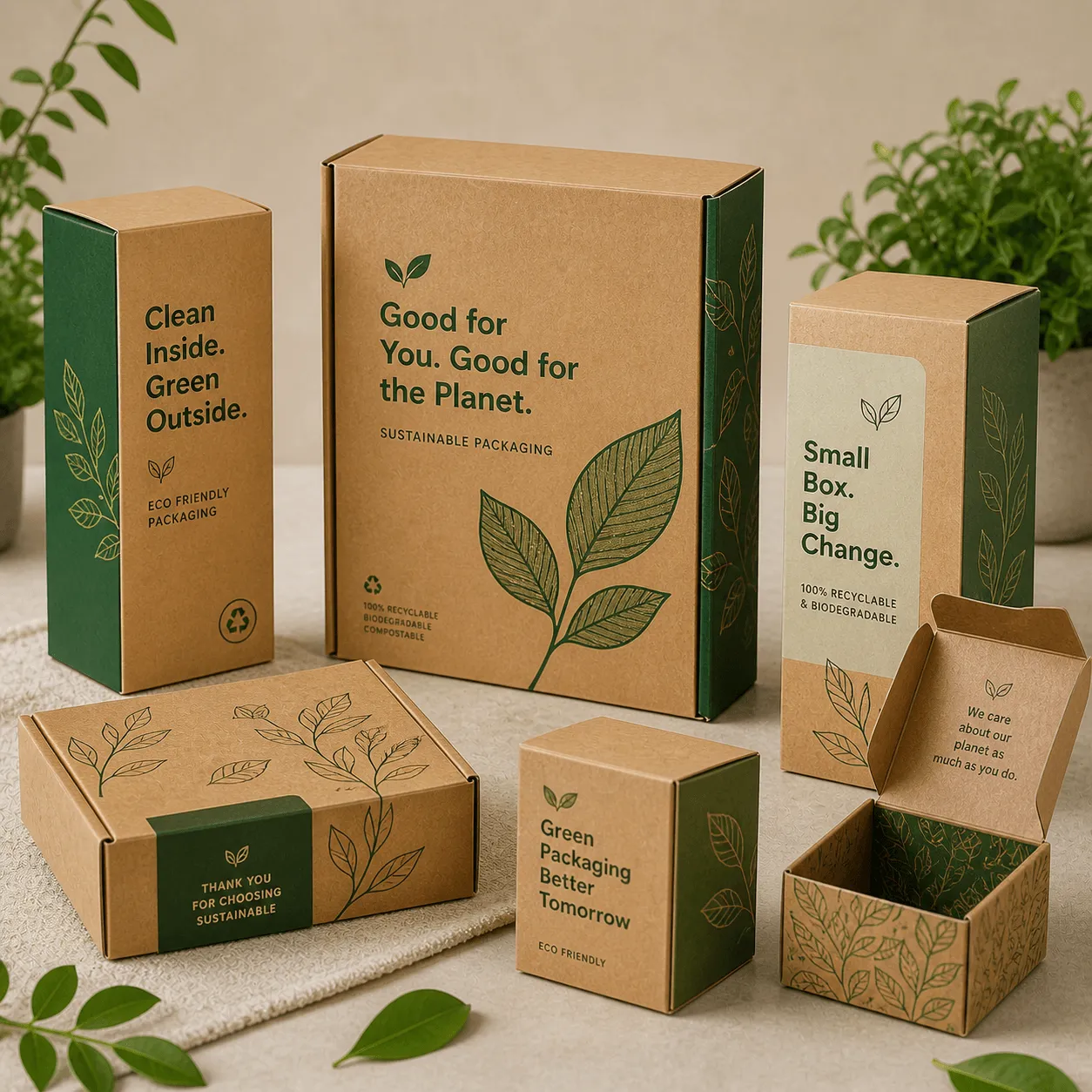
People keep asking us about sustainable packaging trends in 2026, and fair enough, because buyers in the US now notice when a box is mostly plastic and they say so in reviews. Green is part of the deal now.
So here’s our take from the print floor. Three trends we actually see in the orders coming through, then what a small US brand can do about them this year, what it costs, and the mistakes we watch people make (some of them more than once).
Sustainable Packaging Trend 1: Mono-Material Design
The big one. Brands are moving to boxes made of paper and nothing else, so no plastic film laminated on top and no foam glued inside, because a box that is one material can go straight into the curbside bin without anyone peeling layers apart at the kitchen table. Simple wins here.
What does that look like on an actual order? A mailer in plain corrugated, printed direct, with a paperboard insert instead of a foam tray. Maybe a tuck box in kraft with no gloss lam at all. You lose a little shine, sure, and we tell people that up front, but the box stays recyclable and your customer doesn’t have to think about it, which is pretty much the whole point.
One catch we’d flag. Soft-touch and gloss lamination are thin plastic films, so the second you add them you’ve got two materials stuck together, and that’s exactly what this trend is walking away from.
Trend 2: Soy-Based and Water-Based Inks
Petroleum inks are on the way out. We print with soy-based and water-based inks at The Pioneer Packaging, and honestly the color on kraft boxes still comes out rich (brown board just shifts it warmer a bit).
The part nobody mentions? Ink coverage matters about as much as ink type. A box flooded edge to edge in black uses a lot more ink than a one-color logo on natural kraft, and a lot of brands are quietly going lighter on coverage because the bare board looks good anyway. If you’re new to the stuff, our piece on what kraft paper is and how it prints is a decent place to start.
Trend 3: Biodegradable Inserts
Bubble wrap and styrofoam? Skip them. Custom-cut paper or cardboard inserts hold a jar or a bottle just as well, and they break down after use. Want to try it? Our custom product boxes take paper inserts easily.
A quick example. Say you ship a 16 oz glass candle jar, and right now it rattles around in a nest of air pillows inside a box that’s two inches too big, well a die-cut cardboard insert locks that jar in place, the box can shrink to fit, and the shipping carton gets smaller too. Less void, less filler.
Inserts do have limits, to be fair. Very heavy or oddly shaped items sometimes need a double-wall outer box plus the insert, not the insert alone.
What US Brands Can Do About It Now
You don’t need a full rebrand. Most of the brands we work with start with one product, usually the bestseller, and switch that box first, and then they watch what happens with returns and damage before touching anything else.
A rough order we’d suggest goes like this. First, drop the plastic window or lamination if it isn’t doing a real job. Next, swap foam or plastic trays for a paperboard insert. After that, look at the outer box size, because a lot of shipping boxes are just too big. Then ink coverage. Our eco friendly packaging boxes are a fair starting point if you’d rather begin from a style that’s already set up this way.
Shipping heavier stuff? Look at the corrugated boxes range. Single wall handles most ecommerce orders, double wall is for heavier jars and bottles, and most corrugated is recyclable in normal US curbside programs.
And the shop stuff is simple. Minimums are low, often around 50 boxes depending on the style, so you can test a greener box without ordering thousands. Our team does the dieline and artwork layout for free, you get a digital proof before anything prints, and a physical sample is available if you want to hold it first.
Cost Trade-Offs (the Honest Version)
Is sustainable packaging more expensive? Sometimes. Not always.
Plain kraft with one-color print is often one of the cheaper ways to make a custom box at all, since there’s less ink and no lamination step, and if the box gets smaller because of a proper insert you can save on board and on shipping at the same time. Where costs go up is when people want the eco look and also foil, embossing and a magnetic rigid lid, all on one box. That adds up fast.
Price per box drops as quantity goes up, so the biggest lever for most small brands is still order size, not material. Most digital print jobs also have no die or plate charges, and we ship ground free anywhere in the USA. For more on trimming spend without the box looking cheap, see our guide to reducing packaging costs in ecommerce.
Mistakes We See Brands Make
Calling a box “biodegradable” or “compostable” on the print when nobody has checked the full build. Glue, coatings and windows all count, and customers do read the small print.
Going kraft but keeping a heavy gloss lam on top.
That one comes up a lot, and it kind of cancels the reason you picked kraft. Another we see is brands moving to paper but keeping a box way too big for the product, then filling the gap with crinkle paper, which works fine, though a right-sized box with an insert usually looks better on unboxing and ships cheaper.
And mylar. Pouches are great for keeping food fresh, but most mylar is a layered film that standard curbside bins don’t take. If you sell coffee or snacks in pouches, put your eco effort into the outer mailer and the shipper, where paper actually makes sense.
Shipping from New York? We also make eco-friendly custom boxes in New York City, built from recyclable board and printed with your own branding.
Sustainable Packaging Trends FAQs
Are kraft boxes always recyclable?
Plain kraft and corrugated boxes usually are. Add plastic lamination, a PVC window or a foam insert and it gets complicated, so keep the build simple if recycling is the goal.
Do soy-based inks look duller than regular inks?
Not really on white board. On brown kraft the colors shift a bit warmer, which most brands end up liking, but very bright neon shades won’t pop the same way.
What is the cheapest way to make my packaging greener?
Cut out the plastic layers and right-size the box. If you want a hand working out what to change first, ask us for a quote and we’ll go through your current box with you.
Where to Go Next
Worth a look next: custom mailer boxes and the wider range of product packaging boxes. For more reading there’s our list of top custom packaging companies in Chicago and the roundup of cardboard display stand manufacturers in the USA.